A video became viral on social media which showed the Congress Party President Rahul Gandhi taking digs at the Chief Minister of the state, Siddharamaiah, regarding the pothole menace at Bangalore while campaigning for his party in Karnataka where it has its own government at the moment.
However, an inspection of Rahul Gandhi’s actual speech reveals that the video was doctored and people lapped it up without doubting the credibility of the video due to the Congress President’s past record (watch from 14.45).
[youtube https://www.youtube.com/watch?v=SyvpzmiblSc]
While Rahul Gandhi is perfectly capable of saying what the doctored video depicted him as saying, on this occasion, the Congress Party President is not guilty of the idiocy he has been accused of.
For a state that came into existence in 1963, Nagaland has not yet elected a single woman representative in the Assembly. But things might change as five women have filed their nominations for the elections scheduled to be held on 27th February.
Of the 227 candidates who have filed nominations, The National People’s Party has fielded two women candidates Wedie-U Kronu and Dr K Mangyangpula, an alternative medicine practitioner while Nationalistic Democratic Progressive Party and the BJP have fielded one woman candidate each, Awan Konyak, daughter of four-time MLA Nyeiwang Konyak, and Rakhila. The fifth woman, Rekha Rose, is contesting as an independent candidate. The only woman Parliamentarian who was elected to Lok Sabha in 1977 was Rano Shazia in 1977. The ruling Naga People’s Front (NPF) and the Congress have not given tickets to women candidates.
BJP’s Rakhila is contesting for the second time on BJP’s ticket, having lost in 2013 by 800 votes. As per Nagaland Gender Statistics, 2016, women in Nagaland have a high literacy rate of 76% as compared to the National average of 65% and are well represented in Government jobs (23.5%) and private sector (49%). However, women do not enjoy the right to inherit property and are yet to be represented in elected bodies like municipal councils and state assembly. Tribal customary laws of Nagaland are protected under Article 371(A) of the Constitution which excludes women from village councils. While they have 25% reservation in village development boards, they don’t have much say in crucial matters.
In 2016, acting on a petition by the Naga Mothers Association (NMA), the Supreme Court had directed the Nagaland Government to conduct municipal polls with 33% reservation for women. But the violent protests and stiff opposition to reservation forced the NMA to withdraw its name from the petition. The NMA has been fighting a battle in Nagaland to ensure reservations for women.
Will Nagaland see its first woman MLA? Let us wait for the 3rd March verdict.
Former star of NDTV, Barkha Dutt, since quitting the channel in January 2017, has been making one attack after another against her former employers.
We had reported in the past how she had time and tried to expose the misdeeds in NDTV, which includes writing a long Facebook post, to exposes censorship at NDTV. She also spilled the beans on how former corporate lobbyist Nira Radia had helped the channel financially and had also launched other attacks on the channel.
Apart from the channel, she also doesn’t seem to be seeing eye to eye with her former colleagues and it was documented how she and Nidhi Razdan had a fight on twitter.
Come Sunday, Barkha Dutt had taken an interview of actor cum aspiring politician Kamal Haasan at the Harward University. Here he had proclaimed that he won’t align with another aspiring politician in Rajinikanth, if the latter’s hue is saffron, that is if the latter tilts towards the right wing.
As a result of such a statement, various media houses decided to carry this news and portals like Newsminute and New Indian Express credited Barkha, with it being the interview conducted by her:
But incidentally Barkha’s former employers NDTV though didn’t credit her in their report which irked her:
Thanks for pointing it out. Dear @ndtv this is from my conversation with @ikamalhaasan . How about showing some basic professionalism like the other news sites that reported our session. Either attribute or don’t carry. https://t.co/p8wAowiPoG
She while replying to twitter users called this act as, “unprofessionalism on full display”. She also pointed out that the NDTV had lied about Haasan making these remarks in a speech while they were made while talking to her. She also claimed that, had the NDTV anchors been at the receiving end of such a situation, they would have created a huge furore.
She finally proceeded to point out the journalistic code while praising Newsminute:
Hey @ndtv this is what professionalism looks like @thenewsminute carried the same story with complete attribution. Perhaps you could learn the code from them. https://t.co/0H0cjGgOel
Even though Barkha raised a hue and cry on Twitter regarding this matter, the NDTV till the publication of this report, hasn’t paid any heed to her request.
The Islamic seminary of Darul Uloom Deoband has now decided to issue a fatwa against Muslim women taking help of men while trying out bangles in shops. This fatwa was issues based on a question whether it was proper for Muslim women to let strange men touch their arms, to help them wear bangles.
As per the clerics, this act is “wrong and a big sin”. They have in turn asked the women to bring back the bangles from the male run shops and try them on their own. This act is also garnering support from other Muslim clerics who claim that, women can’t talk or meet strangers as per Sharia, hence letting men touch their arms while wearing bangles is wrong.
This isn’t the only odd fatwa to come out of Deoband.
Recently it was reported that Deoband clerics had issued a fatwa against life insurance, as they claimed that Life and death are in the hands of Allah and no insurance company can guarantee a man’s longevity.
Also a few days ago a cleric associated with the Darul Uloom Deoband university issued a fatwa against women watching football games, as watching men playing with bare knees is forbidden for women.
Before this, a fatwa was issued asking Muslim families to not marry men or women who work in banks. The logic provided for the same is that money earned via interest is illegitimate in Islam.
In the past fatwas were issued against posting photos of self and family on social media websites like Facebook and WhatsApp. New Year Celebrations and designer burqas, too have met with the same treatment.
A fatwa was also issued against a 15-year-old Muslim girl for dressing up as Lord Krishna and reciting Gita. A Deoband Ulema had reportedly expressed his displeasure at the girl dressing up as Lord Krishna and termed it as anti-Islamic.
Apart from all this, one such Ulema had proclaimed that a group of Muslim women who performed Lord Ram’s Aarti on the eve of Diwali, ceased to be Muslims.
About 20 girls walked out of an orphanage at night in Ernakulam, Kerala, alleging that they were being harassed by the nuns. They also stated they were beaten up and not even provided food on some days.
#NewsAlert – About 20 girls in the age group of 7 to 15 complained of harassment by sisters and walked out of an orphanage at Ernakulam, Kerala on Friday night. The girls told the Police that they were beaten up by the sisters and there were days when they were not given food. pic.twitter.com/MxPjBQUIZm
The girls, between 7 and 15 years of age, belonged to the Christ King orphanage. A complaint has been filed at the local police station under section 75 of the Juveniles Justice Act.
Orphanages in Ernakulam have been under the scanner earlier as well. In July, last year, the police after an investigation had concluded that children were trafficked into Kerala and had sent back 28 inmates of an orphanage back to their families in Assam, Manipur and Bihar.
A top officer from the Ernakulam rural police had then said,“We suspect that at least some of the 153 orphanages are into the business of bagging sponsorships by exhibiting children. A task force has now been formed to verify the credentials of inmates at these institutions.”
The Child Welfare Committee had launched an investigation in April 2017 to identify children illegally trafficked into orphanages in Kerala from other states.
It was generally believed that the 2G scam which involved a presumptive loss of 1.76 lakh crore was the biggest scam of the UPA regime that ruled India between 2004 and 2014. However the biggest crisis facing Indian economy today, i.e. that of NPA (non performing assets) could been one of the biggest scams of UPA.
The corrective measures taken over a period of past three years have not only brought more transparency in the system, but also unravelled the scale of mismanagement and scam in public sector banks under Congress led UPA.
What is a non performing asset ?
Definition of non performing asset (NPA) is : a loan or advance for which the principal or interest payment remained overdue for a period of 90 days.
A loan can turn into a NPA if the amount taken by the borrower fails to generate any money from productive activities. This could be either due to failure of borrower or roadblocks to the project for which the loan is taken. For example if a highway builder is unable to acquire land from a private person in the path of the road, he will not be able to build the road in time. Thus, the loan will turn into a NPA.
The making of NPA scam
One might ask to how the NPA ‘scam’ was allowed to occur. The 2G scam was based on ‘presumptive loss’ theory, i.e. possible loss to the exchequer due to a faulty process. The theory had been validated post facto as the money raked in through transparent bidding was much higher than the earlier process.
The NPA scam is far more sophisticated and harder to detect in the eyes of a common man. It relies on three important pillars.
Reckless lending without accounting for risks in a given project or overall economy. (Such a system is allowed to take shape when banks are forced to lend to cronies of the regime)
Ever-greening of loans, i.e. postponing the due date of payment everytime the borrower fails to pay. This can also be done by clever accounting techniques.
Lack of effective legal framework to ensure that NPAs don’t affect banks perpetually. This forces banks to resort to ever-greening of loans
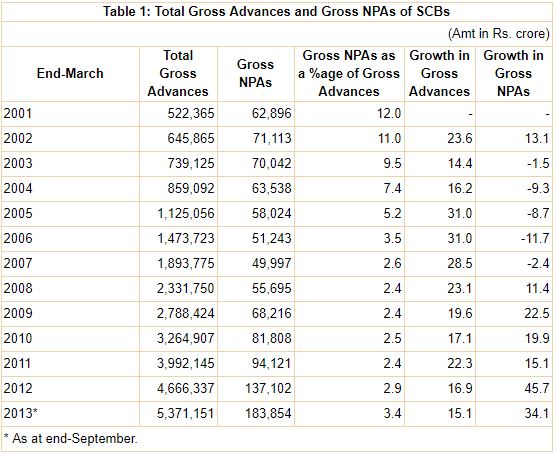
While the first part of the scam is difficult to prove , the other two points in the scam are straightforward affairs. A RBI report titled ‘Re-emerging Stress in the Asset Quality of Indian Banks: Macro-Financial Linkages’ published in February 2014 captures the growth of NPAs under the Congress led UPA regime.
The table from the report is shown below :
Note : Gross Advances mean all loans that have been given out by the banks that are not repaid at that instance of time.
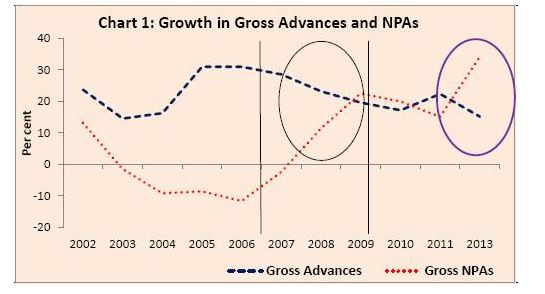
If one sees the steady growth of NPAs in absolute terms, it shows that the figure nearly trebled between 2004 and 2013 (63,538 crores to 183,854 crores) . However , in percentage terms it remained low because the overall amount lent (i.e. gross advances) by banks rose drastically. It must also be noted from the table that NPAs rose steadily after 2006 and then drastically in the 2012 and 2013 by 45.7% and 34.1% respectively. This trend is visible in the graph below.
The delay in growth of NPAs vis a vis the growth of loans is due to the fact almost no loans will turn into NPAs in the first few years. Unless there is some major event, loans are generally serviced well in the initial term, and later the loan quality drops and it turns into an NPA. This is also the time by when any efforts of evergreening have reached their limits.
The report says :
Third Phase: 2009 to 2012: During this period, growth in credit as well as NPAs slowed down in 2010. However, by end-March 2012, there was a sharp contrast in the movement of both, with credit growth witnessing a sharp contraction and growth in NPAs trending up. NPAs grew at around 46 per cent as at end March 2012, far outpacing credit growth of around 17 per cent. This widening divergence in the growth of credit and NPAs has implications for the asset quality in the near term. The decline in credit growth during this period could be attributed to the general economic slowdown that set in as a result of combination of domestic and global factors.
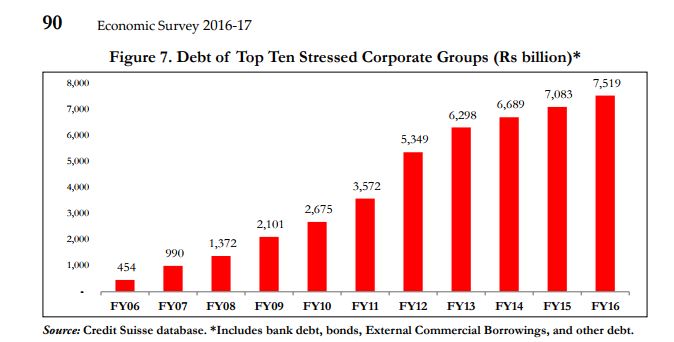
At the same time it is important to note the growth of debt in the top 10 firms of India. It must be noted that the debt of stressed firms rose from 1,372 crores to 6.689 crores in a matter of 6 years.
Thus, by the end of the Congress led UPA regime, growth had slowed down and NPAs had risen drastically. In addition to this, many NPAs were hidden under the carpet. This was bad for Indian economy in two ways.
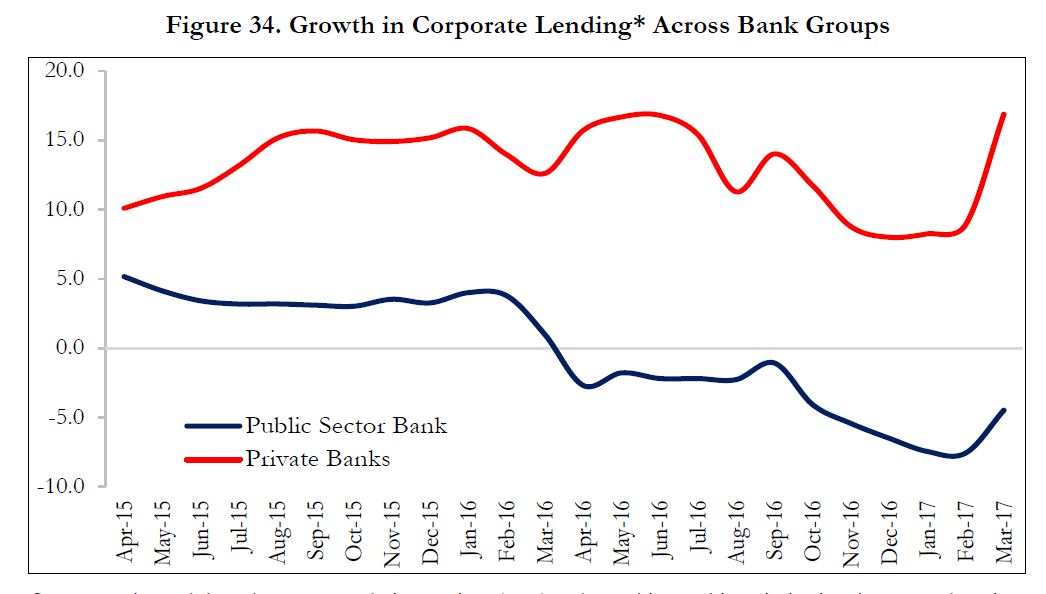
Banks are essential for growth as they fund new ventures. If they are in bad health , economy will not get credit for new ventures ( i.e. growth ) . Secondly, if NPAs are high banks will face losses and the government will have to spend money to bring them back to track. The drop in lending activities of sick public sector banks is visible below is evident
RBI conducted asset quality review i.e. scrutiny of loans given out by banks from 2015 onwards to uncover NPAs. This revealed that the banks had been hiding NPAs in excess of what appeared in the RBI report and data presented above. In August 2017, the government also passed an amendment to Banking Regulation Act in order to empower RBI in managing the NPA problem. After this move, more NPAs are being uncovered.
On December 6. 2017 , NS Vishwanathan told the press that the banks had not applied the rules correctly to identify these NPAs . He said : ‘We’ve assessed banks’ classification based on the rules they are today and we’ve found that in some cases, they have not applied those rules correctly.’
As a result of these exercises, there has been slowdown in growth and businesses. NPAs have risen from 3.4% in 2013 to 9.6% in August 2017. They are expected to reach 10.6% by March 2018. Measures to bring the banks back to good health have been taken by the government in the meantime. The insolvency and bankruptcy code will provide for a legal and transparent way to clear off the NPA. 2.11 lakh recapitalisation plan will bring in fresh funds for the banks to lend, thereby putting the economy back on the growth path.
NPA scam could be bigger than 2G scam
Reports suggest that the value of NPAs could be around Rs 8 lakh crores. Compare this to the value of NPA in 2013 ( i.e Rs 1.83 lakh crore). It is widely accepted that the bulk of NPAs are a part of the UPA legacy. The finance minister had reiterated this fact in Parliament earlier in the year. Thus, the difference between current NPA level and that in 2013 that could be attributed to UPA will run into lakhs of crores.
This time it is not a ‘presumptive loss.’ Only a detailed study by RBI in this regard will bring the actual figures to light. Thus, it can be said that the NPA scam is much bigger than 2G scam.
In poll-bound Nagaland, Nagaland Baptist Church Council (NBCC), the state’s biggest church organisation, has urged the ‘believers’ to choose between the ‘Trishul’ and the ‘Cross’ while fearing that voters getting seduced by money and development offered by those whose hands seek to “pierce the heart of Jesus Christ”. Earlier, Nagaland Baptist Church Council had called Yoga a ‘deeply Hindu’ practice, advising Churches not to practice Yoga.
The Christian organisation has written to all political parties in Nagaland and asked them to rely on state’s own strength. In an open letter, NBCC has stated that India has faced worst ‘persecution of minority communities’ in 2015-17 under the BJP. Referring to the BJP as the political wing of the RSS, the NBCC General Secretary, Rev Keyho, has said that the Hindutva movement in the country has become unprecedentedly strong and invasive in the last few years. He also added that Gods must be weeping to see Naga politicians run after those who ‘seek to destroy Christianity in India’.
Strongly opposing the ‘invasion of Hindutva forces’, Keyho in his letter asserted ‘Pastors, evangelists and missionaries are dragged openly in the streets, harassed, insulted and many made to suffer. Their homes destroyed and children discriminated in schools. Worship places were burnt down and believers are often disturbed and harassed. The Bible is openly burnt and confiscated.’
This is not the first time Church is trying to influence electoral politics. In poll-bound Meghalaya, too, it was reported that in a bid to stop the BJP, the churches are getting into electoral politics.
Last year, during Goa elections, Goan Padre had asked devotees to vote for specific candidates. In fact, a Congress leader from Goa had been forced to retire from active politics after the Church allegedly refused to back his candidature. Following that, in August last year for the by-polls, a magazine named Renowakao, run by a Panjim church Bishop’s House, carried an article which directly attacked the BJP and asked the voters to rein in the ‘tyranny’ prevalent in the whole nation by voting against Goa Chief Minister Manohar Parrikar.
In the recently concluded Gujarat elections, too, a Church in Gujarat urged the people to save India from ‘nationalistic forces’. In a letter, Archbishop Thomas Macwan associated with the Archdiocese of Gandhinagar, had subtly tried to influence the voters’ preference.
Recently, many media anchors jumped on to social media to proudly declare that they had been awarded for their fantastic work in the sphere of news coverage. The likes of NDTV, Aaj Take and other media houses basked in the glory of these awards. While the jury members of such award committees are themselves suspect, let us examine some of the awards in detail.
Let us first observe Aaj Tak. In the recently concluded exchange4media News Broadcasting Awards (ENBA) awards, Aaj Tak won eight awards, two of which are as follows:
Best Anchor (Sweta Singh), Best News Coverage National (Demonetisation)
So do we know Sweta Singh? And have we seen her coverage of Demonetisation in 2016? Yes, we have. She was the anchor, who, in a viral video, in a huddle, had given the breaking news that the new Rs 2000 notes were fitted with some sort of nano GPS chips which made it easy for satellites to locate them. Does this image refresh your memory:
So the channel and anchor which helped spread one of the biggest lies on demonetisation, have now won the award for “best Hindi anchor” and “the best coverage of a national news i.e. demonetisation”.
Moving along, NDTV 24X7 secured News Channel of the year in English, in the same award show. This comes on the back of NDTV’s biggest ex-star, Barkha Dutt, exposing NDTV’s censorship. Another ex-senior reporter with the channel also exposed NDTV. NDTV’s own Sreenivasan Jain had voiced his concern on social media after NDTV deleted his story “for legal vetting” and never restored it. NDTV even published an entire interview where the person being asked the “questions”, Kerala Chief Minister Pinarayi Vijayan, seemed to be reading out answers from a paper. The channel’s current lead face, Nidhi Razdan also conducted an entire debate on fake news. Are these the achievements of NDTV for which it is being rewarded?
Moving to another set of media awards called the “Red Ink awards”, one sees a similar pattern. Veteran journalist Vinod Dua was last year given the “Lifetime Achievement Award”, soon after which we showed how via his video series, Dua has been spreading half-truths and whole lies: At least 15 major lies in around 50 videos.
In 2016, NDTV India’s Ravish Kumar won the “journalist of the year” award at the Red Ink awards. He was also awarded by the NT Awards as the best TV News Anchor. Within a few months, NDTV India was rewarded by the I&B Ministry with an unprecedented one day ban for jeopardising national security. NDTV India’s only defence was that it was “singled out”, thus not denying that they had erred.
More about Sreenivasan Jain: he won two ENBA 2015 awards for his show Truth vs Hype that year, along with the award for best anchor English. He also won the Red Ink award for “journalist of the year” in 2015. Also in 2015, Jain was caught maliciously editing Baba Ramdev’s interview. He presented Ramdev’s answer for one question as an answer to another question, thus completely misquoting him. How can someone who was exposed with video proof, win so many awards?
Political biases aside, the above examples prove without a doubt, that there is something seriously wrong with most Indian TV News awards. When media houses and journalists who have routinely flouted basic journalistic norms, how can they then be awarded? Why is then not a surprise that many on social media mocked these awards when they were announced.
The body of a BJP booth president was recovered from Barjala, Tripura on Sunday, merely days ahead of the state assembly elections to be held on 18th of this month. Incidentally, some opinion polls have been claiming that the BJP is in a strong position to wrestle power from the Manik Sarkar led CPM.
Madhu Deb the party’s booth president from the Ramnagar constituency, was abducted and remained untraceable for a couple of days. The party workers, as a result, pressurised the DGP regarding the matter and he was later found hanging from a tree. BJP President Amit Shah who was in the state has alleged that the CPM cadre was responsible for this act.
As per BJP’s Sunil Deodhar, who has been made in-charge of the state, this was the 11th Tripura BJP activist, killed in the last 13 months. BJP spokesperson Mrinal Kanti Deb though painted an even grim picture by alleging that Deb was the 12th such activist to be killed in the past six months.
Senior BJP leader Himanta Biswa Sarma too alleged that Deb was brutally murdered by CPM goons, and attacked Manik Sarkar by saying that, “white attire of Manik Sarkar ji is getting deeply stained by the blood of innocent and people shall avenge this soon”.
As alleged by the BJP, the state has in recent days, witnessed various murders of its party workers.
In January, a 55 year old BJP worker named Amulya Malakar was hacked to death by an alleged CPM supporter. Just a month before that a BJP activist was killed in north Tripura, where the attackers made him bleed to death.
In July a BJP worker named Nishikanta Chakma succumbed to his injuries during alleged clashes between the CPM and the BJP. December 2016 had seen a BJP leader getting beaten to death by alleged CPM workers.
Incidentally, similar allegations against the CPM, find mention in a recent Swarajya article. The article claims that the communist party creates a climate of terror and intimidation ahead of the polls. As per the article, the CPM restrains opposition candidates from campaigning and issues threats to opposition workers and voters. It is also alleged that CPM workers and musclemen violently go around towns and villages ahead of polling day to create a climate of fear.
Such an intense attack on the BJP functionaries in the state might raise the question whether Tripura is becoming the next Kerala when it comes to violent attacks against BJP workers.
In November a BJP activist allegedly attacked by CPI(M) activists in Kerala’s Thissur, died while undergoing treatment. Earlier in that month, another such worker was killed in Thissur when a car following him, rammed into his bike.
In October the BJP president Amit Shah had outright accused Kerala Chief Minister Pinarayi Vijayan of being directly responsible for the murders of RSS, BJP workers.
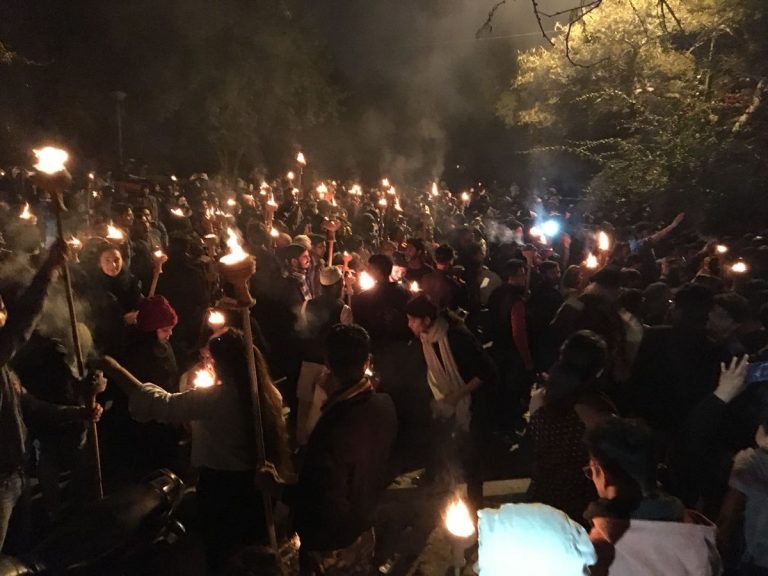
In a message to the JNU community, the Registrar of the university has warned its students and office bearers against disturbing the environment of the campus and urged that they allow classes to be conducted without any hindrance. The letter has alleged that some students and office bearers were preventing their colleagues from attending classes and blocking the main road of the campus.
Students had recently intensified their protest against the compulsory attendance rule which made attending 75% of the classes mandatory for them failing which they would be debarred from appearing for examinations and denied fellowships.
In a statement, the JNUSU said, “JNU Vice-Chancellor Jagadesh Kumar has been trying to destroy JNU through seat cuts, the decimation of deprivation points and reservations, bid to delink MPhil-PhD and BA-MA, scrapping of GSCASH and now with the illegal imposition of compulsory attendance. He is trying to destroy the academic excellence of the university.”
The Registrar has raised objections to the protests citing a High Court order that prohibits protests within a 100-meter radius of the administrative block. In the letter, the Registrar stated, “There are some students, who have not only been non-compliant of the rules but have also been preventing fellow students from attending classes… and, worse, by blocking the main road for days together.” The statement further said, “It is even more unfortunate that during the protest demonstrations on February 10, some students went to the extent of damaging university property at the administrative block.”