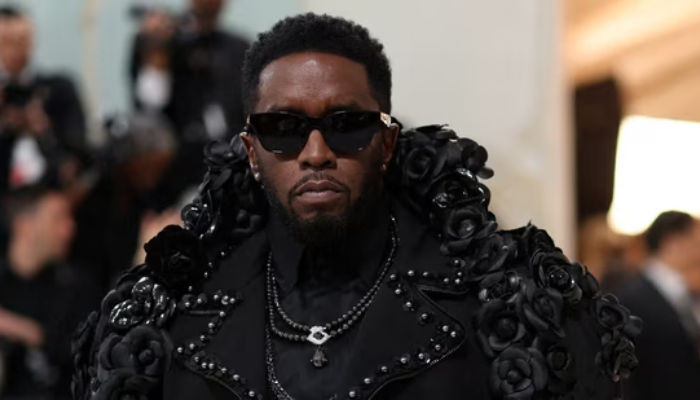
54-year-old Hip-hop mogul Sean “Diddy” Combs was arrested on 16th September in Manhattan following his indictment by a grand jury for racketeering, sex trafficking, and transportation to engage in prostitution. He has been known by many names over the years including Puff Daddy, P. Diddy, Diddy, PD and Love.
The development transpired months after Diddy was the subject of numerous civil cases related to sexual assault and misconduct. Formerly regarded as a legendary figure in the music and entertainment industries, Sean Combs found himself embroiled in a legal battle after it was revealed that he had a terrifying temper that frequently turned violent, especially against women around him.
Combs rose to fame in the 1990s as a music producer, rapper, and entrepreneur. He amassed a vast empire over the years working in the fields of music, fashion, spirits, television, and other media. He was apprehended at the Park Hyatt Hotel on West 57th Street as the charges exposed his nearly two decades of depravity. He is charged with running a sexual offence empire that stretches back to at least 2008. The significant action was taken around ten months after the rapper was at the center of persistent public accusations of sexual and other abuse.
TMZ obtained video of Sean “Diddy” Combs arrest in a New York City hotel lobby https://t.co/naciPVbC35 pic.twitter.com/fkUekBYaCX
— philip lewis (@Phil_Lewis_) September 20, 2024
How the shocking events unfolded
R&B singer Casandra Ventura, also known as Cassie Ventura, was once signed to Combs’ record label Bay Boy Records and was his ex-girlfriend. She filed a startling lawsuit accusing him of physically abusing and raping her for more than ten years, on 16th November 2023. She stated that from 2005 to 2018, Combs had sexually violated, trafficked and severely beaten her, according to her complaint. The pair had an on-and-off affair after they met in 2005 when he was 40 and she was around 22.
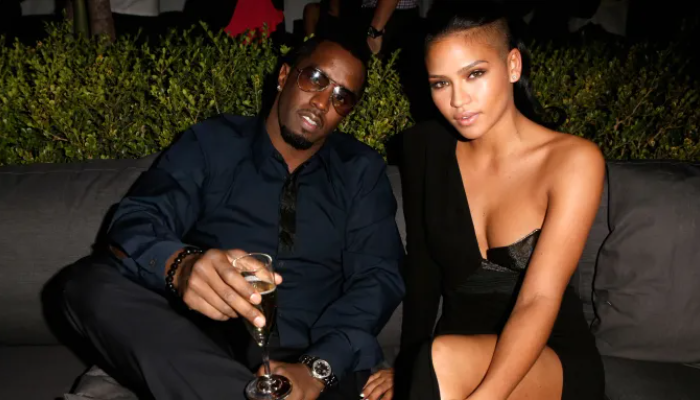
Sean Combs allegedly forced the songstress to have sex with male prostitutes as he filmed the encounters, which he labelled “Freak Outs”, and routinely supplied her with drugs and booze, as per the lawsuit which was submitted with a prominent “trigger warning.”
According to the petition, Cassie added that Combs destroyed Kid Cudi’s vehicle after finding out that he had feelings for her. A settlement that “resolved the claims to their mutual satisfaction” was reached by the former couple just one day after the federal complaint was launched, however, its details remained undisclosed. Combs released a statement which declared, “We have decided to resolve this matter amicably. I wish Cassie and her family all the best.”
Meanwhile, on 19th November, Combs made several recorded calls to a different victim of his sexual assault, seeking her support and “friendship” and trying to persuade her that “she had willingly engaged in acts constituting sexual abuse,” according to a later court filing from prosecutors. The conversations, per the prosecution, were the start of months-long efforts to pressure and buy off possible witnesses as charges against him surfaced.
Same allegations against Seam ‘Diddy’ Combs by different women
On 23rd November last year, another woman accused Combs of drugging and raping her during a date in 1991 and recording the incident on camera. Joi Dickerson-Neal, a former Syracuse University student, filed the complaint, asserting that Combs sexually attacked her while they were out to dinner at the Wells Restaurant in Harlem. According to the complaint, Combs administered drugs to the woman that left her in a “physical state where she could not independently stand or walk.”
A third woman, termed Jane Doe in the complaint, filed a lawsuit charging that in the early 1990s, Combs and singer-songwriter Aaron Hall gang raped her and a friend, on 24th November. The plaintiff claimed that in 1990 or 1991, she and her friend went to an MCA Records-hosted event in New York City where they first met the two men. Later, Combs and Hall brought the women to an after-party at the latter’s apartment, where the complaint, filed shortly before the Adult Survivors Act expired, said that she was “coerced” into having intercourse with Combs. A spokesperson for Combs denied the charges and insisted, “These are fabricated claims falsely alleging misconduct from over 30 years ago and filed at the last minute. This is nothing but a money grab.”
On 28th November 2023, Combs temporarily resigned from his position as chairman of Revolt, his cable television network, due to the growing number of allegations of sexual abuse. It would be only one of many blows to his business caused by the lawsuits.
A fourth sexual assault case was filed against Combs on 6th December, 2023, stating that he and others gave a 17-year-old girl alcohol, drugged and flew her to New York City, where they then gang-raped her at his recording studio in Manhattan. The woman who identified as Jane Doe and filed the lawsuit anonymously in Manhattan federal court, asserted that in 2003, she was sexually assaulted by Combs, Harve Pierre, the longstanding president of his record label Bad Boys, and a third party while she was in the eleventh grade. Combs vehemently refuted the allegations in a statement issued by his representative, declaring, “Enough is enough.” Combs also took to Instagram and posted, “I did not do any of the awful things being alleged. I will fight for my name, my family and for the truth.”
Hulu cancels Sean Combs’ reality show, music producer accused him of sexual harassment, assault
Sean ‘Diddy’ Combs was reportedly set to star in a reality TV series with Hulu called “Diddy+7,” but the streaming service chose to cancel the project on 14th December, 2023, because of his legal issues. Fulwelll 73, James Corden’s production firm, was producing the show.
Producer Rodney “Lil Rod” Jones submitted a $30 million grievance on 26th February, 2024, saying that Combs had sexually abused him on multiple occasions between September 2022 and November 2023, when he was working on Diddy’s most recent album. The producer, who was also Combs’ videographer, accused Combs of grooming him for sex by caressing his genitalia and touching his anus, only to later dismiss the actions as “horseplay.” The producer said to have seen several possibly unlawful drug-related and sexual acts, all of which were listed in the lawsuit. Combs’ attorney referred to the accusations as “pure fiction.”
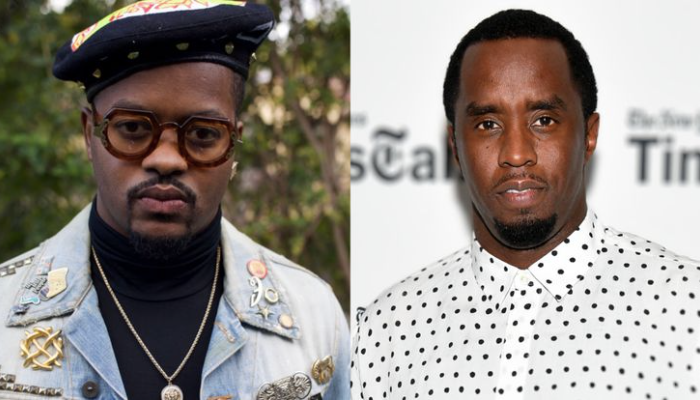
According to an amended complaint filed earlier this year, Combs’ ex-girlfriend Yung Miami, also known as Caresha Rameka Brownlee, was later charged with smuggling the narcotic known as “pink cocaine” for Combs in April 2023. Additionally, the lawsuit claimed that Combs gave Instagram influencer Jade Ramey a “monthly stipend” for her sex work.
Thousands of bottles of Baby oil, ammo found at Sean Combs’ houses during raids
The residences of Sean Combs in Miami and Los Angeles were raided by federal agents on 25th March this year. Agents were observed departing with boxes and bags of evidence, including devices, after showing up at the mansions in the Holmby Hills neighbourhood of Los Angeles with firearms. At the time, law enforcement sources reportedly stated that they moved in with the intention of obtaining Combs’ laptops and phones. He was at one of his Miami properties at the time. His attorneys claimed that his two sons were handcuffed at his Los Angeles residence, during the search.
Thousands of bottles of baby oil and lubricant, ammo, and firearms including three AR-15s with “defaced” serial numbers were discovered during the search, according to federal prosecutors. Combs’s lawyer had then denounced the raid, branding it a “witch hunt.” On 26th March, 2024, his attorney Aaron Dyer claimed that Combs is “innocent” and “will continue to fight” to clear his name, calling the raids “a gross use of military-level force.” There is “no excuse for the excessive show of force and hostility exhibited by authorities or the way his children and employees were treated,” according to the counsel.
Video featuring Sean Combs beating Cassie Ventura surfaces
On 5th March 2016, Combs was seen pushing, kicking, and dragging Cassie Ventura in the corridor of the InterContinental Hotel in Los Angeles, according to surveillance footage that CNN was able to obtain and publish on 17th May of this year. With a bath towel wrapped around his waist, Combs sprinted after Ventura. He then grabbed her by the back of her neck and tossed her to the ground.
The video showed him kicking her while holding the towel in one hand. He then held a pocketbook and bag, kicked her once more and dragged her across the carpeted corridor. Combs is said to have paid $50,000 to the hotel for the security footage.
The footage was similar to what Cassie claimed in her lawsuit, in which it was stated that Combs had previously hit her that evening and that she was attempting to flee when he woke up and pursued her. The Los Angeles District Attorney’s Office noted that no case had been brought before prosecutors and stated that it is not possible to charge Combs for the attack depicted in the footage because of the statute of limitations. However, the assault would be used as a major illustration of his behaviour and highlighted by federal prosecutors in Combs’ indictment as part of conspiracy charges.
He released a video on Instagram on 19th May after the video was made public and apologised, “My behaviour on that video is inexcusable. I take full responsibility for my actions in that video. I was disgusted then when I did it. I’m disgusted now. I went and I sought out professional help. I got into going to therapy, going to rehab. I had to ask God for his mercy and grace. I’m so sorry.”
TV star says Combs drugged and sexually assaulted her in 2003
On 21st May this year, Crystal McKinney, who originally gained recognition in 1998 as the winner of MTV’s first-ever “Model Mission” beauty contest, said she has preserved her unwashed clothes and wrapped them in a plastic bag for more than 20 years from the night Combs raped her. When McKinney, then 22 years old, first encountered Combs in 2003 at a Men’s Fashion Week event, she asserted that he assured her he could help “advance her modelling career.” The lawsuit claimed that Combs manipulated her into having oral sex with him at his Midtown studio on West 44th Street.
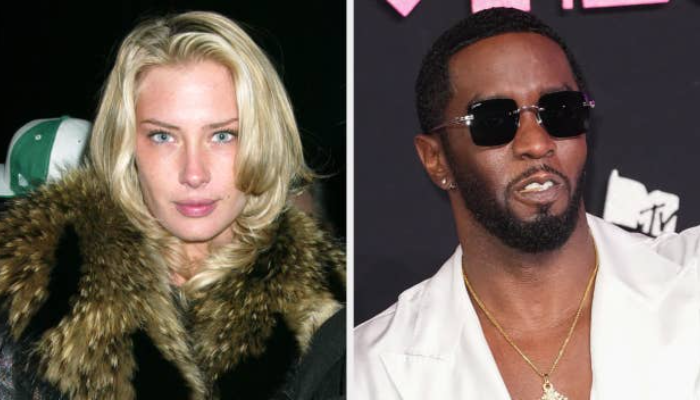
April Lampros, a former Fashion Institute of Technology student in New York City, in the 1990s, also launched a complaint against Combs on 23rd May claiming that she was sexually attacked by him four times between the mid-1990s and the early 2000s. He has been the target of eight lawsuits, the seventh of which accused him of sexual assault.
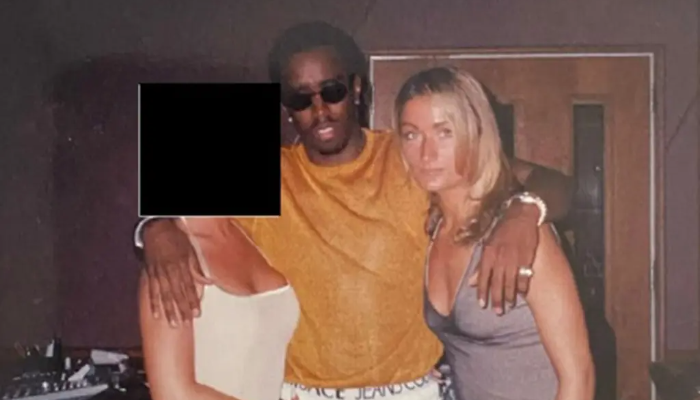
Further humiliation and trouble continue to mount for Sean Combs
On 3rd July, Adria English, an ex-adult film star, filed a complaint against the rapper, claiming that he “groomed” her into a victim of sex trafficking during her employment as a “go-go dancer” at his yearly white party almost twenty years ago. She added that he ruined her career in the entertainment industry,
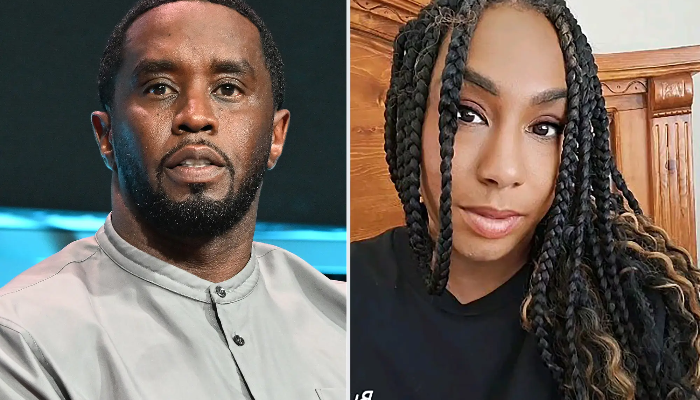
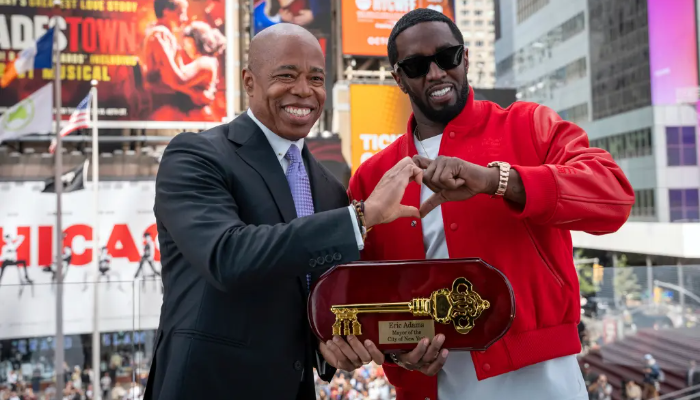
On 10th June, Combs returned a key to the city at the request of Mayor Eric Adams of New York. As a result of the footage of Combs hitting Cassie being leaked, Adams wrote letters to Combs withdrawing the honour. Adams expressed that the footage “deeply disturbed” him. The key was handed over to him in 2023, during a ceremony to celebrate the release of his first studio album in 17 years. Howard University announced that it had terminated a scholarship program in Combs’ honour and revoked an honorary degree awarded to him, a day earlier. It also returned a $1 million donation.
On 26th August, as part of a multipronged defence against the cases brought against him, Combs requested that a federal judge dismiss the music producer’s February lawsuit. According to his attorneys, the case was filled with “tall tales,” “lurid theatrics,” “blatant falsehoods,” and “legally meaningless allegations,” all of which were intended merely to “generate media hype and exploit it to extract a settlement.”
According to a later motion filed by his attorneys, on 5th September, Combs went to New York, settled into a hotel in Manhattan, and prepared to surrender in anticipation of an indictment.
On September 11th, Combs was sued by singer Dawn Richard, who claims that throughout the years he helped build her career, she endured years of physical and psychological abuse, including groping. Richard, a popular figure from the girl group Danity Kane who appeared on the MTV reality show “Making the Band,” claimed in the lawsuit that she was scared of the mogul after seeing Combs mistreat Cassie. Richard is accused by Combs representatives of fabricating “a series of false claims all in the hopes of trying to get a payday, conveniently timed to coincide with her album release and press tour” in an effort to “rewrite history.”

Combs arrest and his indictment
Homeland Security Investigations, which generally handle sex-trafficking investigations, took Combs into custody on the night of 16th September at the Park Hyatt New York. It was an unfair prosecution of an “imperfect person” who is “not a criminal,” according to Combs’ lawyer who added that Combs was detained before he could arrange to bring himself in. On 17th September Combs’ indictment was made public.
He was described as the leader of a criminal organization that has engaged in or attempted to engage in narcotics offences, kidnapping, arson, bribery, forced labour, sex trafficking, and obstruction of justice. He “participated in a continuous and widespread pattern of abuse toward women and other individuals,” including physical assault, according to the report, with the intention of “fulfilling his sexual desires, safeguarding his reputation, and hiding his conduct.” When Combs showed up in a New York federal court, he entered a not-guilty plea. He was to be detained without bond while awaiting trial, per a judge’s ruling.
The allegations in the lawsuit
Singer Dawn Angelique Richard professionally as Dawn Richard of the girl group “Danity Kane” which was established by Sean “Diddy” Combs submitted a lawsuit against him containing unsettling allegations against the prominent artist which played a major role in leading to his downfall. She was chosen to take part in Season 3 of MTV Networks’ reality series, “Making The Band,” sometime around 2004. The show’s plot revolved around the creation and growth of a brand-new musical group under Combs’ guidance.
He would select the winners of the competition to establish a group, which would record albums and tour. She appeared in seasons 3 and 4 of the program which was first broadcasted in 2005 and then in Season 5 of “Making His Band,” which aired in 2009. The lawsuit pointed out that in the decades that followed his ascent to popularity, Combs’ glamorous, larger-than-life personality eclipsed his violent temper and frequent acts of aggression towards women and other members of his inner circle.
It unveiled, “Mr. Combs regularly hurled objects in fits of rage, often throwing items such as mobile phones, laptops, food, and studio equipment across the room or at people. On numerous occasions, Ms Richard witnessed Mr Combs brutally beat his girlfriend, Ms Casandra Ventura. His persistent abuse included choking and strangling Ms. Ventura, striking her with his hands and with objects, slapping her, punching her, and throwing items at her, including a scalding hot pan.”
He even threatened her with statements including, “You want to die today,” “I make n**gg*s go missing” and “I end people,” whenever Richard tried to intervene. “For nearly a decade, Mr Combs manipulated Ms Richard with mantras that submission to his depraved demands was necessary for career advancement, instilling in her the belief that such abuse and exploitation were required for female artists to succeed in the music industry,” the lawsuit noted.
Combs blatantly took advantage of Richard’s talent as a composer and vocalist, withholding her proper compensation, stealing her copyrighted works and subjecting her to years of cruel employment circumstances that included groping, abuse, and false incarceration, among other offences. Notably, he explained the meaning behind his stage name in a 1998 interview with USA Today and disclosed that his “temper” and tendency to “huff and puff” when he was upset earned him the moniker “Puff,” based on the lawsuit.
“Danity Kane’s first album sold over 4,000,000 copies and damages to Ms Richard for unpaid salaries are estimated at $1,000,000.00. Danity Kane’s second album sold over 2,000,000 copies and damages to Ms Richard for unpaid salaries and royalties are estimated at $500,000.00. Damages on unpaid wages for touring on over 100 dates for Ms Richard with Danity Kane are estimated at $1,800,000.00,” the lawsuit further asserted.
How Combs intimidated the women
The lawsuit mentioned that on the set of “Making The Band” and during the auditions, Combs gave off a sense of wealth, power, and superiority. He created an atmosphere of fear and uncertainty by frequently donning sunglasses and avoiding direct eye contact with the female contestants. It added, “During auditions, Mr. Combs spoke to the female contestants in a hostile, condescending manner, making disparaging gender-based remarks such as calling them ‘fat,’ ‘ugly,’ ‘bitches’ and ‘hoes.’ Ms Richard felt threatened and intimidated by Mr Combs’ blatant disdain for the young women, like herself, who were excited for the opportunity to be on his show.”
It highlighted, “On one occasion in or around 2005, during the first season of Making The Band 3, Ms Richard observed Mr Combs’ ex-partner and the mother of three of his children, Kim Porter, leaving his recording studio in tears with visible facial injuries including a lacerated lip. Realizing that Mr Combs was capable of committing acts of violence against women caused Ms Richard to feel deep apprehension and fear that he could one day physically harm her.”
The lawsuit also described Cassie and Combs’s initial encounter, which happened in or around 2006. “The moment Mr Combs first saw Ms Ventura, his demeanour noticeably shifted. Mr Combs positioned himself directly in front of Ms Ventura’s seat, invading her personal space, and fixated on her with an intense, unyielding stare, isolating her from the other people in the room including her then-boyfriend, music producer Ryan Leslie.” It added, “Subsequently, Ms Ventura ended her relationship with Mr Leslie and began dating Mr Combs, who would become violent and abusive towards her.”
Combs denied the five members of Danity Kane, including Richards, access to basic essentials like enough food and rest throughout the creation of “Making the Band” 3 and 4. “When Ms Richard or her Danity Kane bandmates requested meals or rest, Mr Combs refused and chastised them with derogatory comments like ‘You bitches don’t want this’ or ‘Y’all are not hungry enough’ and ‘I’m paying you bitches to work.’ This demeaning behaviour gradually undermined Ms Richard’s confidence and contributed significantly to her growing feelings of insecurity and fear of reprisal from Mr Combs,” the lawsuit stated.
The lawsuit revealed that Combs used to be high on drugs and would frequently be awake for extended periods. “Forced to choose between eating and sleeping, Ms. Richard lost a significant amount of weight, weighing approximately 100 pounds at a height of 5’4. Ms. Richard began to normalize these extreme conditions and perceive them as standard requirements of her participation in Danity Kane,” it mentioned.
Her health worsened to the point where she puked and instead of providing medical assistance, the incident was captured on camera. The lawsuit highlighted, “The unrelenting and rigorous schedule of rehearsals, performance, and near-constant filming that Mr Combs imposed caused Ms Richard to experience extreme weight loss, dehydration, fatigue, and painful rashes from the microphone pack she was required to wear on her back.
Combs also persisted in attending meetings while wearing only his underwear in an additional display of control and power. The lawsuit unveiled, “On one occasion in 2008 at his Miami residence, Mr. Combs emailed Ms. Richard directing her to meet him in the living room. When she arrived, he was wearing only his underwear. Ms Richard asked Mr Combs to put clothes on, but he refused, stating ‘This is my fucking house.’ He then conducted a meeting lasting approximately an hour while dressed in his underwear, causing Ms. Richard to feel violated and embarrassed, and amplifying her feelings of powerlessness.”
It added, “Following the official Danity Kane breakup in early 2009 effectuated by Mr Combs, Ms Richard experienced significant financial hardship. With no prospective opportunities for employment within the entertainment field, Ms Richard spent several months travelling from Baltimore to Daddy’s House Recording Studio in New York, without pay or an allocated budget. Mr Combs promised that Ms Richard’s compositions would result in payment of license fees and royalties under her contract with Bad Boy Records, however, no such compensation was ever reported or paid to her.”
Combs’ gender-based physical violence, criminal acts, sexual assault, threats
Owing to the popularity of her songs, Richard received an invitation to meet with musician Kalenna Harper. Soon thereafter, the two along with Combs launched a new combo called “Diddy–Dirty Money.” The two singers were at Combs’ house in Los Angeles when another shocking instance played in front of their eyes. “Ms Richard observed Mr Combs come down the stairs looking high on drugs, enter the kitchen, approach Ms Ventura, and scream, ‘I’ve been asking you for my shit. I can’t stand you bitch. You never do it right.’ Mr Combs pushed Ms Ventura against the wall and choked her, then picked up the scalding hot pan of eggs and threw it at her, causing her to fall to the ground in a fetal position. Cursing and screaming, Mr Combs dragged Ms Ventura up the stairs,” the lawsuit revealed.
While he pulled Cassie up the stairs, Richard claimed to hear sounds that sounded like breaking glass, smashing and hammering. She got a call the next day to return to his house to continue recording. “This is normal, this was just a lover’s argument where no one was hurt. This is what love is. I’m giving you an opportunity, if you want to make it you’ll shut your mouth. If you say anything, there will be consequences,” he threatened her and Harper after locking the recording room and added that “people end up missing,” to further assert his warning.
Combs took Richard and Harper to his New York residence via his personal aircraft for a post-event celebration in November 2009. The lawsuit stated, “There were many well-known celebrities at the afterparty, and copious amounts of illegal drugs were being openly consumed. Upon information and belief, Mr Combs had arranged for dozens of young women and girls, some of whom appeared to be underage to be transported to the party. The women arrived wearing little to no clothing and were given drugs and alcohol. Many of them appeared lethargic or passed out while Mr. Combs and his guests performed sexual acts on them. Ms Richard believed that her presence at the party was a test to see whether Mr Combs could trust her.”
Combs repeatedly delivered statements such as “This is a buffet, enjoy yourselves. This is what we do, this is how we party.” His parties required guests to turn in their phones upon entry. The doors used to be locked and under the watchful eyes of security officers. No guest could escape without alerting him. He invited police officers to his parties, making it clear to guests that he had control over law enforcement, which generated an atmosphere of fear and an implied warning that reporting him to the authorities would be both unacceptable and pointless.
The lawsuit conveyed, “On many occasions, Mr. Combs had parties at his Miami, Florida residence that lasted for several days. At one of the parties, Ms Richard witnessed Mr Combs openly stating that he had arranged for busloads of young ‘exotic’ girls, such as mixed Black and Asian, Indonesian and albino. Once again, Ms. Richard observed inebriated young girls being sexually violated by Mr Combs and his guests. In a state of panic and terror, Ms Richard fled to the bedroom Mr Combs had insisted she stay in and barricaded the door shut with furniture.”
Combs often physically abused Cassie in front of Richard and other witnesses. The lawsuit highlighted, “On one occasion in or around the fall of 2009, Diddy–Dirty Money was in New York preparing to perform at a festival. Inside their vehicle, Mr Combs grabbed Ms Ventura’s neck, pulled her out of the van onto the grass and pinned her head down, choking her while yelling ‘You gonna get fucked up today.’ This incident took place in the backstage area just outside the festival and was entirely visible to passersby. In another instance, in or around early 2010, Mr Combs punched Ms Ventura in the face in the bathroom of a party in Los Angeles. Frequently, when Ms Ventura attempted to voice an opinion or stand up to Mr Combs, he would strike her or wrap his hands around her throat and choke her.”
Richard and Harper were threatened with “Y’all bitches don’t get in my relationship,” “Don’t tell my bitch what she needs to be doing,” “Just make money and shut the fuck up,” “I end artists,” “I shelve careers,” “You could be missing,” “You bitches want to die today” and other things whenever they tried to step-in. Once, he delivered Cassie an intense punch to the stomach, causing her to scream in agony and collapse in front of the other people during a dinner that Combs was hosting at a restaurant in California.
CEO of Interscope Records Jimmy Iovine was also among his guests. The lawsuit charged, “Even after Mr Iovine watched Mr Combs commit a violent assault in front of numerous high-profile witnesses, the Bad Boy-Interscope deal took place and remained in effect, providing Mr Combs with immense financial rewards and enabling him to commit further acts of violence without fear of repercussions.”
Combs continues his antics and threats
Combs would constantly threaten Richard every time she tried to go to her hotel or get something to eat. He would act aggressively, call her a bitch and utter things like “I don’t want to see your fucking face” and “I make n**gg*s go missing,” among other things. Furthermore, he insulted her physical appearance and refused her food. The lawsuit stated, “Mr Combs criticized Ms Richard for being ‘too skinny,’ yet denied her requests for food and demanded that she drink only peanut butter shakes. Mr Combs had full meals prepared by a chef and ate them in front of Ms Richard and Ms Harper, never offering them food.” He would reply, “Absolutely fucking not” and “This is what it takes to be great,” whenever the two asked him for food or rest.
The lawsuit informed, “As Ms Richard continued to work non-stop, transitioning between the studio, rehearsals, workouts, and back to the studio, she became severely dehydrated and experienced chronic stomach cramping from being undernourished and excessively thin. On the numerous occasions that she told Mr Combs that she was not feeling well, he called her lazy and dismissed her health concerns, instilling in her further apprehension of communicating her needs.”
It further added, “In or around the summer of 2010, Ms Richard experienced abdominal pain, swollen glands and a fever. She was hospitalized and diagnosed with arthralgia (joint pain due to overuse, sprains, tendonitis and infection), anaemia and a low white blood cell count. Ms Richard presented Mr Combs with her medical records specifying that she needed to emphasize eating well, being adequately hydrated, and getting adequate rest, but Mr Combs ordered her to report to the studio the next day for another multi-day recording session.”
Meanwhile, he continued his relentless assault on Cassie. “Ms Richard continued to witness Mr Combs’ abuse towards Ms Ventura. She often wore sunglasses and makeup in an attempt to hide visible injuries. Mr. Combs often exhibited uncontrollable anger during recording sessions, throwing objects like albums, laptops, and food against the wall or at individuals. Mr. Combs frequently flew into frenzied, unpredictable rages,” the lawsuit revealed.
Non-payment, sexual harassment and intimidation
On the other hand, “Diddy–Dirty Money” managed to perform well and sold a lot of records, however, Richard didn’t receive any money. The lawsuit mentioned, “Ms Richard’s unpaid wages and royalties are estimated at $1,200,000.00. Ms Richard’s unpaid touring wages are estimated at over $350,000.00 for touring dates within the United States alone. She was never compensated for the extra time she spent fulfilling Mr. Combs’ promotional contracts, including the CIROC and the DiddyBeats campaign. Mr Combs was paid approximately $250,000 per CIROC appearance. He did not compensate Ms Richard or Ms Harper for these appearances, other than just $5,000 each on a handful of occasions.”
Whenever Richard and Harper inquired him about their irregular and insufficient payments, he would respond with comments like “You don’t want this” or “You bitches aren’t grateful”. The lawsuit unveiled, “Ms Richard estimates losses from CIROC campaign promotions totalling at least $1,562,500.00. Upon information and belief, Mr Combs received an advance on DiddyBeats for which Ms Richard received no compensation.”
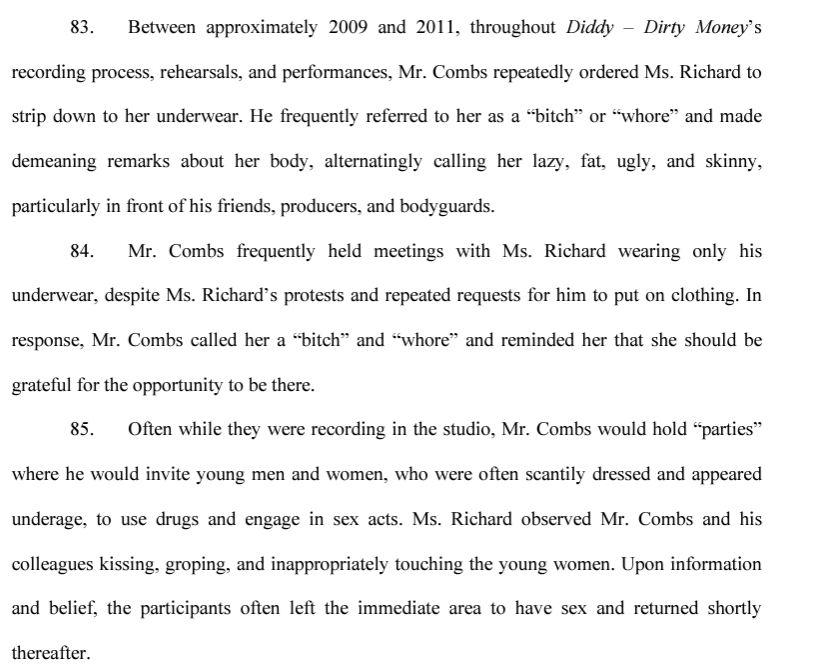
Combs persisted in subjecting Richard to sexual harassment and degrading him even publicly. “Between approximately 2009 and 2011, throughout ‘Diddy–Dirty Money’s’ recording process, rehearsals, and performances, Mr Combs repeatedly ordered Ms Richard to strip down to her underwear. He frequently referred to her as a ‘bitch’ or ‘whore’ and made demeaning remarks about her body, alternatingly calling her lazy, fat, ugly, and skinny, particularly in front of his friends, producers, and bodyguards,” the lawsuit conveyed.
He attended meetings in underwear and abused her when she asked him to put on clothes as well as “reminded her that she should be grateful for the opportunity to be there.” The lawsuit further disclosed, “Often while they were recording in the studio, Mr Combs would hold ‘parties’ where he would invite young men and women, who were often scantily dressed and appeared underage, to use drugs and engage in sex acts. Ms Richard observed Mr Combs and his colleagues kissing, groping, and inappropriately touching the young women. Upon information and belief, the participants often left the immediate area to have sex and returned shortly thereafter.”
Combs would frequently barge into Richard’s changing room between 2009 and 2011 while she was nude, claiming to be prepping for a performance. The lawsuit stated, “Even though a female stylist was present and assisting Ms Richard with her wardrobe, Mr Combs would grope her body, including her bare buttocks and her chest area near her breasts. With no legitimate purpose, and without Ms Richard’s consent, he caressed her buttocks to show the stylist where he wanted her high-waisted panties positioned, and attempted to touch her breasts, claiming to show the stylist where he wanted her bra straps to go.”
It added, “When Mr Combs would enter the changing room, Ms Richard would cover her chest with her hands to prevent him from seeing or touching her breasts. When Mr Combs would touch her body, she would attempt to swat his hands away and state ‘Don’t touch me.’ Mr Combs frequently smacked her bare buttocks and often commented on her body, noting that although she was ‘too skinny,’ she had an ‘ass.’ Ignoring her visible and communicated discomfort, Mr Combs persisted and continued to intrude when Ms Richard was in the dressing room, continued to touch her buttocks and breast area under the guise of showing the stylist what to do, and continued to smack her buttocks without her consent.”
Combs initiated overt sexual attempts toward Richard when “Diddy–Dirty Money” performed in Glasgow, Scotland, in or around October 2010. He made provocative remarks and attempted to flirt with her despite her visible discomfort. He made statements like “You’re looking good,” and “I see what that is,” among other things as she retreated each time, pleading with him not to touch her, but he disregarded her objection.
The lawsuit unveiled, “On their last night in Glasgow, Ms Richard witnessed Mr Combs and several other males gang-banging his female assistant at the hotel pool. Ms. Richard immediately left and went to her hotel room. On their flight back to the United States the next day, she asked Mr Combs where his assistant was and he replied, ‘I don’t give a fuck where that bitch is.’ Ms Richard later learned that he had taken his assistant’s passport with him to the United States, leaving the assistant stranded in the United Kingdom.”
The lawsuit stated, “In Glasgow, Ms Harper confided in Ms Richard that her husband and manager, Tony Vick, was abusive. After an especially severe assault, she confided in Ms Richard that she wanted to leave Mr Vick, and Ms Richard helped her to plan her exit from the relationship. However, the couple reconciled, and both Mr Combs and Mr Vick, who had a close relationship, learned of Ms Richard’s role in helping Ms Harper. Both Mr Combs and Mr Vick became noticeably distrustful of Ms Richard, which exacerbated her fears of harm and reprisal.”
Notably, Combs persisted in his disturbing and outrageous actions. Richard, Harper, and Ventura were at his Los Angeles residence in or around late December 2010 when he expressed, “I want to gift you (fake) titties for Christmas.” He reached out and squeezed Richard’s breasts without her permission. He added, “You’re an A. I’m thinking a D,” after which she flinched away and left from there.
The lawsuit pointed out, “Throughout the abovementioned time period, when Ms Richard resisted Mr Combs’ advances, he retaliated by denying her singing parts in songs, removing her from songs, refusing to allow her to sing in performances, and turning her microphone off during performances. The more Ms Richard rebuffed his advances, the more Mr Combs’ retaliatory behaviour increased.”
Combs imprisons Richard, threatens her father and family
The exhausting routine continued without the opportunity to eat or rest as Richard and Harper were preparing for an impeding performance on Saturday Night Live (SNL), during the same time. They waited all day for Combs to call or bring a car however, he phoned Richard and lashed out, “Where the fuck are you bitches? You bitches don’t want this. Y’all don’t deserve to have someone pick you up. Get a cab.” He hurled profanities at them when they reached the location and yelled, “Where the fuck were you bitches? You bitches don’t want to win. You don’t want this. I’m so tired of y’all,” in front of other people.
The lawsuit stated, “Ms Richard noticed that people in the lobby were reacting to Mr Combs’ tirade. Embarrassed, she asked him to stop swearing and calling them ‘bitches’ in front of everyone. Mr. Combs’ facial expression shifted as he stepped towards Ms. Richard, raised his arm, and swung his fist toward her face. Believing that he was going to hit her, Ms Richard braced for the impact. Before he could strike her, his bodyguard grabbed her, escorted her out of the studio and forced her into the Bad Boy Records Bentley that was parked outside. Ms Harper ran after Ms Richard, and Mr Combs’ bodyguard closed and locked the vehicle’s doors with both women inside.” Richard realized that the internal doors had no knobs, leaving them trapped inside with no way out and called her father to share her ordeal.
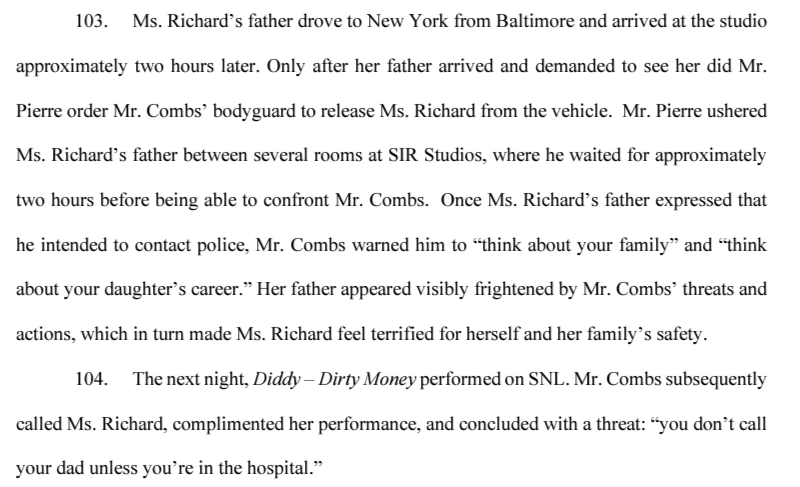
Harper was taken out of the car after some time but Richard was confined there for over two hours. The lawsuit stated, “Ms Richard screamed as loudly as she could, but no one responded. It was late evening in the wintertime, the windows were heavily tinted, and the interior of the car was dark except for faint interior lights. Her belongings and winter coat were in the studio, while the ignition was off and there was no heat. With Mr Combs’ prior threats and violence running through her mind, she felt sheer panic, terror and feelings of claustrophobia at being locked in a small, dark, enclosed space with no way to communicate or call for help. She began to feel cold and feared for her life, not knowing when or if she would be released.”
However, her father arrived there from Baltimore and demanded to see her daughter after which she was released. He also confronted Combs’ who warned him to consider his daughter’s career and his family. “Her father appeared visibly frightened by Mr Combs’ threats and actions, which in turn made Ms Richard feel terrified for herself and her family’s safety,” the lawsuit added. He complimented her SNL performance, the next night and threatened, “You don’t call your dad unless you’re in the hospital.”
The lawsuit also asserted that the defendants have wrongfully benefited from Richard’s compositions and performances, breached contracts, violated her copyrights and failed to account for or pay her as stipulated. It added, “In 2020, Mr Combs selected Ms Richard for a reboot of ‘Making The Band,’ and she spent hours preparing to be a judge on the new show. However, the COVID-19 pandemic halted those plans, and she was never compensated in any way. On or about July 1, 2021, Mr Combs and Bad Boy Records (or Holdings or both), directed Janice Combs Publishing Inc. to assign its administration rights of Ms Richard’s songs, held from her tenure with defendants in the years 2005-2012, to Sony Songs, a division of Sony Music Publishing LLC (Sony).”
It further accused, “The assignment, signed by Ms Richard on October 22, 2024, purported to credit, through a semi-annual accounting, Ms Richard’s royalty account for her compositions from between 80 to 90% of publisher’s share. However, no statements were ever provided, no payments were ever made, and no reversions nor assignments were ever recorded with Performing Rights Organizations or other royalty collecting entities by defendants or by Sony. Defendants have wholly failed to account to or pay her as agreed for her compositions and her performances in breach of the assignment and have thereby infringed her copyrights, resulting in defendants being unjustly enriched.”
The lawsuit charged, “As a result of the acts and conduct complained of herein, Ms Richard has suffered and will continue to suffer the loss of income, wages, benefits, royalties, promotional fees, touring fees and other compensation. She has also suffered, among other things, future pecuniary losses, emotional pain, suffering, inconvenience, loss of enjoyment of life, post-traumatic stress disorder, anxiety disorder, insomnia, panic attacks and other non-pecuniary losses entitling her to an award of compensatory and punitive damages, injunctive and declaratory relief, attorney’s fees and costs, and other remedies as this court may deem appropriate.”
The lawsuit requested the court for a monetary judgment that would represent compensatory damages, which would include, among other things, consequential damages, lost wages, earnings, royalties, publishing, touring, and promotional income, interest on these amounts, as well as any other amounts of money. The lawsuit asked for “a money judgment for mental pain and anguish and severe emotional distress, restitution and disgorgement of all sums unjustly obtained from the plaintiff or inured to the benefit of defendants, civil penalties, punitive and exemplary damages, attorneys’ fees and costs, prejudgment and post-judgment interest and such other and further relief as the court may deem just and proper,” according to the proof.
Combs’ indictment order
The horrifying details of Sean “Diddy” Combs’ (the defendant) abominable behaviour, which he knowingly engaged in while intoxicated by his popularity and position, were also outlined in the indictment order. It read, “He abused, threatened, and coerced women and others around him to fulfil his sexual desires, protect his reputation, and conceal his conduct. To do so, he relied on the employees, resources, and influence of the multi-faceted business empire that he led and controlled-creating a criminal enterprise whose members and associates engaged in, and attempted to engage in, among other crimes, sex trafficking, forced labour, kidnapping, arson, bribery and obstruction of justice.”
He ran his company, which had its headquarters in Manhattan and Los Angeles at different points in time, under several corporate names with US addresses, such as Combs Global, Combs Enterprises and Bad Boy Entertainment (collectively, the Combs Business). Television networks, media companies, record labels, music studios, clothing brands, alcoholic beverages companies, marketing agencies, and clothing lines were some of the corporate entities involved in the Combs business.
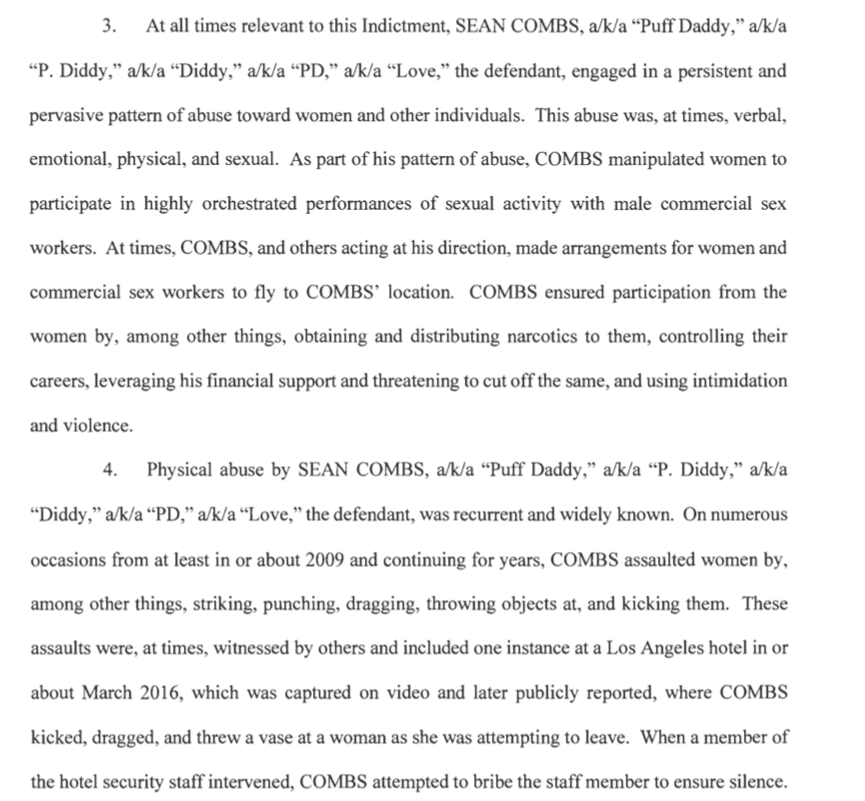
The order highlighted, “At all times relevant to this indictment, Sean Combs engaged in a persistent and pervasive pattern of abuse toward women and other individuals. This abuse was, at times, verbal, emotional, physical, and sexual. As part of his pattern of abuse, he manipulated women to participate in highly orchestrated performances of sexual activity with male commercial sex workers. At times, he, and others acting at his direction, made arrangements for women and commercial sex workers to fly to Combs’ location. He ensured participation from the women by, among other things, obtaining and distributing narcotics to them, controlling their careers, leveraging his financial support and threatening to cut off the same, and using intimidation and violence.”
The order mentioned that Combs was the perpetrator of regular and well-publicised physical abuse. He repeatedly assaulted women by striking, punching, dragging, flinging objects at them and kicking them, among other things starting at least in or around 2009 and lasting for years. There were times when other people observed these attacks, like the time in or around March 2016 at a hotel in Los Angeles when he kicked, dragged, and threw a vase at a woman (Cassie) who was trying to escape. The incident was caught on camera and subsequently made public. He then tried to buy off a member of the hotel security staff who had stepped in to ensure that the matter was buried. His hostility was not limited to these women and also included his staff members, people who saw his mistreatment and others.
His abuse and commercial sex were carried out, facilitated, and covered up by the Combs Business, including some of its employees. These workers, which included personal assistants, household helpers, security personnel, senior supervisors, and other close allies, served as his intermediaries, and his authority over the Combs Business incentivised and supported their actions.
Combs’ criminal enterprise
The order referred to his company as a “criminal enterprise” and conveyed, “Combs, the defendant, and others known and unknown, were members and associates of a criminal organization (the “Combs Enterprise” or the “Enterprise”). Members and associates of the Combs Enterprise engaged in and attempted to engage in, among other activities, sex trafficking, forced labour, interstate transportation for purposes of prostitution, coercion and enticement to engage in prostitution, narcotics offences, kidnapping, arson, bribery and obstruction of justice.”
It added, “At all times relevant to this indictment, Combs was the leader of the Combs Enterprise.” The enterprise comprised of Combs, entities within the Combs Business, including but not limited to Bad Boy Entertainment, Combs Enterprises, and Combs Global, individuals employed by and associated with the Combs Business and others known and unknown. The order mentioned, “The defendant, and others known and unknown, participated in unlawful and other activities related to the conduct of the Combs Enterprise’s affairs.”
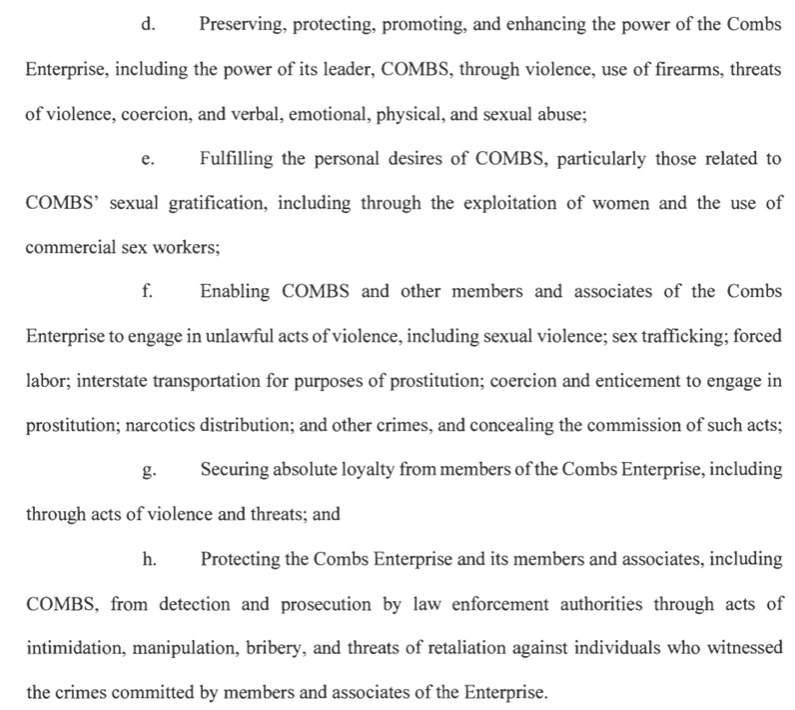
The enterprise’s goal was to enrich its members and allies, especially Combs, its leader and those who showed allegiance to him and willingness to cover up his misdeeds. The business aimed to “preserve, protect, promote, and enhance the power of the Combs Enterprise, including the power of its leader, Combs, through violence, use of firearms, threats of violence, coercion, and verbal, emotional, physical, and sexual abuse. Fulfilling the personal desires of Combs, particularly those related to his sexual gratification, including through the exploitation of women and the use of commercial sex workers,” according to the order.
The order noted that the enterprise sought to facilitate Combs and other members and associates of the enterprise in engaging in illegal acts of violence, such as forced labour, sex trafficking, sexual assault, coercion and enticement to engage in prostitution, interstate transportation for prostitution, distribution of drugs, and other crimes, as well as hiding the commission of such operations. It added, “Securing absolute loyalty from members of the Combs Enterprise, including through acts of violence and threats and protecting the Combs Enterprise and its members and associates, including Combs, from detection and prosecution by law enforcement authorities through acts of intimidation, manipulation, bribery, and threats of retaliation against individuals who witnessed the crimes committed by members and associates of the enterprise.”
Combs and his pervert ‘Freak Offs’ sessions
The order unveiled that Combs, along with other members and associates of the Combs Enterprise, took advantage of the status and authority that came with being a part of the Combs Business to coerce, threaten and entice women into the company of Combs, under the guise of romance. He then persuaded victims into performing prolonged sex acts with male commercial sex workers, a term he described to as “Freak Offs” among other things, by using intimidation, threats, force and other aggressive tactics.
The order further explained, “Freak Offs were elaborate and produced sex performances that Combs arranged, directed, masturbated during and often electronically recorded. In arranging these Freak Offs, he, with the assistance of members and associates of the Combs Enterprise, transported, and caused to be transported, commercial sex workers across state lines and internationally. Freak Offs occurred regularly, sometimes lasted multiple days and often involved multiple commercial sex workers. During Freak Offs, he distributed a variety of controlled substances to victims, in part to keep the victims obedient and compliant. Sometimes unbeknownst to the victims, he kept videos he filmed of victims engaging in sex acts with commercial sex workers. After Freak Offs, he and the victims typically received IV fluids to recover from the physical exertion and drug use.”
The Combs Enterprise members and associates, consisting of high-ranking supervisors, security personnel, domestic staff, personal assistants, and other Combs Business employees, organized and carried out the Freak Offs, among other things. They reserved hotel rooms for the sessions, pre-stocking the hotel rooms with the necessary supplies such as baby oil, lubricant, extra linens, and lighting, cleaned the hotel rooms following the Freak Offs to minimize room damage, coordinated victims, commercial sex workers and Combs to and from the Freak Offs. They provided him with requested supplies, delivered substantial amounts of cash to him to pay the commercial sex workers and arranged for the delivery of IV fluids. “In or about March 2024, during searches of Combs’ residences in Miami, Florida and Los Angeles, California, law enforcement seized various Freak Off supplies, including narcotics and more than 1,000 bottles of baby oil and lubricant,” the order mentioned.
It further exposed Combs’ despicable conduct and added, “Combs subjected victims to physical, emotional, and verbal abuse to cause the victims to engage in Freak Offs. He maintained control over his victims through, among other things, physical violence, promises of career opportunities, granting and threatening to withhold financial support, and other coercive means, including tracking their whereabouts, dictating the victims’ appearance, monitoring their medical records, controlling their housing, and supplying them with controlled substances. During and separate from Freak Offs, Combs, among other things, hit, kicked, threw objects at, and dragged victims, at times, by their hair. These assaults often resulted in injuries that took days or weeks to heal. He also threatened victims’ careers and livelihoods, including if they resisted participating in Freak Offs. Victims believed they could not refuse his demands without risking their financial or job security or without repercussions in the form of physical or emotional abuse. Combs also used the sensitive, embarrassing, and incriminating recordings that he made during Freak Offs as collateral to ensure the continued obedience and silence of the victims.”
There were occasions when Combs Enterprise members and associates, including Combs’ security staff, carried guns. Combs repeatedly brandished or displayed a gun in order to frighten and threaten people, including those who were witnesses to or victims of his violence. Around March 2024, a drum magazine and many weapons and ammo, including three AR15s with tampered serial numbers, were taken by law officials from his homes in Miami, Florida, and Los Angeles, California.
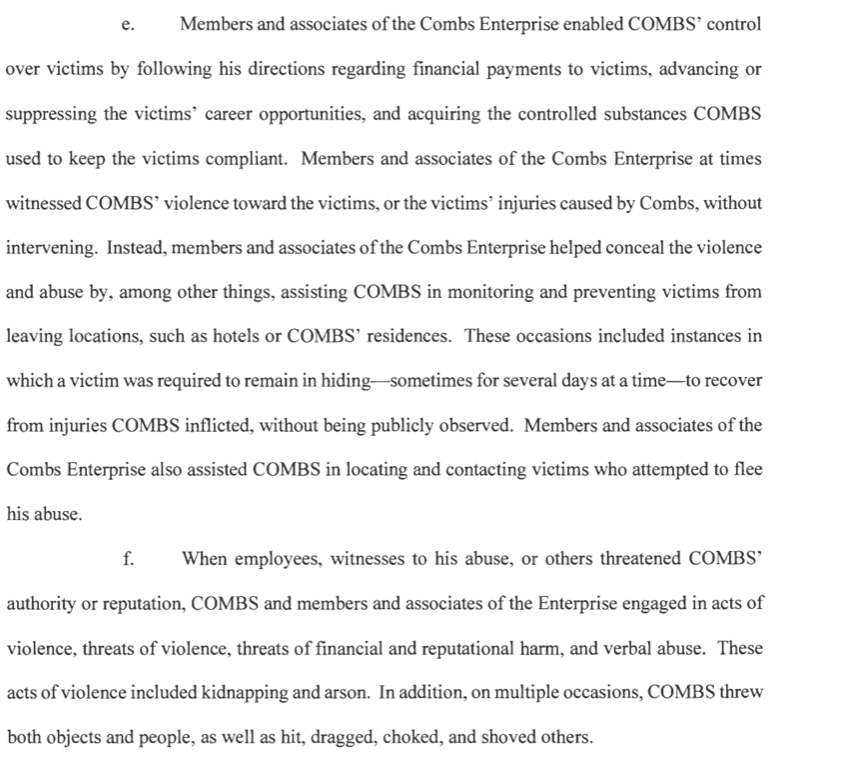
Combs Enterprise members and allies made it possible for Combs to control victims by executing his instructions on monetary payments, to promote or stifle their career opportunities and procure the controlled narcotics Combs needed to maintain the victims’ compliance. The order conveyed, “Members and associates of the Combs Enterprise at times witnessed Combs’ violence toward the victims, or the victims’ injuries caused by him, without intervening. Instead, members and associates of the Combs Enterprise helped conceal the violence and abuse by, among other things, assisting him in monitoring and preventing victims from leaving locations, such as hotels or his’ residences. These occasions included instances in which a victim was required to remain in hiding-sometimes for several days at a time to recover from injuries Combs inflicted, without being publicly observed. Members and associates of the Combs Enterprise also assisted him in locating and contacting victims who attempted to flee his abuse.”
It added, “When employees, witnesses to his abuse, or others threatened Combs’ authority or reputation, he and members and associates of the enterprise engaged in acts of violence, threats of violence, threats of financial and reputational harm, and verbal abuse. These acts of violence included kidnapping and arson. In addition, on multiple occasions, Combs threw both objects and people, as well as hit, dragged, choked, and shoved others.”
Combs and members as well as associates of the enterprise induced witnesses and victims, including through attempted bribery, to remain silent and not report what they experienced or knew to law enforcement when his authority or reputation was threatened by the possibility of bad press or legal and law enforcement action against him, including in or about late 2023 following public allegations on him. These victims and witnesses were given a false account of events during phone calls by Combs and his aides, among other things in an attempt to hide his crimes. These calls were recorded at least twice on account of Combs.
The racketeering conspiracy and charges
The order clarified that Combs and other individuals, both known and unknown, who worked for and were connected to the Combs Enterprise, deliberately banded together, plotted, connived and collaborated to break the racketeering statutes of the United States. They performed “multiple acts involving kidnapping, arson and bribery which are chargeable under the law California Penal Code.” They are also charged with “multiple offences involving the possession with intent to distribute, or distribution of narcotics and controlled substances, including cocaine, oxycodone, alprazolam, 3,4-Methy lenedioxymethamphetamine (MDMA), Bromo-2,5-dimethoxyphenethy lamine (2C-B), gamma hydroxybutyric acid and ketamine in violation of United States Code.”
“It was a part of the conspiracy that Combs agreed that a conspirator would commit at least two acts of racketeering activity in the conduct of the affairs of the Combs Enterprise,” the order stated. The grand jury charged, “From at least in or about 2009, up to and including in or about 2018, in the Southern District of New York and elsewhere, as part of his agreement to conduct and participate in the conduct of the affairs of the Combs Enterprise through a pattern of racketeering activity, Combs, the defendant, agreed to, in and affecting interstate and foreign commerce, knowingly recruit, entice, harbour, transport, provide, obtain, advertise, maintain, patronize, and solicit by any means a person, knowing and in reckless disregard of the fact that means of force, threats of force, fraud, and coercion and any combination of such means, would be used to cause the person to engage in a commercial sex act, in violation of United States Code.”
It further stated, “From at least in or about 2009, up to and including in or about 2018, in the Southern District of New York and elsewhere, Sean Combs, the defendant, in and affecting interstate and foreign commerce, knowingly recruited, enticed, harboured, transported, provided, obtained, advertised, maintained, patronized, and solicited by any means a person, knowing and in reckless disregard of the fact that means of force, threats of force, fraud, and coercion, and any combination of such means, would be used to cause the person to engage in a commercial sex act, and attempted, aided and abetted, and willfully caused the same, to wit, Combs recruited, enticed, harboured, transported, and maintained a person (Victim-1). It added that Combs intentionally attempted to have Victim 1 engage in commercial sex acts, knowing and recklessly ignoring the fact that the person was doing so as a result of force, fraud, and coercion.
The grand jury mentioned, “From at least in or about 2009, up to and including in or about 2018, in the Southern District of New York and elsewhere, Sean Combs, the defendant, knowingly transported an individual in interstate and foreign commerce with the intent that the individual engage in prostitution, and attempted, aided and abetted, and willfully caused the same, to wit, Combs transported, aided and abetted, and willfully caused the transportation of female victims and commercial sex workers in interstate and foreign commerce on multiple occasions with the intent that they engage in prostitution,”
Combs is facing three criminal counts, including racketeering conspiracy, sex trafficking by force, fraud or coercion and transportation to engage in prostitution. His $50M bail package was also rejected by a New York judge on 18th September ahead of his trial in part because of witness intimidation allegations.
Forfeiture allegations
The order conveyed that Sean Combs shall forfeit to the United States all interests he acquired or retained in violation of the United States Code as a result of committing the offence charged in this indictment. It added, “Any and all interests in, securities of, claims against, and property or contractual rights of any kind affording a source of influence over, the enterprise named and described herein which the defendant established, operated, controlled, conducted, and participated in the conduct of, in violation of the United States Code. Any and all property constituting and derived from proceeds obtained, directly and indirectly, said offence, including but not limited to a sum of money in United States currency representing the number of proceeds traceable to the commission of said offence.”
The order mentioned that the defendant would forfeit to the United States all real and personal property involved in, used in, or intended to be used to commit or facilitate the commission of the second offence described in this indictment, as well as any assets traceable to such property, as a result of committing the crime. It also pronounced, “Any and all property, real and personal, constituting or derived from proceeds obtained, directly or indirectly, as a result of said offence, including but not limited to a sum of money in United States currency representing the amount of property involved in the said offence and proceeds traceable to the commission of said offence.”
It further stipulated that Combs should forfeit all real and personal property that either directly or indirectly resulted from the third offence’s proceeds, as well as any property that was used or planned to be used to commit the offence or aid in its commission. “Any and all property, real and personal, that constitutes or is derived from proceeds traceable to the commission of said offence, including but not limited to a sum of money in United States currency representing the amount of proceeds traceable to the commission of said offence,” the order highlighted.
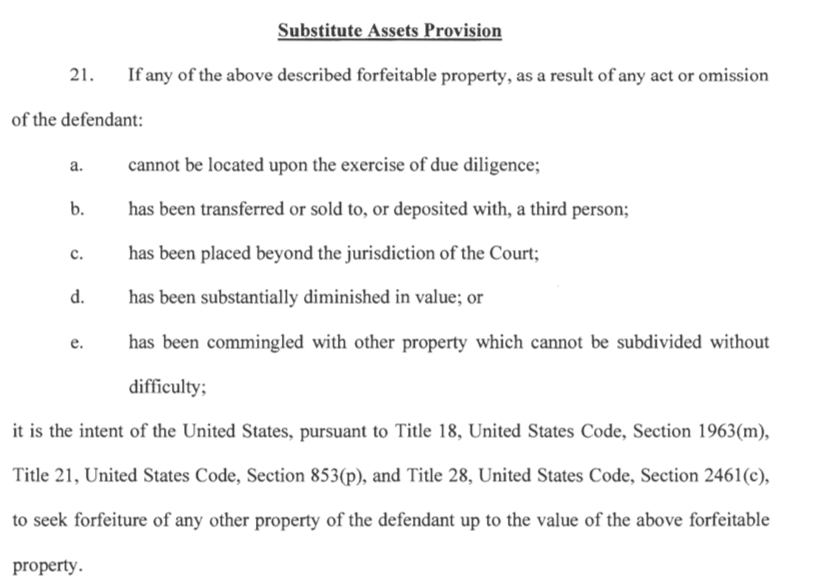
It directed, “If any of the above described forfeitable property, as a result of any act or omission of the defendant, it is the intent of the United States, to seek forfeiture of any other property of the defendant up to the value of the above forfeitable property.”
Notably, a number of well-known and enduring Hollywood figures, such as R Kelly and Harvey Weinstein, have been charged with similar violations that have exposed their decades-long abuse of their position and power as well as their illegal and perverted behaviour. Sean “Diddy” Combs is the most recent addition to the extensive list of such people. The father of seven children, pleaded not guilty but was denied bail. He is held at the Metropolitan Detention Center in Brooklyn as he awaits trial. He has been denied bail twice.