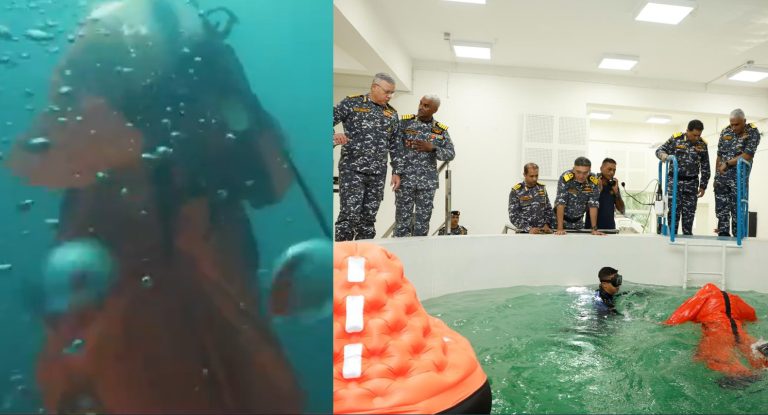
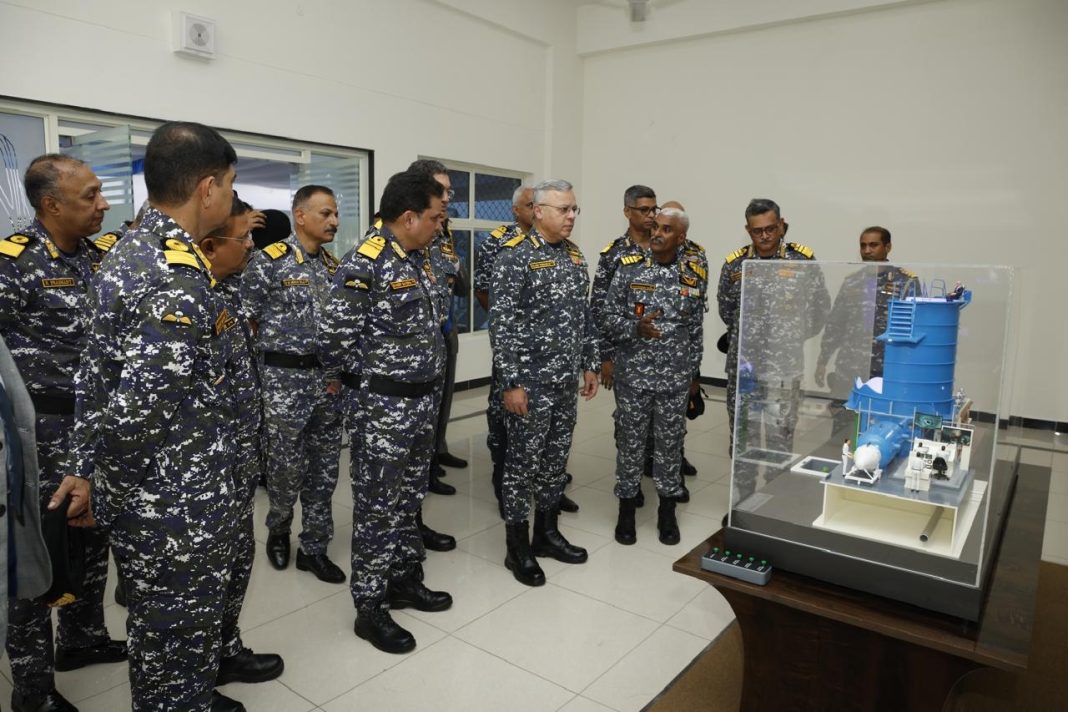
The Kalvari Submarine Escape Training Facility (Vinetra) was commissioned on 13 Sep 24 by Vice Admiral Rajesh Pendharkar, the Flag Officer Commanding-in-Chief, Eastern Naval Command, at INS Satavahana, Visakhapatnam. The facility aims to enhance the escape capabilities of crew from a distressed Kalvari-class submarine.
Vinetra has been designed and developed indigenously keeping in line with the ‘Aatmanirbhar Bharat’ initiative, highlighting India’s focus on self-reliance in defence capabilities.
Constructed by M/s L&T Defence as a turnkey project, the Kalvari Submarine Escape Training Facility is equipped with a five-meter escape tower integrated with an adjacent diving basin. This state-of-the-art facility will be utilised for imparting both basic and refresher escape training to the crew of Kalvari-class submarines, ensuring that they are proficient in escape procedures in the event of a submarine distress situation.
The official handle of Indian Navy spokesperson shared a video on social media demonstrating the working of the facility. They added, Vinetra – the Kalvari Submarine Escape Training Facility, aimed to enhance the escape capabilities of crew from a distressed Kalvari-class #submarine; was commissioned on #13Sep by VAdm Rajesh Pendharkar, FOCINC #ENC, at @IN_Satavahana , #Visakhapatnam.”
The further added, “This indigenously designed & developed facility aligns with the #AatmanirbharBharat initiative, highlighting #India’s focus on self-reliance in defence capabilities.”
The facility “Vinetra” (विनेत्र), meaning “Trainer” represents a significant step forward in building confidence among submariners, ensuring that they are equipped with the skills and training necessary to escape in case of any underwater emergency. This training facility also reinforces the operational readiness, safety protocols and training infrastructure of the Indian Navy. By offering specialised training, it enhances operational readiness and reinforces the Navy’s focus on safety protocols and preparedness in underwater emergency situations.
Kalvari-class submarines are a series of diesel-electric attack submarines built for the Indian Navy. These submarines are based on the Scorpène-class submarines originally designed by the French shipbuilder Naval Group (formerly DCNS). The vessels are constructed by a joint venture of Naval Group and Mazagon Dock Limited. The Kalvari-class submarines are a key component of India’s underwater warfare capabilities, designed for a range of tasks including anti-ship warfare, anti-submarine warfare, intelligence gathering, and area surveillance.
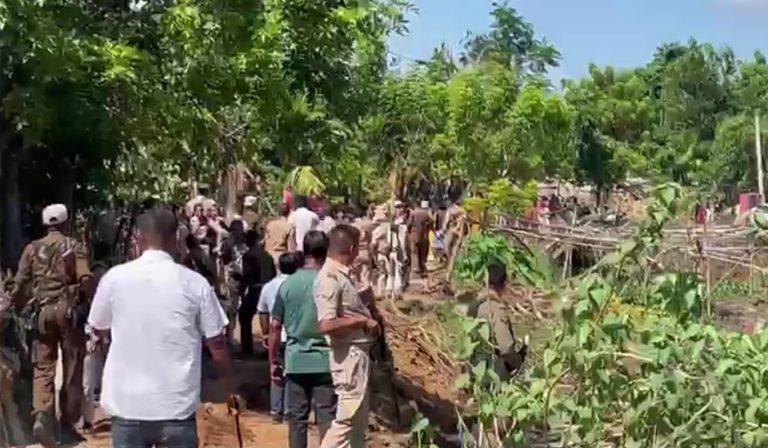
Locals of the Sonapur Kachutali area in Assam’s Kamrup (Metro) district staged a protest on Saturday in support of protecting tribal belt and block areas.
They demanded the eviction of people illegally occupying government land in the area, as well as protection for the indigenous people by the state government.
Locals have alleged that some Congress leaders brought a large number of illegal migrants for vote bank and settled them in government land of Sonapur tribal belt and block areas.
The local Muslim people here are supporting the government’s eviction drive against illegal migrants.
Rahim Baksh, a local youth of the Sonapur Kachutali area, told ANI, “Earlier some Congress leaders brought these illegal migrants to this tribal belt and block area for their vote bank. We want to protect the tribal belt and block area and also the indigenous people. We demand the government to evict the suspected people from here.”
Ashrafuddin Choudhury told ANI that they have been living in the area for the last 100 years and that the illegal migrants should be evicted.
“We have many documents that are 100 years old and we are indigenous people. We want that this tribal belt and block area should be protected. We are with the government in this eviction drive,” Ashrafuddin Choudhury said.
On September 12, two people were killed and seven others were injured in a police firing. After a mob of around 1500 people attacked government officials, including on-duty police, with sharp weapons and threw stones at them, obstructing them from performing their government duty during an eviction drive.
Twenty-two police personnel and a Revenue Circle officer were also injured in the mob attack.
Meanwhile, the administration has served notices to many other people of Sonapur Kachutali area to leave the tribal belt and block area.
(This news report is published from a syndicated feed. Except for the headline, the content has not been written or edited by OpIndia staff)
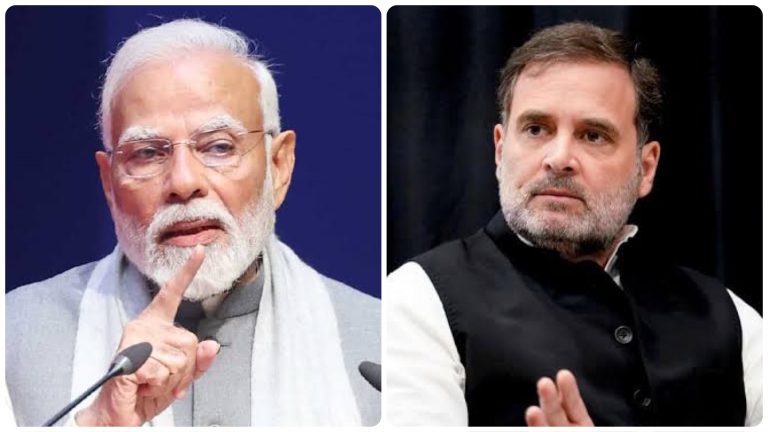
Prime Minister Narendra Modi on Saturday criticized the Congress, accusing them of “engaging in brutality” following an allegation by an India Today journalist who claimed to have been assaulted by Rahul Gandhi’s team in the United States. Speaking at an event in election-bound Doda, Kashmir, PM Modi also mocked Rahul Gandhi’s “Mohabbat ki dukaan” slogan, questioning the harsh treatment of the journalist in the US.
“They (Congress) claim to be running Mohabbat ki dukaan. But a journalist of our country was subjected to cruelty in the USA by Congress. A son of India was insulted in the USA. Those who claim to be champions of freedom of speech indulged in brutality,” Modi said on Saturday in Doda, Jammu and Kashmir.
Prime Minister Modi stated that how the journalist was treated diminished India’s standing on American soil. He also remarked that the Congress is unfit to use the term “Constitution,” seeking to flip the narrative on the party, which has frequently accused the BJP of undermining the Constitution.
Prime Minister Modi emphasised the media’s role as a vital pillar of democracy, questioning whether locking a journalist in a room upholds democratic values. He asked, “Is assaulting an Indian journalist on American soil enhancing India’s reputation?” He added, “The word ‘Constitution’ doesn’t suit you,” directly criticizing the Congress.
India Today journalist assaulted during Rahul Gandhi’s US visit
Last week, a journalist associated with the India Today media network was assaulted by Congress workers in Dallas, Texas, during Rahul Gandhi’s US visit. Journalist Rohit Sharma had gone to Texas to cover Indian Leader of Opposition Rahul Gandhi’s much-anticipated visit. During the event, Sharma was harassed by the Congress workers as he raised the question of Hindus killed in Bangladesh at the hands of Islamists after the fall of the Sheikh Hasina government there.
As per the India Today report, Sharma approached the Chairman of the Indian Overseas Congress (IOC) Sam Pitroda for an exclusive interview hours before Gandhi was scheduled to arrive at the DFW International Airport. The entire interview went well until the last question posed by the journalist.
As the interview drew closer to the conclusion, Sharma asked, “Will Rahul Gandhi raise the issue of Hindus being killed in Bangladesh during his meetings with US lawmakers?” Before Pitroda could respond to the question, other 20-30 close associates and supporters of Congress and Rahul Gandhi who were present during the interview began creating chaos saying that the question asked by Sharma was ‘controversial’.
They assaulted him, snatched his phone, and deleted the entire video of the interview.
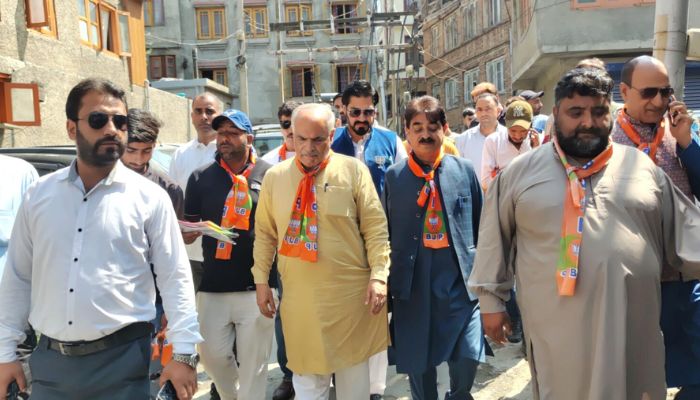
Another major sign of thriving democracy in Jammu and Kashmir is currently being witnessed in the form of door-to-door campaigning in the Kashmir valley for the upcoming assembly elections. Notably, candidates are now reaching out directly to the voters at their doorsteps after a long gap of 37 years.
Strikingly, this is the first time that door-to-door canvassing has returned to the Kashmir Valley since the notorious 1987 Jammu and Kashmir Assembly elections. Back then, elections were overseen by the then-Farooq Abdullah-led National Conference government. NC and Congress were blamed for ‘heavily rigging’ the elections, fomenting a deep divide in the populace, and alienating them from democratic exercise. The tragic aftermath of the 1987 elections was marked by a wave of Pakistan-sponsored terrorism and the purging of the Kashmiri Hindu community.
Following that infamous election, the democratic exercises and poll campaigns became a risky affair for candidates due to threats of terrorists, and the door-to-door campaigning stopped completely.
However, the Kashmir valley has seen major signs of democratic revival in the last ten years of the Modi government. While strict counter-terrorism policy has caused a substantive drop in terror incidents, the Abrogation of Article 370, bringing three tiers of governance in the valley and other progressive developments ensured democratic revival.
Currently, Jammu and Kashmir are in the midst of an election phase with voting to be held between 18th September and 1st October. However, this time the assembly elections are witnessing calmer scenes and intensified election campaigning. The return of door-to-door campaigning signals that democratic exercises are now thriving even in the downtown Valley areas.
Unlike earlier times, when candidates were forced to address people from a distance in tight security, candidates are now shaking hands, embracing supporters, and enjoying tea with supporters during door-to-door campaigns even in parts that were earlier considered prone to terror incidents.
Apart from locals, even the PDP candidates have lauded the transformative journey. A former MLC and PDP candidate running from the Eidgah seat in Srinagar, Khurshid Alam said, “We got back home before dusk earlier. Back then, there was risk. Now, campaigning lasts till one in the morning.”
Echoing the positive sentiment, Pulwama’s Rajpora resident, Gulzar Ahmad said, “People who used to be reluctant and afraid to welcome politicians into their homes with tea and blessings now do it with openness. This degree of involvement has been unheard of in the last forty years.”
To highlight the importance of the LG administration’s transformative initiatives, Ahmad contrasted the present scenario with the dreaded past. He added, “Earlier, candidates were wary about door-to-door canvassing because they thought that Hurriyat leaders and terrorist outfits would organise poll boycotts and stone-pelting.”
According to Ahmad, people are now leaving their houses and approaching politicians directly with their problems.
Analysts believe that the valley could witness a spike in voter turnout. In the majority of the elections held in the previous 40 years, the Valley recorded voter turnout in single digits.
However, post the democratic revival under the LG government, voting in the Srinagar constituency reached a four-decade high of 38.5 percent in the recently held Lok Sabha elections.
Nonetheless, this is the first assembly election since J&K’s special status was abrogated in August 2019. This time it is said to be a multi-corner fight with BJP staked against all other political fronts to make inroads in the Kashmir valley and form its government in Jammu and Kashmir UT.
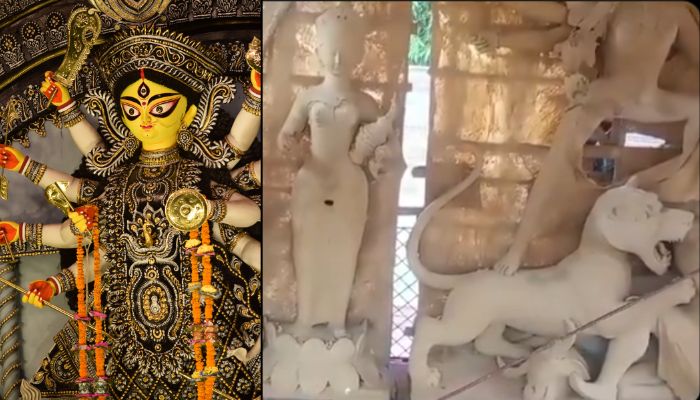
Ahead of the Hindu festival of Durga Puja, idols of the Hindu deity were found vandalised in Jharia village in Hooghly district of West Bengal.
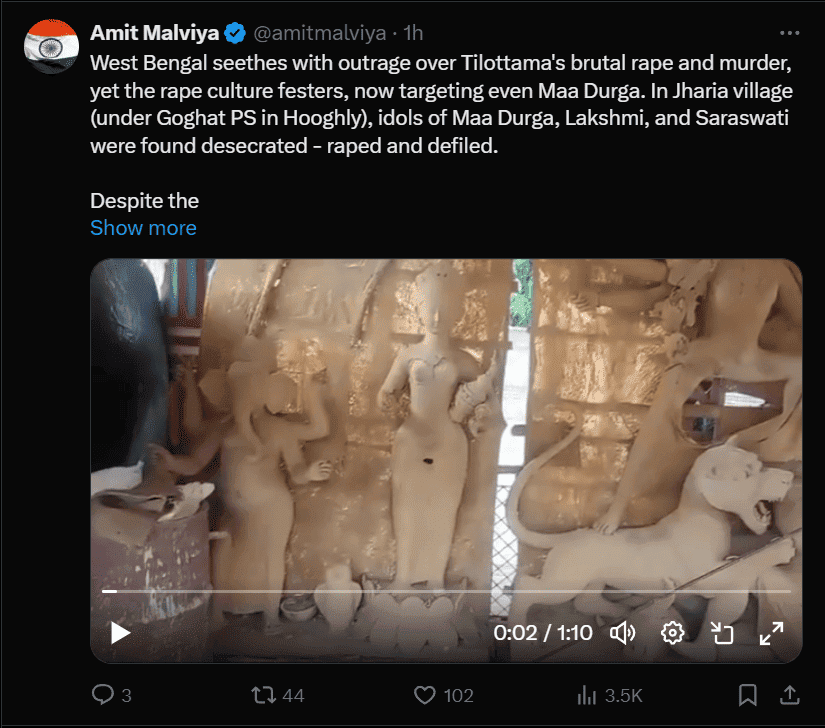
The development was confirmed on social media by BJP spokesperson Amit Malviya on Saturday (14th September). In a tweet, he said, “In Jharia village (under Goghat PS in Hooghly), idols of Maa Durga, Lakshmi, and Saraswati were found desecrated – raped and defiled.”
He has accused the Goghat police of inaction in the case. “Despite the police offering hollow assurance of apprehending and punishing the perpetrators to the enraged villagers, it is all too predictable that this case, like countless other cases, that do not demand the exoneration of a TMC offender, will be relegated to the tortuous, cyclical farce of an investigation,” Amit Malvia added.
Screengrab of the tweet by Amit Malviya
The BJP spokesperson had shared a video of the incident from his X handle. In the video, freshly carved idols of Goddess Durga could be seen in a desecrated state.
Amit Malviya had lashed out at the Mamata Banerjee government over appeasement politics. “If even our Goddesses aren’t safe, what hope remains for women of Bengal, who embody their divine essence?” he concluded.
This is not the first case of idol vandalism that has come to light from West Bengal. Earlier in May this year, three Hindu temples were desecrated by unidentified miscreants in Dhupguri in the Jalpaiguri district of West Bengal.
Following the incident, the local Hindus protested against the incident and blocked a highway, demanding strict action against the accused.
On Friday (13th September), the Attorney General of India told the Supreme Court that the Union government has received some ‘sensitive material’ which is delaying the appointment of Chief Justices of 7 High Courts. This comes nearly two months after the Supreme Court collegium had recommended these appointments.
It is pertinent to note that the Collegium holds the final authority on appointments to constitutional courts but the Union government gathers information about the potential appointees, such as their track record, any criminal record, or activities/links that could harm national interests before executing the recommendations of the SC collegium.
A three-judge SC bench comprising Chief Justice of India DY Chandrachud, Justices JB Pardiwala, and Manoj Misra was hearing a PIL that has sought directions to implement the recommendations of the Collegium in a time-bound manner.
Explaining the delay in the appointment of these seven Chief Justices of High Courts, Attorney General R Venkatramani said, “I have received some information…I’ll share it, information is confidential, sensitive, I’d like to place it on record.”
The attorney general further stated that the government was refraining from filing an affidavit as putting these issues in the public domain would neither be in the interest of the institution nor of the personalities involved.
Venkatramani added, “I would like to place the inputs and my suggestions in sealed cover for perusal by the judges.”
Earlier, on 11th July, the SC collegium comprising CJI Chandrachud and Justices Sanjiv Khanna and B R Gavai had recommended the appointment of Chief Justices of seven High Courts. These included – the appointment of Justices Manmohan as CJ of Delhi HC, Rajiv Shakdher as CJ of Himachal Pradesh, Suresh Kumar Kaith as CJ of J&K and Ladakh, G S Sandhawalia as CJ of Madhya Pradesh, N M Jamdar as CJ of Kerala, Tashi Rabstan as CJ of Meghalaya and K R Shriram as CJ of Madras HC.
Furthermore, there are many more recommendations of the SC collegium which are pending before the Union government. They include appointments and transfers of HC judges.
During the hearing, the CJI-led bench made efforts to persuade the Attorney General to convince the Union government to expeditiously clear the appointments to the HCs. Currently, there is a pendency of 60 lakh cases before the High Courts but 30% of HC judges’ posts are lying vacant.
CJI DY Chandrachud also revealed that he had a conversation with the AG on Thursday. He had requested him to “sort out” the issues that are delaying the appointments that had been recommended by the Collegium.
The bench will now hear the matter on 20th September.
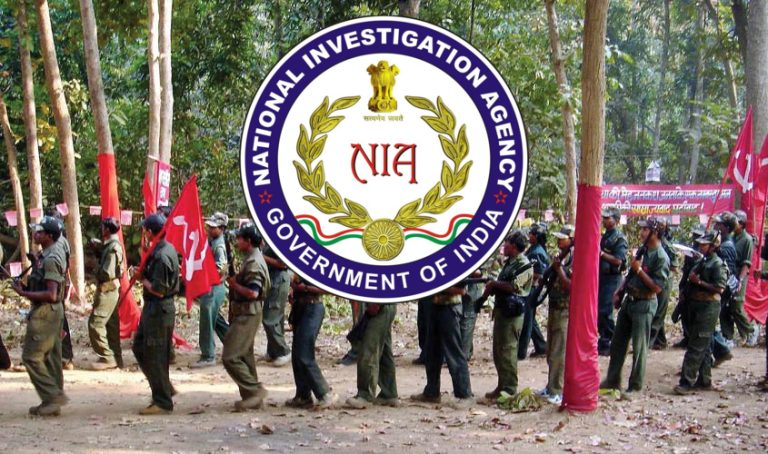
The National Investigation Agency (NIA) has chargesheeted a key Naxal leader in the banned outfit’s Magadh Zone revival case, the agency said on Saturday.
Vinod Mishra, alias Binod Kumar Mishra, a close associate of Polit Bureau Member and Chief of the North Regional Bureau of Naxal outfit Pramod Mishra, alias Sohan Da, alias Banwari Ji, alias BB Ji alias Baba, has been named in the supplementary chargesheet under various sections of the Indian Penal Code (IPC) and the Unlawful Activities (Prevention) Act.
In a statement, the NIA said its investigations have revealed that accused Vinod Mishra provided shelter and logistics support to Naxal leaders and cadres for holding meetings at his house for furtherance of their nefarious activities as part of their efforts to revive and strengthen the proscribed organisation in Magadh Zone (Gaya and Aurangabad area, Bihar).
The case (RC-26/2023/NIA) originated from the arrest of two top Naxal leaders on August 10, 2023. Various Naxal literature, handwritten letters and seven memory cards were seized from their possession at the time of their arrest. The seized memory cards contained various photographs, letters, correspondences and literature related to Naxal activities.
NIA had taken over the probe in October and had registered the case against three accused persons, including Pramod Mishra, along with accused Anil Yadav alias Ankush alias Lavkush and Vinod Mishra, besides others.
In February 2024, the agency had chargesheeted Pramod Mishra and Anil Yadav (Sub-Zonal Committee Member of the Naxal Group). Vinod Mishra, who had been evading arrest since the registration of the case, was nabbed on March 20, 2024, from Dhanbad, Jharkhand.
“Investigations have revealed that the arrested accused and others were engaged in propagating the anti-India ideology of CPI (Maoist) and were also in the process of recruiting cadres and collecting levy to further their agenda to revive the outfit in the Magadh Zone with the aim to disrupt the sovereignty and territorial integrity of India,” said the NIA.
(This news report is published from a syndicated feed. Except for the headline, the content has not been written or edited by OpIndia staff)
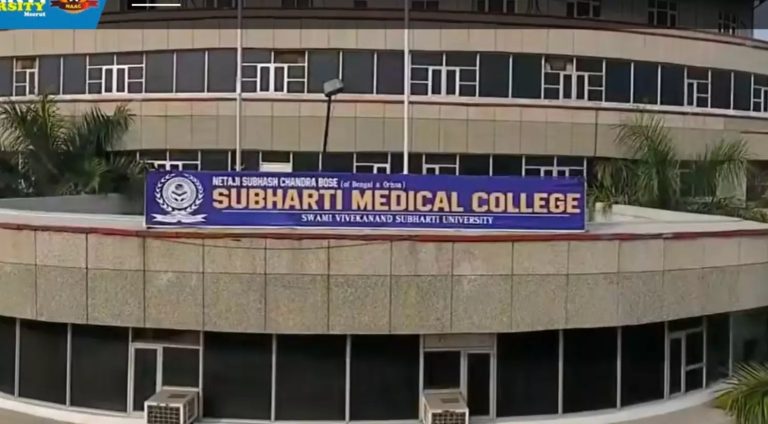
A shocking case of religious conversion for medical seatshas come to light from Uttar Pradesh’s Meerut. After investigating a complaint, the concerned DMs found out that around 20 MBBS candidates adopted Buddhism just to secure a seat under the minority quota at Meerut’s Subharti University. Additionally, the candidates had submitted certificates claiming that they hail from the Buddhist community, however, the certificates were made in violation of UP’s anti-conversion law. Subsequently, the concerned DMs cancelled their certificates.
As per a Dainik Bhaskar report, counselling for MBBS admission is currently ongoing in UP. Certain institutions come under the category of minority colleges. They are permitted to give admission under the minority quota.
After a Supreme Court ruling, a private university named Subharti University was allowed to have a 50% minority quota. In the current admission cycle, it has 200 MBBS seats, out of which 100 seats are reserved for the minority quota. Needless to say, Muslims, Christians, Buddhists, Jains, Parsis, and Sikhs come under the definition of minority.
In the first round of counselling, 22 seats at Subharti Medical University were to be filled under the minority quota. 20 candidates who took admission under this quota, had submitted certificates of Buddhism.
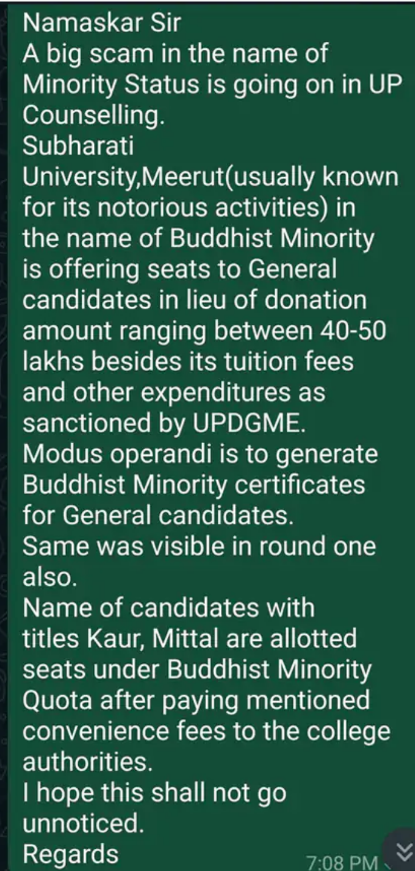
In the meantime, the Director General of the Medical Education Department, Kinjal Singh received a complaint through WhatsApp. The complaint stated that a major scam was ongoing in the name of minority quota in medical counselling. According to the complaint received on WhatsApp, in Meerut’s Subharti University, general candidates were securing seats under the minority quota by paying Lakhs of rupees in donations besides tuition fees and other charges.
The WhatsApp message
The WhatsApp message said: “A big scam in the name of Minority Status is going on in UP Counselling. Subharati University, Meerut (usually known for its notorious activities) in the name of Buddhist Minority is offering seats to General candidates in lieu of donation amount ranging between 40-50 lakhs besides its tuition fees and other expenditures as sanctioned by UPDGME. Modus operandi is to generate Buddhist Minority certificates for General candidates. Same was visible in round one also. Name of candidates with titles Kaur, Mittal are allotted seats under Buddhist Minority Quota after paying mentioned convenience fees to the college authorities. I hope this shall not go unnoticed.”
As per Dainik Bhaskar’s report, candidates with the surname like Mittal were given admission under the minority quota.
Acting on the complaint, Kinjal Singh ordered an investigation. During the investigation, it was found that only candidates belonging to the Buddhist religion were admitted to Subharti Medical University under the minority quota. Subsequently, their certificates were called for.
The investigation also revealed that all the certificates were issued recently. These certificates were issued from Meerut, Bijnor, Saharanpur, Gautam Buddha Nagar, Prayagraj, Lucknow, Varanasi, Muzaffarpur and Hapur districts.
Kinjal Singh ordered the DMs of these districts to investigate their certificates. A copy of the order was also sent to the Director of the Minority Department.
Following the order, DMs of all districts accepted that the certificates were issued in violation of the rules. Except Varanasi, all DMs have ordered the cancellation of the certificates issued to these candidates. The officer of the Minority Welfare Department of Varanasi is on leave. Therefore, a certificate issued from there has not been cancelled.
How can a person lawfully attain a Certificate of Buddhism –
Be a Buddhist by birth
Parents have converted to Buddhism
Duly following the procedure laid down under the Uttar Pradesh Prevention of Unlawful Religious Conversion Act 2021 to convert to Buddhism lawfully, that is certifying that the person is not converting his/her religion under duress or through allurement.
What are the rules under the UP’s anti-conversion law?
The Uttar Pradesh government passed a law in 2021 that prohibits religious conversion through force, coercion, or allurement. The act is called the Uttar Pradesh Prohibition of Unlawful Conversion of Religion Act 2021. Sections 8 and 9 of this law clearly state that a person who wants to convert his/her religion must submit a written declaration to the DM/ADM of his/her district. This written declaration has to be submitted at least 60 days in advance. It should be mentioned that the person wants to change his/her religion with his/her free consent and without any force, coercion, or inducement.
Why these admissions under the Minority quota were found to be unlawful and fraudulent?
All the 20 candidates who got admission under the minority quota and had submitted certificates claiming their religion to be Buddhism, hail from the Hindu Dharma. It is said that they made a Buddhism certificate only to seek admission. These certificates were issued by DM, SDM, and Minority Officers in violation of Uttar Pradesh’s anti-conversion law.
During the investigation, it was found that these certificates violated two rules of UP’s anti-conversion law –
Firstly, the declaration of religious conversion was not submitted to the concerned DM 60 days in advance.
Second violation- The certificates were not issued from the candidate’s home district.
Director General of Medical Education, Kinjal Singh said, “The District Magistrates of Meerut, Bijnor, Saharanpur, Gautam Buddha Nagar, Prayagraj, Lucknow, Varanasi, and Hapur were ordered to submit a report on the issuance of Buddhist minority certificates. After this, the district officials started cancelling the certificates of all these people.”
Meanwhile, the Subharti University management is also being accused of giving admission through hefty donations. This allegation is currently under investigation.
With the escalation in violence and persecution, Hindus throughout the Islamic nation of Bangladesh have taken to the streets to voice their anguish over the rampant attacks on their homes, temples, and families. They have highlighted the systemic targeting of their religious identity and livelihoods by Islamist extremists. The situation has led to a surge in protests, as the Hindu minority seeks justice and protection from the brutalities they continue to face in a country where they are increasingly marginalized.
The protests that were temporarily suspended based on assurances from the chief adviser and other officials resumed on Friday afternoon (September 13), with members of the Hindu community in Bangladesh returning to the streets to demand an end to the repression of minorities.
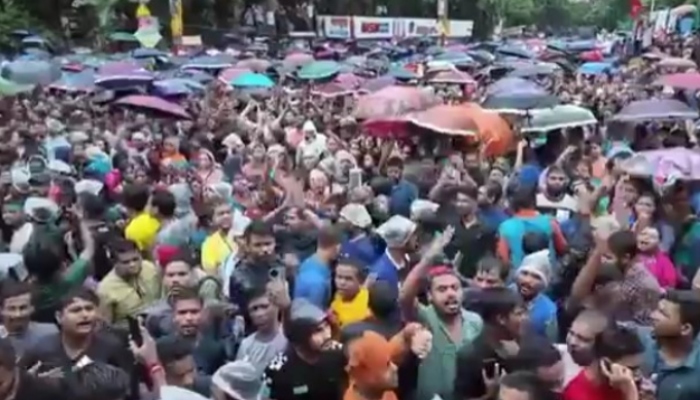
Members of Sanatani Odhikar Andolon—a coalition of various Hindu organizations—and Bangladesh Hindu Jagran Manch blocked the Shahbagh intersection in Dhaka, reiterating their eight-point demand, accusing the government of failing to take effective action to address their concerns. The blockade, initiated around 4:30 pm halted vehicular traffic, leading to significant congestion in the area.
Dhaka Shahbag Blocked By Hindu Organisations For 5 Hours Demanding To The Government To Ensure Their Safety.
Likewise, members of the Sammilito Sanatani Samaj-Bangladesh organised a rally at Jamal Khan Intersection of Chattogram City to press the eight-point demands.
Massive protests in Bangladesh by Hindus in #Chattagram demanding minority rights.
Their eight demands include: conducting a speedy tribunal trial for the incidents of attacks on minorities following the government’s fall; compensating and rehabilitating victims of communal violence; creating a minority protection law; establishing a ministry for minority affairs; converting the Hindu Religion Welfare Trust into a Hindu Foundation; transforming the Buddhist and Christian Religion Welfare Trusts into foundations; recovering endowed properties and formulating a law for their protection; properly enforcing vested property laws; and instituting a five-day holiday for Durga Puja.
Speakers at the event stated that no government in the 53 years since independence has prosecuted the atrocities committed against the Hindu community in the country, creating a culture of impunity for such crimes that has emboldened perpetrators over the years. They also noted that minorities consistently become the targets of repression whenever incidents occur.
After the student-led mass uprising, we thought we would get a non-discriminatory social system. However, since August 5, homes of Hindu people, their temples and business establishments were attacked in 49 districts of the country. According to Prothom Alo’s report, there were a total of 1,068 attacks on Hindus between August 5-20,” said Chinmoy Krishna Das Brahmachari.
“The chief adviser to the interim government is a Nobel Peace Laureate. We hope he will take steps to establish peace for all people, including the Hindu community, in the country,” he added.
Poet and writer Farhad Mazhar stated that the vandalism of shrines across the country was premeditated and criticized the government for failing to take action to prevent the attacks. “Firstly, it is a criminal offence. However, the new government did not take any action to prevent such attacks. Secondly, these attacks on shrines were pre-planned and carried out after public announcements. We have seen these announcements on social media,” he said.
He made these comments while speaking at a human chain event at the National Museum premises in the capital.
The ousting of Sheikh Hasina from power in Bangladesh on 5 August intensified the ongoing persecution and marginalization of Hindus in the Islamic nation, escalating to what can be termed a silent genocide. Under Sheikh Hasina’s government, while there were still incidents of violence against minorities, with her political fall, Islamist groups have gained more influence, and their agenda of creating an Islamic Bangladesh free of minority communities, particularly Hindus, has come to the forefront.
Since her ousting, the persecution of Hindus has taken several forms—ranging from physical violence, destruction of temples and religious symbols and systematic displacement from ancestral lands. Islamist mobs, often posing as pro-democracy, anti-quota, or anti-government protesters, have exploited political unrest to carry out attacks on Hindu communities with greater impunity. In the past few days, numerous Bangladeshi Hindus have stepped forward to share their harrowing experiences amid the ongoing genocide against their community.
Muhammad Yunus, the Chief Advisor to the interim government in Bangladesh, whitewashes Islamist crimes against Hindus
Meanwhile, Muhammad Yunus, the Chief Advisor to the interim government in Bangladesh attempted to downplay the anti-Hindu pogroms unleashed by Islamists following the fall of Sheikh Hasina by calling it ‘exaggerated’. Yunus further tried to contextualise the Islamist violence against the Hindu minority saying that he told Prime Minister Narendra Modi that there were several ‘dimensions’ to the issue.
“I have said this to Modi also that this is exaggerated. This issue has several dimensions. When the country went through an upheaval following the atrocities by (Sheikh) Hasina and the Awami League, those who were with them also faced attacks,” Yunus said.
Further emphasising the ‘political’ aspect of anti-Hindu violence in Bangladesh, Muhammad Yunus said, “Now, while beating up Awami League cadres, they had beaten up Hindus as there is a perception that Hindus in Bangladesh mean Awami League supporters. I am not saying that what has happened is right, but some people are using it as an excuse to seize property. So, there is no clear distinction between Awami League supporters and Hindus.”
“These attacks are political and not communal. And India is propagating these incidents in a big way. We have not said that we can’t do anything; we have said that we are doing everything,” Yunus continued.
On Saturday (September 14), PM Modi shared heartwarming visuals of a new addition to his family at his official residence, Lok Kalyan Marg. The Prime Minister shared heartening visuals of his interaction with a calf, given birth by one of the cows at his residence.
Taking to X, formerly known as Twitter, PM Modi tweeted, “There has been an auspicious arrival of a new member in the Prime Minister Housing Family on Lok Kalyan Marg. In the Prime Minister’s residence, the beloved mother cow has given birth to a new calf, which has a symbol of light on its forehead. Hence, I have named it ‘Deepjyoti’.” PM Modi also shared videos and pictures of the calf inside his residence.
हमारे शास्त्रों में कहा गया है – गाव: सर्वसुख प्रदा:'।
लोक कल्याण मार्ग पर प्रधानमंत्री आवास परिवार में एक नए सदस्य का शुभ आगमन हुआ है।
प्रधानमंत्री आवास में प्रिय गौ माता ने एक नव वत्सा को जन्म दिया है, जिसके मस्तक पर ज्योति का चिह्न है।
In yet another tweet, PM Modi shared pictures of himself sitting along with the calf on his couch, adoringly kissing it on its forehead. In yet another picture, the calf is seen wearing a rose garland with PM Modi praying at a temple inside his residence.
PM Modi’s adorable pictures of spending time with the newborn cow, are winning the internet, with several netizens gushing over the Prime Minister’s loving affection for the calf.
Hinduism regards the cow as a sacred animal. In Hinduism, the cow is considered a sacred animal and symbolises wealth, strength, and motherly love. It is believed to be the earthly representative of the divine and nourishing Mother Goddess, who represents fertility and bountifulness. Their milk is believed to have a purifying effect on human bodies.
PM Modi has never been apologetic about his cultural and religious moorings, evidenced by his participation in Hindu rituals across the country. From participating in Ram Mandir Pran Pratishtha in Ayodhya to various age-old traditions in hallowed temples in Tamil Nadu, PM Modi has displayed he is as religious as an able administrator. Moreover, PM Modi has always been fond of cows, also referred to as gaumata by practising Hindus. Earlier this year, on the occasion of Makar Sankranti, Prime Minister Narendra Modi fed and cared for some cows at his official residence at Lok Kalyan Marg. The pictures had gone viral then wherein PM Modi was seen surrounded by many cows.