Home Blog Page 812

Watch: PM Modi welcomes ‘auspicious arrival’ of a new calf ‘Deepjyoti’ at his residence Lok Kalyan Marg, shares heartwarming visuals

On Saturday (September 14), PM Modi shared heartwarming visuals of a new addition to his family at his official residence, Lok Kalyan Marg. The Prime Minister shared heartening visuals of his interaction with a calf, given birth by one of the cows at his residence.

Taking to X, formerly known as Twitter, PM Modi tweeted, “There has been an auspicious arrival of a new member in the Prime Minister Housing Family on Lok Kalyan Marg. In the Prime Minister’s residence, the beloved mother cow has given birth to a new calf, which has a symbol of light on its forehead. Hence, I have named it ‘Deepjyoti’.” PM Modi also shared videos and pictures of the calf inside his residence.

In yet another tweet, PM Modi shared pictures of himself sitting along with the calf on his couch, adoringly kissing it on its forehead. In yet another picture, the calf is seen wearing a rose garland with PM Modi praying at a temple inside his residence.

PM Modi’s adorable pictures of spending time with the newborn cow, are winning the internet, with several netizens gushing over the Prime Minister’s loving affection for the calf.

Hinduism regards the cow as a sacred animal. In Hinduism, the cow is considered a sacred animal and symbolises wealth, strength, and motherly love. It is believed to be the earthly representative of the divine and nourishing Mother Goddess, who represents fertility and bountifulness. Their milk is believed to have a purifying effect on human bodies.

PM Modi has never been apologetic about his cultural and religious moorings, evidenced by his participation in Hindu rituals across the country. From participating in Ram Mandir Pran Pratishtha in Ayodhya to various age-old traditions in hallowed temples in Tamil Nadu, PM Modi has displayed he is as religious as an able administrator. Moreover, PM Modi has always been fond of cows, also referred to as gaumata by practising Hindus. Earlier this year, on the occasion of Makar Sankranti, Prime Minister Narendra Modi fed and cared for some cows at his official residence at Lok Kalyan Marg. The pictures had gone viral then wherein PM Modi was seen surrounded by many cows.

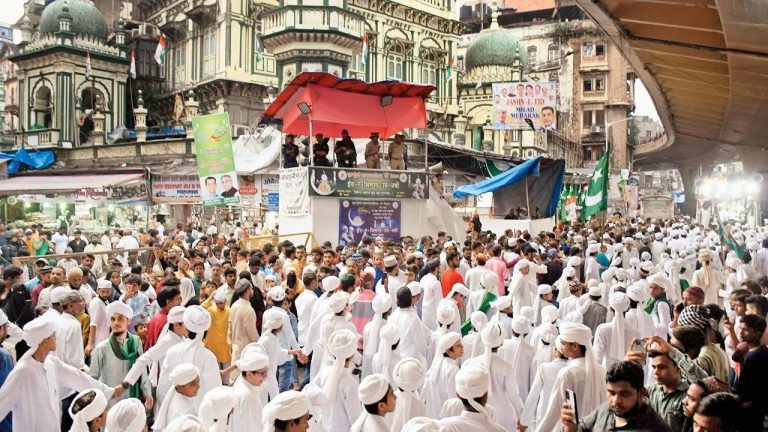
Maharashtra govt reschedules Eid-e-Milad holiday in Mumbai to avoid clash with Ganpati immersion ceremonies

The Maharashtra government has rescheduled the Eid-e-Milad holiday in Mumbai from September 16 to September 18.

The order was issued by an official notification on Friday.

This decision follows requests from Muslim MLAs and organisations, who planned to hold Eid-e-Milad processions on September 18 to avoid conflicts with Ganpati immersion ceremonies.

The notification stated, “Among the 24 public holidays notified by the State Government, the Eid-e-Milad holiday is indicated on Monday, September 16, 2024. Eid-e-Milad, a religious festival of Muslims, is widely celebrated by the Muslim community on a large scale. A procession program is organised on this occasion. On Tuesday, September 17th, 2024, since there is the Hindu festival of Anant Chaturdashi, to maintain peace and social harmony between the two communities, the Muslim Community has decided to organise the procession program on Wednesday, 18th September, 2024. Therefore, the public holiday of Eid-e-Milad is being declared on Wednesday, September 18, 2024 instead of Monday, September 16, 2024.”

The notification also mentioned that outside Mumbai City and Mumbai Suburbs, district collectors will decide whether to maintain the holiday on September 16 or reschedule it to September 18, based on local procession plans.

The change was made as per the notification to “maintain peace and social harmony” between the two communities during these overlapping festivals.

Eid-e-Milad marks the birth of Prophet Muhammad Muslims across the world participate in processions during the celebration.


(This news report is published from a syndicated feed. Except for the headline, the content has not been written or edited by OpIndia staff)

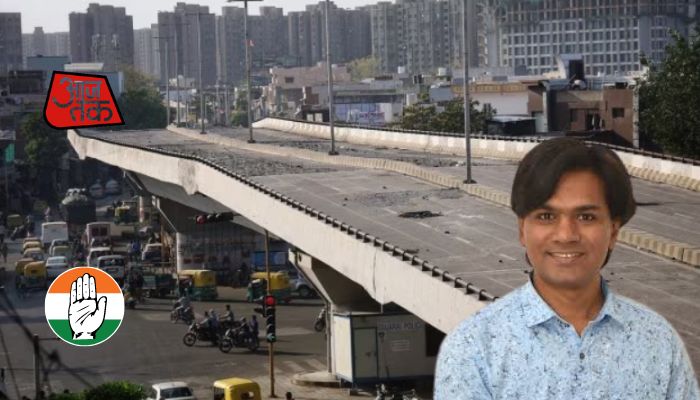
Aaj Tak, Mohammed Zubair spread fake news about cost of demolition of Hatkeshwar flyover in Gujarat, Congress amplifies lies. Here is the truth

On Friday (13th September), the popular Hindi news channel ‘Aaj Tak’ peddled fake news about the construction and demolition cost of the Hatkeshwar bridge in Ahmedabad city of Gujarat.

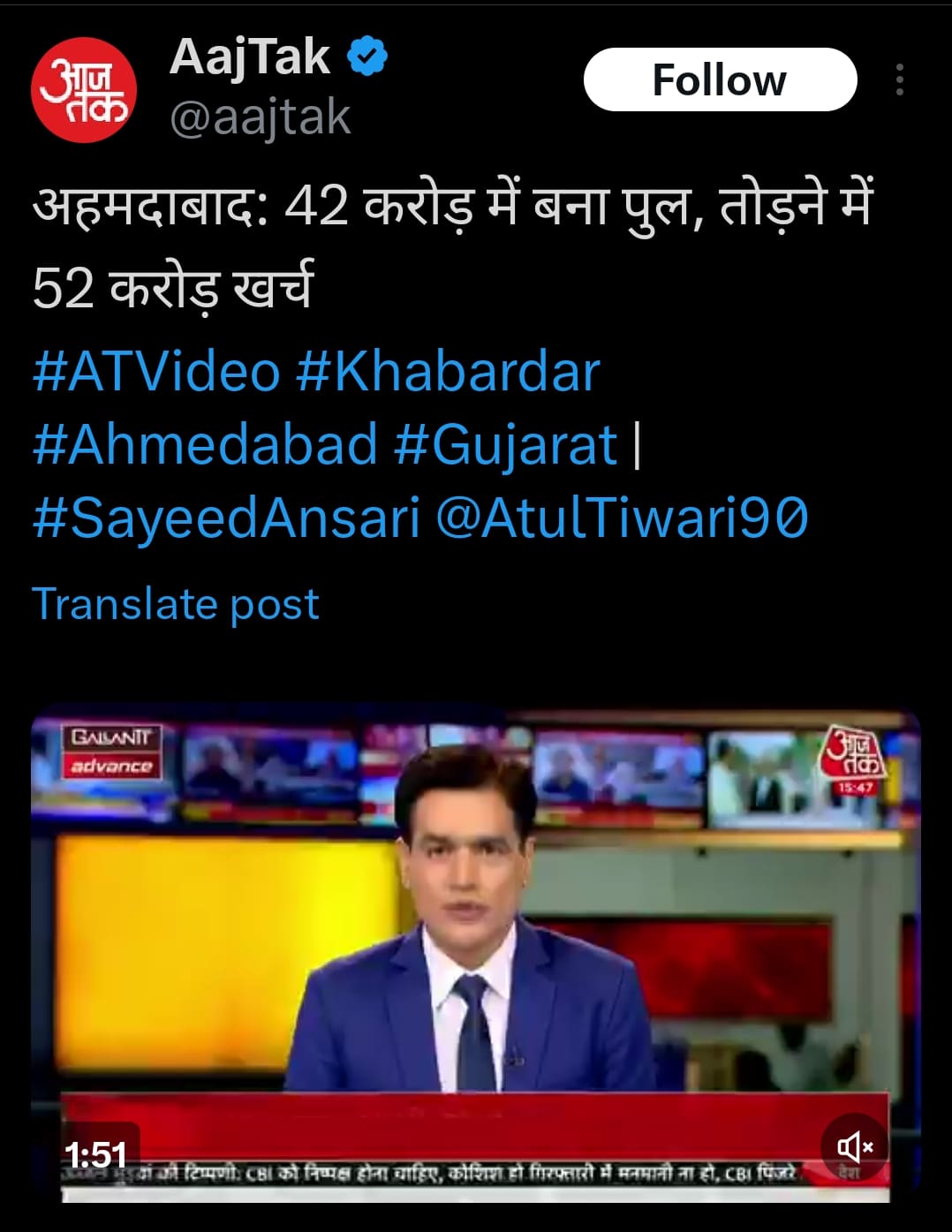
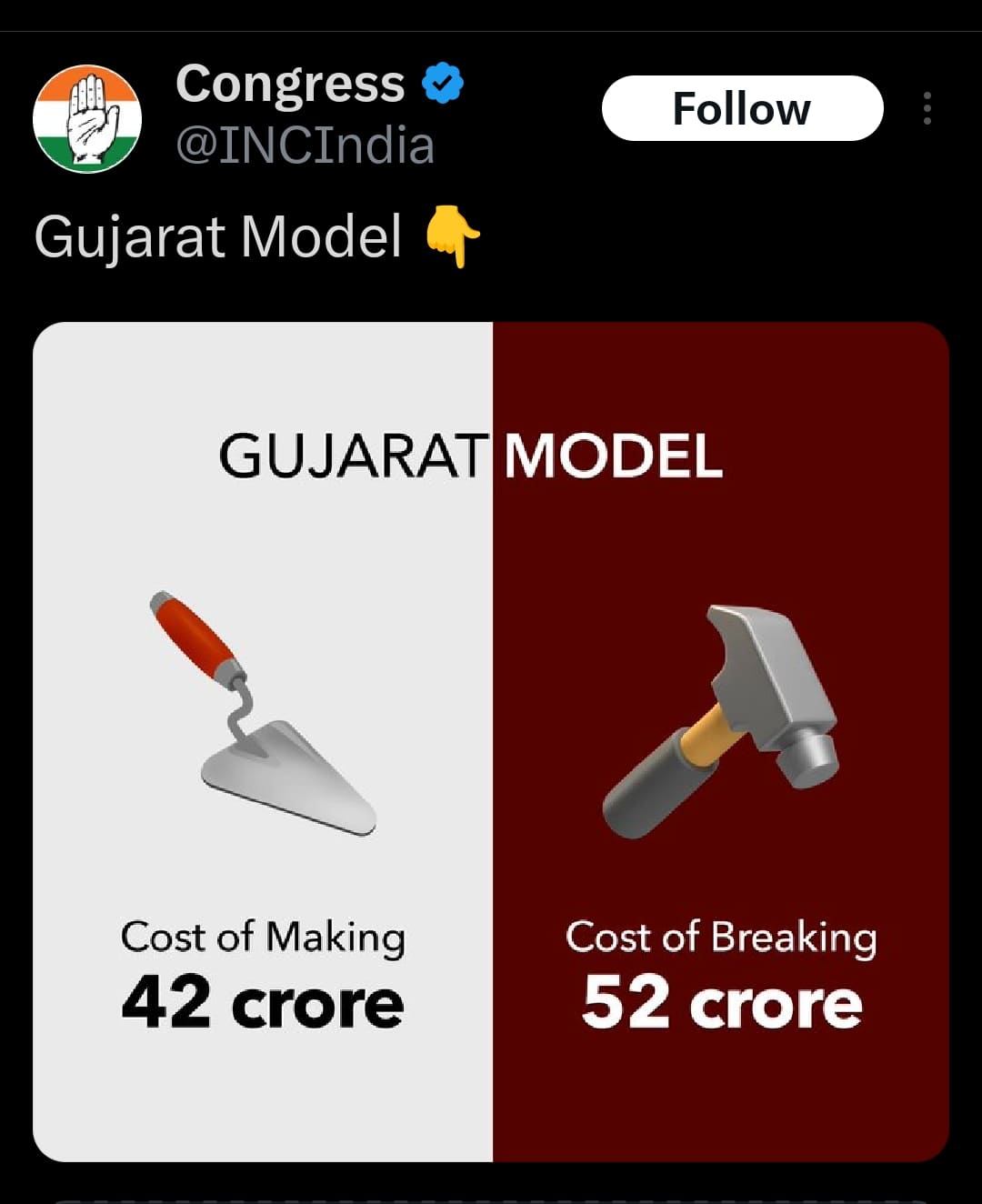
In a tweet, Aaj Tak falsely claimed that the bridge was constructed at a cost of ₹42 crores but the Ahmedabad Municipal Corporation (AMC) spent ₹52 crores on demolishing it.

For the unversed, the Hatkeshwar bridge in Ahmedabad was made open to the public in 2017 but was shut down in 2022 after it developed critical structural stability issues.

Screengrab of the tweet by Aaj Tak

The bridge was constructed by Ajay Engineering Infrastructure Private Limited with SGS India Private Limited as its project monitoring consultant. According to reports, the total construction cost of the infrastructure project was 34 crores.

Aaj Tak falsely claimed that the Hatkeshwar bridge in Ahmedabad was built at a cost of ₹42 crores i.e. 8 crores extra. On top of that, the Hindi news channel alleged that the total cost of demolition stood at a staggering ₹52 crores.

In reality, ₹52 crores (₹51.7 crores to be precise) is not the cost of demolition of the infrastructure project.

It is the total cost of demolition as well as reconstruction of the Hatkeshwar bridge as evident from the tender of the Ahmedabad Municipal Corporation (AMC) issued in July this year.

Aaj Tak made the dubious claims to insinuate a ‘quid pro quo corruption’ on the part of the AMC officials.

While it is true that substandard material was used in the construction of the infrastructure project (as confirmed by experts from IIT Roorkee and SVNIT Surat), AMC was quick to lodge an FIR against the Ajay Engineering Infrastructure Private Limited.

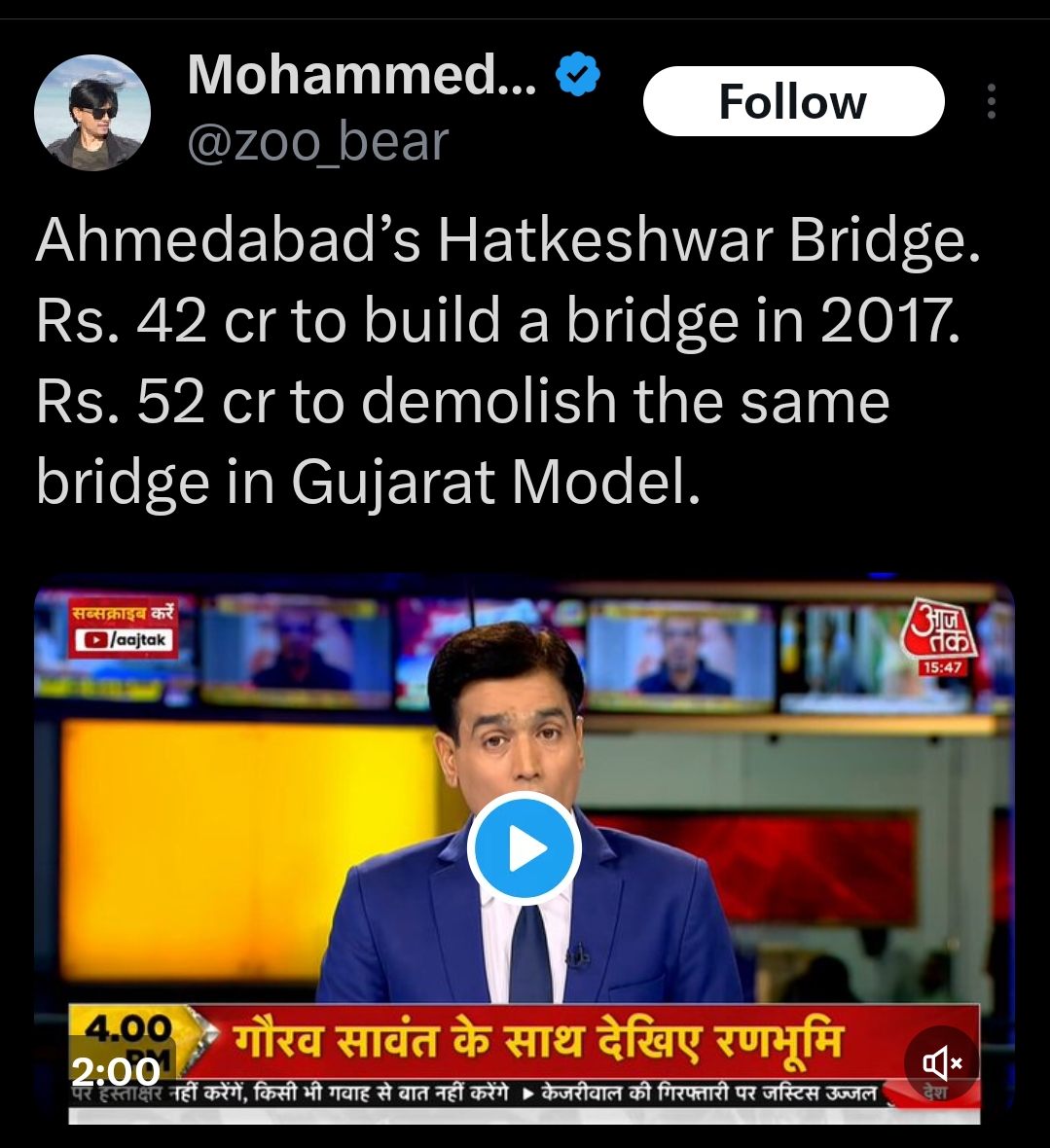
Screengrab of the tweet by Mohammed Zubair

Gujarat Minister Harsh Sanghavi had even clarified that the cost of reconstruction of the Hatkeshwar bridge would be recovered from the contactor which originally built the project in 2017.

This however did not stop the so-called ‘fact checker’ from Alt News, Mohammed Zubair, from disseminating the lies peddled by Aaj Tak. He also took potshots at the ‘Gujarat Model’ based on his fake claims.

The Congress party did not stay behind in propagating fake news about the disparity between the demolition and construction of the Hatkeshwar bridge.

Screengrab of the tweet by Congress

It claimed, “Cost of making – ₹42 crores, cost of breaking – ₹52 crores.”

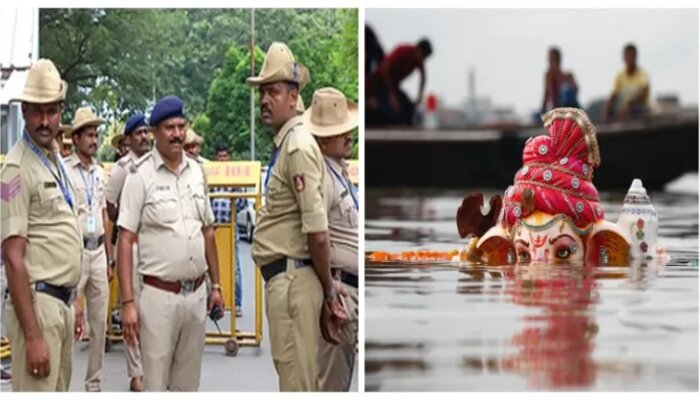
Karnataka: The story behind the heartbreaking picture of Lord Ganesh’s idol locked in police van

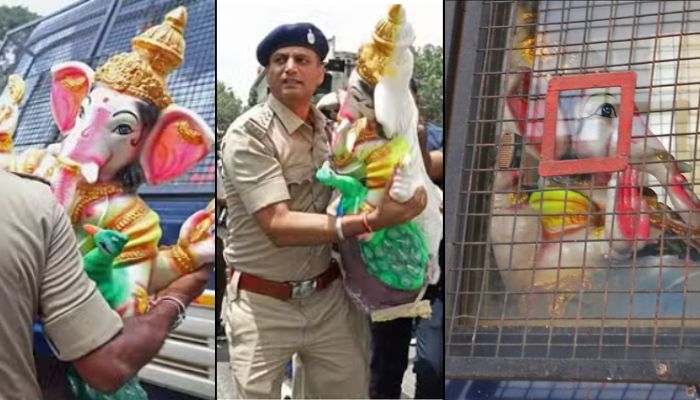
Amid the targeted attack on Hindus by radical Muslim mobs in Nagamangala village in the Mandya district of Karnataka, a picture of Lord Ganesha’s idol being caged in a police van went viral on social media.

The heartbreaking image surfaced online soon after radical Muslim mobs ran a rampage in Mandya and pelted stones at the idol of Lord Ganesha during the immersion ceremony on Wednesday (11th September) night.

By Friday (13th September), images of a cop carrying an idol of Lord Ganesha to safety began trending on social media. The Hindu deity was seen locked in a police van instead of being placed at the temple.

Speculations were soon rife on social media about the whereabouts of the Ganesha idol and the location of the incident. While it was initially believed to be from Mandya, it turns out that the ‘arrest’ of the Hindu deity was carried out in Bengaluru.

As per a report by OneIndia, the seizure of the idol of Lord Ganesha occurred during a protest by Hindus in Bengaluru against the atrocities committed against their community in Mandya.

The Bengaluru police arrested 40 Hindus for taking out demonstrations in the Town Hall area allegedly without permission. The protest was organised by the Bengaluru Metropolitan Ganesh Utsav Committee.

Following the arrest, the police deployed at the site took the Lord Ganesha idol from the Hindu protestors and put it inside their caged vehicle. At that time, photographers covering the demonstration clicked pictures of the Hindu deity being ‘arrested’ by the Bengaluru police.

While speaking about the matter, a cop told OneIndia, “The group of people attempted to protest in front of the Town Hall without permission. As a precautionary measure, about 40 individuals were taken into custody.”

Bengaluru South MP Tejasvi Surya took to X (formerly Twitter) to slam the local police and the Congress-led-Karnataka government for hurting Hindu sentiments. “This visual of Lord Ganesha in a police vehicle is terrifying. Why is the Congress hell-bent on insulting our dieties, & belittling the belief and faith of millions of Hindus?” he tweeted.

Ghaziabad: Juice seller Aamir Khan found mixing urine with juice sold to customers, locals hand over him and his minor assistant to police

0

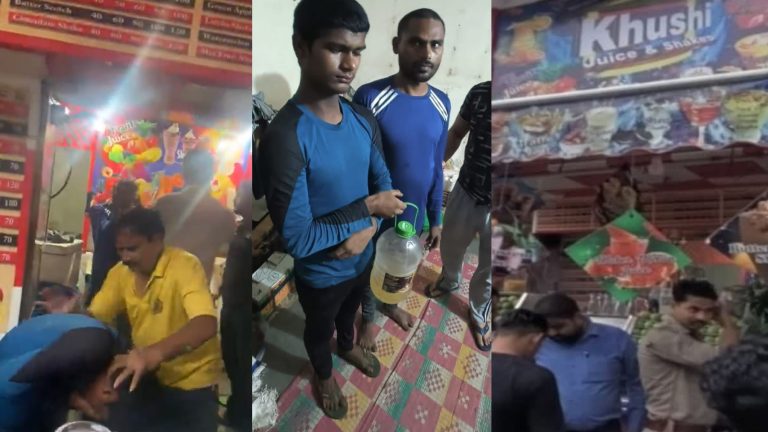
In a shocking incident in Ghaziabad’s Loni Border area, a juice shop was found mixing urine with juices sold to customers. Aamir Khan, owner of Khushi Juice Corner, and his assistant were beaten badly by locals on the allegation of mixing urine in juice and serving it to customers.

On receiving information from people, the police reached the spot and saved Aamir alias Shazid Khan and his assistant from the crowd and took him into custody. Along with him, his minor helper has also been detained by the police. This incident has created a stir in the entire area.

Giving information about the incident, ACP Bhaskar Verma said that the police had received a complaint about urine being mixed in juice on 13 September. When the police reached the spot under Indira Police station and search the shop, an one litre can filled with human urine was found. When asked, the shopkeeper could not give any satisfactory answer to the presence of urine in the shop.

As a result, police arrested Amir Khan and his minor assisted. Police have registered an FIR in this case and further investigation is underway. The can has been sent for analysis.

As per reports, local residents caught the shopkeeper mixing urine with juice, and beat him up. They then called the police and then handed him over to the police.

During the incident, someone also made a video of it, which is now going viral on social media. In the video, some people can be seen beating the two shopkeepers. As the assistant is minor, his name has been withheld from this report, although social media users have been naming both the accused, which reveals that both belong to the same community.

The police are now investigating the reason behind such ghastly act of the juice seller.

Read about the 1895 Dhulia attack by Islamists on Ganesh Visarjan after Lokmanya Tilak mobilised Hindus to celebrate Ganesh festival against Muslim aggression

This year, the Hindu festival of Ganesh Chaturthi was marred by multiple attacks on Ganesh Puja pandals across the country by Muslim mobs. OpIndia documented several such incidents wherein Muslim mobs including minors pelted stones on Ganpati pandals, Ganesh idols and Hindus celebrating their festival.

In Gujarat’s Surat, two Muslim women Rubyna Pathan and Laima Sheikh were arrested for inciting their children to attack and break Ganesh idols. In another incident in Surat, some Muslim minors pelted stones at a Ganeshutsav pandal in the Lal Gate area’s Variyali Bazaar.  In the Kutch district, Muslims attacked Hindu youths carrying an idol of Bhagwan Ganesh. On 7th September, miscreants pelted stones at a Bhagwan Ganesh idol in Mochipura of Ratlam district in Madhya Pradesh. In Karnataka’s Nagamangala, riots erupted after a Muslim mob pelted stones at the Ganpati Visarjan procession merely because the Hindus celebrating were dancing in front of the Dargah for a few minutes.

This, however, is not a new trend. Every year, Hindu processions on festivals like Ganeshotsav, Ram Navmi or Hanuman Jayanti are attacked by Islamist mobs over some excuse or the other. While Islamists hating Hindus is not a lesser-known fact, did you know about one of the first attacks on Ganesh Puja by Muslim mobs? In 1895, riots erupted in Dhulia [Dhule], Maharashtra over the Ganpati celebration. Before delving into what transpired in Dhulia in 1895, it is pertinent to take a look at how Muslims used trivial excuses to attack Hindus just two years before the Dhule Riots, how the Ganpati celebration was popularised and how it irked the Islamists.

1893 Bombay Riots which inspired Lokmanya Bal Gangadhar Tilak to unite Hindus through Ganeshotsav

The grand public celebration of Ganesh Chaturthi gained prominence in Maharashtra and other parts of the country with the efforts of Lokmanya Bal Gangadhar Tilak in 1893. The pattern of Islamist mobs attacking Ganpati processions and pandals is not new in India, rather it dates back to the Mumbai riots of 1893. These riots are one of the first documented incidents in which a Hindu religious celebration, particularly the Ganesh festival, became a trigger for Muslims to unleash violence against Hindus. This trend has persisted over the decades, with similar attacks occurring around the festival season, demonstrating a long history of hatred against Hindus and their festivals harboured by certain Islamist groups.

On the 11th of August 1893, a large communal riot erupted in Mumbai as ceremonial music was being played at the Hanuman temple in Pydhonie. Right before the Bombay riots, similar riots broke out in Prabhas Patan, which was under the control of the nawab of Junagadh. On the 25th of July 1893, Muslims attacked Hindus and desecrated temples in Somnath during Muharram. Muslims in Junagadh had been clamouring for control of all governmental jobs in the state and to avenge the Azamgarh riots.

Following the Somnath riots, several Muslims travelled to Bombay to seek donations to release the arrested Muslim rioters. In response to the destruction in Somnath, prominent Gujarati Hindus in Bombay started collecting funds for Hindu victims.  Muslims from all over India were flocking into Bombay, including Pathans, Chilli Chors, and Julahas from Gangetic areas who had attacked Hindus during the Mau and Rangoon riots. When Hindus in Bombay formed the Society for Cow Protection, the Muslim mobs were agitated and were looking for a fitting opportunity to attack Hindus.

The Islamists found an excuse in ceremonial music played at the Hanuman temple at Pydhonie. This temple was in close vicinity of the Jama Masjid. Armed with lathis, Muslim rioters stormed out of Bombay’s Jama Masjid, beating Hindus and vandalising the Hanuman Temple, claiming that the temple’s bells “disturbed” Namaz. Riots lasted three days, with looting, arson, and killing. Many Hindus died, and temples and stores were ravaged. Historical accounts say that around 80 people were killed in the riots.

However, the British, led by Lord Harris, continually backed the rioting Muslims and blamed Hindus for the rioting. The Cow Protection Movement was blamed for the spark. In 1894, during the Deccan riots, Harris blamed Brahmins for the widespread violence and disobedience. This recurrent injustice convinced Tilak that because the British government was siding with Muslims, it was pointless to expect them to protect Hindus; consequently, Hindus had the right to act in self-defence. Tilak decided to popularise a Hindu festival just as the Greeks used to do to propagate national culture and foster unity. Because Ganeshotsav was already a celebration across caste lines, Tilak saw the festival as a potential unifier of Hindus, fostering feelings of Hindu unity and nationalism.

1895 Dhulia Riots: The first Islamist attack on Ganpati celebration

Notably, before Ganeshotsav, Muharram was the most popular festival in the erstwhile presidency of Bombay. As larger-than-life “Ganpati Melas”, full of music processions, and cultural programs gained popularity among Hindus they served as powerful tools of mass mobilisation. However, the Islamists were for obvious reasons displeased. It is said that in 1895, an idol of Lord Ganesh emerged from the Panjhra [Panzara] river in Dhule. The Hindus then constructed a temple and installed the idol in the sanctum sanctorum of the temple as per the rituals.

Inspired by the tradition popularised by Tilak, a Dhulia resident and freedom fighter Khambete Guruji started the tradition of the Ganpati celebration. As the Ganpati Visarjan procession passed through the old Shahi Jama Masjid of Dhulia/Dhule, the local Muslims turned angry and attacked the Hindus resulting in communal violence, however, the British police opened fire at the crowd leaving several people dead. The temple dedicated to Lord Ganesh came to be known as the “Khooni Ganpati” temple after the riots and Shahi Jama Masjid was called “Khooni Masjid”. While the communal tensions subsided gradually, this was the first known Islamist attack on the Ganpati celebration. In a similar incident, Muslims attacked a procession at the Daruwala bridge in Pune in which freedom fighter Sardar ‘Tatyasaheb’ Hari Ramchandra Natu was injured.

The next major anti-Hindu rioting in Dhule occurred after 6th December 1992, following the demolition of the Babri structure in Ayodhya. Around 1000 Muslims gathered and attacked Hindu homes in Lala Sardar Nagar. They destroyed and burned some Hindu houses.

From 1895 to 2024, a Hindu procession passing through a Muslim-dominated area becomes a flashpoint for Islamist violence. Since 1893, Islamist groups have frequently attacked Ganpati processions. Several communal riots in the twentieth and twenty-first centuries have revolved around the same core issue: processions being attacked as they pass near mosques or through Muslim-dominated, however, now the Islamists are using minors to express their hatred for idol worshipping Hindus as seen in Surat.

The past riots and the recent attacks suggest that over centuries, a lot has changed, India has gained freedom from British Raj, and partitioned to carve out two Muslim-majority countries, yet the Islamist hatred for Kafirs especially Hindus does not appear to be subsiding anytime soon. The Islamists love to assert their dominance and overtly express their religiosity, however, are intolerant of the Hindus expressing their religiosity fearlessly. Islamists have always resisted any type of Hindu resurgence or cultural identity in the public sphere, particularly when such activities are held on a large scale. As Tilak dreamed, the Ganpati celebration should continue to be not just a celebration of the birth of Lord Ganesh but also that of Hindu resurgence and unity.


Karnataka: 10 FIRs, 56 arrests, 94 wanted after radical Muslims attacked Ganpati visarjan procession in Mandya, inspector suspended over negligence

0

A police officer has been placed on leave due to the instance involving stone pelting during Ganpati visarjan (immersion) on 11th September in the Nagamangala area of Mandya district in Karnataka. Ten First Information Reports (FIRs) were filed on 13th September. Fifty-six persons have been apprehended while authorities are searching for ninety others. A holiday has also been declared in educational institutions.

Meanwhile, an official was also suspended for negligence in duty during the riots. Police Inspector Ashok Kumar didn’t inform his senior officers about a similar incident during Ganesh Chaturthi in 2023 and failed to arrange adequate security arrangements this year as well. Mandya Superintendent of Police (SP) Mallikarjun Baladandi stated that the place near the mosque in Badrikoppalu village of Mandya is a sensitive area. More security forces could have been deployed there.

Police sources revealed that 150 people have been booked for violence and rioting. FIR has been registered under sections 16, 109, 115, 118, 121, 132, 189 and 190 of Bharatiya Nagarik Suraksha Sanhita (BNSS). The authorities are collecting CCTV footage of the area to identify the perpetrators and gather information about them. Cops also arrested four individuals on 12th September. Earlier, 52 accused were produced in the court on the 12th of September evening. Mandya District Court sent them to judicial custody for 14 days.

On 12th September, a group of forensic specialists visited the spot to collect evidence. Locals mentioned that the situation in the area is still tense. The police department has imposed a curfew till 14th September and schools and colleges have also been closed. The police conducted a flag march in Nagamangala town and additional security forces have been deported there.

Karnataka Bharatiya Janata Party (BJP) has also formed a five-member committee regarding the issue. “State President Vijayendra Yediyurappa has formed a fact-finding team of leaders to determine the truth of the occurrence that transpired during the Ganpati visarjan procession in Nagamangala and has directed to submit a comprehensive report,” the party wrote on social media.

The youths of Badrikoppalu village were taking out a Ganpati visarjan procession in the town. People from the Muslim community on Mysore Road got into a heated confrontation with the participants as soon as the procession started to cross the road close to a mosque. When the Muslim extremists noticed the disagreement, they began throwing stones at the procession and weapons were also brandished. Many people including some policemen were also injured in the attack. The culprits vandalized shops and set the goods on fire. About 25 shops were reportedly looted, damaged and set ablaze. Multiple vehicles were also burned and destroyed.

Notably, such occurrences during Ganpati visarjan happened in other parts of the nation as well. Muslims including children in Surat and Kutch pelted stones at Ganesha pandals and damaged the idol. An Islamic flag was raised in a temple. Moreover, an Islamic mob attacked a pandal in Lucknow amid “Allah-hu-Akbar” slogans and issued death threats. Likewise, Muslims in Vadodara displayed flags in Arabic outside their homes in opposition to the Ganesha pandals. There was also unrest and stone pelting over installing similar flags on Ganesha Chaturthi in Bharuch as well.

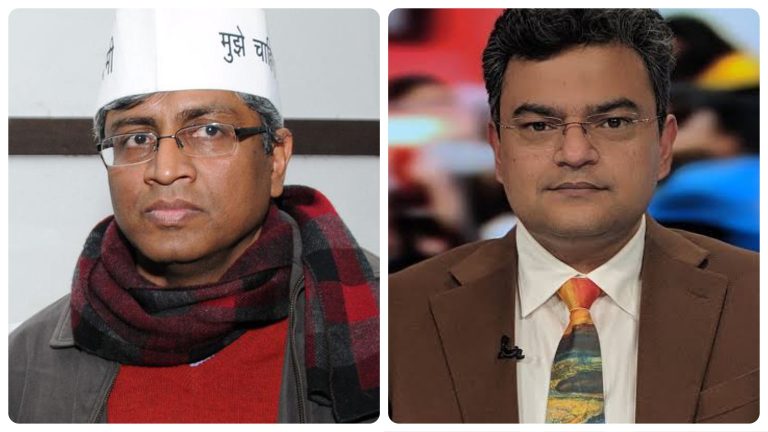
‘I’m not your dad, get out!’: Scientist Anand Ranganathan after journalist-turned-politician-turned-journalist Ashutosh has a meltdown during a news debate

0

Journalist-turned-politician-turned-journalist Ashutosh on Friday had a meltdown while debating during a news show on Times Now Navbharat. Ashutosh reportedly lost his cool after scientist Anand Ranganathan allegedly commented on the issue of which politician Ashutosh met in a backdoor meeting.

A visibly irate Ashutosh being flanked by other co-panellists, including Tehseen Poonawalla, hurled abuses at Dr Ranganathan and threatened him on live television as host Navika Kumar tried to calm things down.

“He constantly comments on me. Ask him to stop making remarks about me,” said Ashutosh, as Ms Kumar tried to lower the temperatures and remind him that it could hurt his health.

Dr Ranganathan, on the other hand, sedately watched the meltdown, reacting only when Ashutosh tried to threaten him after hurling a volley of abuses. “I’m not your dad, get out!” Dr Ranganathan shot back as Ashutosh kept grumbling.

DRDO conducts successful Field Firing Trials of Indian Light Tank ‘Zorawar’, flight test of Vertical Launch Short Range Surface to Air Missile done with Indian Navy

0

Defence Research and Development Organisation (DRDO) on September 13, 2024, successfully conducted the preliminary automotive trials of the Indian light Tank, Zorawar, a highly versatile platform capable of deployment in high-altitude areas. During the field trials conducted in the desert terrain, the Light Tank demonstrated exceptional performance, efficiently meeting all the intended objectives. In the initial phase, the tank’s firing performance was rigorously evaluated and it achieved the required accuracy on designated targets.

Zorawar has been successfully developed by the Combat Vehicles Research & Development Establishment (CVRDE), a unit of the Defence Research and Development Organisation (DRDO), in collaboration with Larsen & Toubro Ltd. Numerous Indian industries, including Micro, Small, and Medium Enterprises (MSMEs), contributed to the development of various sub-systems, showcasing the strength of indigenous defence manufacturing capabilities within the country.

Raksha Mantri Shri Rajnath Singh lauded DRDO, the Indian Army, and all associated industry partners for the successful trials of the Indian Light Tank. He described the achievement as a significant milestone towards India’s goal of self-reliance in critical defence systems and technologies.

Secretary, Department of Defence R&D and Chairman DRDO, Dr Samir V Kamat also extended congratulations to the entire team involved in the project.

Successful flight tests of Vertical Launch Short Range Surface to Air Missile

DRDO and the Indian Navy also conducted back-to-back successful flight tests of the Vertical Launch Short Range Surface to Air Missile (VLSRSAM). The second consecutive test was conducted on September 13, 2024, from the Integrated Test Range (ITR), Chandipur, Odisha. 

The missile intercepted a high-speed aerial target, flying at a very low altitude and simulating a sea-skimming threat, which showcased its precision and capability to neutralise targets. This follows the earlier test on September 12, 2024, when the VLSRSAM missile effectively engaged another low-altitude target. These consecutive tests not only demonstrate the weapon system’s reliability but also validate the recent upgrades made to various components of the system.

Defence minister Rajnath Singh lauded DRDO, the Indian Navy & all associated teams for the successful flight tests and stated that this missile equipped with modern technologies will give further technological boost to the Armed Forces. 

Secretary, Department of Defence R&D, and Chairman DRDO, Dr. Samir V Kamat also congratulated the teams involved in the flight tests of the VLSRSAM system.

After Sanjauli, protests break out in Mandi in Himachal over illegal mosque construction, water canon used on Hindu protestors

0

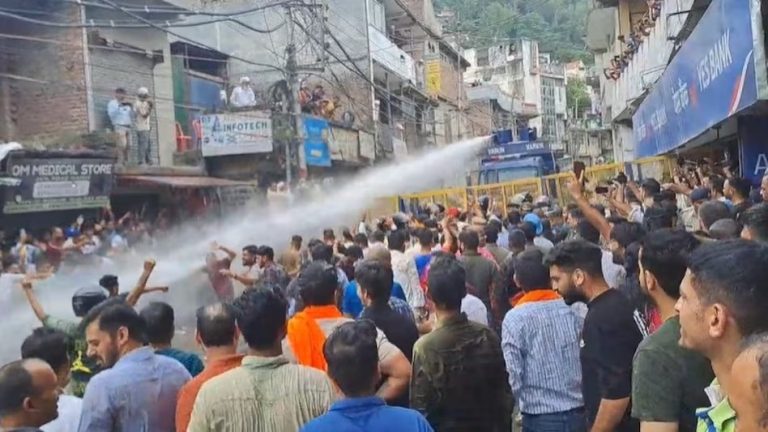
Hindu organisations staged a protest over an alleged illegally constructed mosque in Mandi on Friday. As the crowd tried to bring down the line of barricades, police resorted to firing water cannon to disperse the crowd.

The protests had been called for by Hindu organisations even after Mosque authorities demolished parts of the complex that were allegedly unauthorized. Large crowds of protestors gathered along the jail road in Mandi and shouted slogans against the state government demanding action against the alleged illegal construction.

Earlier in the day, the Himachal Pradesh Police tightened security and placed barricades in the Jail Road area in Mandi on Friday.

According to Mandi Superintendent of Police Sakshi Verma, the heightened security was done following information received by the police of a gathering called by some organisation.

This protest followed those those that broke out over the illegal construction of a mosque in the Sanjauli area of the city on Wednesday.

Around 300 police personnel were deployed across the city and police nakas were placed at the entrance of Mandi town, Verma added.

“Law and order will be maintained. Through different sources, we have information that some organisations have given a call to gather here. 300 police personnel have been deployed, and police nakas have been placed at the entrance of Mandi town. Action will be taken on violation of prohibitory orders under 163 BNS,” SP Verma said.

However, BJP spokesperson Chetan Bragta criticised the Police for using force to disperse the protestors, “Another brazen attack on Hindus by the Congress government of Himachal, this time in Mandi. First Shimla, now this–using water cannons and force to suppress people. What exactly is this government trying to achieve?”

Earlier today, the police released the stone-pelting video of Wednesday’s protest held in Sanjauli over the alleged illegal construction of a mosque in Shimla.

Eight FIRs had been registered so far and six policemen were injured in the protest, including a woman police officer who had vertebral fractures and is in a serious condition.

Earlier on Wednesday, protestors removed the first layer of barricading and clashed with the security forces while entering the Dhalli Tunnel East portal during their protest march. Police personnel used water cannons and resorted to lathi-charge to disperse protestors heading towards the Sanjauli area of Shimla.


(This news report is published from a syndicated feed. Except for the headline, the content has not been written or edited by OpIndia staff)