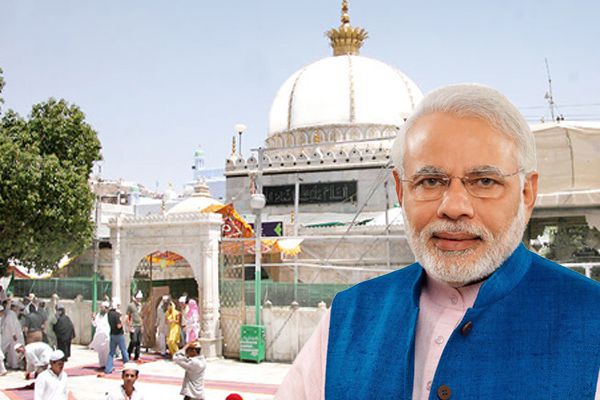
Ajmer Sharif Dargah will prepare and distribute 4000 kg of vegetarian “Langar” food to mark Prime Minister Narendra Modi’s 74th birthday on September 17.
“In celebration of the birthday of Prime Minister Narendra Modi and in conjunction with “Sewa Pakhwada,” the historic and world-famous “Big Shahi Deg” at Ajmer Dargah Sharif will once again be used to prepare and distribute 4000 kg of vegetarian “Langar” food, continuing a tradition that has been upheld for over 550 years,” an official statement from the Dargah authorities said.
Gaddi Nashin-Dargah Ajmer Sharif, Syed Afshan Chishty, speaking to ANI on Wednesday, said that the vegetarian food will be distributed to the people.
“On the occasion of his (PM Modi’s) birthday, seva programmes will be organised at religious places in the country…On the occasion of his birthday Prime Minister, we will prepare 4,000 kg of vegetarian food, which will include rice and pure ghee, dry fruits and distribute it. Along with this, the Gurus and poor people around us will also be given langar as a service,” he told ANI on Wednesday.
“We will also pray for the long life of PM Modi on his birthday. The entire langar is being organised by the Indian Minority Foundation and Chishty Foundation of Ajmer Sharif,” Syed Afshan Chishty added.
The entire process, from lighting the “deg” to food distribution, is conducted with utmost devotion and care, serving thousands of devotees and seekers who come to pay their respects. The ceremony will begin with the lighting of the “Big Shahi Deg” at 10:30 PM inside the Dargah of Hazrat Khwaja Moinuddin Chishty . Special prayers (Dua) will be offered for peace, unity, prosperity, and the well-being of Prime Minister Narendra Modi, as per the release.
“The prayers will also invoke blessings for the success of “Sewa Pakhwada” and the well-being of all citizens. – The “deg” is one of the world’s largest cooking vessels, capable of preparing up to 4000 kg of food, and has been used for centuries to serve “Langar” to devotees. During the cooking process, continue throughout the night, devotees and volunteers will gather to offer prayers and engage in recitation of “Quranic verses,” “Naats” (devotional songs), and “Manqabat”, Qawwalis” (poems in praise of the saints),” the Dargah authorities said.
The distribution will continue throughout the morning, ensuring that all attendees and nearby communities are able to partake in the blessed food. Volunteers will help in distributing the food in an organized manner, as per the release.
“The event will conclude with prayers of gratitude and unity for the welfare of the nation and all humanity. This event not only marks the celebration of Prime Minister Narendra Modi’s birthday but also reflects the spirit of “Sewa” (service) and community welfare that is central to the teachings of Hazrat Khwaja Moinuddin Chishty,” said the Dargah authorities.
(This news report is published from a syndicated feed. Except for the headline, the content has not been written or edited by OpIndia staff)
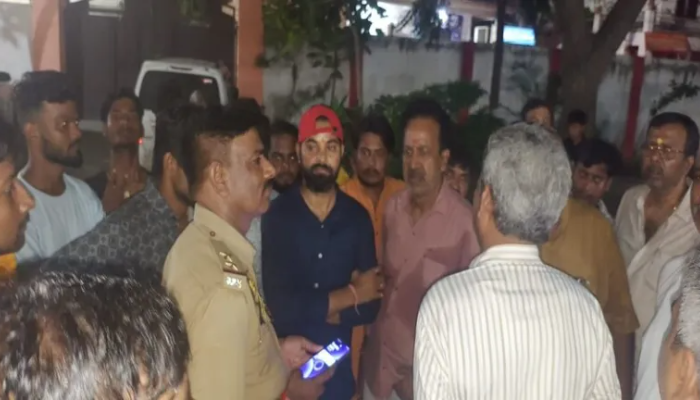
On 10th September, Muslim extremists pelted stones at a Ganesh Puja pandal in Lucknow, Uttar Pradesh and broke the urn (kalash) kept near the idol amid slogans of “Allah Hu Akbar.” Afterwards, Hindu organizations protested at the police station and demanded action. The authorities have registered a case and arrested two suspected minors. The case pertains to the Chinhat police station area of Lucknow. A day earlier, Kiran Chaurasia, who lives near the mosque in Ganga Vihar Colony registered a complaint which stated that like every year she had installed the idol of Lord Ganesh at her home on 7th September per religious traditions.
However, a Muslim mob including minors and youths of twenty to twenty-five people started harassing her from the very next day. According to her, she performs aarti every day between 7 and 7:30 in the evening. Notably, the perpetrators started passing in front of the pandal during the aarti and raised “Allah hu Akbar” along with many other provocative slogans. People in the crowd also threatened the Hindus who were performing aarti and also tried to disrupt the sacred rituals.
The complaint further unveiled that she was performing aarti with some girls in the pandal at around 7:30 pm when a group of aggressive young Muslim men reached there. They attempted to damage the idol and threw stones at the pandal due to which the urn present near the deity broke. The incident led to unrest in the area as the culprits created a ruckus and threatened to kill the Hindu family if they performed the puja again.
Afterwards, the victim went to the police station and complained that her religious feelings had been offended. Hindu devotees and representatives of Hindu organisations arrived at the police station as soon as word of the occurrence spread. All the senior officers rushed to the spot with the police force and took stock of the situation, as soon they learned about the matter. The authorities have identified the accused and initiated action to arrest them.
Cops have also been deployed near the pandal. According to Deputy Commissioner of Police (DCP) Shashank Singh, investigation of the case and other necessary legal action is underway per the relevant sections of the law. He added that the situation is currently under control.
OpIndia has a copy of the complaint in which the victim has demanded strict action against the accused.
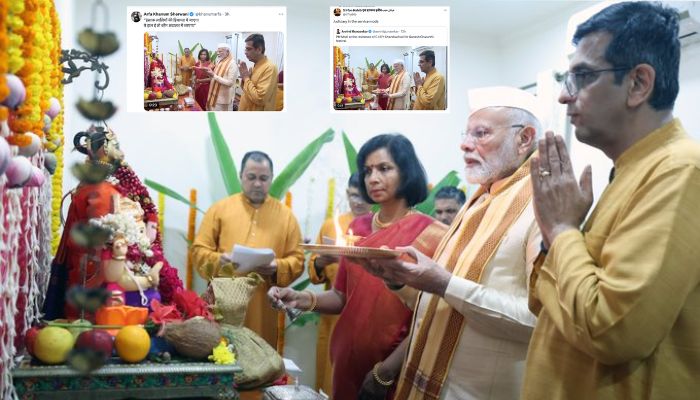
The left-liberal coterie takes delight in manufacturing controversies where none exists. This time the liberals are suffering a massive meltdown over Prime Minister Narendra Modi’s visit to the residence of CJI DY Chandrachud for Ganesh Puja on the 11th of September. As the visuals of PM Modi performing Ganpati aarti at CJI’s residence surfaced on social media, several left-liberals claimed that the independence of the judiciary has been compromised, and the principles of separation of power have been risked. Basically, they are using a personal visit and a sweet gesture by PM Modi to further their imaginary ‘democracy in danger’ narrative.
Joined Ganesh Puja at the residence of CJI, Justice DY Chandrachud Ji.
May Bhagwan Shri Ganesh bless us all with happiness, prosperity and wonderful health. pic.twitter.com/dfWlR7elky
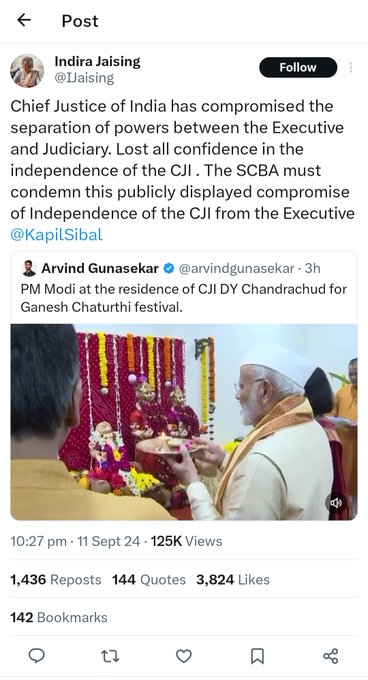
In this vein, senior Supreme Court lawyer Indira Jaising expressed her discontent over PM Modi’s visit to CJI Chandrachud’s residence and said: “Chief Justice of India has compromised the separation of powers between the Executive and Judiciary. Lost all confidence in the independence of the CJI. The SCBA must condemn this publicly displayed compromise of Independence of the CJI from the Executive @KapilSibal.”
Taking to X, Rashtriya Janata Dal (RJD) MP Manoj Kumar Jha said: “That is the state of the republic….ladies and gentlemen. Jai Hind.”
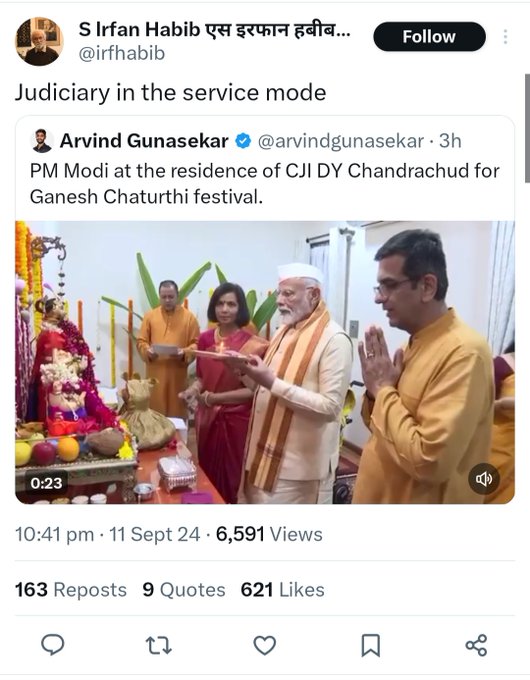
‘Historian’ Irfan Habib accused CJI and the Indian judiciary of being in the ‘service’ of the Modi government and said: “Judiciary in the service mode.”
Insinuating that PM Modi’s personal visit to the CJI’s Ganpati puja undermines ‘secularism’ lawyer Sanjay Hegde said: “Separation of church & state?”
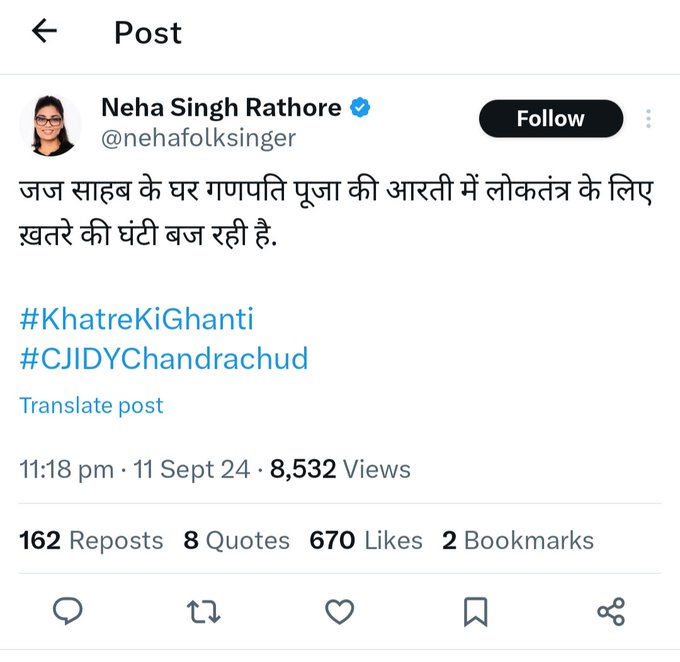
Meanwhile, folk singer Neha Singh Rathore claimed that “the bell of danger for democracy is ringing at CJI’s house.”
Similarly, ‘Tribal Army’ asserted that somehow PM Modi doing Ganpati puja at CJI Chandrachud’s residence on a personal visit raises ‘concerns’ over secularism and judicial impartiality. “Chief Justice of India Dy Chandrachud’s participation in Ganpati Puja with PM Modi raises serious questions on secularism and judicial impartiality. Participating in religious events with prominent political persons in power undermines the independence and credibility of the judiciary,” the X user posted.
Shiv Sena (UBT) leader Priyanka Chaturvedi directly raised questions over the impartiality of CJI Chandrachud and said: “Okay. After the festivities are over hopefully CJI will deem fit and be slightly freer to conclude the hearing on Maharashtra and the blatant disregard of Article 10 of the Constitution in Maharashtra. Oh wait, elections round the corner anyway, it can be adjourned for another day,” Chaturvedi posted.
Meanwhile, ‘journalist’ Saba Naqvi said: “People say the CJI is a great legal mind. He obviously has original views on separation of State & Church. All I can think about is the spectacle of two of our nation’s most powerful men, while Manipur burns. Waiting for the enlightened to take suo moto notice of the rapes, killings and civil war.”
People say the CJI is a great legal mind. He obviously has original views on separation of State & Church. All I can think about is the spectacle of two of our nation's most powerful men, while Manipur burns. Waiting for the enlightened to take suo moto notice of the rapes,… https://t.co/LquwlCGfuC
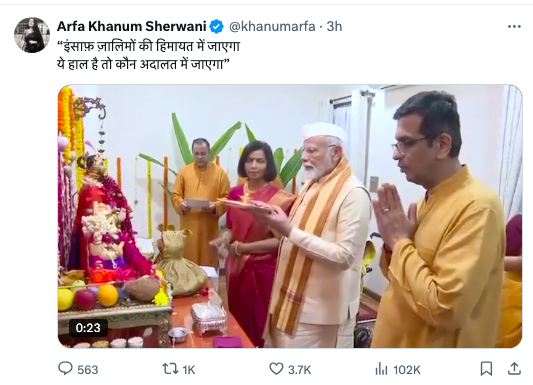
Suffering another “zakham”, TheWire ‘journalist’ Arfa Khanum Sherwani said: “Justice will stand in support of the oppressors If this is the situation then who will go to the court.”
The left-liberal ecosystem’s outrage over Prime Minister Narendra Modi’s visit to the CJI for Ganesh Puja and darshan, alleging a perceived infraction of the separation of powers and a compromise of judicial independence, is completely absurd, Hinduphobic, and hypocritical.
PM hosting Iftar parties with taxpayer’s money was all great and lovely
Under the UPA government, Iftar Parties were all the rage. They were organised at the Rashtrapati Bhavan and PM’s residence too. This party was attended by several notable dignitaries, including the then CJI of India. However, no raked up ‘democracy in danger’, ‘separation of state and church [read religion]’ argument then? The question arises, had the left-liberal ecosystem outraged in a similar fashion as they are doing over Ganpati Puja if CJI Chandrachud happened to a Muslim and invited the PM to his Iftar party?
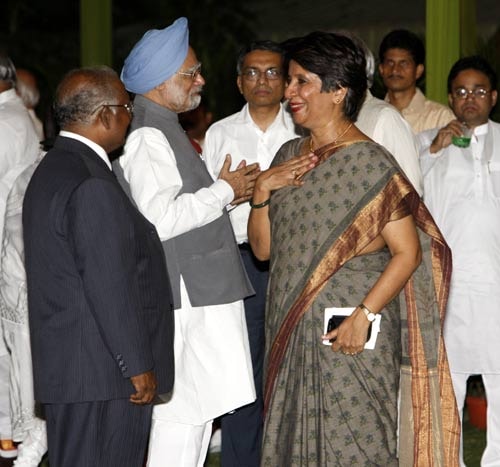
Prime Minister Manmohan Singh with Chief Justice of India K.G. Balakrishnan and Foreign Secretary Nirupama Rao. (Image source: IndiaToday)
Even though PM Modi’s visit to CJI Chandrachud’s Ganesh Puja was personal and not official, the left liberals have slipped into ‘democracy khatre mein hai’ mode, however, there was no such meltdown in 2009, when the then Prime Minister Dr Manmohan Singh hosted Iftar party at his residence which was attended by the then CJI K.G. Balakrishnan. Perhaps, for the left liberals, Ganesh Puja implies the ringing of the bell of ‘danger’ to democracy while the Iftar party implies ‘cementing secularism’.
Is the democracy, separation of powers of judiciary and executive, and judicial independence really compromised by PM Modi’s personal visit to CJI’s religious celebration?
India, a Hindu-majority country, is a land of various festivals that bring people together. Cultural and religious traditions are inextricable in all aspects of Indian society, including politics, the judiciary, and public service. A social or religious visit, such as the Ganesh Puja, is not uncommon. PM Modi’s visit to the CJI’s residence for a religious event resonates with India’s cultural fabric, in which personal relationships and social norms do not always influence the professional autonomy of individuals in high positions. Many leaders, regardless of party affiliation, participate in similar social and religious gatherings that are viewed as part of Indian customs rather than a violation of professional or constitutional restrictions.
The Legislative, the executive and the judiciary are the three pillars of democracy, it is only when they work in tandem that our democracy remains strong. While the judiciary has a crucial independent and unbiased role to play, it should not be assumed that the CJI, the Supreme Court or High Court judges are supposed to hate parliamentarians and the Prime Minister regardless of which party is in power. It is a juvenile contention that somehow CJI inviting PM Modi to his residence for a small celebration of a festival compromises his judicial impartiality.
There have been several instances when judges expressed their biased opinions and yet the same left-liberal ecosystem did not question their impartiality or their secular credentials. In February this year, former Justice Joseph Kurian asked CJI Chandrachud to drop the Supreme Court’s motto “Yato Dharmastato Jaya” (Where there is Dharma, there is Victory), taken from the Hindu epic Mahabharat. Speaking at an event organised by left-liberals and the controversial portal TheWire, former Justice Joseph suggested that the Supreme Court’s motto diverges from the national motto and, by implication, the national ethos. Back in 2018, Joseph equated the Catholic Church to the Preamble of India but no one cried ‘secularism khatre mein hai’.
Notably, Article 25 of the Indian constitution guarantees all citizens including the Prime Minister and the Chief Justice of India, the freedom of conscience and the right to freely to profess, practise and propagate religion. Thus, the Prime Minister, CJI and others, including opposition leaders, are allowed to meet each other and greet each other in social interaction.
“(1) Subject to public order, morality and health and to the other provisions of this Part, all persons are equally entitled to freedom of conscience and the right freely to profess, practise and propagate religion. (2) Nothing in this article shall affect the operation of any existing law or prevent the State from making any law—(a) regulating or restricting any economic, financial, political or other secular activity which maybe associated with religious practice; (b) providing for social welfare and reform or the throwing open of Hindu religious institutions of a public character to all classes and sections of Hindus,” Article 25 of the constitution states.
Advocate Prashant Bhushan accused CJI Chandrachud of violating the code of conduct and said: “Code of Conduct for Judges: “A Judge Should practice a degree of aloofness consistent with the dignity of his office. There should be no act or omission by him which is unbecoming of the high office he occupies and the public esteem in which that office is held” Violation of Code”.
Code of Conduct for Judges: “A Judge Should practice a degree of aloofness consistent with the dignity of his office. There should be no act or omission by him which is unbecoming of the high office he occupies and the public esteem in which that office is held” Violation of Code pic.twitter.com/kNjuMosbgZ
Clearly, in the opinion of Bhushan, the CJI being a practising Hindu doing Ganesh Puja at his residence is an “act unbecoming of the high office”. Bhushan, however, forgot that even CJI has the right to practice his religion in his personal life and is free to invite anyone to the celebration of any festival at his residence in a personal capacity.
This assertion that a single personal visit by PM Modi to the CJI’s residence may jeopardise judicial independence overgeneralises the power and structure of India’s judiciary. The Supreme Court of India follows well-defined procedures, with judgements based on collective decision-making by several judges rather than the influence of particular politicians, including the Prime Minister. The idea that a personal meeting or a social or religious visit might compromise judicial impartiality is both imaginative and devoid of any evidence. Gone are the days when Justice P. N. Bhagwati eulogised Indira Gandhi in 1980 over her electoral triumph in a congratulatory letter.
Historically, noted personalities, including the PM and other politicians as seen in the case of PM Singh inviting CJI Balakrishnan, have had social interactions with members of the judiciary without undermining the principle of judicial independence. The system has established checks and balances in place to prevent any external entity, especially the prime minister, from exerting excessive power over the judiciary. In fact, the judiciary enjoys independence to such an extent that sometimes even judicial overreach goes unnoticed or at times is celebrated by the same liberal gang.
In our country, the principle of separation of powers ensures that the three branches of government—executive, legislative, and judicial—function independently, but it does not preclude social or cultural contact between them. PM Modi’s visit to the CJI’s residence for a religious occasion does not imply influencing court judgements or undermining judicial autonomy.
Thus, the liberal meltdown is simply a flawed interpretation of the separation of powers. This principle is meant to prevent interference in carrying out constitutional duties, rather than to eradicate all types of social or personal interaction and harbour scorn for each other. Evidently, the liberal outcry over PM Modi visiting CJI Chandrachud’s residence poses no significant threat to the judiciary’s independent functioning, and the outrage stems from ideological opposition and juvenile hatred rather than genuine concerns.
On Wednesday, 11th September, a Shia individual was arrested in Pakistan’s Punjab province on ‘blasphemy’ and terrorism charges after allegedly criticising the Prophet’s companions. According to the reports, Talha and Muneeb, two teenage boys, argued over a minor matter in the Ghala Mandi region of Sahiwal district, around 200 kilometers from Lahore, on Tuesday, 10th September.
During the altercation, Talha called his father, Nadim Anjum, who allegedly showed a pistol to Muneeb, abused and started hitting him. Then, Muneeb, the son of a local Sunni mosque prayer leader, informed his father, Muhammad Umar, about the incident. “Umar from the mosque announced that Nadim Anjum, a Shia by faith, committed blasphemy as he insulted companions of the Prophet,” police officer Muhammad Azam was quoted as saying.
Jamiat Ulema-e-Islam Radical Muslim mob got inside Police Station demanding the police to handover the #blasphemy accused, of course for lynching, Moreover the police used tear gas to disperse the Radical mob. pic.twitter.com/tZP4jQL90X
He further stated that a large number of people marched towards Anjum’s residence after this provocation, forcing the police to make the arrest. Anjum, meanwhile, denied the charges of blasphemy and stated that Muneeb’s father wanted to settle a score with him for thrashing his son. The police eventually filed an FIR in the case.
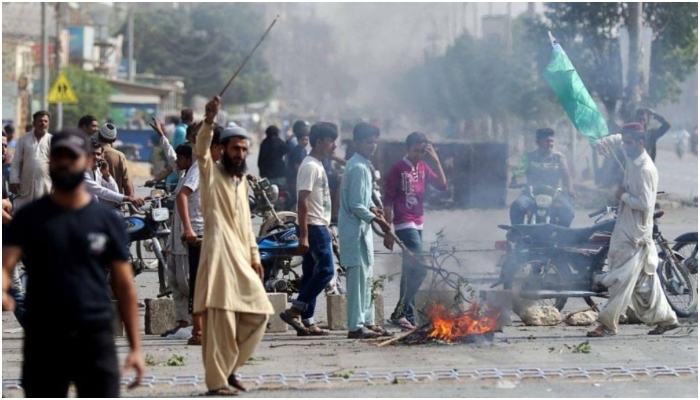
Following this incident, members belonging to Tehreek-e-Labbaik Pakistan (TLP) and other religious parties led a massive protest demanding that the police hand over the blasphemy aacused to them. The protesters blocked traffic on the western bypass in Quetta and burned tires on the roads blocking the movement of the vehicles. The protesters are also said to have launched a grenade attack at the Kharotabad police station.
As per the Pakistani local reports, the protesters gathered outside the Kharotabad Police Station, and raised slogans against the arrested accused. They also demanded that the police hand over the accused to the public. Meanwhile, some of the miscreants launched a hand grenade attack on the Police station. However, it landed a few meters away from the location, resulting in no injury or loss of life.
“We have registered an FIR under sections 295C and 34 of the penal code against the blasphemy suspect and arrested him soon after receiving information about the incident,” a senior police officer said. Following discussions with TLP leaders, officials from the district administration and senior police officers were able to disperse the crowd and reopen the western bypass.
The TLP later held protest rallies in other districts of Quetta, marching along several highways with placards and banners bearing their demands.
It is crucial to note that last month, a mob of thousands, protesting in Pakistan against Supreme Court Chief Justice Qazi Faez Isa, raised slogans of ‘Sar Tan Se Juda’ after Isa ordered the release of a Ahmadiyya man Mubarak Sani. Sani was accused of blasphemy in 2019 over distributing pamphlets promoting his religious beliefs. He was convicted under the Punjab Holy Quran (Printing and Recording) (Amendment) Act, 2021, however, the 3-judge bench led by Justice Isa noted that Sani was charged for an offense not criminalised until 2021. Consequently, the top court granted bail to Sani and ordered his immediate release.
Mubarak Sani – ahmediya muslim of pakistan – was arrested for blasphemy. His crime – distributing pamphlets propagating ahmediya islam. supreme court of pak today said non-muslims (like ahemdiya muslims!!) have the right to do so. Zombies attack pak sc. pic.twitter.com/QKRgK1xal3
Soon after, the TLP and other Islamists launched a hate campaign against Qazi Faez Isa. In Peshawar, around 3000 people blocked the roads in February and raised slogans like “Death to Qadianis” etc. The agitation of Islamists compelled the Supreme Court to issue a statement ‘defending’ its decision in the Mubarak Sani case. The TLP members also placed a bounty of 1 crore Pakistani rupees on Judge Isa’s head.
It must be noted that blasphemy allegations have been used as a weapon by Islamists to attack people, especially non-Muslims, in Pakistan. From Arabic calligraphy to QR-code, or the non-Muslims practicing their faith, anything can offend these Islamists who then resort to violent protests, giving ‘Sar tan se juda’ calls, mob lynching etc.
In a shocking revelation, the National Commission for Protection of Child Rights (NCPCR) has submitted before the Supreme Court of India that the education system in madarsas in India is fundamentally flawed. The commission added that the madarsas violate children’s right to education as mandated by the Constitution of India. According to NCPCR, “madarsa education severely inhibits the right to education of children in India and has no constitutional basis to subsist in terms of the Right to Education Act or under Article 21A of the Constitution.”
Darul Uloom Deoband’s influence: A pathway to extremism?
In its submission, NCPCR exposed the deep-rooted influence of Darul Uloom Deoband over madarsas. The commission described it as a “school of thought with a very strict and conservative interpretation of Sharia.” The NCPCR further stated that “it has also been alleged by Taliban extremist groups to have been influenced by the religious and political ideologies of Darul Uloom Deoband, which has a looming presence in the madarsas.” The assertion made by the Children’s Rights Commission raised concerns over the potential radicalisation of the students in madarsas.
Children deprived of formal education and basic rights
The commission pointed out that the children who study in madarsas are deprived of their fundamental rights under the Right to Education Act (RTE), 2009. They do not get access to standardised education, mid-day meals, and trained teachers. The commission highlighted, “In the absence of the RTE Act, the students studying in madarsas are also deprived of the facilities and entitlements which are provided to students studying in regular schools.” Furthermore, the NCPCR added that there is a serious issue of corporal punishment at the madarsas. The children are being taught about the supremacy of Islam, and there have been instances of sexual assault against minors within the madarsa premises.
The commission said that being minority institutes, madarsas enjoy exemptions that violate, “the fundamental right to equality before the law (Article 14); prohibition of discrimination on the grounds of religion, race, caste, sex or place of birth (Article 15(1)); that children are given opportunities and facilities to develop in a healthy manner and in conditions of freedom and dignity and that childhood and youth are protected against exploitation and against moral and material abandonment (Article 39(f)) and also interrupts the State’s responsibility under Article 13 (2) to not make any law which takes away or abridges the rights conferred under the fundamental rights and any law made in contravention of this shall, to the extent of the contravention.”
Non-Muslim students in madarsas: A case of religious coercion
Another shocking exposé by NCPCR suggested that a significant number of non-Muslim students were found to be enrolled in madarsas, which violated Article 28(3) of the Constitution of India. The revelation, combined with the assertion that these institutes promote Islamic teachings, suggests that these Islamic institutes violate Section 75 of the Juvenile Justice Act 2015. The NCPCR argued that “keeping children from professing any other religion apart from Islam shall amount to a violation of Section 75 of the Juvenile Justice Act 2015.”
Objectionable content in curriculum: Promoting extremist views
The NCPCR also took cognisance of the books prescribed in madarsas through fatwas issued by Darul-Uloom-Deoband. One fatwa declares that “Taqwiyat-ul-Iman is an authentic book,” a text known for its rigid views on Islam. The commission found that some of the madarsa teachings include text that talks about the supremacy of Islam, which fuelled concerns about indoctrination. Furthermore, NCPCR found out that certain books used in madarsas contain guidance on inappropriate relationships with minors. This raises several ethical and legal concerns regarding the madarsa education system.
The commission said, “The Commission has been in receipt of complaints regarding the fatwas issued by Darul Uloom Deoband, which contained references from a book titled ‘Bahishti Zewar’. It is pertinent to mention here that the said book contained content which is not only improper but is also objectionable and illegal regarding children, as the same contains text regarding engaging in a sexual relationship with a minor. The book is also alleged to be taught to children in madarsas, and further fatwas containing such objectionable information are accessible for all.” The book was removed from Darul Uloom Deoband’s website after notice from NCPCR in 2023.
The commission pointed out that a fatwa regarding ‘Ghazwa-e-Hind’ was also found to be part of the website of Darul Uloom Deoband. The NCPCR said, “The Commission has also taken cognizance of another objectionable content on the website of Darul Uloom Deoband wherein a fatwa talks about the invasion of India (Ghazwa-e-Hind) and how whoever will be martyred in it shall be a great martyr.” NCPCR said that being an educational body, issuing such fatwas exposes “children to hatred against one’s own country and eventually causing them unnecessary mental and physical suffering.”
Constitutional misuse and lack of oversight
The commission pointed out that Article 29(2) of the Constitution is being misused by madarsas to justify their practices. The commission said, “Madarsas serve as the primary institutions for teaching Islamic studies is undeniable.” NCPCR contended that this exemption does not align with the broader constitutional obligation to provide children with a balanced and formal education, accusing these institutions of operating “under the veil of Article 29(2) of the Constitution of India.”
Judicial review sought to correct “grave misconduct”
The NCPCR challenged the actions of Anjum Kadri, who filed the petition before the Supreme Court of India against the judgement by the Allahabad High Court where it struck down the Uttar Pradesh Board of Madrasa Education Act 2004. The commission said that the Act stood against the principles of secularism and the constitutional mandate of Articles 14, 21, and 21A.
Notably, the High Court’s judgement was stayed by the apex court bench led by CJI DY Chandrachud, saying that though there was a legitimate interest in ensuring quality education, the remedy was not to strike down the Act.
On Wednesday, 11th September, a special court in Uttar Pradesh that heard cases of the National Investigation Agency (NIA) and UP Anti-Terror Squad (ATS), awarded life sentences to Maulana Umar Gautam and 11 others. These accused persons had been convicted for carrying out over 1,000 illegal religious conversions. Apart from them, 4 others, Rahul Bola, Abdul Mannan alias Munnu Yadav, Mohd Atif alias Kunal Ashok Choudhary, and Mohd Salim were convicted by the Lucknow court on Tuesday, 10th September. They were each awarded 10 years of prison sentence.
Those who have been awarded life sentences have been identified as key accused Umar Gautam, Arshan Mustafa alias Bhupriya Bando, Adam alias Prasad Rameshwaram Kovere, Mufti Qazi Jahangir Qasmi, Kaushar Alam, Faraz Babullah Shah, Irfan Sheikh, Salahuddin Zainuddin Sheikh, Dheeraj Govind, Mohd Kaleem Siddiqui, Mohd Salim, Sarfaraz Ali Jafari, and Abdullah Umar.
They have been convicted under sections 417 (cheating), 153-A (promoting disharmony, enmity, or feelings of hatred between people on religious grounds), 153-B (making or publishing statements that promote disharmony on religious grounds), 295A (deliberate and malicious acts that are intended to outrage religious feelings by insulting a religion or religious beliefs), 121 (conspiring to overawe, using criminal force, the central government or any state government), 123 (concealing facts with intent to facilitate design to wage war) of the Indian Penal Code, and also under other relevant sections of the Uttar Pradesh Prohibition of Unlawful Conversion of Religion Act.
#WATCH | Lucknow: Uttar Pradesh DGP Prashant Kumar says "On June 20, 2021, a case was registered in connection with illegal religious conversion. Two people were named in it, namely Mohammad Umar Gautam and Mufti Jahangir Alam Qasmi, who used to run an Islamic Da'wah Center in… pic.twitter.com/igXWWlHXdP
The sentences were pronounced by NIA/ATS court judge Vivekanand Saran Tripathi following debates about the magnitude of punishments. The attorney said that all 16 prisoners were taken before the court from the Lucknow district jail around 12.30 pm on Wednesday, September 11, and the quantum of the sentence was pronounced at 4.45 pm. He stated that all prisoners were transferred to jail in judicial custody once the quantum of punishment was determined.
As per the reports, the judge mentioned that the criminals’ time in jail would be included in their sentencing. The court further ordered that compensation of Rs 2 lakh each shall be given to the victims of forced religious conversions.
Vulnerable women and specially abled children were the target of Umar Gautam
The prosecution counsel stated that the ATS had charged 17 people in the case, but the legal proceedings against one of the accused, Idris Qureshi, were delayed by the Lucknow bench of the Allahabad High Court, after which his file had been separated and the matter involving him remains pending.
The counsel further said that on June 20, 2021, the ATS disrupted the forced conversion scheme by arresting Umar Gautam, head of the Islamic Da’wah Centre based in Delhi’s Batla House, and Mufti Kazi Jahangir Kasmi, an employee of the center. He stated that 15 others, including Umar Gautam’s son Abdullah Umar, were apprehended during the subsequent inquiry.
Notably, the ploy, which involved the conversion of specially-abled children and other disadvantaged individuals to Islam, was allegedly supported by multinational organisations, including Pakistan’s spy agency, ISI. According to the ATS, nearly 1,000 persons were unlawfully converted in two years before the operation was exposed in June 2021.
⚡⚡BREAKING ⚡ ⚡ A special NIA-Anti-Terrorist Squad (ATS) court in Lucknow sentenced 12 individuals, including Islamic preacher Maulana Kaleem Siddiqui and Islamic Da'wah Centre founder Mohammed Umar Gautam, to life imprisonment for their involvement in an illegal religious… pic.twitter.com/nGm3n860As
According to a top ATS official, Umar Gautam targeted vulnerable people by telling them how he converted to Islam from the Hindu Thakur caste. ATS official said that Gautam used to highlight caste prejudice in religion to persuade his audience. The authority stated that the convicts also promised individuals employment if they converted to Islam.
The ATS, during the investigation, recovered a list with names of 31 non-Muslim girls who fell into the conversion trap and most of these girls belonged to the rural areas. Upon questioning, the accused confirmed to the ATS officials that it was easier to brainwash girls living in villages into embracing Islam. They said that these girls are mostly uneducated and belong to lesser privileged families, so it becomes easier to lure them with jobs and financial aid, which was what Umar Gautam exactly did to lure his targets into embracing Islam.
According to ATS, as many as 12 out of the 31 girls who had fallen into the conversion trap were from rural areas. Besides belonging to rural areas in Uttar Pradesh, some women belonged to villages of Jharkhand, Bihar, Uttar Pradesh, and Assam. The gang members gauged the victim’s vulnerabilities and accordingly used it to their advantage to trap the victims and convert them to Islam. Since most of these rural girls belonged to the economically backward class and were financially oppressed, they became easier targets for Umar Gautam and his cartel.
Conversion racket funded by Pakistan’s ISI
OpIndia reported earlier that Umar Gautam and Qasmi planned to first convert the hearing and speech-impaired children into Islam and then put hatred in their minds against other religions. The perpetrators brainwashed the differently-abled children into hating non-Muslims, accepting Islam, and planning to use them as suicide bombers as the scope of retaliation from such children is limited.
Amidst all these startling revelations made in the case, it was also revealed that the entire religious conversion racket was funded by some foreign organisations, including Pakistan’s ISI. In fact, many victims’ families had come forward to narrate how they fell prey to this mass religious conversion racket. The father of a victim named Manu Yadav had alleged that he received a threatening call on his son’s mobile number from Pakistan asking him not to create hindrance in the conversion of his son.
Mohammad Umar Gautam was earlier known by the name of Shyam Prasad Singh Gautam
Notabl, Umar Gautam was earlier a Hindu and was known by the name of Shyam Prasad Singh Gautam. He had shunned his faith in Hinduism and embraced Islam. Born in 1964 in a regal Rajput family from Fatehpur, Shyam Prasad Singh Gautam is a distant relative of former Indian Prime Minister V P Singh. In 1984, Gautam met one Nasir Khan in his neighbourhood in Pratapgarh, who played a key role in Gautam’s conversion to Islam. During that time, Gautam had met with an accident and could not go to college. Khan helped Gautam in attending classes. He also took Umar Gautam to a hospital and brought meals for him from his mess.
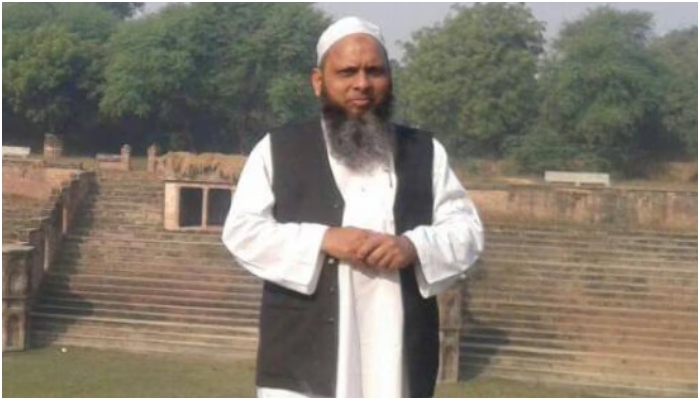
This man, Mohd Umar Gautam, convicted today for forced conversion of physically challenged children
Born into a Hindu family, he converted to Islam over fear of hellfire, in his own words
Khan, being a devout Muslim, provided books and scriptures on Islamic beliefs to Gautam. Gautam diligently read all the books provided by Khan, which also included books on the Prophet Muhammad, Islamic hadiths, and other doctrines. In 1986, two years after he met Khan, Gautam renounced his Hindu faith and converted to Islam.
Soon after he embraced Islam, he converted his wife and later his mother. From there, started his inexorable quest to convert others to Islam. It is believed that Gautam used every possible means to manipulate his victims to bring them into the fold of Islam in the given case.
The Jeddah chapter of the Aligarh Muslim University, in 2018, felicitated Mohammad Umar Gautam with an award for propagating Islam. “In recognition of his ongoing extraordinary contribution and continued work in spreading Islam with full devotion and steadfastness,” the memento awarded to Gautam for his efforts to convert people into Islam read.
AMU rewards Mohammad Umar Gautam
Notably, Gautam’s name has also appeared in the case of conspiracy to assassinate Dasna Devi Temple chief Yati Narsinghanand Saraswati. A detailed report on this case can be read here.
ED filed a case based on ATS investigation
UP ATS had initially filed an FIR in an illegal religious conversion case in June 2021. The authorities later arrested Siddiqui in Meerut following an investigation in September of that year. ATS stated that the arrested individual operated the country’s largest conversion syndicate and that he managed a trust through ‘hawala’ donations.
ATS further stated that Rs 1.5 crore was fraudulently donated from Bahrain and Rs 3 crore from other Gulf countries for this purpose. Kaleem helped Umar and Mufti Qazi with conversion work at the Islamic Da’wah Centre (IDC). Umar and Mufti were arrested in 2021 by the ATS. Maulana Kaleem also established a trust named Waliullah, which undertakes illegal conversion activities under the guise of operating social harmony initiatives around the country.
On the 11th of September afternoon, a patient at Secunderabad’s state-run Gandhi Hospital attacked a woman junior doctor. Hospital employees and others got hold of him and then turned him over to the police who stated that the patient was being examined and a case had been registered. According to the Gandhi Junior Doctors Association (JUDA), the woman intern was “assaulted” by an intoxicated patient when she was working in the hospital’s casualty department at around 3:30 pm, causing major concerns about their safety. The man is reportedly mentally unstable.
The doctor informed the superintendent of the facility right away. The Chilkalguda police apprehended the accused who is from Musheerabad after the hospital staff notified them. Chilkalguda inspector A Anudeep said, “He is suffering from seizures. Even after bringing him to the police station, he continued to have seizures. We are in the process of examining him.” The entire incident was recorded on the camera. The footage revealed that he abruptly lunged at the house surgeon who was attending another patient, grabbed her hand and held her by the apron as she was passing by. Several patients and hospital staff were present when the incident occurred. They moved swiftly to try to stop him save the victim. The perpetrator was being treated at the institution for the past three days.
A patient undergoing treatment at Gandhi Hospital allegedly misbehaved and assaulted a female junior doctor
He was roughed up by hospital staff and others and handed over to police. Police said that the patient is being examined and they are in the process of registering a… pic.twitter.com/02F3HZQjFL
“In response, the superintendent assured that both a police and an institutional FIR will be filed without delay to address the situation appropriately,” a statement released by JUDA read. The JUDA fiercely opposed the occurrence and demanded prompt as well as firm action to guarantee the protection and safety of all interns and medical personnel. The group added that they had reported the incident to the superintendent of Gandhi Hospital and called for a thorough inquiry into the matter as well as measures to prevent similar incidents in the future.
“The Gandhi JUDA condemns the assault and calls for swift and decisive action to ensure the safety and security of medical staff and interns. The association demands a thorough investigation into the incident and measures to prevent such incidents in the future,” the association further stated in the press release.
Dr. M Vamshi Krishna, vice-president of the Telangana Junior Doctors Association (T-JUDA) unveiled, “The patient was in a delirious state (confused mental condition), and in the struggle to escape from him, the doctor’s apron was torn. Security personnel arrived soon after, prompting the patient to attempt to flee, but he was apprehended by Special Protection Force (SPF) personnel stationed at the main gate.”
She disclosed that the casualty ward security guards were stationed close to the door, checking in new patients and attendants, which caused a few minutes’ delay in their response. The patient was nabbed and given over to the police at the on-site outpost and Chilkalguda police were contacted.
According to a senior police officer, the offender was accused of grasping and acting inappropriately toward the female intern after being committed to the hospital by his family. He mentioned that a police team learned about the occurrence over ‘Dial-100’ and arrived at the hospital. The individual was turned over to the police by hospital security. The First Information Report has been launched based on the complaint. The issue is under inquiry and further legal action is underway.
On 11th September, communal clashes erupted in the Mandya district of Karnataka after stones were pelted at the Ganesh idol near a dargah in Nagamangala town on Mysuru Road.
According to reports, some Hindu youths were taking out a procession for the immersion of the Ganesh idol in Badarikoppalu village. When the procession was about to cross a dargah on Mysuru Road, people from the Muslim community came and started a heated argument with the Hindu devotees. Following the altercation, members of the Muslim community allegedly pelted stones at the Ganesh idol and displayed lethal weapons. According to a News18 report, slippers were also thrown at the idol.
Stone pelting during Ganesh immersion procession in Nagamangala, Mandya by Muslims objecting that Ganesha procession shouldn’t go in a particular road.
Members of the Hindu community became angry at the attack and approached the police seeking justice. They kept the Ganesh idol in front of the police station and staged a massive protest. As more people learned about the incident, they reached the police station and joined the protest, demanding permission to take out a procession on Mysuru Road.
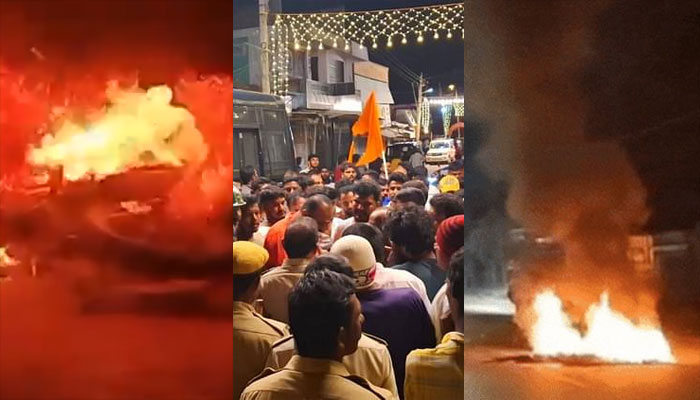
Following the incidents, some miscreants set shops owned by Hindus on fire. Several shops were ransacked. Bikes and other vehicles parked on the side of the roads were also damaged and burnt.
In a #CONgress-ruled state, Hindus can't even carry out a peaceful Ganesh Procession without facing violence and attacks.
Muslim youth heavily pelted stones at the Ganesh Procession in Mandya district of Karnataka.
Speaking to India Today, Mandya Superintendent of Police (SP), Mallikarjun Baladandi, said, “There were arguments between members of the two communities over this. Police intervened and tried to disperse the crowd. Due to the large number of people, the police had to resort to lathicharge to control the situation. Following that, people protested in front of the police station. Members of the other community also gathered in large numbers and started throwing stones. They even torched a few bikes and shops on the roadside.”
The situation in the area became tense, and Section 163 of Bhartiya Nagarik Suraksha Sanhita (order issued in urgent cases of nuisance or apprehended danger) has been imposed. Additional forces were deployed to manage law and order.
Tensions escalated during the Ganesh Utsav procession in Nagamangala, Mandya district, Karnataka, when a group of Muslim youth allegedly pelted stones at the procession. This led to a violent response, with several shops and vehicles being burned and vandalized. Reports indicate… pic.twitter.com/RckBXdEeHW
SP Baladandi added that the situation was “completely under control” and “We have sufficient police forces, and fire engines are at the spot. No one suffered major injuries; only a few sustained minor injuries.”
Union Minister HD Kumarswami condemned the violence that took place in Mandya, Karnataka. In a post in Kannada, he said, “I strongly condemn the incident that occurred during the Ganesh immersion procession in Nagamangala, Mandya district. Miscreants from a particular community deliberately instigated violence by targeting devotees who were peacefully participating in the Ganapati procession. They threw stones, sandals, and petrol bombs at the public and police and brandished swords, demonstrating a blatant failure of law and order in the town.”
ಮಂಡ್ಯ ಜಿಲ್ಲೆ ನಾಗಮಂಗಲದಲ್ಲಿ ಗಣೇಶ ವಿಸರ್ಜನೆ ವೇಳೆ ನಡೆದಿರುವ ಘಟನೆಯನ್ನು ನಾನು ಉಗ್ರವಾಗಿ ಖಂಡಿಸುತ್ತೇನೆ. ಗಣಪತಿ ದೇವರ ಮೆರವಣಿಗೆಯಲ್ಲಿ ಶಾಂತಿಯುತವಾಗಿ ತೆರಳುತ್ತಿದ್ದ ಭಕ್ತರನ್ನು ಗುರಿ ಮಾಡಿ ಒಂದು ಸಮುದಾಯದ ಪುಂಡರು ಉದ್ದೇಶಪೂರ್ವಕವಾಗಿಯೇ ದಾಂಧಲೆ ಎಬ್ಬಿಸಿ ಸಾರ್ವಜನಿಕರು-ಪೊಲೀಸರ ಮೇಲೆ ಕಲ್ಲು, ಚಪ್ಪಲಿ ಎಸೆದು ಪೆಟ್ರೋಲ್ ಬಾಂಬ್…
— ಹೆಚ್.ಡಿ.ಕುಮಾರಸ್ವಾಮಿ | H.D.Kumaraswamy (@hd_kumaraswamy) September 11, 2024
He added, “When these miscreants continue to oppress those who were peacefully protesting in front of the police station seeking protection, it raises serious concerns about where we stand. The failure of local police is also evident here.”
“The @INCKarnataka party and the state government, in their political self-interest, have excessively appeased a specific community, leading to this heinous incident in Nagamangala. Such appeasement politics must stop. If it doesn’t, tough times are not far for the Congress party. I earnestly appeal to the public to maintain peace. The government must take immediate action to restore peace in the town. Moreover, if the police misuse this incident to display arrogance against the leaders and workers of the opposition parties, it will not be tolerated,” he further said while attacking the Congress-led Karnataka government.
Nagamangala will observe a bandh on 12th September. The bandh call has been issued by the Vishwa Hindu Parishad (VHP) and Bajrang Dal.The bandh was announced by Mahesh, the Taluk Secretary of Bajrang Dal.
Attack on Hindus during Ganeshotsav
The attack on Ganesh Idol in Mandya was not the first incident of attack on Hindus during Ganeshotsav this year. On 11th September, it was reported that stones were pelted on Ganesh Mandap in the Kutch village of Nakhatrana. Muslim children were reported to have been used to execute the conspiracy due to which the idol of Lord Ganesha was vandalised. Seven people including Hussain, Asif, Sahil were arrested.
On 10th September, Rubyna Irfan Pathan and Laima Salim Shaikh were arrested for breaking the idols of Lod Ganesh in the Soni Bazar area of Athwa, Surat. It is believed that the two women also incited their children to break the idols.
On the night of 10th September, tensions mounted in Bharuch when Hindus and Muslims came face to face after members of the Muslim community forcefully installed Islamic flags and pylons atop Hindu houses during the Ganesh Chaturthi celebration.
On 6th September, Hindu youths carrying an idol of Bhagwan Ganesh were attacked by Islamists in the Mundra area of Kutch district, Gujarat.
On 7th September, miscreants pelted stones at a Bhagwan Ganesh idol in Mochipura of Ratlam district in Madhya Pradesh.
On 7th and 8th September, stones were pelted at a Ganeshotsav pandal in the Lal Gate area of Surat, Gujarat. As per reports, some Muslim minors pelted stones at the pandal, leading to hundreds of Hindus protesting and demanding strict action. The police swiftly swung into action and made some arrests. Security has been increased in the area.
A blast has been reported in Chandigarh’s Sector-10 at around 6:03 pm on 11th September. According to the available information, three miscreants came in an auto-rickshaw and threw a grenade at House number 575. No injury has been reported as all the family members were inside the house. The grenade blasted into the bungalow’s verandah and created a 7-8 inch crater, damaging the glass windows in the house.
The bungalow targeted in this incident belongs to a Retired Principal. According to an Aaj Tak report, the house owner is Ramesh Malhotra. However, earlier the house was occupied by a retired SSP of Punjab Police, who is suspected to be the target of the attack.
The entire chain of events has been caught on CCTV cameras installed in the bungalows in this posh locality. In the CCTV footage, an autorickshaw is seen coming from the spot moments after the blast. Before that, a man can be seen running from the house and sitting in the auto. It is suspected that suspects were in the auto-rickshaw who threw the grenade towards the bungalow.
It is said that there were three people in the auto. Glasses of windows of the house shattered due to the blast.
Chandigarh के सेक्टर-10 में एक कोठी के अंदर हैंड ग्रेनेड फेंका गया है। ब्लास्ट हुआ है। आवाज दूर तक सुनाई दी। कोई घायल नहीं हुआ क्योंकि सभी लोग घर के अंदर थे। मौके पर पुलिस तैनात है।
चंडीगढ़ में कई वर्षों बाद ऐसे ग्रेनेड से हमला हुआ है।
Following the incident, police’s bomb squad, dog squad, and NIA teams rushed to the spot and are investigating the matter. As per initial reports, Police are suspecting gangster-terror angle in this incident. They have pictures of two suspects who are believed to be involved in this incident. According to the agencies, some foreign group may be involved in this incident.
According to Aaj Tak report citing sources, the family who are currently living in this bungalow were not the target, rather the miscreants reportedly wanted to target a person who was living in this bungalow before them. It seems that the attack was hatched earlier and the one executing it carried out after a long time before the earlier resident left the bungalow.
The report added that earlier the family of a retired SSP of Punjab Police used to reside in this bungalow. It is reported that a few months ago, they had received intelligence about a threat from gangsters. However, by the time the Rinda gang planned the attack, the family of the retired SSP had left from here.
SSP Kanwardeep Kaur said that it was a pressure blast which damaged flower pots and glass windows. The family has told that two people came in an auto. They carried out this incident.
SSP said that at the time of the blast, the family was sitting in the verandah. They have seen the auto rider and the accused who hurled the grenade at their house. Police are gathering information about the tenants living in the house and those who lived there before.
The Union Cabinet has approved a programme called ‘Mission Mausam’ to create “a more weather-ready and climate-smart Bharat” with an outlay of Rs.2,000 crore over two years
The mission’s focus will include improving observations and understanding for providing highly accurate and timely weather and climate information across temporal and spatial scales, including monsoon forecasts, alerts for air quality, extreme weather events and cyclones, weather interventions for managing fog, hail, and rain,capacity building and generating awareness.
To be implemented by the Ministry of Earth Sciences, it is aimed at boosting India’s weather and climate-related science, research, and services.
“It will help to better equip stakeholders, including citizens and last-mile users, in tackling extreme weather events and the impacts of climate change,” an official release said.
The ambitious program will help broaden capacity and resilience across communities, sectors, and ecosystems in the long run.
As part of the Mission Mausam, India will exponentially expound research and development, and capacity in atmospheric sciences, especially weather surveillance, modelling, forecasting, and management.
By integrating advanced observation systems, high-performance computing, and cutting-edge technologies like artificial intelligence and machine learning, Mission Mausam will set a new benchmark for predicting weather with high precision.
Critical elements of Mission Mausam will include the deployment of next-generation radars and satellite systems with advanced sensors and high-performance supercomputers, the development of improved Earth system models and a GIS-based automated Decision Support System for real-time data dissemination.
Mission Mausam will directly benefit numerous sectors, such as agriculture, disaster management, defence, environment, aviation, water resources, power, tourism, shipping, transport, energy, and health. It would also enhance data-driven decision-making in areas such as urban planning, road and rail transport, offshore operations, and environmental monitoring.
Three institutes of the Ministry of Earth Sciences: the India Meteorological Department, the Indian Institute of Tropical Meteorology, and the National Centre for Medium-Range Weather Forecasting will primarily implement Mission Mausam.
These institutions will be supported by other MoES institutions (Indian National Centre for Ocean Information Services, National Centre for Polar and Ocean Research, and National Institute of Ocean Technology), along with collaborating national and international Institutes, academia and industries, furthering India’s leadership in weather and climate sciences and services, the release said.
(This news report is published from a syndicated feed. Except for the headline, the content has not been written or edited by OpIndia staff)