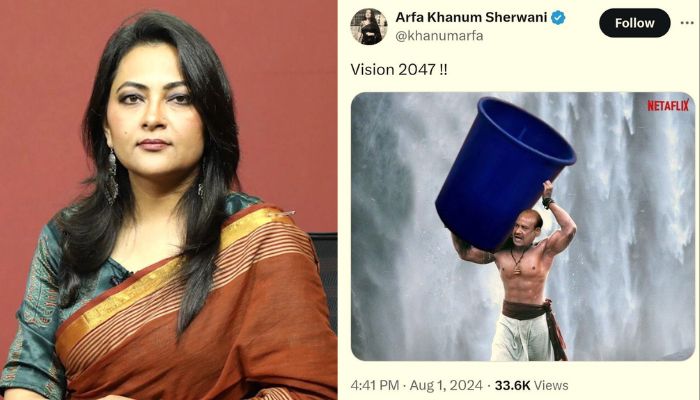
A police complaint has been lodged against far-left propaganda portal The Wire’s Arfa Khanum Sherwani for her Hinduphobic post that insulted Shivling.
X handle Legal Hindu Defence, a volunteer legal group that champions the rights of Hindus and extends legal help to Hindus hounded for expressing their opinions online, shared a police complaint filed against Ms Sherwani that has the potential of sparking violence and creating unrest in the society.
शिवलिंग का अपमान करने वाली आरफ़ा बेगम के ख़िलाफ़ @legalhindudef का परचम लहराएगा ??
“The statement of the accused can create civil unrest in the society. The statements of the accused stand false prima facie which were reiterated even after the knowledge with the intention to disturb public peace. This promotes enmity amongst public groups,” the complaint read, adding that offences under sections 352, 353(2), and 293 of Bhartiya Nyay Sanhita, 2023, have been committed.
Arfa Khanum shares Hinduphobic post to mock the new parliament; deletes the tweet later after massive backlash
On Thursday (1st August), Arfa Khanum Sherwani of The Wirestirred the hornet’s nest after she resorted to brazen Hinduphobia to settle political scores.
In a tweet, she wrote, “Vision 2047.” The propaganda artist used the iconic poster from the 2015 movie ‘Baahubali: The Beginning’ wherein the male protagonist Shivudu (played by Prabhas) is seen lifting a giant Shivling using his bare hands.
Arfa Khanum not only replaced the picture of Prabhas with Lok Sabha Speaker Om Birla but went a step ahead to desecrate the sacred Hindu representation of Lord Shiva.
Arfa Khanum Sherwani shares an iconic pic from movie Baahubali, with Shivling replaced with a dustbin
The senior editor of the leftist propaganda portal, The Wire, replaced the Shivling with a dustbin. Arfa Khanum Sherwani had no qualms about vilifying the Hindu Faith and hurting the religious sentiments of a billion Hindus.
This is however not the first time that she has deliberately mocked Hindu beliefs. In the past, the propaganda artist had shared derogatory cartoons showing Lord Ram persecuting a Dalit man.
Arfa Khanum Sherwani had also posted provocative tweets, making ‘gaumutra’ and ‘gobar’ jibes. For the unversed, these terms were mainstreamed by Pulwama attacker and Jaish-e-Mohammed (JeM) terrorist, Adil Ahmed Dar. to dehumanise the Hindu community.
Interestingly, Arfa Khanum Sherwani was seen dog-whistling against former BJP spokesperson Nupur Sharma in 2022 after she quoted Hadiths to point out the relationship between Prophet Muhammad and his wife Aisha during a TV debate.
The senior editor of The Wire had not only attempted to provoke Indian Muslims against Nupur Sharma but also sought legal action against her.
“A national spokesperson of the ruling party BJP uses the most derogatory words for the Prophet of Islam on national television. He is my Prophet and the Prophet of 200 million Indian Muslims,” she tweeted on 28th May 2022.
The propaganda artist further added, “Strictest punishment should be given to her as per the law of the land.”
On the 31st of July, the Bombay High Court quashed an FIR lodged in 2018 against a 73-year-old man who was accused of raping a woman on the false promise of marriage. The High Court bench comprising Justice A.S. Adhikari and Justice Neela Gokhale stated that the parties had been in a sexual relation for up to 31 years and that the complainant had never spoken up about her apparent opposition to the relationship.
The High Court said this while hearing an application under Section 482 of the Criminal Procedure Code of 1973 seeking the quashing of an FIR filed against the 73-year-old applicant Lalchand Sirumal Bhojwani for offences punishable under Sections 376, 420, and 506 of the Indian Penal Code of 1860.
“In the past 31 years, she has willingly and knowingly participated in the relationship with the Applicant,” the court said.
Notably, the complainant woman who worked at the applicant’s company had claimed in 2018 that the applicant had called her to the office on a holiday and raped her. She claimed that the applicant raped her for 30 years on the false promise of marrying her. She further alleged that the accused threatened to defame her if she married someone else. The complainant accused the applicant of deceiving her by making false promises of marriage only to have a sexual relationship with her.
The court, however, observed that the complainant was aware of the applicant’s marriage and still stayed in a relationship with him. Also, the applicant never promised to divorce his first wife to marry the complainant.
“She is adult enough to know that the law forbids a second marriage and there is no allegation in the complaint that, the Applicant promised to divorce his first wife and then marry her. Even otherwise, this would purely be wishful thinking on the part of the complainant that the Applicant will marry her after divorcing his existing wife,” the court said.
The Court noted that she did not take advantage of the options provided to her to leave and report the matter, which supports the Applicant’s claim that the relationship was entirely consensual. The Court stated that it is a classic situation of a deteriorating relationship between the parties, followed by the complainant filing a police case. As a result, the Court ruled that the complainant’s sexual relationship with the applicant was not against her will or without her agreement, and no case of rape or cheating was established. Finally, the court dismissed the FIR and granted the application.
This, however, is not the first case wherein women have filed cases against their partners after their relationship turned sour and passed off consensual sex as rape. Notably, accusing a partner of rape after a relationship fallout, despite having consensual sex, is a complex and sensitive issue. It is thus, pertinent to take a look at such cases and what has been the opinion of Indian courts in this regard.
Consensual sex between adults does not amount to rape: What the Supreme Court said in the Deepak Gulati vs. State of Haryana case
In Deepak Gulati v. State of Haryana (2013), the woman (at that time 19-year-old) consented to sexual relations with the assumption that the accused would marry her, despite the fact that “she was conscious of the fact that her marriage may not take place owing to various considerations, including the caste factor”. The defendant served more than three years of his sentence before being acquitted by the Supreme Court.
The Supreme Court emphasised that consensual sex between adults, which happens to end in a broken relationship, does not constitute rape. It further clarified the distinction between a false promise of marriage and voluntary sex in the absence of such a commitment.
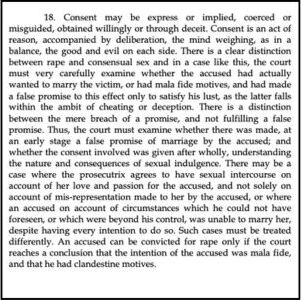
“Consent may be express or implied, coerced or misguided, obtained willingly or through deceit. Consent is an act of reason, accompanied by deliberation, the mind weighing, as in a balance, the good and evil on each side. There is a clear distinction between rape and consensual sex and in a case like this, the court must very carefully examine whether the accused had actually wanted to marry the victim, or had mala fide motives, and had made a false promise to this effect only to satisfy his lust, as the latter falls within the ambit of cheating or deception. There is a distinction between the mere breach of a promise, and not fulfilling a false promise,” the court said.
“Thus, the court must examine whether there was made, at an early stage a false promise of marriage by the accused; and whether the consent involved was given after wholly, understanding the nature and consequences of sexual indulgence. There may be a case where the prosecutrix agrees to have sexual intercourse on account of her love and passion for the accused, and not solely on account of misrepresentation made to her by the accused, or where an accused on account of circumstances which he could not have foreseen, or which were beyond his control, was unable to marry her, despite having every intention to do so. Such cases must be treated differently. An accused can be convicted for rape only if the court reaches a conclusion that the intention of the accused was mala fide, and that he had clandestine motives, the court added.
Excerpt taken from relevant SC order
Unless coercion is involved, consensual sexual relations not rape: Supreme Court in Dhruvaram Murlidhar Sonar vs The State of Maharashtra case
A widow working as an Assistant Nurse at the Primary Health Centre at Toranmal, Dhadgaon Taluq, Nandurbar District of Maharashtra had accused Dhruvaram Murlidhar Sonar who worked at the same place as a medical officer of raping her. She contended that the appellant had said that since they belonged to different communities their marriage registration would take a month. After that, she moved into the appellant’s government quarter. The duo resided together as husband and wife and had a sexual relationship. However, she claimed that the appellant did not marry her.
In this case, the Supreme Court stated that consensual physical relationships between adults cannot be deemed rape because the relationship does not culminate in marriage, given that there was no deception or coercion involved. The court noted that not on any occasion the appellant forcibly established sexual relations with the complainant.
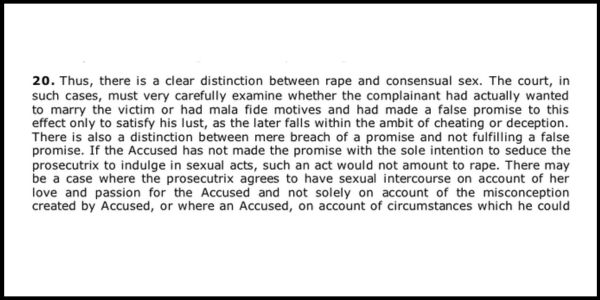
Justice Abdul Nazeer said, “Thus, there is a clear distinction between rape and consensual sex. The court, in such cases, must very carefully examine whether the complainant had actually wanted to marry the victim or had mala fide motives and had made a false promise to this effect only to satisfy his lust, as the latter falls within the ambit of cheating or deception. There is also a distinction between a mere breach of a promise and not fulfilling a false promise. If the accused has not made the promise with the sole intention to seduce the prosecutrix to indulge in sexual acts, such an act would not amount to rape.”
Excerpt taken from SC order
Uday vs State of Karnataka (2003)
In this case, the prosecutrix, who was about 19 years old, consented to sexual intercourse with the accused Uday, whom she was deeply in love with. The prosecution claimed that the prosecutrix continued to meet the accused because he promised to marry her later. The prosecutrix became pregnant and filed a case after the accused failed to marry her. The Supreme Court said that consent cannot be said to be given under a misconception of fact and emphasised that misconception of facts be examined on a case-to-case basis.
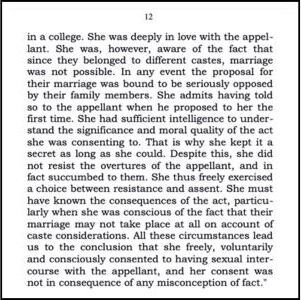
The court noted that the prosecutrix was a grown-up college-going girl and she was aware that any marriage proposal between her and the appellant Uday would be opposed by their families since they belonged to different castes. The court ruled that the prosecutrix chose to engage in a sexual relationship with the appellant and kept it secret as long as she could despite knowing that her marriage with Uday may never happen due to caste differences. The court concluded that the woman voluntarily consented to have sexual relations with the appellant.
“She had sufficient intelligence to understand the significance and moral quality of the act she was consenting to. That is why she kept it a secret as long as she could. Despite this, she did not resist the overtures of the appellant, and in fact succumbed to them. She thus freely exercised a choice between resistance and assent. She must have known the consequences of the act, particularly when she was conscious of the fact that their marriage may not take place at all on account of caste considerations. All these circumstances lead us to the conclusion that she freely, voluntarily and consciously consented to having sexual intercourse with the appellant, and her consent was not in consequence of any misconception of fact,” the court said.
Excerpt taken from Supreme Court order
When Supreme Court said that consensual sex on genuine promise of marriage cannot be called rape and filing FIR against a man in such a case amounts to harassment
In 2022, the Supreme Court ruled that it is not rape if a consensual intimate relationship is founded on a real promise of marriage that cannot be fulfilled. The bench of Justice Sanjay Kishan Kaul distinguished between “a false promise to marriage which is given with the understanding that it will be broken and a breach of promise which is made in good faith but subsequently not fulfilled.”
The court overturned an FIR filed in 2016. A woman accused the appellant of rape and cheating. They had a consensual relationship based on the man’s promise of marriage. However, the couple split up and three years later, the woman filed a complaint against the appellant. However, the court noted that the woman abused the criminal process by filing a case against the appellant adding that legal proceedings against the man would amount to harassment. Finally, the court quashed the FIR.
“The parties chose to have a physical relationship without marriage for a considerable period of time. For some reason, the parties fell apart. It can happen both before or after marriage,” the court said.
When Orissa HC said “Consensual sex cannot be called rape if marriage promise broken”
In July 2023, the Orissa High Court ruled that if a consenting physical relationship was predicated on a promise of marriage that could not be fulfilled for various reasons, it cannot be called rape. The high court dismissed a rape accusation against a Bhubaneswar resident. The complaint against him was made by a woman who had been a friend of the petitioner and has been in a marital conflict with her husband for five years.
“A sour relationship, if initially started and developed genuinely with friendship, should not always be branded as a product of mistrust, and the male partner should never be accused of rape,” the court said.
A similar verdict was given by Kerala High Court in July this year.
Whether it is on assurance of marriage or not, consensual sex cannot be deemed rape: Karnataka HC said
In June this year, the Karnataka High Court held that consensual intercourse in a relationship is not deemed rape if the relationship ends, regardless of whether it is on the pretext of marriage or otherwise. On the 28th of June, a single-judge bench led by Justice M Nagaprasanna rendered the decision while hearing a petition from a man charged with rape and cheating. In this case, the man and complainant met in 2012 at his shop and soon their friendship turned into a physical relationship. In her complaint filed in 2018, the woman claimed that the man had stopped taking her calls and was avoiding her, eventually, it turned out that he got engaged to another woman.
The accused man’s counsel, however, told the court that when the woman came to his shop in 2018, he clearly informed her that he got engaged and that he was not interested in her anymore. The accused contended that the rape complaint against him was meant to extort Rs 10 lakh from him and that he never promised to marry her, rather, it was only a consensual relationship.
“…merely because love wanes away by efflux of time, either at the hands of the complainant or the accused, it would not mean that all consensual acts done between the two could be dubbed as rape….whether it is on the pretext of marriage or otherwise, the acts between the petitioner and the respondent were purely consensual,” the court said.
“…it is an admitted fact that the petitioner and the complainant have had a physical relationship for six years. In the considered view of this court, such a relationship would not amount to rape as defined under Section 375 of the IPC as it is the case of the complainant herself that they were in love and if they were in love, every act in the six years period cannot but be termed to be consensual. In the considered view of this court, the offence under Section 376 of the IPC is loosely laid against the petitioner, which cannot be permitted to be tried,” the court added.
In a similar case, in August 2023, the Karnataka High Court dismissed two criminal proceedings brought by a woman against a Bengaluru resident alleging rape in the promise of marriage following a six-year relationship. The court called it a textbook example of exploitation of the legal system.
“It is not one, two, three, four or five, but six years of a consensual physical or sexual relationship between the petitioner and the complainant after having met through a social media platform. The complaint narrates all details. The allegation that is made later is, from 27 December 2019, the intimacy between the two waned. Fading away of intimacy after 6 years of consensual acts of sexual intercourse cannot mean that it would constitute ingredients of rape,” the court said while dismissing the criminal proceedings against the accused.
“Males cannot be singled out in voluntary sexual union”: When Calcutta HC acquitted a man accused of consensual sex with a minor girl
Back in 2021, the Calcutta High Court absolved a man booked under the Protection of Children against Sexual Offences Act (POCSO) Act, noting that a male alone cannot be indicted for an act of consensual sex between two sufficiently mature persons. The court noted that the 16-year-old girl voluntarily participated in the sexual act and she was not naive to not know about its implications.
If the union is participatory in nature, there is no reason to indict only the male just because of the peculiar nature of the anatomy of the sexual organs of different genders,” a single-judge bench of Justice Sabyasachi Bhattacharyya said.
Rape or no rape?
The above discussion makes it clear that free consent plays a crucial role in whether a sexual relationship between two individuals can be deemed rape or not. It is pertinent to understand what consent exactly means. Consent is considered free if it is granted without force, undue influence, fraud, deception, and “mistake or misconception of facts”.
Courts have frequently emphasised that consensual sex between adults performed voluntarily does not constitute rape. The Supreme Court and numerous High Courts have concluded that a broken relationship or unfulfilled marriage commitment does not automatically translate consenting sex into rape.
It is unjustified to accuse a partner of rape in the aftermath of a consenting sexual relationship. It not only weakens genuine instances of sexual violence but diminishes the gravity of the offence. False accusations have the potential to devastate people’s lives, reputations, and professions, as well as result in false convictions or lengthy legal proceedings. Using rape accusations as a revenge tactic is harassment of accused men and an attack on their dignity. Sometimes, false rape allegations are levelled to extort money.
False rape charges for personal vendetta after a relationship turns sour also perpetuate dangerous preconceptions and biases against both genders, fostering a culture of fear and suspicion in relationships. In addition to destroying the lives of the involved men, these false allegations also harm the integrity of the judicial process.
In 2017, the Delhi High Court judge Pratibha Rani observed that women tend to call their consensual physical acts as incidents of rape. “This court had observed on a number of occasions that the number of cases where both persons, out of their own will and choice, develop a consensual physical relationship, when the relationship breaks up due to some reason, the women use the law as a weapon for vengeance and personal vendetta. They tend to convert such consensual acts as incidents of rape may be out of anger and frustration thereby defeating the very purpose of the provision. This requires a clear demarcation between the rape and consensual sex especially in the case where the complaint is that consent had been given on promise of marriage,” she said while the plea filed by a 29-year-old woman alleging that her husband raped her in 2015 before their marriage.
The prevalence of fake rape charges can be understood by the fact that, according to National Crime Records Bureau (NCRB) figures, around 74% of rape cases under Section 376 of the IPC conclude with the accused being acquitted.
Entering into a physical or sexual relationship based on a promise of marriage is a serious decision that must be carefully considered. Courts have frequently ruled that consensual sexual relations cannot be considered rape if the consent was freely provided, even if the promise of marriage was later broken. It is important to note that if the accused has consistently made false promises since the beginning of the relationship only to abuse the victim and satiate his sexual desires, this is deemed rape since consent is obtained via a misinterpretation of facts.
Entering a relationship with the anticipation of marriage might have some serious emotional consequences. Suppose the relationship does not lead to marriage. In that case, it can arouse a sense of betrayal, hurt, and even disillusionment, which is sometimes used to justify filing false rape cases by terming consensual sex as rape. Couples must communicate honestly about their intentions and expectations in a relationship. Men cannot become collateral damage in an unsuccessful relationship.
Turkiye has blocked access to the social media platform Instagram, according to its national communications authority, as per a report in the Al Jazeera. The decision comes after a top government official slammed Instagram for “censoring” Hamas-related content.
In a post on its website, the communications authority said that “instagram.com has been blocked by a decision on the date of 02/08/2024”, without stating a reason.
On Wednesday, the country’s Communications Director, Fahrettin Altun, accused the social media platform of blocking condolence posts on the death of Hamas political bureau chief Ismail Haniyeh, Al Jazeera reported. Altun accused Israel of trying to plunge the region into further turmoil through killings and secret operations.
In a post on X, Altun stated, “I also strongly condemn the social media platform Instagram, which prevents people from posting condolences on Haniye’s martyrdom without giving any reason. This is a very clear and obvious attempt at censorship.”
“We will continue to defend freedom of expression against these platforms, which have repeatedly shown that they serve the global system of exploitation and injustice. We will stand by our Palestinian brothers at every opportunity and on every platform. Palestine will be free sooner or later. Israel and its supporters will not be able to prevent this,” he added.
On July 31, the Islamic Revolutionary Guard Corps (IRGC) said that Hamas Political Bureau chief Ismail Haniyeh had been killed in an attack in Iran’s capital, Tehran.
In a statement, the IRGC said that Haniyeh and one of his bodyguards were killed when their house was hit in Tehran. A projectile hit a residence allocated to war veterans in Tehran at 2 am (local time) on Wednesday, according to a Press TV report.
In a statement to Mehr News Agency, the IRGC said, “With condolences to the heroic nation of Palestine and the Islamic nation and the combatants of the Resistance Front and the noble nation of Iran, this morning (Wednesday) the residence of Ismail Haniyeh, the head of the political office of the Islamic Resistance of Hamas, was hit in Tehran, and following this incident, he and one of his bodyguards were martyred.”
The Turkish Ministry of Foreign Affairs condemned the killing of Ismail Haniyeh and offered condolences to the Palestinian people.
It accused the Israeli government of lacking intention to achieve peace. It said that the attack was aimed at spreading war in Gaza to a regional level. It further said that Turkiye will continue to support the “just cause” of the Palestinian people.
In a statement, the Turkish Ministry of Foreign Affairs said, “The Netanyahu Government’s lack of intention to achieve peace has been demonstrated once again. This attack is also aimed at spreading the war in Gaza to a regional level. If the international community does not act to stop Israel, our region will face an even greater conflict.”
(This news report is published from a syndicated feed. Except for the headline, the content has not been written or edited by OpIndia staff)
On Thursday, 1st August, Uttar Pradesh Chief Minister Yogi Adityanath launched a blistering attack on the Opposition alliance of Congress and the SP in the state legislature stating that the names of SP leaders were recently linked to the rape of an extremely backward girl in Ayodhya and the death of a lawyer in Hardoi.
He stated that the accused in the rape case is linked to the newly-elected MP, whereas the accused in the Hardoi case is a former district president of the SP who had multiple charges recorded against him between 2012 and 2017.
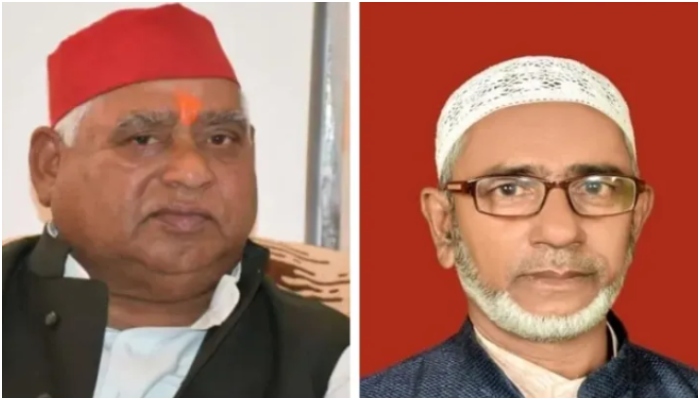
According to the chief minister, Moid Khan, an active member of the SP and a member of the Ayodhya MP’s team, was found to be involved in the rape of a 12-year-old girl. He was arrested. He stated that the accused sits, eats, and walks with the SP MP because the party has not taken action against him.
The CM stated that the unfortunate murder occurred in Hardoi this week and that the name of SP’s former district president, Virendra Yadav, has come up.
The chief minister slammed the Opposition INDI group, asking where the Rs 1 lakh bond for people had gone. He was making reference to a promise the Opposition coalition made during the Lok Sabha elections, which has since become famous as a khat-khat scheme.
“These criminals are the biggest stigma of the society, they are bacteria and need to be treated otherwise it will be difficult to improve the situation in Uttar Pradesh.” Responding to the opposition Samajwadi Party members, CM Yogi said, “You don’t want action? What will you do? Will you garland such criminals?”
ऐसे अपराधियों को माला पहनाएंगे क्या?
ये अपराधी समाज के सबसे बड़े कलंक हैं, कोढ़ हैं और इस कोढ़ को जब तक हटाएंगे नहीं, तब तक उत्तर प्रदेश की स्थिति को ठीक करने में कठिनाई होगी… pic.twitter.com/U0F6eKnXTu
He predicted the collapse of Congress and the SP in 2027.
He also slammed the Opposition alliance for allegedly promoting fiction about the Constitution’s death during the Lok Sabha elections. He inquired, “Who were the people who strangled the Constitution?” People in the Opposition had stated that if Prime Minister Narendra Modi won a third term, he would overthrow the Constitution.
“Prime Minister Modi has been in power for 10 years, has the Constitution been abolished? No! Rather the Constitution has become stronger under Prime Minister Modi,” Yogi said while he added that no one respected Baba Saheb Bhimrao Ambedkar as much as Modi did.
He stated that Prime Minister Modi had the Panch Teerths of Baba Saheb erected. Whether it is the grand memorial at his birthplace in Mhow, Madhya Pradesh, or the mansion in England where Baba Saheb Ambedkar obtained his higher education, Prime Minister Modi designated it as an India house.
He further stated that Modi created a memorial to Baba Saheb Ambedkar’s home in Delhi. He built a memorial in Nagpur, where Baba Saheb received Buddhist initiation. According to CM Yogi, Prime Minister Modi and the Maharashtra BJP administration completed the construction of a memorial at Baba Saheb Ambedkar’s Chaitya Bhoomi in Mumbai. The opposition spread rumors against him. The Congress, which defeated Baba Saheb Bhim Rao Ambedkar, is fooling the nation. Using NCRB statistics from 2016 to 2024, the CM prioritized the establishment of the rule of law.
SP’s Moid Khan arrested for gang-raping, impregnating a minor
Samajwadi Party leader Moid Khan and his servant Raju have been arrested for raping a minor girl. The victim from a laborer’s family was also blackmailed by making an obscene video of her. Police have registered a case and arrested Moid Khan and his servant Raju.
The incident took place in Purakalandar police station area of Ayodhya. Samajwadi Party leader Moid Khan has a bakery shop in the outpost area of Bhadarsa here. It is here that a laborer woman from an OBC community and her 12-year-old minor daughter live. About 75 days ago, the victim was returning after working as a laborer with her mother. Then on the way, Raju Khan, a servant working in Moid’s shop, called the victim to his shop to have toast. The girl had been coming to Moid’s shop earlier too, so she trusted him and went there.
It is being told that Raju and his owner Moid took turns to gang rape the victim in the shop. During this time, a video of rape was also made by the accused. Threats were also given to make the video viral if the incident was told to anyone. Later, after threatening her with this video, both the accused gang-raped the victim for 2 months. As a result of this, the victim became pregnant. The mother became suspicious when the girl had stomach pain. When the girl’s mother came to know about this, she asked the whole reason. The victim told the whole story to her mother. Ultimately a complaint regarding the matter was lodged with the police.
Days after three UPSC aspirants died due to drowning in the flooded basement of Rau’s IAS Study Circle in Delhi, rival coaching centres are now poaching students through ‘free education’ and monetary support for the deceased.
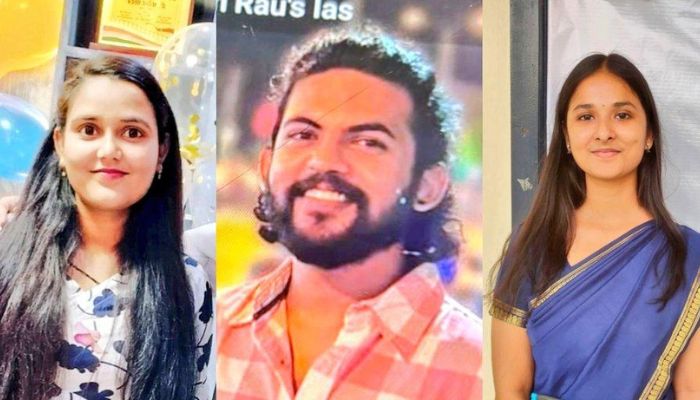
For the unversed, three young lives were lost (Shreya Yadav, Tanya Soni, and Nivin Dalwin) after it rained on 27th July in Delhi and flooded the basement of Rau’s IAS Study Circle. The coaching institute had been illegally using the basement as a library.
The three unfortunate students, who were in the basement at that time, had nowhere to escape and died due to drowning. This led to widespread protests by UPSC aspirants against the coaching institute.
In the meantime, rival coaching institutes in Delhi’s Rajendra Nagar and Mukherjee Nagar areas attempted to capitalise on the growing anger among students of Rau’s IAS Study Circle.
Some of them announced a sum of ₹10 lakhs for the families of Shreya Yadav, Tanya Soni, and Nivin Dalwin. The rival coaching centres are also poaching students enrolled at Rau’s IAS Study Circle.
On Friday (2nd August), Sriram’s IAS allowed UPSC aspirants from the Rau’s IAS Study Circle to use their classrooms and libraries. Vajiram and Ravi went a step ahead to induct students from the rival coaching centre for free.
Similar offers have been made by Drishti IAS and Next IAS, besides providing ₹10 lakh compensation to the three deceased students.
In a positive development for the scientific community, the finance ministry has reversed a customs duty hike on laboratory chemicals. The recent Union budget increased customs duty on these chemicals from 10 per cent to 150 per cent, disrupting research budgets.
On July 31, TOI reported that the customs duty on approximately 40,000 items had been raised from 10 per cent to 150 per cent.
However, late Wednesday, the finance ministry announced that all chemicals, except undenatured ethyl alcohol, intended for research and development will continue to attract only a 10 per cent customs duty.
The ministry stated that this “amendment” in the notification was made in the “public interest” and took effect on Thursday. Additionally, a penalty clause has been introduced for those attempting to import these chemicals as meant for research fraudulently. Importers are required to submit an undertaking before the deputy commissioner of customs or the assistant commissioner of customs, declaring that the imported goods will be used in laboratories or for research and development purposes and will not be sold or traded after importation. If the chemicals are found to be used for other purposes, a higher customs duty rate will be applied.
The scientific community welcomed the amendment reducing the customs duty. Government sources noted that most chemicals attract duties of 2.5 per cent, 5 per cent, 7.5 per cent, or 10 per cent. Some importers had been misdeclaring undenatured ethyl alcohol as lab chemicals to avoid the 150 per cent duty on undenatured ethyl alcohol.
To prevent this misuse, the 2024-25 budget increased the Basic Customs Duty on lab chemicals under CTH 9802 to 150 per cent. However, to address the concerns of genuine users, the Basic Customs Duty on lab chemicals under CTH 9802 (excluding undenatured ethyl alcohol of any alcoholic strength) for use in laboratories and research and development purposes has been reduced to 10 per cent.
The Hon’ble Supreme Court intervening in a state’s policy matter, staying the impugned directives issued by the SSP Muzaffarnagar Police on July 17, 2024, against the owners of the shops and eateries along the Kanwar Yatra route to display their names outside such shops, not only raises eyebrows but also escorts a way for serious constitutional disharmony.
Before getting into the legal nuances, it is imperative to note that the State of Uttar Pradesh subsequently expanded the directive statewide on July 19, 2024, and the State of Uttarakhand verbally issued an oral advisory effective July 19–20, 2024.
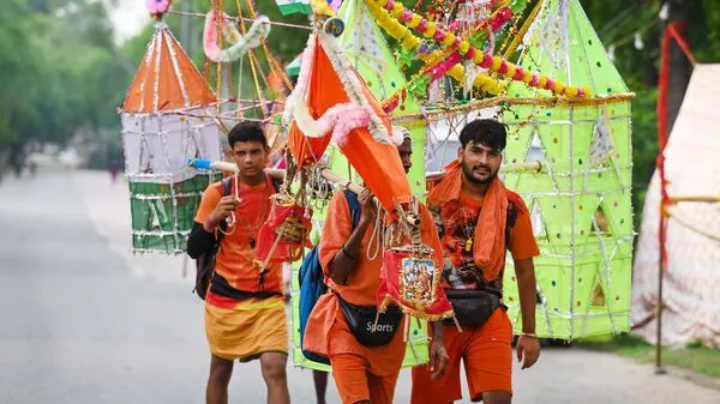
For brevity, the Kanwar Yatra is an annual revered pilgrimage where Shiva devotees, known as Kanwarias, travel to Hindu pilgrimage sites like Haridwar, Gaumukh, and Gangotri in Uttarakhand, and Ajgaibinath in Bihar. They collect holy water from the Ganges River and carry it over long distances to offer at local Shiva shrines or temples such as Pura Mahadeva, Augharnath, Kashi Vishwanath, and Baidyanath. For the most revered pilgrimage of the Hindus, Kanwar Yatra is not only symbolic of faith but also of purity. The purity further stems from the food-‘shudh shakahari’ (pure and clean vegetarian) that the Kanwariyas consume during the auspicious yatra.
Consequentially, a directive was realized necessary to promote the interests of the holy pilgrimage and was thereby issued. However, amidst the practice, the intervention in the requirement of ‘shudh shakahari bhojan’ was menaced when a stay on the same directive was imposed. The Hon’ble Apex Court was of the opinion that the requirement of displaying the names of the proprietors of the establishments and also the names of their staff would hardly achieve the intended objective.
“…If it is specifically argued that the directive without any support of constitutional or legal provisions are permitted to be enforced, it will infringe the secular character of our republic. This will also have the effect of violation of the guaranteed rights under Articles 14, 15(1), 17 of the Constitution”, the bench had further observed.
However, the order by the division bench comprising Hon’ble Justice Hrishikesh Roy and Hon’ble Justice SVN Bhatti may have ignored the fact or purposely attempted to sideline a settled provision in the Constitution of India that matters of religious concerns, public health, law and order, and are purely a subject-matter of State policy.
Moreover, it is the Apex Court that has time and again acknowledged the fact itself while refusing to intervene. For instance, a bench comprising Chief Justice DY Chandrachud and Justices JB Pardiwala and Manoj Misra while dealing with a PIL filed by advocate-petitioner Ashwini Upadhyay seeking direction to the Union and state governments to ensure that Hindus, Buddhists, Sikhs and Jains have rights similar to those of Muslims in managing their places of worship, had noted, that such a right was already guaranteed to all religious denominations under Article 25 of the Constitution. “We are not going to direct the government to do x, y or z in respect of religious places. That is entirely a matter of policy or for Parliament. It is a matter of legislative policy to design a proper law. We will not enter the legislative domain,” it had observed then.
The purpose of the directives is quite broader than what it is being put in light for. Displaying names and identifying the shop owners would help in geotagging locations. GeoTagging is the process of adding geographical identification metadata to various media because it is the duty of the State to ensure that the vendors are registered and identifiable especially when a religious event of this large scale
Furthermore, during such religious processions, the probability of communal disharmony and violence is either high or unavoidable. That is exactly when the State exclusively has to maintain law and order in the affected area. Therefore, if any directive is issued to avoid the most probable outcome or of an untoward incident which is a highly likely chance, it ordinarily should not be fiddled with by any authority, however high it might be.
The third aspect is revenue generation for the State, which is a primary concern. Ensuring food vendors comply with revenue guidelines allows the State to identify and take appropriate action against any breaches. This process not only aids in identifying the vendors but also holds them accountable. Many vendors operating along the Kanwar route are generally unregistered and thus unidentifiable, making their identification crucial for the proper functioning of the Kanwar pilgrimage. When vendors do not display boards or the proprietor’s name, it becomes more difficult for the State to manage those who violate the basic rule of law.
Fourth and the most important angle is the overreaching role that the Judiciary played in the present matter. When it ought to have reviewed, it misled itself into an adventure. Judicial adventurism peaked when the State’s initiatives were put to a halt.
Further, the directive never instructed to shut down any food shop falling in the route. The business owners who retrenched their employees as a purported consequence of the directive issued, cannot be said to be a direct and plausible interpretation of directions. The said action was not at the government’s behest and cannot be justifiably termed so.
Therefore, contrary to the postulations that it would infringe, on the guaranteed rights under Articles 14, 15(1), and 17 of the Constitution of India, the directive is not ultra vires to the spirit of the Constitution. However, what is more, concerning is the reasonable apprehension that why anything be sold under a garb. Why should penance exist for carrying out the most revered ‘yatra’? Moreover, why would the Hon’ble Supreme Court intervene in a matter that falls exclusively within the legislative domain of the State? We believe the confusion to date persists. A subject matter that purely lies with the State to legislate on, cannot be turned into shambles just by vaguely quoting the Constitution of India.
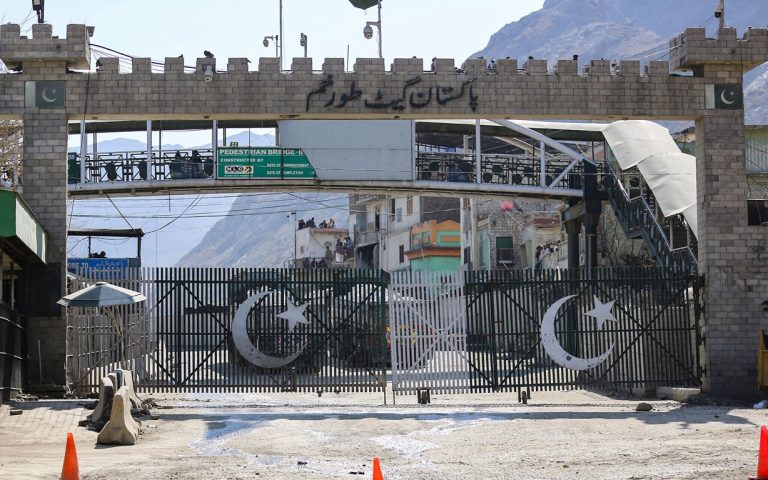
Trade has been suspended along the Pakistan-Afghanistan border at Torkham after authorities started asking Afghan cargo truck drivers for travel documents, Pakistan-based The Express Tribune reported. In response to the decision, Taliban authorities suspended all vehicular movement entering Pakistan.
Earlier in January, the Pakistani government had implemented the rules of visa and travel documents requirements, according to a customs official. However, they agreed to the Taliban’s request and placed an exemption till July 31.
Speaking to The Express Tribune, an official said, “Today, as the period of six months has expired, the Afghan side has been informed that the travel documents requirement would be reimposed from Thursday.”
He said, “Further travel into the country will not be possible without visas and passports.”
After the implementation of the rule by Pakistani authorities, the Taliban has halted the movements of cargo vehicles and suspended the trade point at Torkham until further orders are issued, according to The Express Tribune report.
A Taliban-appointed official said, “Pakistani drivers are allowed to enter Afghanistan without travel documents, while Pakistan has pushed us to halt trade activities. In protest and till further orders, all trade activities from Torkham will be suspended.”
Earlier in March, the Torkham border crossing between Afghanistan and Pakistan was closed for pedestrians after a clash between officials of the Frontier Corps (FC) and the Federal Investigation Agency (FIA), Pakistan-based Geo News reported, citing security sources.
According to sources, the fight erupted after the FC officials continued to interfere despite being told to stop. After this, the FIA immigration staff closed offices in protest, Geo News reported, citing sources.
Meanwhile, FC sources have stressed that the security of the border is their responsibility, according to Geo News report. They further said, “FC officials keep a close watch on passengers for security.”
(This news report is published from a syndicated feed. Except for the headline, the content has not been written or edited by OpIndia staff)
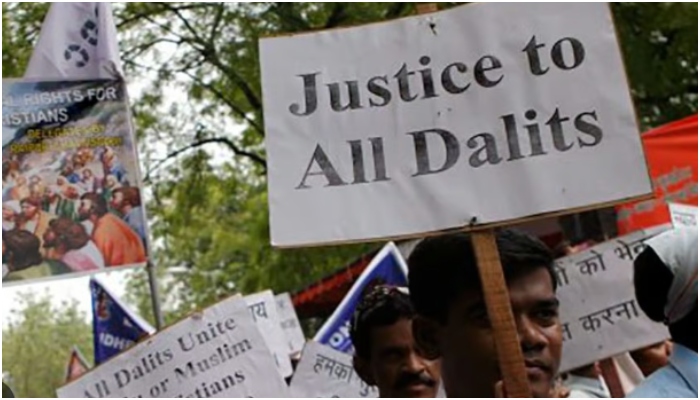
Dalit organisations have always been against granting Scheduled Caste status, and hence reservation advantages, to Dalits who have converted to Christianity and Islam. On Thursday, 1st August, several organisations in Kerala continued to protest against granting benefits to people who have converted. They were voicing their dissent at the public hearing led by former Chief Justice of India K.G. Balakrishnan’s commission, which is hearing whether Dalit converts to religions other than Sikhism or Buddhism should be granted SC status
Justice Balakrishnan, who declined to speak with the media, was joined by commission members Ravindar Kumar Jain and Sushma Yadav.
The Kerala Pulayar Maha Sabha (KPMS) maintained that converted Dalits were in a considerably better educational, financial, and social position than SC communities, and hence there was no question of including them in the 10% reserve (8% for SC and 2% for ST).
“However, we are not opposed to reservation for them, which can be established separately as was done for economically disadvantaged sections of forward communities,” KPMS added.
“Even now, meritorious groups that are still backward are not receiving full reservation benefits,” Suresh Kumar, district president, and Devaraj Devasudha, district committee member of KPMS, informed The Hindu as they came out from the hearing, which was not open to the media.
Notably, this is the second meeting held by the commission. The first hearing in this case was held in Thiruvananthapuram.
M.T. Sivan, state president of KPMS, proposed removing the Pulayar group, which he said was dominating among SCs in Kerala, from the 8% reservation for SCs, and creating an exclusive 5% reservation for the community through a constitutional amendment. “We have no problem in bestowing SC status on converted Dalits and extending them benefits under 8% reservation once this is done,” stated Sivan.
Meanwhile, Nisha Rajesh, general convener of the SC/ST Federation, stated that Dalits who sought better pastures could not be granted SC status just to receive reservation advantages. She added that it would be unfair to those who remained within the Dalit community and endured all of the persecution and hardships.
“There is a hidden political agenda behind the demand of converted Dalits for SC status. They eye to corner the benefits of Dalit political mobilisation, including candidature during elections, on account of their much better financial and official status despite the fact that there is no statistics about the population of converted Dalits,” she was quoted as saying.
According to Janardhanan KK, one of the Mahatma Gandhi Trust’s three secretaries, awarding SC status to Dalits who converted to Christianity and Islam meant they would gain from both the communities to which they were converted and the SC, which could not be tolerated.
“Even the prevalent reservation benefits for SCs are being denied during admissions when institutions insist on payment of huge amounts to even accept applications. The new generation among the SC communities hardly ever question it,” he remarked.
The concern stems from a Presidential Order issued in 1950. Paragraph 3 of that ruling outlined that only individuals who practice Indic faiths – Hindus, Sikhs, and Buddhists – would be considered Scheduled Castes. Those who convert to Islam or Christianity after leaving Hinduism would not be eligible for the same benefits. The 1950 ruling was reaffirmed several times whereby the High Court and the Supreme Court of India reiterated the same position.
However, the Congress government initiated a political campaign in 2004 to extend reservation to Dalit Christians, promising to include them in Scheduled Castes if elected. This cycle was repeated in the 2021 Telangana elections where Congress had promised quotas for “backward Muslims” and inclusion of Dalit Christians in Scheduled Castes.
The same issue appeared in 2024 with the Supreme Court asking the Modi government to respond to a plea that said those Dalit Hindus converted to Christianity or Islam should be given the same reservation benefits as extended to the SC category.
Reservations for Scheduled Castes (Dalits) were granted due to their economic and social backwardness. The Economic Weaker Section (EWS) reservatnow handles economic backwardness, so additional reservation based on identity change could encourage Hindus to convert. 70% of Indian Christians are Dalit converts and are demanding additional benefits.
Any reservation granted to “Dalit Christians or Muslims” would be a travesty of justice to those who remained true to their ancestral and dharmic traditions. Not only that, but it would serve as an incentive for missionaries to convert more Hindus by offering inducements and false promises, while retaining their reservation benefits.
On Thursday (1st August), Arfa Khanum Sherwani of The Wire stirred the hornet’s nest after she resorted to brazen Hinduphobia to settle political scores.
In a tweet, she wrote, “Vision 2047.” The propaganda artist used the iconic poster from the 2015 movie ‘Baahubali: The Beginning’ wherein the male protagonist Shivudu (played by Prabhas) is seen lifting a giant Shivling using his bare hands.
Arfa Khanum not only replaced the picture of Prabhas with Lok Sabha Speaker Om Birla but went a step ahead to desecrate the sacred Hindu representation of Lord Shiva.
Hinduphobic tweet by Arfa Khanum Sherwani
The senior editor of the leftist propaganda portal, The Wire, replaced the Shivling with a dustbin. Arfa Khanum Sherwani had no qualms about vilifying the Hindu Faith and hurting the religious sentiments of a billion Hindus.
This is however not the first time that she has deliberately mocked Hindu beliefs. In the past, the propaganda artist had shared derogatory cartoons showing Lord Ram persecuting a Dalit man.
Arfa Khanum Sherwani had also posted provocative tweets, making ‘gaumutra’ and ‘gobar’ jibes. For the unversed, these terms were mainstreamed by Pulwama attacker and Jaish-e-Mohammed (JeM) terrorist, Adil Ahmed Dar. to dehumanise the Hindu community.
Interestingly, Arfa Khanum Sherwani was seen dog-whistling against former BJP spokesperson Nupur Sharma in 2022 after she quoted Hadiths to point out the relationship between Prophet Muhammad and his wife Aisha during a TV debate.
The senior editor of The Wire had not only attempted to provoke Indian Muslims against Nupur Sharma but also sought legal action against her.
“A national spokesperson of the ruling party BJP uses the most derogatory words for the Prophet of Islam on national television. He is my Prophet and the Prophet of 200 million Indian Muslims,” she tweeted on 28th May 2022.
A national spokesperson of the ruling party BJP uses the most derogatory words for the Prophet of Islam on national television. He is my Prophet and the Prophet of 200 million Indian Muslims. Strictest punishment should be given to her as per the law of the land.
The propaganda artist further added, “Strictest punishment should be given to her as per the law of the land.”
Arfa Khanum Sherwani, who accused Nupur Sharma of committing blasphemy and insulting Prophet Muhammad, was seen casually replacing Shivling with a dustbin in a tweet on Thursday (1st August).
It must be noted that the blatant display of Hinduphobia by the senior editor of The Wire is not without reason.
The infamous speech at AMU and a hidden agenda
In January 2020, Arfa Khanum Sherwani had urged Indian Muslims to pretend to be inclusive as part of a grand strategy .
“At least for some time, we must steer clear from religious sloganeering. Do Ibadat at home. Do Ibadat to your heart’s content at home. Draw your strength from religion at home. But when you decide to protest as a Muslim, then you lose the battle,” she said during an infamous speech in AMU.
She convinced the large assembly of Muslims that they should tone down their religious identity as a strategic ploy. Arfa Khanum Sherwani pointed out that by appearing inclusive, they were not “compromising” on the ideology.
PFI agenda for 2047
In July 2022, OpIndia reported how the radical Islamic outfit ‘Popular Front of India (PFI)’ had prepared an 8-page document titled ‘India Vision 2047.’ One of their sinister agenda was to completely dominate the ‘coward Hindus’ and subjugate them. Key points of the document:
PFI laments the fact that the ruling community of India – Muslims – have now become second-class citizens. It says that there are 9 districts in the country where the Muslim population is above 75%.
PFI says that the current condition of Muslims started from the time of the Britishers, who it hilariously claims, adopted discriminatory policies against Muslims and “favoured” Hindus. “The privileges earlier enjoyed by Muslims in terms of property rights, etc. were withdrawn, Government jobs were denied and trade facilities were restricted. Since the dawn of the independence, the Government of India dominated by the upper caste Hindus adopted discriminatory measures against Muslims”, the document says.
The document says that Muslim kids compete with Dalit kids and that “the rise of sectarian Hindutva forces has further aggravated the socio-economic and political conditions of Muslims. The political deprivation of Muslims has come so low that the Government of India does not bother to consult Muslims even on the matters concerning Shariat”.
It says that the Muslim community is divided by “silly differences” and therefore it was difficult to fight “Hindutva forces”. It further said that the Muslim community, being the second largest in the world (in terms of the Indian population) needs to give a “model to the world” as to how the community needs to fight “anti-Muslim forces”.
The Islamist organisation outlined its own role in the Muslim community. “The world looks at Indian Muslims as a model and the Indian Muslim community hopelessly waits for a miracle to happen. Sooner or later, leadership has to emerge from within the community to protect it from the immediate threats and to provide a real development model for the deprived sections of the society based on freedom, truth and equal enforcement. This is the role the Popular Front of India sees itself in”.
In the document, PFI says that they have given themselves the date of the year 2047 to ensure that there is an Islamic government in India.
“We dream a 2047 where the political power has returned to the Muslim community from whom it was unjustly taken away by the British Raj”, says the document.
Pertinently, the PFI document says that the Muslim community has always been a minority and it does not need to be a majority to win. “If we look into history of Islam, Muslims were always in minority and for victory we do not need to have a majority. Popular Front of India (PFI) is confident that even if 10% of total Muslim population rally behind it, PFI would subjugate the coward majority community to their knees and bring back the glory of Islam in India”, the document says.
The document clearly says that PFI cadres and leaders and working towards the establishment of an Islamic government in India. “PFI cadres and Muslim youths should be repeatedly told that they all were working for Deen. Allah had created the world/Kayanaat and Muslims were made for two reasons, the first to establish the law of Allah and secondly Muslims are Daai on earth. This should always be kept in mind that the rule of Islam has to be established”, the document underlines.