Home Blog Page 912

‘Was afraid of Halala’: Samreen becomes Suman Yadav after Ghar Wapsi in Bareilly, marries Mitrapal amidst chants of Gayatri Mantra and Havan

In Uttar Pradesh’s Bareilly district, a Muslim girl named Samreen (22) did Ghar Wapsi and embraced Hindu Dharma. After reverting to Hindu Dharma, she changed her name to Suman Yadav. Suman also tied the marital knot with a Hindu youth named Mitrapal. The couple took seven vows in front of the fire at the Agastya Muni Ashram in Bareilly, promising to always support each other. Samreen performed the Vedic ritual with a havan amidst chants of the Gayatri Mantra. On Tuesday (25th June 2024), after doing Ghar Wapsi, Samreen expressed her dislike for the burqa, stating that she was afraid of triple talaq and Halala.

Samreen’s father, Jameel Ahmed, works in the clothing business. She is originally from the Senthal area of Bareilly. Samreen’s father only educated her up to the 5th grade. About two years ago, she went to a relative’s house in the Izzatnagar area to attend a function. Mitrapal’s house was in the neighbourhood of her relative’s place. During this time, they met for the first time. Mitrapal has completed his intermediate education and works in a private job with a monthly salary of Rs 12,000.

After conversing for a few days, they became friends, and their friendship eventually turned into love. They also decided to get married. However, when Samreen’s family learned about their relationship, they imposed numerous restrictions on her. They started monitoring her outings and took away her phone. They also started searching for a prospective Muslim bride for Samreen. Meanwhile, Samreen and her lover Mitrapal were also trying to get married as soon as possible.

Through his friends, Mitrapal found out about the Agastya Muni Ashram and the priest K.K. Shankhdhar, who had facilitated several Ghar Wapsi ceremonies. On Tuesday (25th June), Samreen managed to leave her house and reach Mitrapal. From there, they went to the Agastya Muni Ashram where priest K.K. Shankhdhar checked their documents. Samreen stated that she wanted to perform Ghar Wapsi and marry Mitrapal of her own free will, without any coercion. She also submitted written proof of this.

The couple finally tied the marital knot. After doing Ghar Wapsi, Samreen chanted the Gayatri Mantra and performed a havan as per Vedic rituals. Besides priest K.K. Shankhdhar, members of the Hindu organization present in the temple blessed Samreen. Mitrapal’s family happily welcomed Samreen, now Suman Yadav, as their daughter-in-law. Samreen mentioned that she was not very familiar with Islamic practices and the teachings written in religious books.

Speaking to the media, Samreen also mentioned that she started liking Hindu Dharma after observing the customs and ways of her lover’s family. Samreen added that she does not like the burqa. She was also afraid of triple talaq and Halala. After marriage, Samreen went to her in-laws’ house with her husband.

CBI moves to arrest Arvind Kejriwal from Tihar, questions him in excise policy case before presenting before trial court

The Central Bureau of Investigation on Tuesday (25th June) moved to arrest Arvind Kejriwal from Tihar Jail in the Delhi liquor policy case. This happened on the eve of the Supreme Court hearing his petition appealing the Delhi High Court ruling delaying the trial court’s order to give him bail.

As per the reports, the CBI also questioned Kejriwal in this case and granted permission to bring the Delhi Chief Minister before the relevant trial court on Wednesday (June 26), where he is expected to request his custody.

Notably, Kejriwal will appear before the CBI court on Wednesday morning, where he will be detained for further custodial interrogation.

The ED arrested Kejriwal on March 21, stating that the Delhi chief minister diverted money from liquor vendors to support party activities. The Aam Aadmi Party and other opposition parties have said that this case is part of the Narendra Modi regime’s habit of employing central agencies to target opposition figures.

Sanjay Singh, the AAP’s leader, dubbed the CBI’s move a “big conspiracy”. “At a time when there is a cent percent possibility that Arvind Kejriwal will get bail from the Supreme Court, sources have informed me that the Centre is conspiring to register a fake CBI case against the Delhi CM and get him arrested by the CBI. The entire nation can see this and is standing in solidarity with Arvind Kejriwal,” Singh said.

Earlier in the day, the Delhi High Court stayed the trial court’s decision to grant Kejriwal regular bail. According to Justice Sudhir Kumar Jain, the trial court did not fully understand the evidence presented by the Enforcement Directorate (ED). The judge also agreed with Additional Solicitor-General S.V. Raju’s allegation that the Central agency was not given adequate time to argue its stay application.

Advocate Hari Shankar Jain files complaint against Asaduddin Owaisi for saying ‘Jai Palestine’: Here is what articles 102 and 103 say, and how Owaisi could have broken it

Amidst the controversy over the “Jai Palestine” slogan raised by AIMIM MP Asaduddin Owaisi in the Lok Sabha after taking the oath, senior advocate Hari Shankar Jain has filed a complaint against Owaisi seeking his disqualification as an MP.

Taking to X on 25th June, Hari Shankar Jain’s son and lawyer Vishnu Shankar Jain informed that a complaint has been lodged against Owaisi in terms of articles 102 and 103 of the constitution.

“A complaint has been filed before the President of India against Mr. Asaduddin Owaisi in terms of article 102 and 103 of the constitution of india by Mr. Hari Shankar Jain seeking his disqualification as member of parliament,” Jain posted.

What articles 102 and 103 of the Indian Constitution say

Owaisi’s remarks have triggered an outrage over an Indian MP raising slogans hailing another nation in the Indian parliament. This has raised questions about potential disciplinary actions, including disqualification from Parliament.

Notably, Article 102 of the Indian constitution states rules pertaining to the disqualification of a Member of Parliament.

Clause 1: This article deals with the disqualifications for membership of either house of Parliament. It states that a person shall be disqualified for being chosen as, and for being, a member of either House of Parliament if:

  • He holds any office of profit under the Government of India or the Government of any State, other than an office declared by Parliament by law not to disqualify its holder.
  • He is of unsound mind and stands so declared by a competent court.

(c) He is an undischarged insolvent.

(d) He is not a citizen of India, or has voluntarily acquired the citizenship of a foreign State, or is under any acknowledgment of allegiance or adherence to a foreign State.

(e) He is so disqualified by or under any law made by Parliament.

Clause 2: A person shall be disqualified for being a member of either House of Parliament if he is so disqualified under the Tenth Schedule.

Notably, the Tenth Schedule of the Constitution also known as the “Anti-Defection Law,” was added by the 52nd Amendment Act in 1985. Its primary purpose is to combat political defections by legislators, which can undermine the stability of governments. It contains Provisions as to disqualification on grounds of defection, exemptions and powers of the Chairman/Speaker of the House in this regard.

Asaduddin Owaisi’s pro-Palestine remarks can be taken into consideration under Article 102 (4) for demonstrating his allegiance or adherence to a foreign State “Palestine”.

“For the purposes of this clause, a person shall not be deemed to hold an office of profit under the Government of India or the Government of any State by reason only that he is a Minister either for the Union or for such State. A person shall be disqualified for being a member of either House of Parliament if he is so disqualified under the Tenth Schedule,” the constitution states.

The rules regarding decisions on questions pertaining to the disqualification of an MP are stated in Article 103 of the Constitution. Here is what clauses 1 and 2 of this Article state:

  • Clause 1: This article states that if any question arises as to whether a member of either House of Parliament has become subject to any of the disqualifications mentioned in Article 102, the question shall be referred to the President of India, whose decision shall be final.
  • Clause 2: Before giving any decision on such a question, the President shall obtain the opinion of the Election Commission of India and act according to such opinion.

The controversy erupted on Tuesday when AIMIM MP from Hyderabad, Asaduddin Owaisi took the oath as a Member of Parliament and raised the ‘Jai Palestine’ [hail Palestine] slogan inside the Lok Sabha. After taking the oath, Owaisi said, “Jai Bhim, Jai Meem, Jai Telangana, Jai Palestine”. Asaduddin Owaisi expressed solidarity with Palestine at a time when the territory is engaged in a violent conflict with Israel after the Palestinian terrorist group Hamas launched a brutal attack on Israeli civilians in October last year.

While defending his action, Owaisi asserted that there is no clause in the Constitution prohibiting him from chanting “Jai Palestine”. However, now advocate Hari Shankar Jain has lodged a complaint against Owaisi under the above-discussed sections of the constitution.

Asaduddin Owaisi’s act of raising the “Jai Palestine” slogan after taking his oath is seen as a violation of parliamentary rules. It exemplifies a form of political grandstanding that detracts from the dignity of the parliamentary process. It must be recalled that the same Owaisi had raised strong objections to raising Vande Mataram and Bharat Mata ki Jai slogans. If Owaisi’s action is considered a serious breach of conduct, it could trigger proceedings under Articles 102 and 103. The Speaker of the Lok Sabha could refer the matter to the President, who, after consulting the Election Commission, could decide on the disqualification.

‘He is doing Namaz several times’: Orissa High Court commutes death sentence of Sheikh Asif Ali, who was convicted for rape and murder of a 6 year old girl

On 20th June, the Orissa High Court commuted the death sentence of Sheikh Asif Ali to life imprisonment from death sentence. Asif is convicted of rape and murder of a six-year-old girl. The court noted in the judgment that Asif was consistently offering Namaz several times a day and he was ready to accept the punishment as “he has surrendered before God”. The court took his readiness to accept his punishment as a sign of remorse and potential to reform.

The Bench comprising of Justice SK Sahoo and Justice RK Pattnaik stated, “The punishment should not be disproportionately great is a corollary and it is dictated by the same principle that does not allow punishment of the innocent, for any punishment over what is deserved for the criminal conduct is punishment without guilt. There is no cogent evidence that the appellant is beyond reform and rehabilitation,” while commuting the death sentence to life imprisonment.

The incident

On 21st August 2014, the young victim and her minor cousin went to buy chocolates at around 2 PM. By 3 PM the girl did not return which worried her family. They called the villagers and initiated a search for her. The 6-year-old was found naked and unconscious in a narrow part of Sheikh Khairuddin’s house. She was rushed to a primary health care centre from where she was referred to SCB Medical College and Hospital in Cuttack. While she was being taken to the hospital, the victim succumbed to her injuries.

The victim’s cousin disclosed later that Sheikh Asif Ali and Sheikh Akil Ali had forcibly taken her away. A complaint in the matter was filed by the victim’s family leading to a case being registered against the accused under Sections 302, 376-D, and 376-A of the Indian Penal Code (IPC) and Section 6 of the Protection of Children from Sexual Offences (POCSO) Act.

During the investigation and based on the postmortem report of the deceased, it was found that the accused in the case gagged the mouth of the deceased and lifted her in arms to take her away. They raped the 6-year-old child and then strangulated her to death.

Trial and Orissa High Court observations

Though the trial court convicted the accused under the said Sections of IPC and POCSO, the Orissa High Court, upon re-examination of evidence and testimonies acquitted Sheikh Akil Ali of all charges due to lack of evidence. In the case of Sheikh Asif Ali, the court said, “The prosecution failed to establish the charge under section 376-D of the IPC against the appellant Sheikh Asif Ali. He is acquitted of such charge but found guilty under sections 302, 376-A of the IPC, and Section 6 of the POCSO Act.”

Rationale for commutation

While commuting the sentence, the Orissa High Court noted that there was a lack of cogent evidence that indicated Asif was beyond reform and rehabilitation. The court emphasised that capital punishment should be reserved for the “rarest of rare” cases where life imprisonment is insufficient.

Despite acknowledging the heinous nature of the minor girl rape, the Court highlighted the circumstantial basis of the case and the absence of premeditation. The court remarked, “Keeping in view the ratio laid down in the decisions discussed above, it is borne out of the record that the offence was committed against a girl child aged about six years in a most horrendous, devilish and barbaric manner, but the case is based on circumstantial evidence and there is no material on record that the crime was committed in a pre-planned manner.”

The court noted, “It seems that both the appellants noticed the deceased in the company of cousin brother while they were returning after purchasing chocolates and then the deceased was lifted away and she was subjected to rape during the course of which she sustained injuries on different parts of her body and her death was due to shock and haemorrhage as a result of injuries to genital track which were fatal in the ordinary course of nature. No harm has been caused to the minor cousin while lifting away the deceased even though the appellants must have been aware that is likely to disclose their misdeeds before the family members and others.”

Punjab: NIA announces rewards of Rs 10 lakh each for information on 2 accused wanted in VHP leader Vikas Prabhakar’s murder case

0

 The National Investigation Agency (NIA) on Tuesday declared a cash reward of Rs 10 lakh each against two wanted accused in connection with the murder of Vishwa Hindu Parishad (VHP) leader Vikas Prabhakar in Punjab.

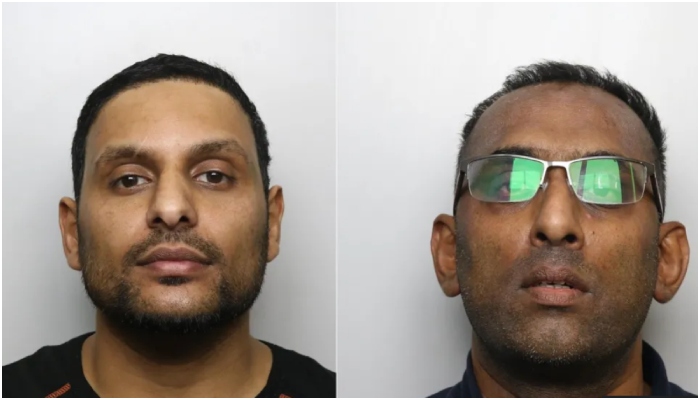
Harjit Singh alias Laddi, son of Kuldip Singh, a resident of Garpadhana village in Punjab’s Nawanshahr, and Kulbeer Singh alias Sidhu, son of Sukhvinder Singh, a resident of Yamuna Nagar, Police Station Sadar Jagadhari, Haryana, are absconders in the murder case registered on May 9 this year, the NIA said in a statement.

Vikas Prabhakar was shot dead by two unidentified motorcycle-borne men at his shop in Nangal town in Punjab’s Rupnagar district on April 13, 2024. The two assailants entered Bagga’s confectionery shop located near the Rupnagar railway station and opened fire at him and then fled from the scene.

The NIA said that the identities of the informants will be kept a secret in their interest. The agency also shared photos of the duo.

Earlier, on April 16, the Rupnagar Police, in a joint operation with the state special operating cell (SSOC) in Mohali, arrested two Pakistani-backed operatives in connection with this high-profile murder case.

With this, the Punjab police claimed to have solved the murder case within three days. “In a major breakthrough, Rupnagar Police, in a joint operation with SSOC #Mohali, has solved the Vikas Prabhakar Murder Case in less than three days with the arrest of 2 operatives of a terror module backed by #Pakistan-based terrorist masterminds,” the Punjab Police posted on social media platform X.

The two were arrested on April 16 with two weapons- 32 bore pistols, 16 live cartridges, one empty used cartridge, and a TVS Jupiter scooty used in the crime.

From the preliminary investigations, it has been revealed that this is a terror module, operated and funded by Foreign-based handlers operating from Portugal and other places, the police added.

(This news report is published from a syndicated feed. Except for the headline, the content has not been written or edited by OpIndia staff)

Kenya: Several dead as Police opens fire on protesters trying to storm Parliament Building while opposing tax hikes

On Tuesday, June 25, in Kenya, several people were feared dead after Police opened fire at protesters who tried to storm the Parliament building as protests against tax hikes descended into violence and chaos. The protesters have set parts of the Parliament building on fire and plumes of smoke can be seen in videos doing rounds on social media. Meanwhile, hundreds of MPs, who could not leave the parliament, have been rushed to the basement.  

Police opened fire after tear gas and water cannons failed to disperse the crowds. According to news agency Reuters, a journalist counted the bodies of at least five protesters outside parliament. A paramedic, Vivian Achista, said that at least 10 had been shot dead. Another 50 people are said to have suffered gunshot wounds and it is feared that the casualty figures may rise.   

(Masked protester showing bullet casing during protest against tax hikes in Kenya, Image Source – BBC)

Chaotic scenes erupted near the Kenyan Parliament building when MPs were debating the controversial finance bill before passing it. Soon, gunshots were heard as the disputed finance bill was passed. While police opened fire, several protesters stormed the Parliament building. Police are trying to ensure the safety of MPs as hundreds of them were unable to leave the parliament when protesters breached the complex. Local media reported that most MPs have taken cover in a basement.

(Police in riot geares, resorted to tear gas shelling and firing to prevent violent protesters from entering Kenyan Parliament, Image Source – BBC)

BBC reported that protesters have damaged a section of parliament where a huge plume of smoke can be seen. As per Live TV footage, the protesters vandalised the parliament building and damaged a section of its structure. Additionally, windows and chairs inside the parliament can be seen as broken. 

In one of the viral videos, several protesters could be seen pulling apart a stand that displays flags in the Parliament building and smashing the poles against the floor. Another man kicked the doors to the senate. 

It is pertinent to note that the protests are mainly Gen-Z-led rallies, which began last week over demands to scrap the finance bill that proposes tax hikes. The protesters have caught the government off guard and forced President William Ruto to say over the weekend that he was ready to talk to the protesters. 

However, protests on Tuesday afternoon turned violent as crowds started to throw stones at police and push back against barricades while attempting to storm the parliament complex. 

Meanwhile, protests and clashes have also taken place in several other cities and towns across Kenya. 

As per reports, the said finance bill seeks to generate an extra $2.7 billion in taxes to help reduce the substantial debt burden, as interest payments alone account for 37% of the annual revenue. Despite the government making concessions by agreeing to eliminate proposed new taxes on bread, cooking oil, car ownership, and financial transactions, these measures have not been sufficient to appease the protesters. The protesters who were initially demanding the reversal of tax hikes have now started demanding the resignation of President William Ruto. 

A protester Davis Tafari, who was trying to enter parliament, told Reuters, “We want to shut down parliament and every MP should go down and resign. We will have a new government.”

‘False and misleading’: Indian Railways debunks viral claims that said IRCTC account holders cannot book tickets for people with different surnames

On Tuesday (25th June), the Spokesperson of the Indian Railways debunked fake news circulating on social media, which falsely claimed that under new railway E-ticket booking rules, new restrictions have been imposed on booking tickets for others and that people would be jailed for booking tickets for passengers with different surnames. The Spokesperson categorically dismissed the claims, stating, “The news in circulation on social media about restrictions in booking e-tickets due to different surnames is false and misleading.”

Notably, it all started after some media reports falsely claimed that new restrictions had been imposed on booking IRCTC tickets for others and that booking train tickets for others via personal IRCTC ID can land you in jail. Delhibreakings.com reported that according to Section 143 of the Railway Act, only officially appointed agents are authorized to make bookings for third parties. Violating this rule can result in legal action, including a potential jail term of up to 3 years and a fine of Rs. 10,000. It also mentioned the “same surname rule”.

(Snippet from Delhibreakings.com article)

The report added that the new regulation mandates that individuals “can only book tickets for blood relations or those with the same surname”, using personal ID. Booking for friends or others could lead to a hefty fine of Rs. 10,000 or a jail term of up to 3 years, or both, the report had further claimed. 

Soon, several X users started sharing the media report with many of them peddling it with further misleading claims and false allegations against the Indian Railways. Some of the users deleted their posts after the Indian Railways debunked the false claims.

Many users expressed concerns that, in many cases, post-marriage, many women retain their maiden surnames. If the news turns out to be true, it could become criminal for a spouse to book tickets for their partner or vice versa, they lamented.

Allaying their fear, the Spokesperson of the Indian Railways busted the fake claims. It categorically asserted that the claims about restrictions in the booking of e-tickets due to different surnames are “false and misleading.”

It clarified that tickets from the IRCTC Site are being booked as per Railway Board Guidelines. It stressed that IRCTC users can book tickets from their User ID for “friends, family and relatives”, which strikingly can be irrespective of the passenger(s)’ surname. Additionally, one user can book up to 12 tickets per month which could go up to 24 per month, in case of proper authentication through Aadhar. 

However, the release mentioned that the ‘commercial sale’ of tickets on personal user IDs is an offence. While users can book tickets for others, irrespective of surname, selling tickets booked on their ID for monetary gain is a crime.

The requirements stated in the press release are as under – 

1. One can book tickets on a personal User ID for friends, family, and relatives.

2. Booking can done for up to 12 tickets per month which in the case of Aadhaar-authenticated users can go up to 24 tickets per month if one of the passengers on a ticket is also Aadhar authenticated.

3. Tickets booked on personal User IDs are not meant for commercial sale and such an act is an offence under section 143 of Railways Act 1989.

Constitution copy Rahul Gandhi flashes at everyone was conceptualised by someone who was against OBC reservations: Read about SC Adv Gopal Sankaranarayanan

During his election campaign and after the election results, Congress leader Rahul Gandhi has been alleging and furthering the unsubstantiated trope against PM Modi-led NDA government that the ‘Constitution is in danger’ and that it wants to do away with the reservations for vulnerable sections of society. The falsehood was amplified by circulating a doctored video of Union Home Minister Amit Shah. As part of his political rhetoric, he has been waving a red and black leather pocket-sized constitution copy to project himself as the saviour of the Dalits (SC), Tribals (ST), and OBC communities, and the one safeguarding their constitutionally enshrined reservations. 

Ironically, while asserting protecting the constitution and reservations, by extension, the Gandhi scion has been flashing a small copy of the constitution that was conceptualized by Supreme Court advocate Gopal Sankaranarayanan who has spoken against OBC reservation as well as a complete overhaul of existing reservations. He has been demanding the introduction of a creamy layer in the SC/ST reservation and incorporating a 10% EWS reservation from the existing 50% limit.   

Notably, Lucknow-based Eastern Book Company has secured intellectual property rights for the said red-black leather-bound Constitution copy meaning the book cannot be copied by other publishers. 

One of the directors of the Eastern Book Company, Sumeet Malik told PTI that the idea of printing a court pocket edition came from Supreme Court advocate Gopal Sankaranarayanan, who suggested that they should publish a version that fits easily in the lawyers’ court pockets. 

Now it is pertinent to note that the Supreme Court lawyer Gopal Sankaranarayanan has been speaking against the OBC reservation, particularly the inclusion of dominant communities which “discriminated against SCs and STs”. 

In an interview with a legal portal Law School Policy Review & Kautilya Society, Sankaranarayanan expressed concerns about the increasing demand for reservation by communities who didn’t face historical discrimination. He asserted that the Parliament went ‘beyond’ the balance that the Constitution intended to achieve when it extended reservations beyond the SC/ST category to include the OBC category. He argued that it was wrong to put the accused and victim in the same category noting that some of the OBC communities getting reservations are the ones who discriminated against SCs.  

Elaborating his rationale against OBC reservations, Gopal said, “Unfortunately, I believe that it went beyond that (balance intended by the Constitution) the minute we went beyond SC/ST. When we went into the entire OBC domain, we took the measures of historical discrimination, slowly, a little bit in a direction where groups that were socially fairly strong, and in large numbers, were now getting the benefits that should have gone to those who have historically discriminated. Please remember that a large number of those who are the OBCs were the ones who have discriminated against SCs, now you’re putting them both in the same benefit category effectively.” 

Additionally, he was part of the pleas that were filed in the Supreme Court demanding the introduction of a creamy layer in the SC/ST reservations. Back in 2018, a plea was filed by Samta Andolan Samiti, the umbrella body of general and OBC government employees and nine people belonging to the SC/ST community.

Appearing for the petitioners, advocate Gopal Sankaranarayanan sought the introduction of the creamy layer concept in SC/ST reservations to keep the rich among them out to ensure that the benefits go to the poor and the needy.

The counsel argued that due to the non-application of the concept of creamy layer in SCs and STs, the actually backward and deprived members of the SCs and STs are having a “heart burning” that uplifted/affluent and advanced portion of castes included in SCs and STs are taking away the benefits, which are designed for them.

Last year, he appeared in the Supreme Court to challenge the EWS reservation. Elaborating his opposition to the EWS reservations, he told the legal portal, “I was fine with saying EWS is good, but nuance it by saying that it is limited to 50% and doesn’t allow them to cross the 50% limit.” 

In a glaring irony, while the Supreme Court lawyer has been advocating for limiting reservations to a 50% cap, Rahul Gandhi, who has been declaring his intent to breach this limit and raising slogans such as ‘Jitni Aabadi Utna Haq,’ has been brandishing a copy of the Constitution conceptualized by the former.

Nonetheless, the Constitution copy that I.N.D.I. alliance leaders including Rahul Gandhi have been flashing at everyone roughly measures 20 centimetres in length and nine centimetres in breadth. Its first edition was launched in 2009 and there have been about 16 editions of this book, which have been published so far. The publisher has used Bible paper which is very thin. All the article numbers are in red and the text is in black. EBC publisher Sumeet Malik claims to have sold 5,000 copies in the last three months which is the same number that the publisher sold in 2023. 

Aam Aadmi Party’s Saurabh Bhardwaj raises questions on judiciary after stay on AAP Supremo Arvind Kejriwal’s bail, says that Court was prejudiced

The Delhi High Court on Tuesday, June 25th, granted the Enforcement Directorate’s request to stay the trial court’s bail ruling for Delhi Chief Minister Arvind Kejriwal in the money laundering case in the liquor policy excise scam.

On June 20th, a High Court bench led by Justice Sudhir Kumar Jain suspended a bail order given by the trial court. The bench reserved the order on June 21st after the agency challenged the trial court’s verdict, which was placed on hold until the ruling. Delhi CM Arvind Kejriwal later filed an appeal with the Supreme Court on Saturday, challenging the High Court’s interim stay ruling. The Supreme Court postponed the hearing on Kejriwal’s petition, indicating that it wanted to wait for the High Court’s verdict on the subject.

Meanwhile, commenting on the Delhi High Court’s decision to stay the trial court’s order granting bail to CM Arvind Kejriwal in the excise policy scam, AAP leader Saurabh Bhardwaj said that the High Court judge didn’t know what was written in the lower court order and that he did not know the basis on which the bail was granted.

“He already stayed that (trial court) order, we have never heard or seen this. Even the Supreme Court asked how can this happen. I believe that court was already prejudiced,” Bhardwaj said.

“It is very unusual that without reading the order of the trial court, Delhi High Court stayed the court order granting bail to Kejriwal…We will make a legal strategy regarding it,” the AAP leader added.

The Delhi High Court today, June 25, remarked that the trial court has not applied its mind and has not considered the material in the case. “Trial court observation not correct, need more time to consider ED plea,” the higher court said.

Arvind Kejriwal, who was arrested by the Enforcement Directorate on March 21, was set to be released from Tihar Jail on Friday, June 21, if the High Court had not intervened. The High Court stopped the implementation of the challenged order, saying, “Until the pronouncement of this order, the operation of the impugned order shall remain stayed.”

The court ordered all parties to provide written arguments by June 24th. The court stated that it would postpone its decision for two to three days to thoroughly analyse the case files.

MP: Muslim man pronounces triple talaq to his wife for voting BJP in Lok Sabha elections

In Madhya Pradesh’s Chhindwara district, a 26-year-old Muslim woman has alleged that her husband gave her “triple talaq” after he was enraged with her for voting for the BJP in the Lok Sabha election. According to an ETV Bharat report, the Muslim man pronounced triple talaq on his wife after she joined the Bhartiya Janata Party.

On Sunday (23rd June), the woman who filed a police complaint against her husband accused him and her in-laws of physically and mentally torturing her for dowry.  However, the woman’s husband has refuted the allegations, accusing her of having extramarital affairs.

Meanwhile, Kotwali police station in-charge Umesh Golhani said that the complainant got married to her husband eight years ago. Their relations were normal for some time, but subsequently, her husband, mother-in-law, and sisters-in-law allegedly started insulting and assaulting her over some sort of issue.

The woman claimed she was booted out of the house around one and a half years ago and lived with her husband in a rented room. The officer went on to say that the complaint woman supported and voted for a political party, which infuriated her husband, who then gave her a ‘triple talaq’.

On the victim’s complaint, the police have filed a case against her husband, mother-in-law, and four sisters-in-law under the Dowry Prohibition Act, the Muslim Women (Protection of Rights on Marriage) Act, and the Indian Penal Code. The victim’s statement was recorded, and additional legal action is being pursued.

Meanwhile, the victim woman claimed that her husband had earlier sent her the talaq notice and that his family had falsely accused her of being ‘characterless’.

“I responded to the talaq notice through my lawyer.” Later, I supported and voted for the BJP. When my husband, his mother, and sisters learned of this, he gave me triple talaq. His family members asked him to either leave them or give triple talaq to me,” the victim said.

However, the woman’s husband said she had affairs that created the “disturbance” and that he offered her multiple chances to the complainant for reconciliation keeping in mind the future of their children. He said that there were no elections in 2022, so this is not a question of “instant triple talaq” or backing any political party. He claimed that he first gave talaq to his wife on the 30th of March 2022, and then twice again in October and November 2023, per Muslim law. He also accused the complainant of slandering his name to conceal her extramarital affairs.