

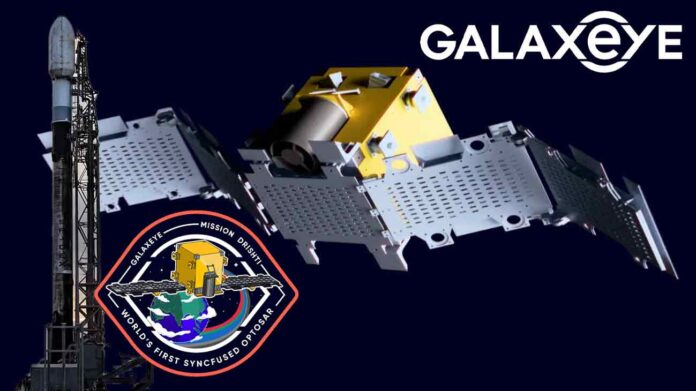
In a landmark moment for India’s private space industry, Bengaluru-based startup GalaxEye Space successfully launched its flagship Mission Drishti satellite aboard a SpaceX Falcon-9 rocket today. The 190-kg spacecraft, hailed as the world’s first OptoSAR imaging satellite and India’s largest privately built satellite to date, lifted off from Space Launch Complex-4E (SLC-4E) at Vandenberg Space Force Base at approximately 12:30 PM IST (corresponding to local launch window).
The launch marks a major milestone not only for GalaxEye, an IIT Madras-incubated company founded in 2020 by a team of young engineers, but for India’s self-reliance in advanced Earth observation technology. Mission Drishti introduces groundbreaking “OptoSAR” (Optical + Synthetic Aperture Radar) capability, fusing a high-resolution Synthetic Aperture Radar (SAR) sensor with a 7-band multispectral imager (MSI) on a single platform.
Separation Confirmed!
— GalaxEye (@GalaxEye) May 3, 2026
The world's first OptoSAR Satellite is now in space.
Made in India for the world.
Go Drishti! Go @GalaxEye! Go India! pic.twitter.com/tNKFKwvlK6
This hybrid payload eliminates the traditional trade-offs in Earth imaging: SAR provides all-weather, day-and-night visibility that can penetrate clouds, rain, and darkness, while the optical component delivers intuitive, high-clarity multispectral data. The fused resolution is approximately 1.8 meters, delivering up to three times more actionable information than conventional single-sensor satellites.
Powered by NVIDIA’s Jetson Orin platform for onboard AI analytics and electric propulsion for extended orbital life, Drishti is designed for near-real-time, decision-grade intelligence. Its applications span defence and strategic surveillance, precision agriculture, disaster management, urban planning, and environmental monitoring.
Falcon 9 is vertical at pad 4E in California ahead of tonight’s launch of the CAS500-2 mission with 45 payloads on board. The 37-minute launch window opens at 11:59 p.m. PT → https://t.co/Q2izSXSwxf pic.twitter.com/gDqIBcsTmn
— SpaceX (@SpaceX) May 3, 2026
GalaxEye envisions Drishti as the first node in a 10-satellite constellation (Drishti Constellation) targeted for completion by 2029, enabling continuous global coverage. The Drishti Constellation would deliver continuous, all weather visibility anytime, anywhere even during nights and cloud cover. The satellite will enable governments, defence and other industries to carry out advanced geospatial analysis.
The satellite’s journey to orbit began years earlier with precursor technology demonstrations, including the GLX-SQ payload flown on ISRO’s PSLV-C60/POEM-4 mission in December 2024. After rigorous testing and integration in India, the 190-kg Drishti spacecraft was shipped to the United States for integration with the Falcon-9 rideshare mission. GalaxEye CEO Suyash Singh had earlier described it as “the heaviest and largest satellite built by an Indian private company.”
He said that the company’s Gen-2 satellites are expected to send images of 0.5 resolution, and they will weigh about 300 kg.
Prime Minister Narendra Modi hailed the achievement in a post on X, underscoring the national significance of the mission and the role of India’s youth and policy reforms in fostering private space innovation. He said that Mission Drishti by GalaxEye marks a major achievement in our space journey.
Mission Drishti by GalaxEye marks a major achievement in our space journey. The successful launch of the world’s first OptoSAR satellite and the largest privately-built satellite in India is a testament to our youth’s passion for innovation and nation-building.
— Narendra Modi (@narendramodi) May 3, 2026
Heartiest…
The launch comes as validation of India’s evolving space policy, which has opened doors for private players through IN-SPACe and eased access to ISRO facilities. GalaxEye’s collaboration with SpaceX for the ride-share launch also highlights growing Indo-US space ties, even as India continues to build its own indigenous launch capabilities.
GalaxEye has confirmed successful deployment and initial contact with the satellite. The company will now focus on commissioning the payload, with first imagery expected in the coming weeks.
This successful debut not only elevates GalaxEye on the global stage but also signals the arrival of India’s private space sector as a credible force in cutting-edge satellite technology. With Mission Drishti now in orbit, the “unblinking eye” over the planet is set to deliver unprecedented insights for a more secure and sustainable future.
