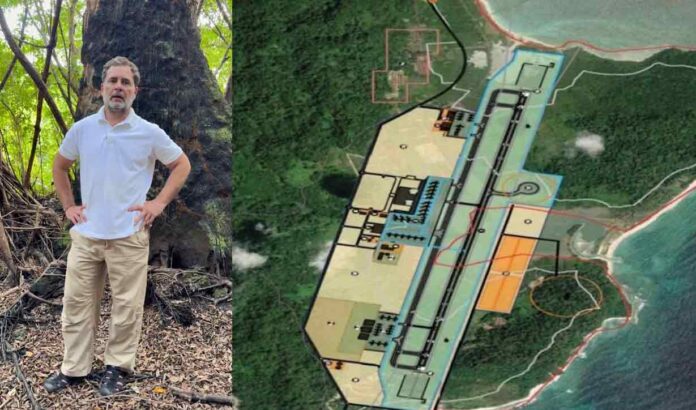
The Great Nicobar Island (GNI) Project, initiated by NITI (National Institution for Transforming India) Aayog and introduced in 2021, has been in the spotlight as one of the most ambitious infrastructure proposals in the Indian Ocean Region (IOR). It is essential for transforming the region into a global maritime centre while taking into account ecological considerations and the welfare of tribal communities.
Nonetheless, the usual suspects, particularly the Indian National Congress and its entire ecosystem, along with foreign propagandists, have resumed their efforts to peddle a deceiving narrative against the vital project, in line with their regular response to every major decision concerning the nation, aiming to manipulate public sentiment in their support and obstruct the nation’s progress.
A frantic effort by Congress to stall the project
The Congress, notorious for allegations revolving around a multitude of scams during its tenure, denounced the project as “the next big scam in the making” with an image of PM Modi and Adani suggesting that the two have been involved in similar activities in various regions of India.
The next big scam in the making
— Congress (@INCIndia) April 30, 2026
👉 Great Nicobar Project pic.twitter.com/2TVY4BKkdV
Rahul Gandhi even travelled to the Andaman Islands to add a dramatic effect to his repeated accusations, contending that the project “is millions of trees marked for the axe. It is 160 square kilometres of rainforest condemned to die. It is communities that have been ignored while their homes have been snatched away. This is not development. This is destruction dressed in development’s language.”
The Raebareli MP also painted it as “one of the biggest scams and gravest crimes against this country’s natural and tribal heritage in our lifetime.” He demanded its termination, asking the people to align their voices with his disapproval.
I travelled through Great Nicobar today.
— Rahul Gandhi (@RahulGandhi) April 29, 2026
These are the most extraordinary forests I have ever seen in my life. Trees older than memory. Forests that took generations to grow.
The people on this island are equally beautiful – both the adivasi communities and the settlers – but… pic.twitter.com/vYdBWdYfIJ
While the party’s first family is occupied with unnecessary fearmongering, how can other leaders abstain from partaking in such antics? Therefore, Rajya Sabha MP and key aide to Gandhi, Jairam Ramesh, defined the project as a “recipe for ecological disaster.”
This is a distinguished former navy chief giving his professional view on the Great Nicobar Infra project. Viability aside, it is a recipe for ecological disaster. https://t.co/gbP3UPUrW7
— Jairam Ramesh (@Jairam_Ramesh) April 28, 2026
Senior Congress spokesperson Supriya Shrinate also hopped on the bandwagon to characterise Gandhi as a leader of the people, stressing that his political focus is on “issues that touch people’s lives, protect our forests, safeguard biodiversity, and secure our climate future.” She conveyed, “It doesn’t gloss over environmental devastation in the name of reckless development to benefit a few crony capitalists,” in an obvious attack on PM Modi and Adani, conveniently overlooking the assignments awarded to the businessman by Congress governments.
Shrinate then tactfully shifted to her true intention of pleading with people to vote for the party and endorse Gandhi, alleging that he is against “the brand of politics which spreads communal poison, ignores the daily struggles of Indians, and pursues power by bending every institution and trampling people’s rights.”
“Caring about Great Nicobar means caring about the politics that defends it. It’s time to stand with Rahul Gandhi and his politics,” she added. Essentially, she exploited the issue to solicit voter support before the party’s political future is entirely relegated to obscurity.
To all ecologists, conservationists, and environmentally conscious citizens who claim they “don’t care about Rahul Gandhi’s politics” but insist that the destruction of forests and displacement of people in Great Nicobar must stop.
— Supriya Shrinate (@SupriyaShrinate) April 29, 2026
This is what politics is supposed to be about.… pic.twitter.com/6q03vvVHbz
Another Congress member asserted that PM Modi discusses development publicly while his true intention is destruction, in reference to the project.
कैमरे के सामने विकास,
— Adv. Vijay Singh (@VijaySingh_law) May 1, 2026
कैमरे के पीछे विनाश‼️ pic.twitter.com/uvFAde3wrb
Last year, former Congress supremo Sonia Gandhi even authored an editorial in The Hindu, critcising the project as a disaster. From the upper echelons of Congress leadership to ordinary supporters, all are working to demonise the highly pivotal venture.
After the grand old party spearheaded the misleading campaign, it was promptly embraced by its cabal, including “journalists” and “influencers” who ridiculed the project, deemed it pointless and unnecessary, and labelled it hazardous to the local environment and residents.
“Journalist” Swati Chaturvedi reiterated Rahul Gandhi’s unfounded objections to the crucial plan under the guise of “protecting fragile ecology.
Completely agree with Gandhi on this. The fragile ecology of the Great Nicobar must be protected https://t.co/X7tMfadTCL
— Swati Chaturvedi (@bainjal) April 30, 2026
Congress loyalist Mohit Chauhan wrote, “Millions of trees and a very dense forest will be wiped out. If you think this is being done for defence purposes, then the joke is on you.”
Great Nicobar Island: 910 sq km
— Mohit Chauhan (@mohitlaws) April 30, 2026
The total project area: 166 sq km
Planned tree-cutting area: 130 sq km
It is about 15% of the island’s total area.
Millions of trees and a very dense forest will be wiped out.
If you think this is being done for defence purposes, then the joke… pic.twitter.com/VNTkd3IUtq
According to the Tribal Army, the project is “deeply concerning” due to its “risk to fragile ecosystems, biodiversity and survival,” arguing that it constitutes destruction instead of development. “When decisions come at the cost of nature and indigenous rights, they must be questioned,” the account insisted.
The ’s approval of the Great Nicobar Project is deeply concerning. An ₹80,000 crore project that risks fragile ecosystems, biodiversity, and the survival of the cannot be called development—it is destruction.
— Tribal Army (@TribalArmy) March 31, 2026
When decisions come at the cost of nature and indigenous rights, they… pic.twitter.com/gBZDfrU3gh
Another member of this group boasted that the Leader of the Opposition in the Lok Sabha was not on vacation but rather in the Andaman Islands to voice objections against “Gautam Adani’s ₹81,000 crore Great Nicobar project,” which would clear 130 square kilometres of rainforest, devastate wildlife sanctuaries and displace the indigenous populace.
The person referenced “The Ganga Expressway,” which links Meerut to Prayagraj and was primarily constructed by Adani Enterprises Limited, to allege corruption. He declared that Rahul Gandhi is “raising alarm” against the entrepreneur who is damaging a UNESCO (United Nations Educational, Scientific and Cultural Organisation) biosphere and accused PM Modi of “cutting the ribbon” to assist him in acquiring a revenue stream of thousands of crores in the name of development.
Rahul Gandhi wasn’t on a holiday.
— Sincere Dibya (@TheSincereDude) April 30, 2026
He was in Andaman to OPPOSE Adani’s ₹81,000 crore Great Nicobar project; one that would bulldoze 130 sq km of rainforest, destroy wildlife sanctuaries, and displace indigenous tribes.
Now let’s talk about this “development” you’re so proud of:… https://t.co/0HpigmZFKH
Meanwhile, a 6-month-old video featuring “comedian” Kunal Kamra, infamous for his anti-India rhetoric and Hindumisia, about the project has begun to surface on social media, with alarming comments designed to scandalise both the uninitiated and common citizens as well as attack the Modi government. The opposition’s ecosystem started posting the footage which was also retweeted by “journalist” Ravish Kumar.
NICOBAR NIGHTMARE!
— তন্ময় l T͞anmoy l (@tanmoyofc) April 30, 2026
₹92,000 CRORE "DEVELOPMENT" TO WIPE OUT 1 CRORE TREES, INDIGENOUS TRIBES & ENDANGERED TURTLES!
They're Turning Pristine Great Nicobar Island into a Mega-port, Airport, Power Plant and Township For 3.5 Lakh People.
Cost? Skyrocketed from ₹10,000 crore to… pic.twitter.com/xAHomV3maZ
The entire gang banded together in an orchestrated attempt to frame the project as a grave mistake that was solely intended to profit Adani at the expense of the environment and native people.
Great Nicobar Island Project: The reality and the propaganda
The project, which has been cleared by the National Green Tribunal, covers around 166 square kilometres and is close to Galathea Bay on Great Nicobar Island. The mega project, which is expected to cost between ₹72,000 and ₹92,000 crore, intends to transform the island into a significant economic and geopolitical powerhouse.
It entails the removal of around a million trees and the diversion of roughly 130 square kilometres of forest area. A 450-MVA gas and solar power plant, an integrated township, a dual-use civil and military airport, along with an international container transhipment terminal, are part of the endeavour.
The international greenfield airport would also have a 3,300-meter runway that can deal with wide-body aircraft. These dual-use military and public facilities will transform the Andaman and Nicobar tri-service command into a front-line strategic arm. The project has 4 stages. Phase 1 is expected to handle 4 million TEUs and is scheduled for completion by 2028. The capacity will likely increase to 16 million TEUs by 2058.
Great Nicobar is nearly as far away from Colombo, Port Klang and Singapore as it is from a main east-west shipping route. Currently, almost 40% of India’s transhipment business is handled by Colombo alone, while about 25% of the country’s cargo is delivered through foreign ports. With its natural depth of 18 to 20 metres, the government outlined that the Galathea Bay port can lessen this reliance and save thousands of crores a year in port revenue and associated economic activity.
Moreover, the project serves as the main attraction of India’s “Necklace of Diamonds” strategy, which strives to offset China’s “String of Pearls.” India would be able to monitor and, if needed, intercept shipping via one of the most important waterways in the world if it had a fully operational military and commercial base at Galathea Bay, which is situated at the entrance to the Strait of Malacca.
Furthermore, Iran has been offering an actual illustration of what it means to be adjacent to a vital strait with the ability to threaten, facilitate and weaponise international trade since February 2026.
On the other hand, Congress governments have previously obstructed airstrips, radar facilities and port expansions in the Andaman and Nicobar Islands, claiming vulnerable ecosystems. As a result, the archipelago was left economically stagnant and tactically underutilised. Their approach hampered India’s infrastructural growth in critical regions while China efficiently transformed its own border areas and took policy decisions to further its influence.
Now, when the Modi government ultimately resolved to leverage the geological resources of India for both its benefit and greater utility, the party and the left-liberals have resorted to their longstanding anti-development position, trying to confine the nation within the detrimental cycle of inaction and disregard for future security in pursuit of their short-term political goals.
They object for the sake of their politics but never provide any constructive criticism or alternative recommendations. They solely desire for the project to stop, the status quo to persist and no improvements in these rapidly escalating and unpredictable times, where national interest must be prioritised above any political manoeuvring. However, it is too much to hope from the Indian opposition or its left-liberal brigade.