

Soon after the events at Euromaidan, when Russian President Putin knew that Ukraine might soon be lost to a hostile government, one of his first moves was to annex Crimea. Kremlin cited historical, cultural and social reasons for the move. But anyone who has ever studied the geopolitics of the region can clearly see why annexing Crimea was crucial for Russia. Russia has gone to war for Crimea in the past, and it will do so again and again, whenever needed, because Crimea has Sevastopol.
Sevastopol is the critical, and in a way, the only major warm-water port for Russia. Technically, there can be others, but Novorossiysk on Russian territory is storm-prone and not that deep. Sevastopol is the focal point where Russian navy and commercial vessels access the Black Sea, without needing ice-breakers and risking winter-time limited operational status. Despite being the biggest nation on the planet, most other Russian ports are either on freezing waters, but Sevastopol is the exception.
Geography was the main character when Catherine the Great ruled in the 1700s, that fact hasn’t changed under Putin’s regime either.
🗓#OTD in 1783 the Russian city of #Sevastopol was founded by the executive order of Empress Catherine the Great.
— Russia 🇷🇺 (@Russia) June 14, 2021
⚓️ It is home to the Russian #BlackSea Fleet, a #WWII Hero City, place of Russia's 🎖 military valour & glory, dear to all Russians.
🥰 Happy Birthday, Sevastopol! pic.twitter.com/ZREoaZURdl
Civilisations have risen and fallen through ports. Empires are built through ports and maritime routes. Any nation that wants to be a global power needs to become a maritime power first.
Alfred Thayer Mahan’s famous idea, that sea power determines the rise and fall of nations, was valid during the reign of ancient Rome, the advent of the Spanish and British empires in the Middle Ages, and the brutal history of colonisation in the last few centuries to this day.
Land-locked or maritime-hesitant nations inevitably find themselves at the mercy of those who command the oceans. For India, blessed with one of the longest coastlines and a commanding position astride the Indian Ocean, the imperative is stark: it must fully realise its maritime potential or risk remaining a continental giant overshadowed by true blue-water powers.
India has underutilised its maritime potential for decades
India is geographically one of the most blessed nations for maritime activities. With over 10,000 km of coastlines, a central position astride key Indian Ocean trade routes, numerous natural deep-water harbours, and favourable monsoon winds historically aiding navigation.
We have an entire Ocean named after us, but we are, ironically, not even using 50% of our maritime potential, letting our geographical blessings go unharnessed while our neighbours profit from our waters. For decades, we have been lagging behind other smaller or less advantageously placed nations like Singapore, the Netherlands, South Korea, or even China.
Criminal underutilisation of coastline, marine resources and capabilities
The neglect of naval power and maritime trade literally caused India years of occupation and colonial exploitation at the hands of global powers. Despite this, successive governments have learned no lessons even after Independence. India has, for decades, criminally underutilised its maritime capabilities and potential.
Shipbuilding
As of 2025–26, India holds less than 1% of the global shipbuilding market, ranking a distant 16th in a world dominated by China, South Korea and Japan who control over 92% of the shipbuilding market.
India’s annual output is tiny, around 40,000–47,000 Gross Tonnage per year on average, that too only in recent years, while global leaders produce millions of gross tonnage.
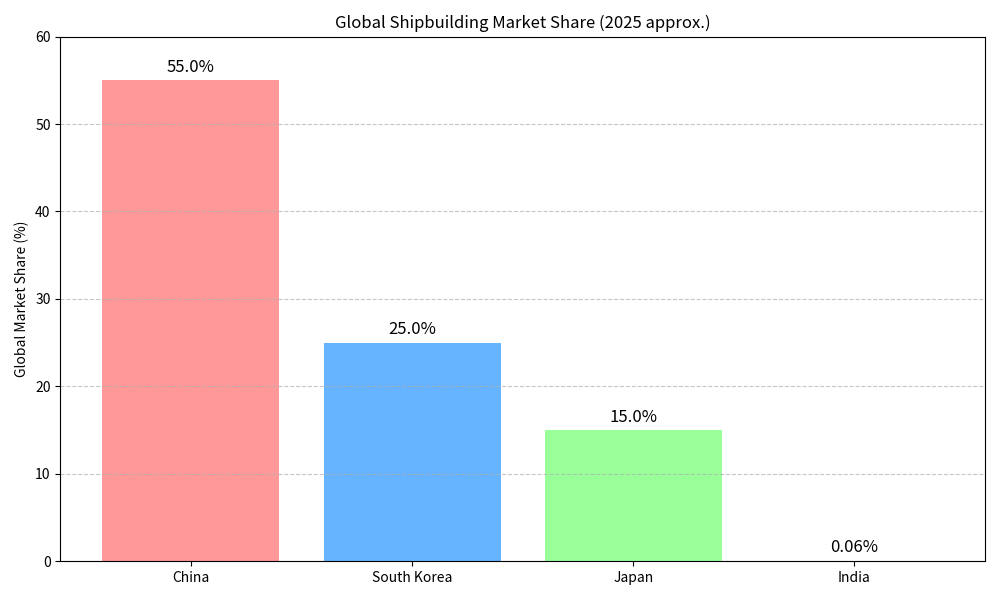
The Modi government has rightfully identified and understood the lacuna. Policies have been brought to rectify those mistakes and the current government is willing to invest capital and willpower into shipbuilding. The NDA government is aiming for 5% global share in shipbuilding by 2030 and a global top 5 rank by 2047, both ambitious goals, but much-needed.
Merchant Fleet & Shipping Capabilities
Indian-flagged ships carry only 5–7% of the country’s export-import trade. Foreign vessels handle the remaining 93–95%, leading to significant forex outflow and dependency. The picture is even more concerning when we look at global tonnage capacity. Globally, India accounts for less than 1% of total world shipping tonnage.
In 2025-26, a record performance, India’s merchant fleet and shipping capacity crossed 14.2 million Gross Tonnage, with the addition of 92 cargo ships, a roughly three-fold increase compared to 2024-25. But we are still far, far behind where we should be. India-owned and India-flagged vessels are currently around just 1500, keeping us at the 17th or 18th in the global cargo-carrying capacity rankings. This needs to improve a lot if we aspire to become a world leader.
Ports & Cargo Handling
Ports and Cargo Handling are the most concerning sector in the overall maritime capabilities debate for India. As discussed above, few other nations in the world have been blessed with a coastline and geographic maritime potential as we are, yet, we have preferred to live detached from the oceans for generations.
“India’s proud maritime heritage is well known. We were always known for shipbuilding and coastal trade. We are the land of the Cholas and the Marathas, whose naval might, trading impact and strategic brilliance became pathways of progress and power. Their vision showed us how the oceans can serve as bridges of opportunity. However, a decade ago, when we assumed office, India’s maritime sector was filled with outdated laws and limited capacities. This was not acceptable to us”, PM Modi had written in October 2025.
India has over a dozen major ports, but only two of them, namely JNPA and Mundra, consistently rank in the worldwide top 40–50 by container throughput. In 2025-26, India’s major ports handled 915.17 million tonnes (MT) surpassing the target of 904 MT.
In the World Bank’s Container Port Performance Index (CPPI 2024, referenced in 2025–26 reports), JNPA ranked 23rd and Mundra 25th among the top 30 globally. Nine Indian ports (including non-major ones) feature in the global top 100. Giant ports like Shanghai (47+ million TEUs) and Singapore are dwarfing India’s ports by miles. Vessel turnaround times have improved, but still lag world-class benchmarks. Capacity utilisation often hovers around 50% for India.
Why the Galathea Bay International Container Transhipment Port and the Great Nicobar Project is not just crucial, but an absolute national security necessity
The Strait of Malacca is a narrow chokepoint through which over 40% of global trade currently passes. Great Nicobar, located just 40 Nautical Miles from the Strait, sits at one of the most critical maritime arteries on the planet. And have just watched global trade pass us by.
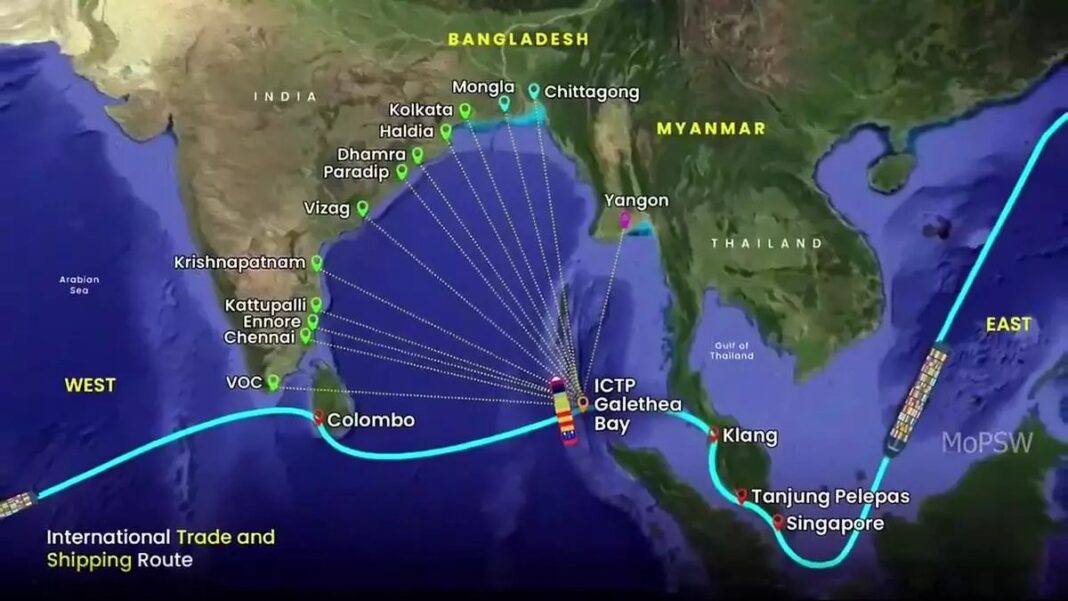
Galathea Bay is a natural deep-water harbour on the southeastern coast of Great Nicobar Island. With its over 20 metres draft, this geological blessing sits right there on Indian territory, unutilised and ignored for decades while Singapore, Colombo flourished as global ports.
The Bay can accommodate the largest container vessels without the limitations faced by many competing hubs. Galathea Bay International Container Transhipment Port (ICTP) is not just a peripheral port project; it is going to be India’s strategic anchor in the eastern Indian Ocean, transforming the Andaman & Nicobar archipelago from a remote outpost into a forward-operating springboard for both commerce and defence.
Commercially speaking, the ICTP will directly address India’s chronic vulnerability. Currently, around 75% of India’s containerised cargo is transshipped through foreign ports like Colombo and Singapore, causing not just a massive foreign exchange outflow, but a colossal logistical dependency.
MoPSW is developing Greenfield International Container Transshipment Port in Galathea Bay at Great Nicobar island. ICTP will allow Great Nicobar to participate in the regional & global maritime economy as a major player in cargo transshipment@narendramodi@NITIAayog@DPIITGoI pic.twitter.com/sB5W0tVsNL
— Ministry of Ports, Shipping and Waterways (@shipmin_india) February 12, 2024
The proposed Galathea Bay ICTP will internalise this traffic, slash costs, boost export competitiveness, and position India as a major hub for Asia-Europe, Asia-Africa, and Asia-US trade routes. The larger Great Nicobar Project proposes a civil-military airport, 450 MVA renewable-heavy power plant, and an integrated township to complete the ecosystem, creating a self-sustaining maritime node.
The government has cited the Galathea Bay ICTP and Great Nicobar project as an “unsinkable aircraft carrier”, an ambitious but critical move that secures trade lifelines, projects naval power, counters encirclement, and cements India’s emergence as a true maritime superpower.
Even if the historical instances of key trade routes making and breaking empires were not sufficient, the ongoing hostilities in West Asia, where the closure of the Strait of Hormuz sent economic and logistical shockwaves through the entire world, should be enough to stress the criticality of a marine trade choke point. Galathea Bay is not just commercially prudent for India; it is a strategic military and commercial master move against China.
As PM Modi had said earlier, this is not the era of war. But this is the era of technological advantage and consistent, relentless global competition for resources and power. India has lost not years or decades, but centuries due to political turmoil and colonisation by foreign powers. Geography has ordained us as the guardian of the Indian Ocean, it is high time we asume that role strategically and officially. That Ocean belongs to us, if we do not move to claim it, someone else will.


