

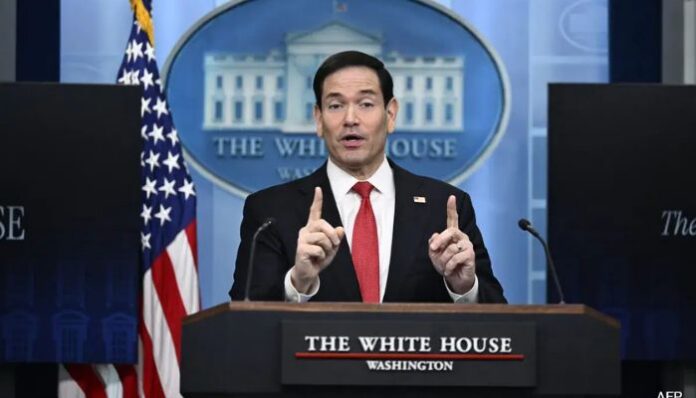
US Secretary of State Marco Rubio announced on Tuesday, 5th May, that “Operation Epic Fury,” a nearly two-month-long military campaign that triggered a US-Israel conflict with Iran, has now effectively ended. However, he made it clear that the situation is still uncertain, especially with tensions continuing in the Strait of Hormuz.
US Secretary of State Marco Rubio said Tuesday the #US military campaign against #Iran, which was jointly launched with Israel on Feb 28, is "over".
— China Daily (@ChinaDaily) May 6, 2026
"The operation is over, Epic Fury, as the president notified Congress. We're done with that stage of it," Rubio said at a White… pic.twitter.com/V6DkigaExn
Speaking at a White House briefing, Rubio said, “The operation is over… We’re done with that stage of it.” He explained that the US is no longer in an offensive mode and has now shifted its focus to a defensive approach, mainly aimed at ensuring safe passage for commercial ships through the Strait. “This is not an offensive operation… There’s no shooting unless we’re shot at first,” he added.
Operation Epic Furry against Iran is over announces US Secretary of State Marco Rubio. pic.twitter.com/dYm17BwaDC
— Aditya Raj Kaul (@AdityaRajKaul) May 5, 2026
Focus shifts to security and diplomacy
Rubio’s remarks signal a clear change in strategy from the earlier aggressive stance taken by the administration. The conflict had escalated in February when Donald Trump demanded “unconditional surrender” from Iran and called for dismantling its nuclear programme.
Now, the focus appears to be on diplomacy. Rubio said a US delegation led by Jared Kushner and Steve Witkoff is still in talks to understand Iran’s position. “We don’t have to have the actual agreement written out, but we have to have a diplomatic solution that is very clear about the topics,” he said.
His statement came shortly after the administration informed Congress that formal “hostilities” had ended following a ceasefire reached nearly a month ago. However, missile and drone attacks by Iran targeting ships and areas like the United Arab Emirates have continued, raising concerns about how stable the ceasefire really is.
Ceasefire holds, but risks remain
Earlier in the day, Defence Secretary Pete Hegseth said the ceasefire is still in place despite recent flare-ups. While US forces have responded to threats by intercepting missiles and destroying small Iranian boats, officials said they have avoided large-scale combat operations.
Still, the ground reality remains tense. Only two commercial ships have managed to pass safely through the Strait under US protection since the Navy began operations this week. The waterway, which is just 21 miles wide at its narrowest point, remains highly risky due to the presence of missiles, drones and sea mines. Before the conflict, nearly 130 ships used this route daily.
‘Project Freedom’ and global concerns
Rubio said the US is now focusing on reopening the Strait through a new initiative called “Project Freedom.” He described it as a gradual effort to create a “protective bubble” for ships. “This is the first step,” he said, adding that the goal is to end what he called Iran’s “economic arson.”
He also noted that while the US is leading the effort, several other countries have quietly offered support. “This is a favour to the world,” Rubio said, pointing out that many ships stuck in the region are facing shortages of food, water and supplies.
The disruption in the Strait has already pushed up global energy prices and shaken markets. Rubio warned that the situation could have been even worse if Iran had nuclear weapons. “If Iran had a nuclear weapon… we wouldn’t be able to do anything about it,” he said. “They would do exactly to the world with a nuclear weapon what they’re doing now with the Strait.”
Strong remarks on Iran
Rubio also accused Iran of continuing efforts linked to developing nuclear weapons, including advanced centrifuges and missile systems. While Iran has repeatedly denied such intentions, Rubio said, “they just don’t mean it.”
In a sharp remark, he described Iran’s leadership as “insane in the brain,” while urging them to make a “sensible choice” and return to meaningful negotiations.
