

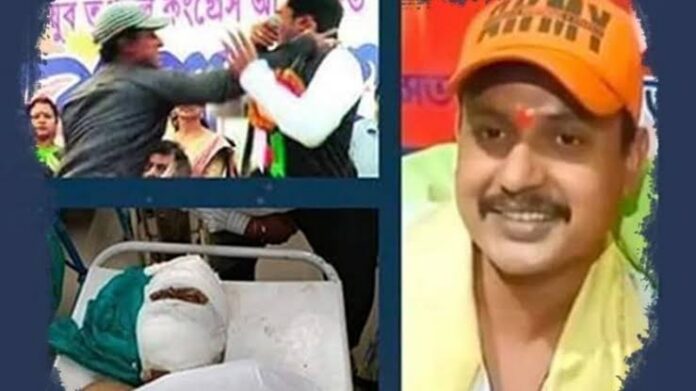
The murder of Chandranath Rath, a close aide and Personal Assistant of BJP leader Suvendu Adhikari, has once again brought West Bengal’s long and controversial history of political violence under sharp scrutiny. As tensions escalate following the Trinamool Congress’s defeat in the 2026 Assembly elections, it is time to revisit several political violence incidents from the Mamata Banerjee era, including the mysterious 2021 death of Devasish Acharya, the man who had slapped TMC MP Abhishek Banerjee in 2015.
Rath was shot dead late on the night of May 6 in the Doharia area of Madhyamgram in North 24 Parganas district. According to reports, around eight motorcycle-borne assailants intercepted his vehicle at around 10:20 pm and opened fire at close range while he was returning to Barasat. Rath, who was seated beside the driver, suffered multiple bullet injuries and died on the spot, while his driver sustained serious injuries and was shifted to SSKM Hospital.
Police officials described the attack as a “planned murder”. A senior officer reportedly stated that the assailants appeared determined to ensure Rath’s death, claiming that one of the attackers waited after firing to confirm he had succumbed.
The killing has dramatically intensified the already volatile political atmosphere in the state. West Bengal BJP president Samik Bhattacharya accused the Trinamool Congress of fostering an atmosphere of political terror.
“Earlier, they attacked our leaders, including Suvendu and Dilip Ghosh. Killing the Leader of the Opposition’s PA is a message,” Bhattacharya said while reacting to the incident.
The Trinamool Congress, however, condemned the murder and called for a court-monitored CBI probe, while also pointing to the deaths of its own workers in post-poll clashes.
Yet for many BJP leaders, Rath’s killing has revived memories of earlier politically sensitive cases that never stopped raising questions, particularly the 2021 death of Devasish Acharya.
Devasish Acharya, the man who slapped Abhishek Banerjee, was found dead under mysterious circumstances
Acharya had become a politically controversial figure in 2015 after he stormed onto a public stage and slapped Abhishek Banerjee during a TMC event. He was immediately thrashed by TMC workers before being arrested by police under stringent charges, including attempt to murder.
While Abhishek Banerjee later publicly claimed he had “forgiven” Acharya and appealed for leniency, several TMC leaders triggered outrage with their remarks at the time. Senior TMC leader Subrata Mukherjee had controversially justified the mob assault as a “reaction” and even invoked parallels with the aftermath of former Prime Minister Indira Gandhi’s assassination.
Six years later, in June 2021, Acharya, who had joined the BJP in 2020, was found critically injured under mysterious circumstances in East Midnapore. Hospital records showed that unidentified men had dropped him at Tamluk district hospital in the early hours before disappearing. He later died during treatment.
Police investigations at the time revealed that Acharya had left a tea stall after receiving a phone call shortly before he went missing. His family alleged murder, while BJP leaders demanded an independent investigation. By then, Acharya had joined the BJP.
The fresh political violence allegations after the 2026 Assembly elections, coupled with the assassination-style killing of Rath, have once again pushed these unresolved episodes back into public debate. BJP leaders argue that the incidents collectively point towards what they describe as a deeply entrenched culture of political intimidation and retaliatory violence in West Bengal.
Rath himself was considered one of Suvendu Adhikari’s most trusted aides. Originally from Chandipur in Purba Medinipur and a former Indian Air Force personnel, he had worked closely with Adhikari since 2018 and remained part of his inner circle even after the latter defected from the TMC to the BJP.
As investigations continue into Rath’s murder, opposition leaders are increasingly demanding accountability not just for the latest killing, but also for past politically sensitive deaths and assaults that continue to cast a shadow over Bengal’s political landscape.
