

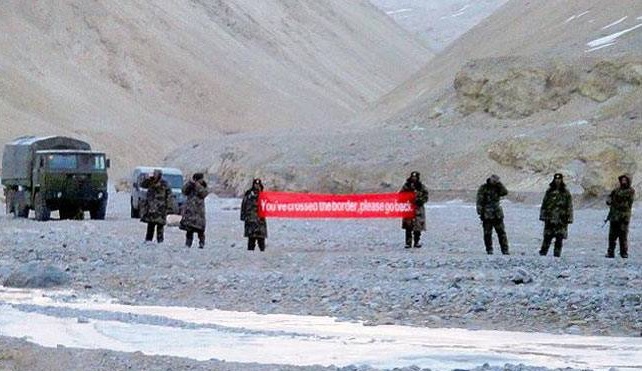
Amid the ongoing standoff between the Indian Army and China’s People’s Liberation Army (PLA) at India-China-Bhutan tri-junction, Chinese state-controlled media argued that its troops would be entitled to enter Kashmir with the “logic” that Indian troops entered Doklam plateau.
“Even if India were requested to defend Bhutan’s territory, this could only be limited to its established territory, not the disputed area. Otherwise, under India’s logic, if the Pakistani government requests, a third country’s Army can enter the area disputed by India and Pakistan, including India-controlled Kashmir,” Director of the Center for Indian Studies at China West Normal University Long Xingchun wrote in an article in Global Times.
Indian Army and Chinese troops are locked in an eyeball-to-eyeball confrontation at the Sikkim-Bhutan-Tibet tri-junction after China’s attempts to forcefully build a strategic highway through the Doklam plateau, which is Bhutanese territory. The 269-sq km Doklam plateau is strategically located at the Sikkim-Bhutan-Tibet tri-junction, the place where borders of the three countries meet.
The Global Times article suggests that Beijing can internationalise Doklam issue without worrying about western countries because the West has a lot of business to do with China.
Referring to the exchange of fire between India and Pakistani troops along the Line of Control in Kashmir, another article in Global Times said it is not a good idea for India to open “two fronts conflict”.
“Aside from the border spat with China, India is embroiled with Pakistan over an exchange of fire at the Kashmir border. Both India and Pakistan accused each other of initiating the incident on Saturday that caused civilian deaths on both sides of their controlled border in Kashmir,” the article said.
“That there are frequent conflicts and military scuffles between the areas of Kashmir controlled by the two sides. China has nothing to do with the situation in Kashmir, but it would be unwise for India to engage in two conflicts at the same time,” Lin Mingwang from the Institute of International Studies, Fudan University, Shanghai was quoted as saying in Global Times.
Another commentary in Global Times has criticised the reported move by Tibetan government in exile to hoist the Tibetan flag on the shores of Bangong Lake in Ladakh. Though there is no evidence of the New Delhi’s involvement in the reported incident, the Global Times article accused India of using the Tibet card and instigating the Tibet movement in a bid to exert pressure on China.
“Although the involvement of New Delhi remains unclear, we hope they did not send any signal of approval,” the article authored by Yu Ning read.
The article argued that India’s large-scale poverty and the need for peace and development are the reasons why “New Delhi cannot afford to mess up the China-India bilateral relationship”.
A brazen editorial in Global Times last week had called for a disintegration of Sikkim from the rest of India and promoting anti-India sentiments in Bhutan.


