

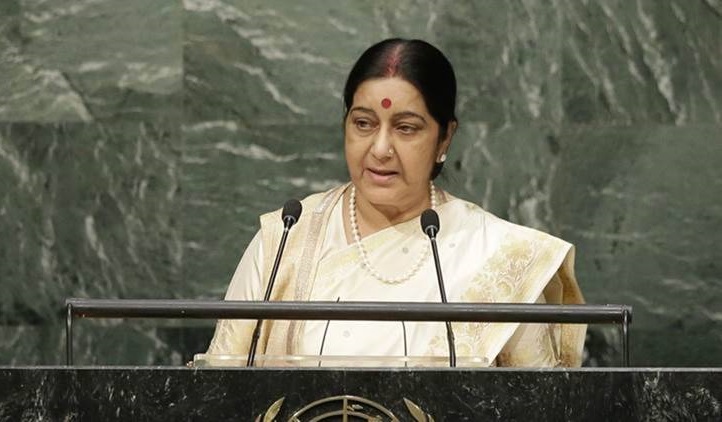
External Affair Minister, Sushma Swaraj today clearly indicated that though the Government has approved the Kartarpur corridor initiative, as it will always stand by regional peace, it should not be misunderstood, as India is not ready for any dialogue process with Pakistan unless Pakistan stopped sponsoring terrorism.
While talking to the media in Hyderabad, as she was there to campaign ahead of the assembly polls, Swaraj said, “Bilateral dialogues and Kartarpur corridor are two different things. I am very happy that for the last 20 years, rather many years, the government of India has been asking for this Kartarpur corridor. For the first time, Pakistan responded positively to this. But that doesn’t mean that the bilateral dialogue will start only on this (Kartarpur). We always say terror and talks can’t go together. The moment Pakistan stops terrorist activities in India, the dialogue can start. The dialogue is not connected with only Kartarpur corridor.”
Sushma used this occasion to also show her strong resentment over Pakistan’s invitation to Prime Minister Narendra Modi to attend the 20th South Asian Association for Regional Cooperation (SAARC) summit. “We are not responding to the invitation unless Pakistan stops terrorism, we will not respond. We will not participate in SAARC”, Sushma asserted.
It is pertinent to mention here that India had boycotted the 19th SAARC summit which was scheduled to take place in November 2016 in Islamabad, following the September 18 terror attack on the military base in Uri in Jammu and Kashmir.
The summit was then cancelled as several countries, including Bangladesh, Afghanistan and Bhutan had also walked out following India’s decision to exit the summit in order to create diplomatic pressure on Pakistan.
Earlier this year, MEA Sushma Swaraj had walked out early of an informal meeting of SAARC nations at the sidelines of the UN general assembly. Swaraj had stated in her short statement that the ecosystem of terrorism can only be dismantled with solid action on the ground.
Before that, India had accepted the newly elected Pakistan PM Imran Khan’s proposal for peace talks after he resumed office. However, after the incidents of abduction and killing of Indian security personnel by Pakistan-sponsored terrorists and the release of Pakistani postage stamps glorifying terrorists, India had cancelled the proposed talks.
The Kartarpur Corridor initiative, which has lately hogged a lot of limelight, will allow Indian Sikh pilgrims to travel to Gurdwara Darbar Sahib in Kartarpur without a visa. It is likely to be completed within six months.


