

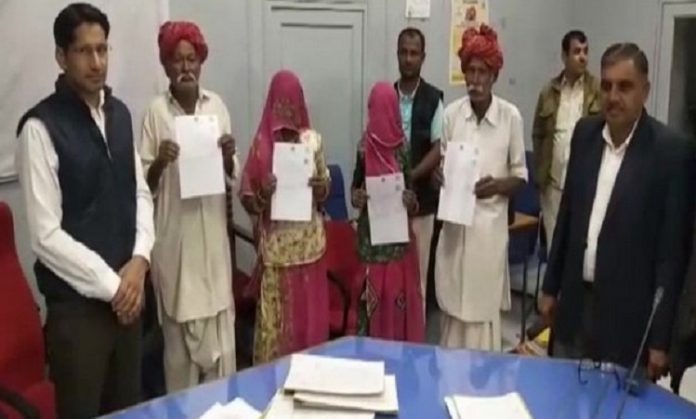
Following the historic passing of Citizenship Amendment Act, which gives citizenship to persecuted minorities of three neighbouring countries, the Jaisalmer district administration has organised a camp on Friday to help refugees from Pakistan to avail the citizenship of India, reports ANI.
According to the reports, the Jaisalmer district administration led by Sub Divisional Magistrate (SDM) Om Prakash Bishnoi had organised the camp in which 15 refugees from Pakistan completed the procedures and formalities necessary to obtain the Indian citizenship rights.
SDM Bishnoi stated that such camps are frequently organised to bring all concerned departments under one platform. He said that the reporting and clearance process is controlled online by the Centre.
On Thursday, the Citizenship (Amendment) Bill, 2019 became an act of law after President Ram Nath Kovind gave his assent to the historic legislation.
Prior to this, both the houses of Parliament had passed the bill after the much-heated debate. The Citizenship (Amendment) Bill was passed by Rajya Sabha on Wednesday and by Lok Sabha on Monday.
The Citizenship Amendment act seeks to give Indian citizenship to the members of Hindu, Sikh, Buddhist, Jain, Parsi and Christian communities who have come from three neighbouring Islamic countries – Pakistan, Afghanistan, and Bangladesh after facing religious persecution.
The Act states the refugees of the six communities will be given Indian citizenship after residing in India for five years, instead of earlier requirement of 11 years. The Act also proposes to give immunity to such refugees facing legal cases after being found as illegal migrants. The cut-off date for granting citizenship will be December 31, 2014.
The law will not be applicable to the tribal areas of Assam, Meghalaya, Mizoram, and Tripura as included in the Sixth Schedule of the Constitution. Further, the law will not cover the areas covered under the Inner Line Permit (ILP), notified under the Bengal Eastern Frontier Regulation, 1873. The ILP regime is applicable in Arunachal Pradesh, Nagaland, and Mizoram.


