

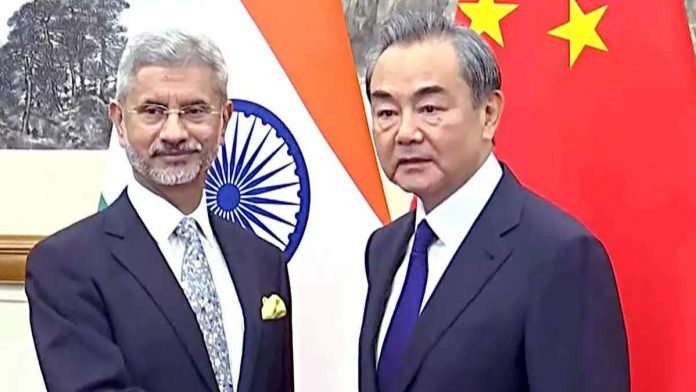
Amid the rising tension at the Line of Actual Control, Indian and the Chinese Foreign Ministers met for a meeting at Moscow in Russia yesterday. The bilateral talks between the Indian Foreign Minister, S Jaishankar and his Chinese counterpart Wang Yi were preceded by a meeting at the Shanghai Cooperation Organisation (SCO) and a luncheon meeting between Russia, India and China (RIC).
The meeting resulted in a five-point course of action on which both the countries agreed. However, a document released by the Chinese Foreign Ministry made certain claims in relation to the agreement reached in the meeting which were categorically rejected by the Indian side. The document claimed that the Indian side did not consider the relations to be dependent on the settlement of the boundary question.
The document further claimed that the Indian side believed that the policy of China towards India has not changed. Both the claims are in direct contrast to the position maintained by India. The Indian Foreign Minister had clearly stated several times that the status of bilateral ties cannot be delinked from the situation at the LAC.
Besides, the five-point plan released by the Ministry of External Affairs does not include any of the claims made in that document. The things agreed upon by both the countries as per the five-point plan are:
- Both the sides should take guidance from the series of consensus of the leaders on developing India-China relations which included not allowing differences to become disputes.
- The present situation at the border areas is not in the interest of the either side and therefore the border troops of both sides should continue their dialogue, quickly disengage, maintain proper distance and erase tensions.
- Both the sides shall abide by all the existing agreements and protocol on China-India boundary affairs, maintain peace and tranquility in the border areas and avoid any action that could escalate matters.
- Both sides should continue to have dialogue and communication through the Special Representative mechanism on the India-China boundary question. And in this context the WMCC (Working Mechanism for Consultation and Coordination) on India-China border affairs should also continue its meetings.
- As the situation eases, both sides should expedite work to conclude new Confidence Building Measures to maintain and enhance peace and tranquility in the border areas.
China’s position regarding the ongoing stand off at the LAC has been ambiguous. While on hand it claims to be in favour of maintaining peace at the LAC and abide by the existing protocols, it also accuses India of aggression and expansionism giving itself a clean chit.


