

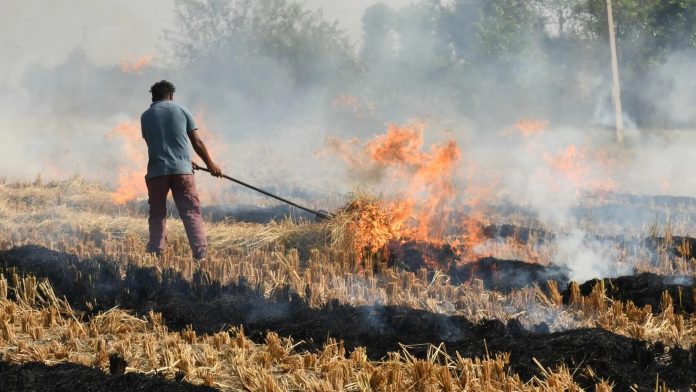
The Delhi government, led by the Aam Aadmi Party (AAP), has spent more than 23 crores on advertising related to air pollution mitigation, but just a few lakhs on acquiring decomposers to actually mitigate pollution caused by stubble burning in the last 2 years. The Delhi government spent over Rs 15.8 crore on advertisement for the Pusa bio-decomposer in 2020-21, and 7.47 crore in 2021-22.
The Delhi government’s Directorate of Information and Publicity (DIP) revealed the amount spent in 2020-21 in a written response to BJP MLA OP Sharma’s inquiry during the Assembly’s Monsoon Session in July 2021. Accordingly, Rs 40,000 was spent on purchasing the chemical to turn stubble into compost in 2020-21.
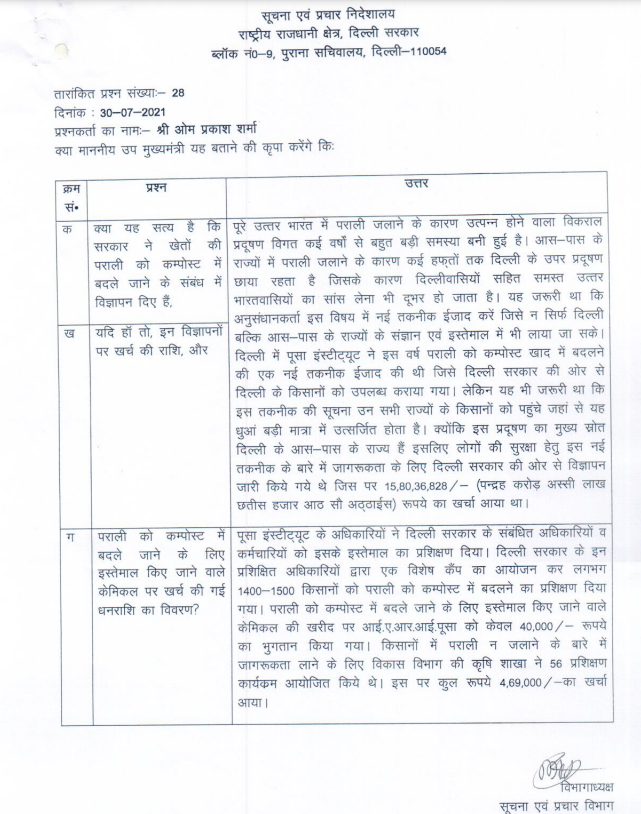
The Agriculture Branch of Development sponsored 56 training programmes at a cost of Rs 4,69,000 to improve farmer knowledge about stubble burning. A total of 15.8 crores were spent only on advertising about the bio decomposer. In 2020-21, the amount spent on advertising is 336 times higher than the amount spent on effective mitigation measures for the problem.
Similarly, for the fiscal year 2021-22, Delhi Assembly Leader Ram Singh Bidhuri has inquired about this. He had inquired how much money the Delhi government had spent in the fiscal year 2021-22 to purchase a bio-decomposer solution for making manure from stubble. In response to this inquiry, the government stated that the Delhi government paid 3 lakh 4 thousand 55 rupees on purchasing a bio-decomposer solution.
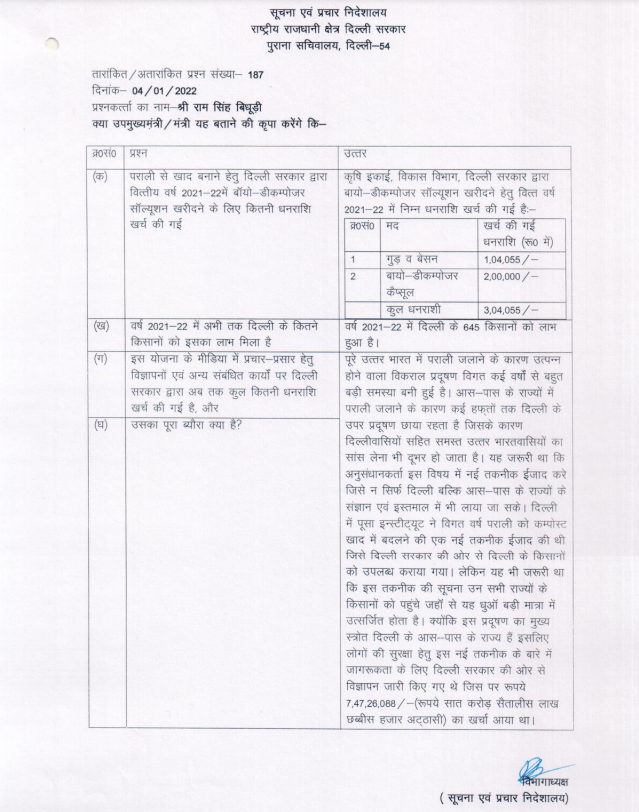
According to the response, Rs 1 lakh 4 thousand 55 was spent on jaggery and gram flour, while Rs 2 lakh was spent on bio-decomposer capsules. A total of Rs 3 lakh 4 thousand 55 was spent in this manner.
In its answer, the Delhi Government stated that, in addition to purchasing a bio-decomposer, Rs 24 lakh 62 thousand was spent on a tractor rented for spraying it and Rs 18 lakh on tents during the fiscal year 2021-22.
As a result, the Delhi government spent around Rs 46 lakh on bio-de-composer spraying in the fiscal year 2021-22. In another part of the response, it has been stated that the Delhi government has spent 7 crores 47 lakh, 26 thousand 88 rupees on advertising the same.
Combining the statistics for the previous two years’ expenditure on stubble burning mitigation, it is evident that more than 23 crore rupees are spent only on marketing. This is around 99% of the entire amount allocated for the purpose.
Stubble Burning and the resulting high levels of air pollution have been a regular characteristic of winters in Delhi, for many years. This issue needs serious attention from the authorities responsible.


