

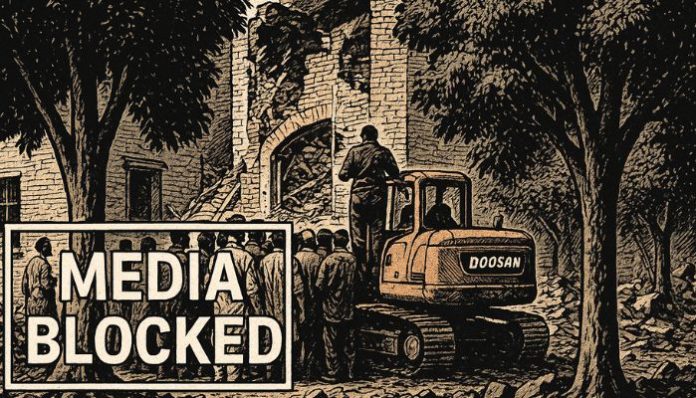
On the intervening night of 6th and 7th May, India conducted a targeted military operation, Operation Sindoor, and destroyed at least nine terror camps deep inside Pakistan and Pakistan-occupied Jammu and Kashmir (PoJK). Indian authorities have confirmed that the strikes were carried out to avenge the Pahalgam terrorist attack that claimed the lives of 26 innocent Hindu tourists and destroyed camps linked to Jaish-e-Muhammad, Lashkar-Taiba and Hizbul Mujhaideen. Meanwhile, Pakistan is as usual trying a cover-up and has blocked media access to all targeted locations. This raises questions about what the hostile neighbouring country is trying to conceal.
At one such site in Muridke, near Lahore, a complex was visibly seen to be damaged, as reported by BBC Urdu. Large buildings within the complex were hit. Eyewitnesses stated that three missiles struck the area and that a mosque within the complex was also destroyed. The location is linked to L:ashkar-e-Taiba’s terror camp, Markaz Taiba Muridke. It is also known as the Nursery of terror. Despite visible rescue operations underway, the presence of police personnel, and scattered debris, the BBC reporter was not allowed access to the actual site. He stated in his report that it was completely cordoned off. The officials also refused to give any statement.
Pattern of denial, repetition of history
This is not the first time Pakistan has blocked media access following strikes by Indian armed forces. After the two successful strikes by India in 2016 (surgical strike) and 2019 (Balakot air strike), Islamabad adopted a similar approach. In fact, Pakistan continued to call surgical strike of 2016 a “figment of imagination” for years. The hostile neighbour dismissed Indian claims, restricted media access, and circulated false narratives using its sold-out media. Only days later did select foreign journalists gain limited access, and they were guided by Pakistani authorities, by which time, the sites were cleaned up. The survey conducted by the media personnel was carried out under heavy surveillance, which raised doubts about the authenticity of the scenes presented.
The current refusal to grant access to the media—especially when India has categorically stated that it successfully neutralised active terrorist launchpads—puts the intentions of the Pakistani government under scrutiny. It appears that Pakistan wants to hide the real casualty figures, particularly those of trained terrorists. Pakistan’s actions suggest an intent to prevent the international community from confirming the nature of the installations that it has repeatedly claimed to be “civilian”.
Speculation will continue to persist unless Pakistan grants full access to the media and comes clean about the exact death toll of terrorists at the sites targeted by India. Until then, the question remains: “What exactly are you hiding, Pakistan?”


