Today marks fifty years since one of the darkest chapters in India’s democratic history, the imposition of the Emergency. The people of India mark this day as Samvidhan Hatya Diwas. On this day, the values enshrined in the Indian Constitution were set aside, fundamental rights…
— Narendra Modi (@narendramodi) June 25, 2025
“It was as if the Congress Government in power at that time placed democracy under arrest!” PM Modi tweeted.
In a subsequent tweet, PM Modi elaborated upon the skulduggery of the Congress government that was in power during the imposition of the emergency. “No Indian will ever forget the manner in which the spirit of our Constitution was violated, the voice of Parliament muzzled and attempts were made to control the courts,” PM Modi tweeted.
PM Modi also acknowledged and paid tributes to those who opposed the Emergency (1975-77), positioning them as guardians of democracy. By referring to “people from all over India, from all walks of life, from diverse ideologies,” he emphasized national unity, inclusiveness, and cross-party collaboration, subtly projecting that the resistance transcended political divides.
We also reiterate our commitment to strengthening the principles in our Constitution and working together to realise our vision of a Viksit Bharat. May we scale new heights of progress and fulfil the dreams of the poor and downtrodden. #SamvidhanHatyaDiwas
— Narendra Modi (@narendramodi) June 25, 2025
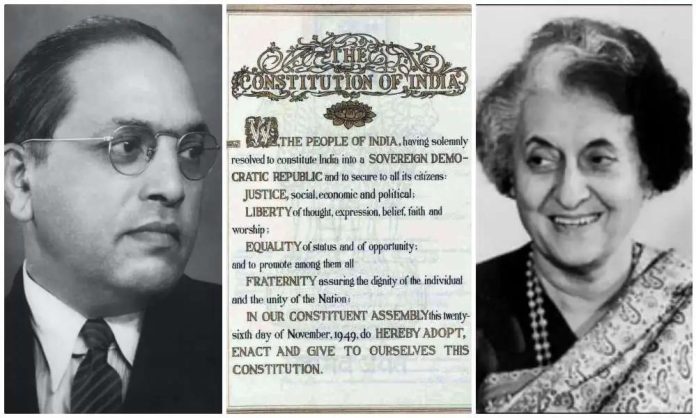
As India reflects on that dark chapter, it is important to revisit an often-overlooked but significant fact: Dr. BR Ambedkar, the man widely hailed as the principal architect of the Constitution, was fundamentally opposed to embedding rigid ideological labels like ‘Socialist’ and ‘Secular’ into the foundational text of the Republic.
His opposition was not grounded in contempt for the values themselves but stemmed from a deep commitment to democracy, individual liberty, and the evolving nature of society.
The foundational debates: Ambedkar’s rejection of fixed ideological labels
The framing of the Constitution of India was marked by intense debates that shaped the identity and future direction of the nation. One of the most crucial debates unfolded on 15 November 1948, when Professor KT Shah proposed that India should be explicitly declared a “Secular, Federal, Socialist Union of States.”
Dr. Ambedkar, serving as the Chairman of the Drafting Committee, firmly repudiated the amendment and offered reasons that continue to resonate even today, especially in the context of political overreach during the Emergency and subsequent debates around constitutional integrity.
Ambedkar raised two primary objections:
1. The Constitution should not impose an ideology
Ambedkar viewed the Constitution as a framework for governance, not as an ideological manifesto. He firmly believed that the Constitution should regulate the functioning of the state, while preserving the freedom of future generations to decide the country’s social, economic, and political direction based on prevailing circumstances.
In response to Shah’s proposal, Ambedkar famously said:
“What should be the policy of the state, how society should be organised in its social and economic side, are matters which must be decided by the people themselves according to time and circumstances.”
His argument was not a rejection of socialism per se, but a rejection of codifying it as an eternal, unalterable principle. Societies evolve. Ideologies that seem relevant at one point in history may be replaced or refined by new systems better suited to future challenges. By embedding socialism into the Constitution, Ambedkar believed it would “destroy democracy altogether” by stripping future generations of the right to choose their own course.
2. Socialist principles were already embedded in the Constitution
Ambedkar also pointed out that the drafted Constitution already reflected socialist values within the Directive Principles of State Policy. He specifically referred to Article 31, which included provisions aimed at preventing the concentration of wealth, ensuring equal pay for equal work, and promoting social justice.
Ambedkar rhetorically asked:
“If these directive principles… are not socialistic in their direction and in their content, I fail to understand what more socialism can be.”
In his view, explicit ideological branding was unnecessary. The Constitution already empowered governments to pursue policies that advanced social and economic equity, without tying the country to rigid dogmas.
Moreover, Ambedkar emphasised flexibility. While socialist ideals had merit, binding the country to them constitutionally would hinder the government’s ability to adapt to new economic realities or emerging philosophies.
The ‘Secular’ debate: Ambedkar’s nuanced approach
While Ambedkar did not present specific reasons against adding the word ‘secular’ to the Preamble during the debates, his overall opposition to Professor Shah’s proposal reflected similar concerns about ideological rigidity.
Notably, Ambedkar was a vigorous advocate for keeping religion and state affairs separate as witnessed during debates on the framing of the Constitution. His commitment to religious pluralism and impartiality was reflected in various constitutional provisions, particularly Articles 14, 15, 16, and 25, which guarantee equality before the law and prohibit discrimination based on religion.
Ambedkar was convinced these safeguards rendered the explicit mention of secularism in the Preamble redundant.
Even Jawaharlal Nehru, the first prime minister of independent India and a thorough proponent of secular governance, argued that Indian secularism differed from its Western counterpart. In Europe, secularism emerged from the historical conflict between Church and State. In India, with its deeply intertwined religious and social fabric, secularism was to be a functional, lived principle rather than a mere label in the Preamble.
The 42nd Amendment: How Indira Gandhi defied the spirit of the Constitution
During the Emergency (1975–77), a period often regarded as the most authoritarian phase in independent India’s history, then Prime Minister Indira Gandhi introduced the 42nd Amendment, inserting ‘Socialist’ and ‘Secular’ into the Preamble.
The amendment was widely criticised as a political move designed to consolidate Gandhi’s grip over state institutions, appease some sections of society through token symbolism, and reframe constitutional ideals to comply with the incumbent government’s preferences.
The context of the Emergency, marked by press censorship, mass arrests, the suspension of civil liberties, and centralised power renders the amendment’s ideological additions suspect.
As PM Modi noted in his June 25 tweets:
“The 42nd Amendment is a prime example of their shenanigans. The poor, marginalised and downtrodden were particularly targeted, including their dignity insulted.”
The amendment, introduced during a period when democracy itself was under siege, stands in stark contrast to Ambedkar’s vision, where constitutional changes should emerge from free, democratic debate, not political insecurity.