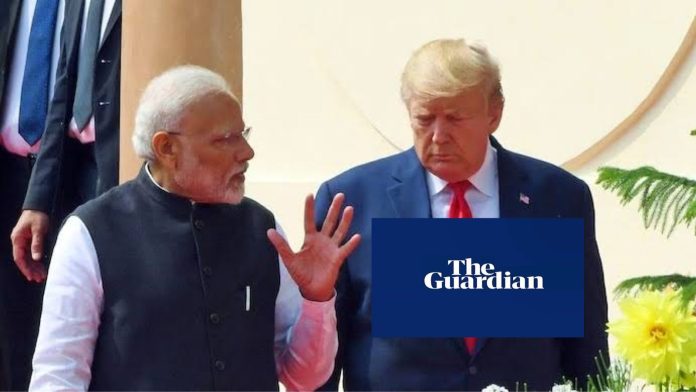
There is something strangely predictable about India’s English-speaking liberal elite. The moment the West throws a tantrum against India, they rush to the nearest foreign media outlet, eager to pen an “I told you so” sermon that blames India, never the West, for the breakdown. The latest to join this brigade of sepoy intellectuals is Mukul Kesavan, who in The Guardian recently authored a column that squarely pins the blame for the temporary strain in Indo-US ties on PM Modi.
The headline itself was dripping with colonial smugness: “Blindsided by Trump, Modi is learning hard lessons about India’s place in the new world order.” In other words, stop pretending you are an equal, India. Know your place. Treat the United States with the respect it commanded half a century ago, or face tariffs.
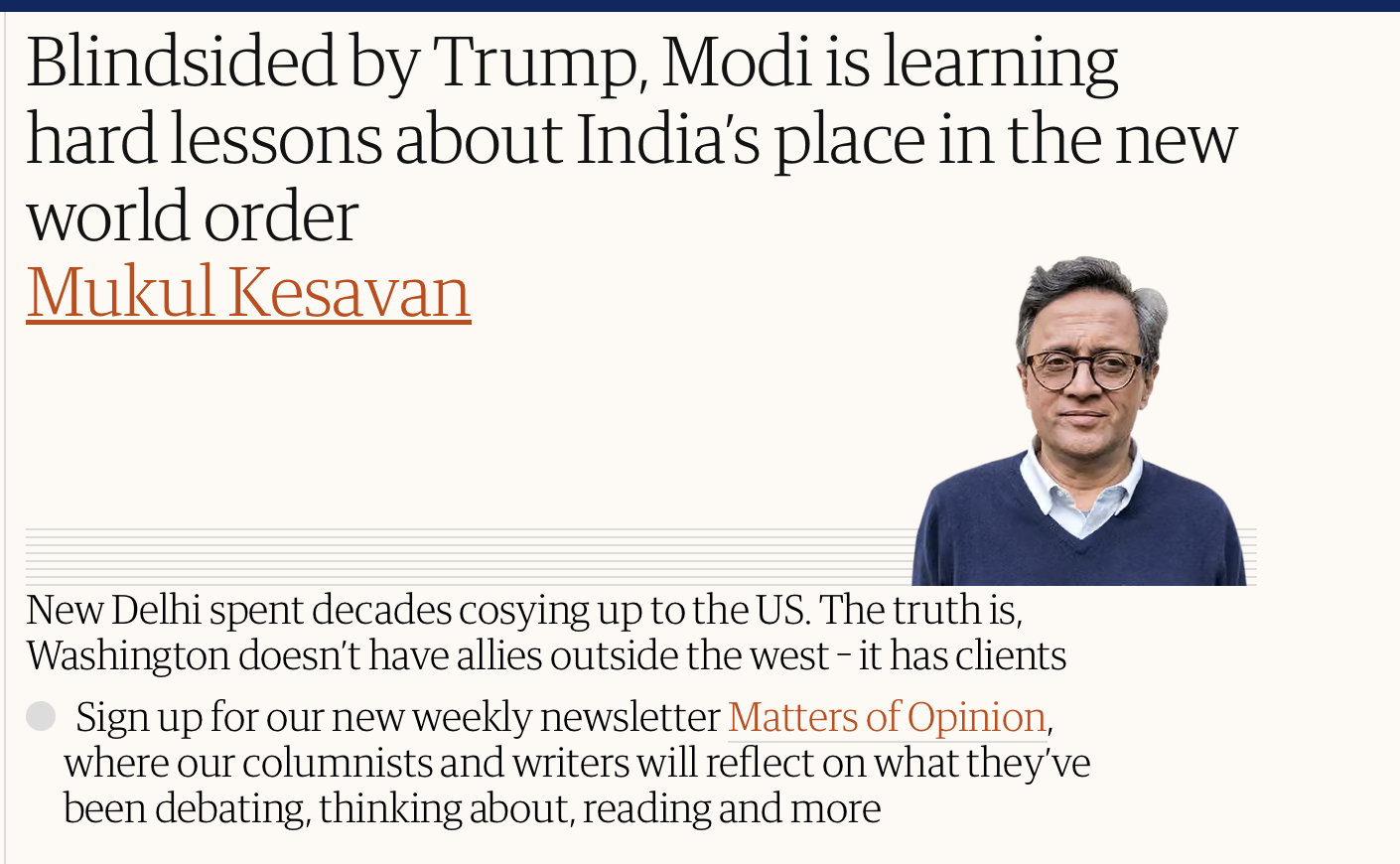
But perhaps the most striking aspect of this entire episode is not the arrogance of Trump, or the opportunism of Western leaders who conveniently target India while sparing China. It is the eagerness of India’s own “brown sepoys” men like Kesavan, to amplify that arrogance and paint it as wisdom. Instead of standing with their own country against foreign bullying, they gleefully side with the bully, gaslighting their readers into believing India committed a big blunder by standing up for her honor and not massaging the ego of a mercurial narcissist.
Trump’s tariffs: A weapon of bullying, not policy
Mukul Kesavan describes Trump’s imposition of tariffs on India as if it were some inevitable lesson in “realpolitik” that Modi failed to grasp. He conveniently glosses over the fact that these tariffs were not a matter of economics but punishment.
In April, Trump slapped India with a 25% tariff, already higher than what most US allies faced. When India refused to yield, that tariff was doubled to 50%. The supposed reason? India’s purchase, refining, and re-exporting of Russian crude oil during the Ukraine war.
Let’s pause for a moment. China is the largest buyer of Russian oil, by far. Yet China faced no such tariff hike. Why? Because the United States knows better than to open a full-blown trade war with Beijing, given the American economy’s dependence on Chinese supply chains. India, on the other hand, was seen as a softer target, a country that could be pressured through economic arm-twisting.
But the calculation backfired. India kept buying Russian oil, ensuring affordable energy for its citizens and a stable refining industry. In fact, far from undermining the global economy, India’s refiners helped stabilise global fuel supplies, with Europe ironically being one of the biggest beneficiaries. The West that sanctioned Russian crude ended up buying Indian-refined Russian fuel.
If anything, India saved Europe from its own energy crisis. Yet, in Kesavan’s telling, India deserves the punishment and Modi deserves the humiliation. Only a sepoy mindset could twist victim-blaming into analysis.
The attack on Ambani and “Brahmins”: Exploiting India’s caste fault lines
Trump’s tariffs were only one part of the strategy. The other was a coordinated smear campaign against India’s business elite. Treasury Secretary Scott Bessent targeted Mukesh Ambani, alleging that India’s richest families were profiteering from Russian crude. The dog whistle was clear: turn the spotlight on Ambani, vilify him, and sow divisions inside India.
Then came Trump’s notorious aide, Peter Navarro. In an extraordinary and deeply offensive statement, Navarro invoked caste politics, accusing “Brahmins” of profiteering “at the expense of the Indian people.” Think about that: a senior White House official casually imported India’s internal caste divisions into global trade negotiations.
Adding to this chorus of arrogance, US Commerce Secretary Howard Lutnick recently declared that India would “say sorry” within a month or two for resisting Trump’s diktats. The remark perfectly sums up Washington’s entitled mindset: expecting India to behave like a vassal state, and exposes why sepoys like Kesavan so eagerly amplify this bullying as “realpolitik.” In reality, Modi’s government has shown restraint and maturity, refusing to dignify such condescension with a reaction while keeping India’s long-term interests paramount.
This was not diplomacy. This was psy-ops, a deliberate attempt to weaponise India’s social fissures in order to pressure the Modi government into signing an unfavourable trade deal. The expectation was that India’s internal critics would amplify these attacks, thereby isolating Modi.
And lo and behold, Mukul Kesavan obliges. Rather than call out the racist, casteist rhetoric of Trump’s advisers, he writes a column in The Guardian blaming Modi for “overreaching” and “miscalculating.” For Kesavan, the real scandal isn’t that American officials mocked India’s caste dynamics, but that India refused to bend.
False equivalence with Pakistan: The old American playbook
Another strand of Kesavan’s argument parrots Trump’s treatment of India and Pakistan as “squabbling South Asian neighbours.” After the Pahalgam terror attack, India launched a swift and decisive response. Trump and his vice president, JD Vance, tried to spin the crisis as if their phone calls had stopped a war. When India refused to endorse this fiction, the White House sulked.
Kesavan frames this as Modi’s failure. But let’s be clear: this is the same American playbook that has been used for decades. Washington loves to bracket India and Pakistan together, reducing one of the world’s largest democracies to the same level as a failed terror-sponsoring state.
Modi rightly rejected this false equivalence. India will never allow its couter-terrorism policies to be dictated by an American president desperate for a Nobel Prize. Yet for Kesavan, India’s refusal to play along is a diplomatic misstep. He is less offended by Trump humiliating India than by Modi refusing to accept the humiliation quietly.
Strategic autonomy: India is not for sale
The central thrust of Kesavan’s piece is that India under Modi foolishly tilted too close to the US, believing it had a permanent seat at the “white man’s table.” This is both historically false and analytically dishonest.
India’s foreign policy under Modi has been remarkably consistent: deepen ties with the United States, yes, but never at the cost of sovereignty. That is why India simultaneously buys Russian oil, expands defence ties with France, joins the Quad with Japan and Australia, and attends SCO summits with Putin and Xi.
This is strategic autonomy: ,the very principle that guided India’s non-alignment during the Cold War, but now adapted to a multipolar 21st century.
Ironically, Kesavan himself admits this when he says “Non-alignment flies today under the flag of strategic autonomy.” Yet he still twists it into a criticism, as if Modi should apologise for pursuing exactly what every serious Indian statesman from Nehru to Vajpayee aspired to: an India free to choose its partners, not dictated to by any bloc.
The irony is that Trump himself, in a rare moment of honesty, admitted that the US had “lost India and Russia to China.” What he didn’t say was that it was his bullying, his tariffs, his casteist taunts, his attacks on Indian business, that drove India to broaden its embrace of multipolarity.
Kesavan’s anger is not that Modi “lost” America. It is that Modi refused to lose India’s dignity to please America.
The dignity of silence vs. the cowardice of sepoys
Through all of the tariffs, the attacks on Ambani, the Brahmin jibes, and the veiled threats, India has maintained a dignified silence. Modi even reciprocated when Trump recently extended an olive branch, calling him a “great friend.” That is statesmanship: refusing to be dragged into the mud, keeping long-term strategic interests above short-term slanging matches.
Perhaps, Kesavan would interpret this perforative charm offensive by Modi as weakness. But what he calls weakness is in fact maturity. A confident India doesn’t need to issue X rants. It plays the long game. Sadly, brown sepoys like Kesavan, blinded by ideological prejudice and crippled by intellectual shallowness, simply lack the depth to grasp this nuance.
Kesavan’s piece betrays his abject lack of maturity as he rushes to The Guardian, the favourite platform of colonial nostalgia masquerading as progressive thought, and writes a lecture about how India should know its place.
This is the essence of the brown sepoy: silence when the West insults India, but loud indignation when India refuses to bow.
Historical parallels: From Nehru’s kowtow to Modi’s spine
To understand the contrast, let us recall history. In 1962, when China invaded India, Nehru begged the Americans for military help. Washington’s response was humiliating: they offered conditional aid, lectured India on its “socialist policies,” and even toyed with mediating Kashmir in exchange. Nehru swallowed the insult because he had no choice.
In 1971, during the Bangladesh Liberation War, Indira Gandhi faced the same American arrogance. Richard Nixon and Henry Kissinger called her names, sent the Seventh Fleet into the Bay of Bengal, and tried to bully India into submission. But Indira, unlike Nehru, stood firm. India liberated Bangladesh and rewrote South Asia’s map.
Fast forward to 2025. Modi faces similar bullying. This time through tariffs and oil diplomacy rather than fleets and armies. And like Indira, he refuses to blink. He keeps India’s interests of prime importance, whether in buying Russian oil or refusing unequal trade terms.
The sepoys who once applauded Nehru’s humiliations now criticise Modi’s defiance. That is the inversion of India’s liberal elite: surrender is “sophistication,” but sovereignty is “hubris.”
The real “hard lesson”
The Guardian headline sneers that Modi is “learning hard lessons about India’s place in the world.” But the truth is the opposite. The real hard lesson is being learned in Washington: that India is no longer a pushover.
Trump is realizing the hard way that hyphenating India and Pakistan was a big mistake; that Modi is not someone like Asim Munir who could be influenced by simply inviting him over for a sumptuous meal at the White House.
India will not be told who it can trade with. India will not apologise for buying affordable oil. India will not accept being bracketed with Pakistan. India will not sign a bad trade deal just because the American President wants us to.
If that frustrates Trump, so be it. If that makes Mukul Kesavan choke on his colonial hangover, even better.
Because this is the India of 2025: proud, assertive, civilisationally confident. It knows that the West’s “rules-based order” was always a euphemism for Western hegemony. And it knows that the multipolar world is here to stay.
Learning for sepoys and the West: India will not crawl when asked to bend
At the end of the day, this is what it boils down to. Mukul Kesavan and his ilk see India’s refusal to bow as a failure, not as a nationalistic defiance. They measure success not by what India achieves for its people, but by how well India conforms to Western approval.
PM Modi, whatever his critics say, measures success differently. For him, India’s dignity is non-negotiable. And that is precisely why the sepoy class despises him: because he exposes their irrelevance in a world where India no longer needs their colonial hand-holding.
So let us be clear: Modi is not “blindsided.” India is not “learning its place.” It is Trump and his sepoys who are learning theirs that in this new world order, India will not crawl when asked to bend. It is a reminder to everyone that India, under Modi, is not the timid nation of yesteryears. It is a confident civilisational power that knows how to stand up against bullying, protect its interests, even if that unsettles both Washington and its sepoy cheerleaders.