Bengal was one of the worst-affected areas during the colonial rule, enduring not only the scars of communal violence inflicted by Islamists but also suffering from the divide-and-rule strategy employed by the British. Subsequently, it was separated into two parts by a permanent boundary, with one section being transferred to Islamists under the guise of religion during the partition of the country in 1947.
While the nation was emancipated from the bonds of the British Empire, the colonisers left a violent legacy with this move. It stood as a stark manifestation of their brutality that dimmed the dawn of independence for India. The situation was dire in Bengal during partition. Millions of people were forced to migrate as partition ripped over the region like a jagged wound and wreaked unprecedented havoc.
An indifferent barrister sketches India’s future
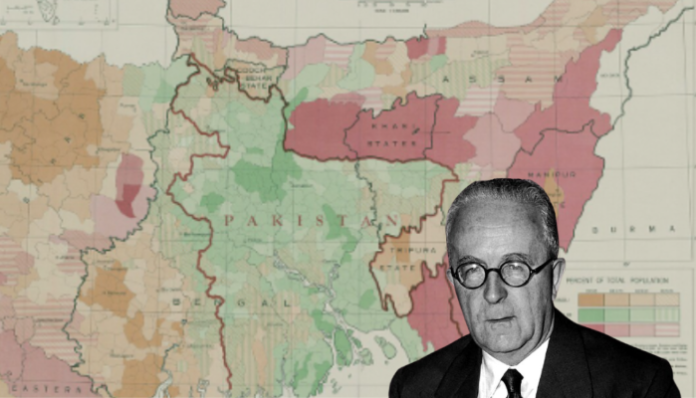
Sir Cyril Radcliffe was entrusted with the task of splitting the country into two parts. He was a London-based barrister who had “never travelled east of Paris,” much less visited India. However, he was entrusted with the crucial responsibility, illustrating their commitment to the future of a nation and its populace which they had already torn apart during their nearly 200 years of oppressive regime. .
The mission assigned to Radcliffe was to draw the border that would split the undivided nation into India and Pakistan within 5 weeks. He drew two international borders while serving as the chair of the Boundary Commission: one in Bengal that split India from East Pakistan (Bangladesh) and another in Punjab that parted India from West Pakistan (Pakistan).
His primary criterion was that areas with a greater proportion of the Hindu community should be given to India while those with Muslim majority should belong to Pakistan.
Radcliffe created a line that led to one of the biggest humanitarian catastrophes in history and profound errors began to surface. India gained independence but his actions left residents of several border towns in Bengal on edge for three full days. People were filled with anxiety, uncertainty and confusion. The same delayed their independence from 15th August to 18th August 1947.
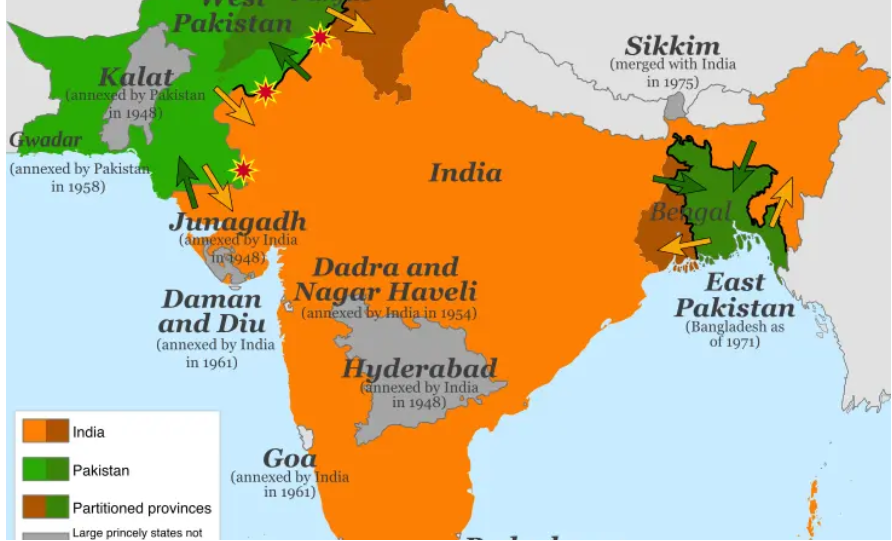
Radcliffe awarded a portion of Nadia to East Pakistan while drawing the line that would later bisect Bengal. East Pakistan was also given the possession of the entire Murshidabad and sizable portions of Malda, Dinajpur and 24 Parganas.
Independence arrived three days later in some parts of Bengal
A few days before 15th August 1947, an All-India Radio broadcast revealed that East Pakistan had been granted authority over portions of Bengal’s border districts, including Malda, Nadia, Murshidabad and North 24 parganas. These towns and villages had a large Muslim population. However, they were dominated by Hindus and had ended up on the wrong side of the boundary.
People were in a panic and large-scale protests transpired in a few border towns and villages on 15th August. There was a complete blackout in several areas and women refrained from cooking for two days. The Hindu majority launched strong demonstrations.
The Muslim League retaliated by hoisting their crescent flag on 14th August and their followers marched through the streets while yelling “Allahu Akbar” slogans as tensions flared. The documented history of the partition disclosed that Muslim League supporters in Nadia’s Town Hall, English Bazar, Murshidabad, Ranaghat and other parts of the new frontier displayed the flag of Pakistan.
Tushar Kanti Ghosh, a retired teacher recounted, “It was the darkest dawn ever when we saw the Pakistan flag hoisted atop the Malda district collectorate’s office,” reported The Times of India. The fear of potential assaults by Muslim mobs was so great that Hindus were advised to keep boiled water in large containers to protect their homes from possible attacks.
The Nadia royal family was leading the agitation against the decision as East Pakistan had also acquired their capital, Krishnanagar. The raising of the Pakistani flag by the Muslim League at the Krishnanagar District Library which is close to the royal palace, particularly infuriated the family.
Similar reports emerged from other areas as many people including prominent figures registered their opposition. “It was an error by the Boundary Commission that created the misunderstanding. Eminent personalities like Ashu Choudhury and Baldevananda Giri were in Kolkata overnight and appealed to the commission to include Malda in India,” highlighted senior journalist Md Ataullah.
Lord Louis Mountbatten, the final British Governor-General who presided over the handover of sovereignty from Britain to the two nations, received appeals from prominent figures in Bengal and the Nadia royal family. Radcliffe was then instructed to correct his wrongdoing by Mountbatten.
These regions were regarded as Pakistan for three days from 14th to 16th August. However, the commission then formally declared that only parts of three districts (Malda, Dinajpur, and Jalpaiguri) and three Muslim majority subdivisions of Nadia (Meherpur, Chuadanga and Kustia) would be transferred to East Pakistan as India would retain the rest, on the night of 17th August.
A historical injustice was corrected. As a result, these towns and villages observe 18th August as the “Bharat Bhukti Dibas” (India Inclusion Day). They now raise the tricolour on 15th August in unison with the rest of India as well as on 18th August which is their own Independence Day.
Rectification of the “Radcliffe Line”
The Radcliffe Line was changed in response to uprisings in a number of these regions with a Hindu majority. Murshidabad was returned to India as the districts of Malda, Nadia and Dinajpur were divided and distributed between both nations.
24 Parganas and the Bongaon subdivision of the Jessore district of East Pakistan were merged. Three days later, eleven of the 16 police station areas in the Malda district were returned to India, after Radcliffe gave them to East Pakistan on 15th August.
On 18th August, Ashok Sen, the district magistrate of Malda at the time, raised the Indian national flag in the district’s administrative building to signify the district’s integration into India.
The genesis of a blunder
On 9th August, Radcliffe submitted the award report on Bengal. The paperwork concerning transfer of power outlined that Lord Mountbatten asked his staff whether it would be preferable to publish it immediately. The counsel appeared to have supported postponing the announcement. They alleged that British would be held accountable for the ensuing “disturbance.”
Hundreds of thousands of unassuming individuals had no idea where their house and homeland stood after boundaries were formed. Their lives were put at stake merely to uphold British interests. The Congress party had claimed 59% of the entire undivided region for India. However, roughly 36% of the territory was granted to West Bengal by Radcliffe’s boundary commission.
Radcliffe also ceded the entire Chittagong Hill Tracts to Pakistan which were dominated by Buddhist tribal people, on the grounds that its economic survival depended on connections to Chittagong port, despite fierce opposition.
Furthermore, political figures, powerful businessmen, regents and even Lord Mountbatten made numerous demands of Radcliffe. On the other hand, the maps and census records that were provided to him were either out-of-date or inaccurate. Additionally, he was not pleased with the Boundary Commission members.
The commission was set up for disaster which it indeed turned out to be as a result of the negligence and reckless attitude of the British.
Celebrations to commemorate integration into India
Local historian Anjan Sukul had contacted the state government, presenting documentary evidence to seek authorization for the Independence Day celebrations on 18th August. However, the then-Chief Minister Jyoti Basu denied the request.
Afterward, he met with Prime Minister P V Narasimha Rao. The Ministry of Information and Broadcasting then approved the submission to celebrate Independence Day on 18th August 18th and raise the tricolor flag.
Now, the national flag is hoisted, cultural activities are organized and processions are taken out on 17th August while separate celebrations of an even grander scale are held on 18th August.