

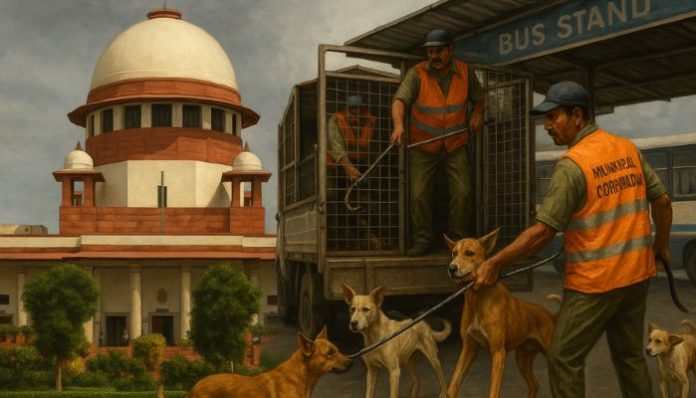
On 7th November, the Supreme Court of India ordered all states and Union Territories to remove stray dogs from educational institutions, hospitals, sports complexes, bus stands and depots, railway stations, and other government buildings. These dogs, as per the orders, must be moved to a designated shelter after due sterilisation and vaccination as per the ABC Rules 2023. The apex court has categorically said that these dogs “shall not be released back to the same location from which they were picked up”.
The order passed by the three-judge bench of the Supreme Court comprising Justice Vikram Nath, Justice Sandeep Mehta and Justice NV Anjaria dealt with three separate issues. The first matter that was discussed in the order was the compliance affidavits that the apex court had asked the states and UTs to file but they failed to submit by 27th October. After the court expressed dismay and ordered all State Secretaries to be physically present at the next hearing, which was on 3rd November, not only were the affidavits filed but the officials were also present.
Amicus Curiae Gaurav Agrawal prepared a summary of the compliance affidavits submitted by the States and UTs, which highlighted grave deficiencies and shortcomings in the information furnished by some of the States and UTs. The court noted that compliance with the directions issued by the court was either not effected or remained incomplete. The court ordered the States and UTs to peruse the report and take appropriate steps to address the deficiencies and shortcomings mentioned. The States and UTs have been directed to file comprehensive additional affidavits before the next date, indicating the remedial measures undertaken to ensure full compliance with the directions of the court and to rectify the lapses highlighted by Khanna in his report. “Any lethargy in this regard shall be viewed seriously,” the court said.
The court ordered to remove animals from highways
The second matter that the court dealt with was about the directions issued by the Rajasthan High Court’s Jodhpur bench ordering the state to remove all cattle and other animals from public roads and highways to prevent accidents caused by them. The court noted that such accidents have become alarmingly frequent across the country, leading to loss of human life, grievous injuries, and damage to property. Calling it “symptomatic of a larger failure on the part of the administrative authorities entrusted with public safety”, the court noted that the uncontrolled presence of cattle and stray animals on National Highways, National Expressways, and State Highways is a serious and avoidable threat, “particularly during night-time or in high-speed zones”.
Citing Article 21 of the Constitution of India that guarantees the right to life and safety, the court said that there is a need for immediate, coordinated, and sustained action by all concerned agencies including municipal authorities, road and transport departments, public works departments, and highway authorities.
Thus, the court reaffirmed the Rajasthan High Court’s directions and extended them to MCs, road and transport departments, PWDs of all states and UTs, and the National Highway Authority of India, and ordered them to remove all cattle and other stray animals from State Highways, National Highways, and National Expressways.
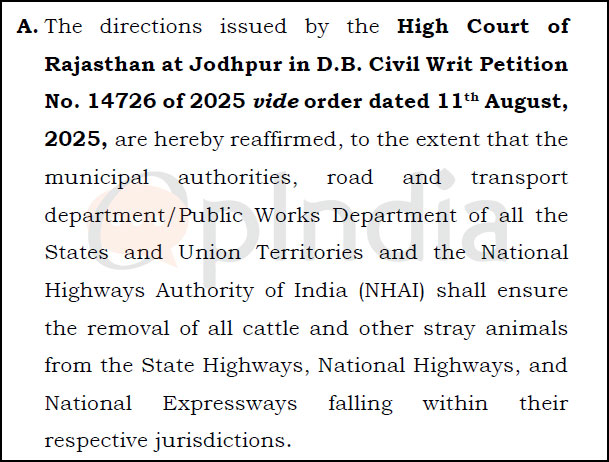
The court specifically said that the animals must be relocated to Gaushalas, in the case of cattle, and designated shelters, in the case of other animals including dogs. Furthermore, the animals should be provided with all necessary food, water, and veterinary care in accordance with the provisions of the PCA Act 1960 and the ABC Rules 2023.
Special 24/7 teams are to be formed for continuous surveillance and immediate response to reports of stray cattle and other animals obstructing the roadways. All National Highways, State Highways, and National Expressways should display helpline numbers linked to the control rooms of the local police, NHAI, and district administration at regular intervals so that commuters can report the presence of stray animals or accidents caused by the animals.
The court has directed the Chief Secretaries of all States and UTs, the chairperson of NHAI, and the Ministry of Road Transport and Highways, Union of India, to file status-cum-compliance affidavits within eight weeks from the date of the order, indicating the mechanism established for removal and sheltering of stray animals from highways, the constitution and functioning of patrol teams, and the operational status of helpline numbers and installation of signboards displaying helpline numbers.
Remove dogs from institutional premises including schools, colleges, railway stations, bus stands and hospitals
The third and most important aspect of the order was about the removal of dogs from educational institutions, hospitals, sports complexes, bus stands and depots, and railway stations. The court noted that there is a disturbing increase in dog-bite incidents within the premises of institutional areas. The court said, “The recurrence of such incidents, particularly within institutional spaces meant for learning, healing, and recreation, reflects not only administrative apathy but also a systemic failure to secure these premises from preventable hazards. The situation calls for immediate judicial intervention to safeguard the fundamental right to life and safety of citizens, especially children, patients, and sportspersons, under Article 21 of the Constitution of India.”
The court further pointed out that scientific assessments, including those conducted by WHO and NCDC, have estimated that a large ratio of animal-related deaths annually in India are attributed to rabies, with over 90% of human cases resulting from bites inflicted by domestic or stray dogs. The court said, “The brunt of this menace has been borne by children, elderly people, and economically weaker sections who, in addition to being vulnerable, also lack timely access to post-exposure prophylaxis,” an issue that OpIndia has repeatedly raised in detailed articles on the stray dog menace.
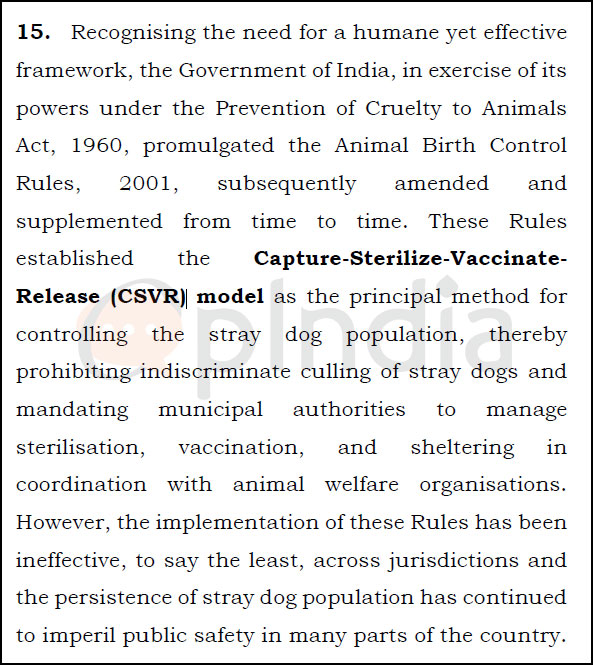
The court said though the Capture-Sterilise-Vaccinate-Release or CSVR model under ABC Rules 2023 is used as the principal method for controlling the stray dog population, the implementation of these rules has been ineffective across jurisdictions, and the persistence of the stray dog population has continued to “imperil public safety in many parts of the country”.
The court cited several cases reported in mainstream media, including a Welsh entrepreneur bitten by a stray dog during a morning run, a class III student bitten by a stray dog inside a classroom in Panamaram of Wayanad district in Kerala, six students bitten by a stray dog that entered a government primary school in Siswal of Hisar district in Haryana, students bitten by stray dogs in the Bengaluru University Campus in the Kengeri area, multiple patients bitten by stray dogs in IMH Kilpauk of Chennai, five people bitten by a stray dog at Ernakulam General Hospital in Kochi, patients attacked by stray dogs at Acharya Harihar Post Graduate Institute of Cancer in Cuttack, Odisha, a resident doctor bitten by several stray dogs at Government Medical College and Hospital in Nagpur, two doctors, paramedical staff, and an attendant bitten by a stray dog at King George’s Medical University, Lucknow, two foreign coaches bitten inside Jawaharlal Nehru Stadium, New Delhi, during the World Para Athletics Championship 2025, 18 people bitten at the Railway Station in Kannur, Kerala, nine people including an RPF officer bitten by a stray dog at Dombivli Railway Station, Maharashtra, 30 people bitten by stray dogs in six months at Alappuzha Railway Station, Kerala, eight persons bitten by a rabid dog at Sambhal Railway Station in Uttar Pradesh, 50 people attacked by a stray dog at Kannur Bus Stand, Kerala, and several people bitten by a stray dog at KSRTC Bus Stand in Kottayam, Kerala.
The court noted that uncontrolled reproduction of stray dogs due to inadequate implementation of sterilisation programmes, improper disposal of food waste, absence of effective perimeter management and institutional coordination, and lack of widespread public awareness regarding preventive conduct and post-dog-bite medical procedures are some of the reasons for the stray dog menace.
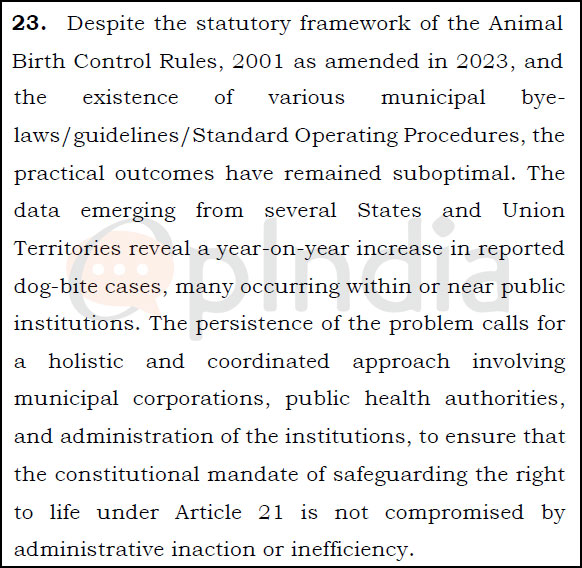
Despite the ABC Rules, various municipal bye-laws, guidelines, and SOPs in place, the practical outcomes have remained suboptimal, the court said. Furthermore, the court noted that year-on-year data on dog bites has shown a spike in such cases. “The persistence of the problem calls for a holistic and coordinated approach involving municipal corporations, public health authorities, and the administration of the institutions, to ensure that the constitutional mandate of safeguarding the right to life under Article 21 is not compromised by administrative inaction or inefficiency,” the court noted.
The court, hence, gave two weeks’ time to State Governments and UTs to identify all government and private educational institutions, hospitals, public sports complexes, bus stands and depots, and railway stations. The administrative heads of these institutions have been directed to coordinate with local or municipal authorities under the overall supervision of the District Magistrate and secure the premises using fences, boundary walls, gates, and such other structural or administrative measures to prevent the ingress of stray dogs. The exercise should be completed as soon as possible, preferably within eight weeks.
Furthermore, the management of all educational institutions, hospitals, sports complexes, bus stands and depots, and railway stations have been asked to designate a nodal officer responsible for the upkeep and cleanliness of the premises and to ensure that stray dogs do not enter or inhabit the campus. The details of the assigned officer are to be displayed prominently at the entrance.
Every three months, local municipal authorities and panchayats should carry out inspections of all such premises to ensure that there are no stray dogs. “Any lapse in this regard shall be viewed seriously, and responsibility shall be fixed upon the concerned municipal officials or administrative authorities,” the court directed.
The court said that it is the responsibility of the municipal body to remove every stray dog found within the abovesaid premises and shift the animal to a designated shelter after due sterilisation and vaccination as per ABC Rules 2023.
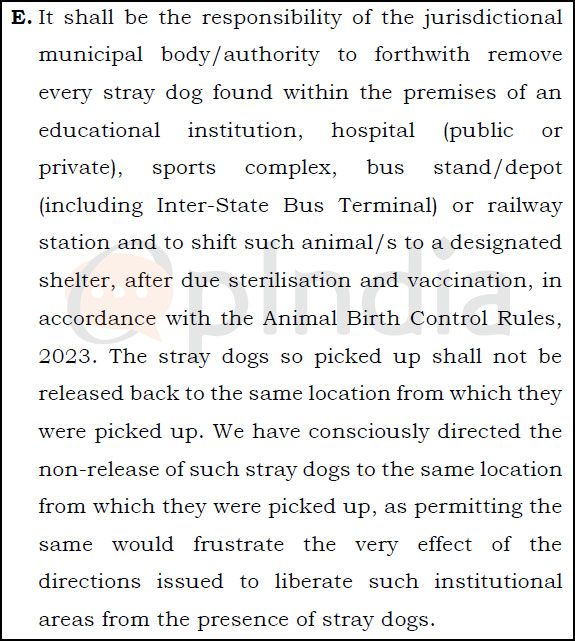
The court barred the release of the dogs to the same location and said, “The stray dogs so picked up shall not be released back to the same location from which they were picked up. We have consciously directed the non-release of such stray dogs to the same location from which they were picked up, as permitting the same would frustrate the very effect of the directions issued to liberate such institutional areas from the presence of stray dogs.”
Furthermore, the management of stadiums and sports complexes has been asked to deploy security or ground-keeping personnel specifically to ensure there are no stray dogs at the premises.
The Animal Welfare Board of India has been directed to issue a detailed SOP within four weeks for the prevention of dog bites and the management of stray dogs in institutional premises.
Notably, when the court narrated the order during the hearing on 7th November, the counsel representing NGOs and self-styled dog lovers tried to argue that removing dogs from institutional premises would lead to a vacuum attracting new dogs, but the court refused to consider the argument.
Sr Adv Anand Grover: Please consider…hear us before…
— Live Law (@LiveLawIndia) November 7, 2025
A party in person: New dogs will occupy territory if you remove them
Bench refuses to consider submissions and modify order.#StrayDogs
With this order, the court has taken a decisive step towards prioritising human life and safety. While it marks an important beginning, the court may also need to recognise the growing problem of stray dogs in gated societies, parks, and residential areas, where children, the elderly, and vulnerable groups face attacks almost daily. The order has sparked concern among animal welfare groups and self-styled dog lovers, some of whom are reportedly planning to appeal against the 7th November order, arguing that it is harsh towards dogs and other animals, including cattle, as the court has also directed their removal from highways. Ultimately, it will now be for the court to balance compassion for animals with the protection of human lives.
OpIndia is doing a series on stray dog menace that can be checked here.


