

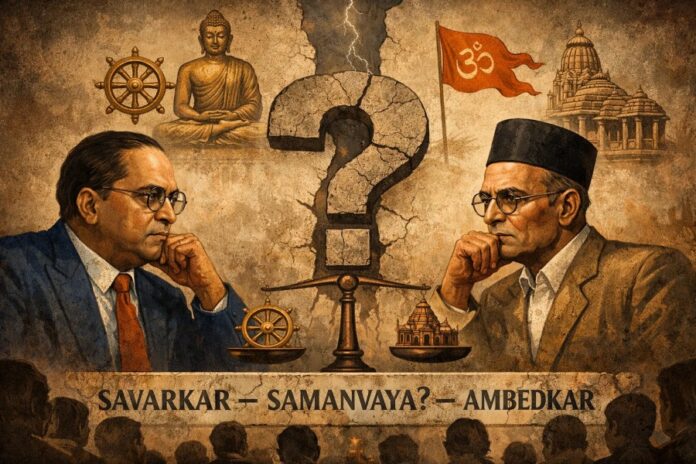
Today, a serious churn is underway within the Hindutva movement regarding the viability of a samanvaya between V.D. Savarkar (hereafter referred to as ‘Savarkar’) and B. R. Ambedkar (hereafter referred to as ‘Ambedkar’). A growing section now openly questions whether such a harmonization is either intellectually sound or strategically wise. This internal divide, however, is not simplistic. Those who advocate this samanvaya fall broadly into two camps.
The first supports it for electoral and pragmatic reasons. They view Ambedkar’s symbolic capital as socially and politically indispensable and believe that integrating him into the Hindutva narrative strengthens coalition-building and expands outreach. The second camp, however, supports this samanvaya on ideological grounds. For them, Ambedkar isn’t limited to just being a Dalit emancipator or the architect of the Constitution. He is a Hindu civilizational icon. He is deified as Bodhisattva Babasaheb Ambedkar. It is this ideological position that requires closer scrutiny.
This article will primarily engage the latter claim: the attempt to present Ambedkar as organically and ideologically aligned with Savarkarite thought. At the same time, it will argue that the electoral pragmatism adopted by the BJP–Sangh ecosystem in this regard is a double-edged sword, carrying long-term risks alongside short-term gains.
While the electoral motivations of the first camp are transparent, the second camp, which frames this project as a matter of civilizational synthesis, must explain why Ambedkar, in particular, is elevated as the necessary counterpart to Savarkar. Is it based on the belief that both Savarkar and Ambedkar grasped partial truths, and that their harmonization would produce a more complete civilizational framework? Or is it an attempt to draw Ambedkar’s admirers into the Hindutva fold by asserting that the two figures were fundamentally aligned? That burden of explanation rests with them.
We will consider the arguments which support their hypothesis of samanvaya:
- Savarkar & Ambedkar diagnosed caste as a civilisational pathology that needed to be dismantled and overcome.
- Ambedkar, even though he converted out of Hinduism, converted to Buddhism, thereby staying within the Dharmic fold.
- Ambedkar adopted the Savarkarite definition of the Hindu as the legal definition.
- Savarkar praised Ambedkar’s efforts to emancipate the Depressed classes.
- Savarkar & Ambedkar both shared a concern for Muslim communal politics.
On Hinduism and Caste
While it is true that both Savarkar and Ambedkar called for the dismantling of the caste order, the similarity largely ends there. The structural divergence lies in their diagnosis of the problem and the civilizational conclusions they drew from it.
Without entering into the merits of their historical claims, the central question is this: Did they view caste as an internal degeneration of Hindu society, for which responsibility lay collectively across the community? Or did they view it as a system rooted in Brahmanism?
A reading of Ambedkar’s works, particularly ‘Who Were the Shudras?’, makes his position clear. He argued that the Shudras were originally part of the Kshatriya order and were later degraded following conflict with Brahmins, who denied them ritual status and pushed them into the fourth varna. Caste, in this telling, was the outcome of historical struggle and power consolidation. In his unfinished manuscript ‘Revolution and Counter-Revolution in Ancient India’, Ambedkar framed Indian history as a prolonged struggle between Brahmanism and Buddhism. Brahmanism embodied ritual supremacy and graded hierarchy. Buddhism represented egalitarian and anti-caste impulses. Caste thus emerged, in his framework, as the product of a dominant priestly order entrenching itself. The oppression of lower castes was interpreted in structural, almost class-like terms. Essentially, Marxist dialectics of oppressor and oppressed were mapped onto the caste order.
Those who seek to establish samanvaya must therefore confront an uncomfortable question. Are they overlooking the implications of importing such dialectics into the civilizational reading of Hindu history? Or is the situation more serious? Do they implicitly accept this framing, wherein large stretches of Indian history are reduced to a moral drama of a malevolent priestly class subjugating the rest of society? If the latter is conceded, then the very civilizational continuity that Hindutva seeks to defend is reinterpreted through the lens of structural oppression rather than organic evolution.
One cannot simultaneously defend Hindu civilization as a continuous cultural inheritance and endorse a framework that treats its foundational institutions as instruments of systemic domination. That tension must be addressed without emotive rhetoric.
But the battle is not lost for Ambedkar’s Hindutvavadi admirers. They posit that Ambedkar posited that a “tectonic shift” occurred within the Hindu social fabric: a transition from a Guna-Karma (merit and action) framework of Varna to a rigid, birth-based system of caste. But even this wasn’t acceptable to Ambedkar. He wrote,
‘…. if under the Chaturvarnya of the Arya Samajists an individual is to take his place in the Hindu Society according to his worth, I do not understand why the Arya Samajists insist upon labelling men as Brahmin, Kshatriya, Vaishya and Shudra. A learned man would be honoured without his being labelled a Brahmin. A soldier would be respected without his being designated a Kshatriya. If European society honours its soldiers and its servants without giving them permanent labels, why should Hindu Society find it difficult to do so, is a question which Arya Samajists have not cared to consider.’
– Annihilation of Caste: The Annotated Critical Edition (Navayana, 2014), p. 222.
He questioned the very nature of what was called “Hindu religion,” writing:
‘What is this Hindu Religion? … What is called Religion by the Hindus is nothing but a multitude of commands and prohibitions… To put it in plain language, what the Hindus call Religion is really Law, or at best legalized class-ethics.’
– Annihilation of Caste: The Annotated Critical Edition (Navayana, 2014), p. 252.
He went further:
‘I have, therefore, no hesitation in saying that such a religion must be destroyed… There is nothing irreligious in working for the destruction of such a religion.’
– Annihilation of Caste: The Annotated Critical Edition (Navayana, 2014), p. 253.
It is a foundational critique. Though some argue that he intended only to reject caste-sanctioning portions of scripture, his own words reveal a broader indictment. He saw the Shastric framework itself as intrinsically juridical, hierarchical, and morally stifling. And before the typical retort comes from within Hindutva circles that Shastra here refers to only Smritis, Ambedkar categorically included Vedas, Ramayana, Mahabharata, Gita as part of the Brahminical literature. Consequently, a part of Brahminism.
Savarkar’s framing was fundamentally different. He rejected the notion that caste oppression could be attributed to one varna or to “Brahmanism” as a conspiratorial force. For him, caste discrimination was a collective Hindu failing. Savarkar did not treat the Dharma Shastras as eternally binding mandates. He was willing to reject injunctions that harmed social cohesion. But Savarkar opposed retrospective interpretations that portray the entire civilizational past as uniformly oppressive. In his view, many scriptural injunctions were contextual and may have served social purposes in their own time. However, he regarded them as historical documents of Hindu civilization. When Ambedkar publicly burned the Manusmriti, Savarkar condemned the act, comparing it to the destruction of Nalanda by Islamic invaders (Samagra Savarkar Vangmaya, Vol. 7, pg: 265). For Savarkar, even seemingly flawed texts were part of a civilizational archive.
Their divergence extends to Buddhism. Ambedkar embraced Buddhism as a civilizational alternative. It was looked at as a moral and social revolution against Brahmanical hierarchy. Savarkar, by contrast, criticized what he saw as the political consequences of Buddhist dominance, arguing that excessive pacifism weakened India’s martial capacity. In Six Glorious Epochs of Indian History, he presented a counter-narrative of Hindu resurgence and valor, implicitly challenging depictions of Hindu history as one of continuous oppression or defeat. Incidentally, Savarkar, in ‘Randundubhi’, dedicated a whole chapter to counter Ambedkar’s assertion of ‘The Hindus’ has been a life of continuous defeat (Babasaheb Ambedkar writings and speeches, Volume 17, Part 2, pg: 19).
The divergence, therefore, is not over whether caste should be annihilated, but over how Hindu civilization & its history itself is to be interpreted. One figure looked at Hindu history as as organic evolution marred by error while the other saw it as a long struggle shaped by rivalry & structural domination. This difference in diagnosis of caste & history of Hindu civilization cannot be brushed aside as ‘tactical differences.’
On Ambedkar’s conversion to Buddhism & Savarkar’s praise of Ambedkar
On the question of Ambedkar’s conversion out of Hinduism, proponents of samanvayaoften argue that his embrace of Buddhism did not constitute a civilizational rupture. They contend that by converting to Buddhism, Ambedkar remained within the broader Dharmic fold. The conversion, they say, was motivated by a quest for equality and dignity, not hostility toward Hindu civilization. Some even repeat the formulation that Ambedkar likened the shift to “moving from one room to another within the same house,” whereas conversion to Christianity would have meant vacating the house altogether.
But it is striking that the very thinker with whom they seek to harmonize Ambedkar did not interpret the event in such benign terms.
In a Kesari article dated 30 October 1956, Savarkar wrote bluntly (Samagra Savarkar Vangmaya, Vol. 7, pg: 273. (English Translation done by Pritam Golatkar):
‘Ambedkar did not do us any favour by not converting to Islam or Christianity.’
Savarkar did not treat the conversion as a harmless internal rearrangement within a common civilizational home. More pointedly, Savarkar recalled Ambedkar’s earlier public considerations of conversion to Islam, Christianity, and Sikhism. He wrote:
‘Ambedkar in his newspapers and speeches has been declaring that Buddhism is the best of all religions, but this same doctor once sang the sweetness of the Muslim religion and his determination that I am going to adopt the best religion of Islam. Didn’t he say so? Didn’t he once announce that ‘I am going to accept the best Christianity’? After that, didn’t he raise the hull that ‘I am going to accept Sikh religion? At that time Dr. Ambedkar was not an immature child studying in some school. Even then he was wearing the title of doctor. Did he not know then that Buddhism is the best of all religions in the world? And if he says that he did not know, is it not obvious that those declarations of that time of his were not an indication of the profound wisdom of religion, but the declarations of immature wisdom & pure misdirection.’
This is not the language of someone who believed Ambedkar’s conversion was civilizationally seamless. It is curious whether Ambedkar’s Savarkarite admirers are fully aware of this indictment. If not, they would do well to consult the complete article in Samagra Savarkar before invoking selective quotations (before Ambedkar’s conversion) to suggest deep ideological consonance.
Indeed, admirers frequently cite Savarkar’s praise of Ambedkar’s efforts against untouchability (Veer Savarkar Historical Statements: 15-1-1942):
“… this uprooting of untouchability is bound to contribute in-evitably to the solidarity and strength of the PanHindu cause even if some may not be aiming at this ultimate effect. That is why I appreciate highly the Herculian efforts of Dr. Ambedkar to raise the depressed classes to the level of full citizenship and am confident that even his occasional anti-Hindu utterances and attitude cannot but lead ultimately to the strengthening of the Hindu sanghatan movement”.
The admirers argue that as a visionary Sanghatanist, Veer Savarkar dismissed Ambedkar’s “anti-Hindu utterances” as secondary to the ultimate goal of Hindu Sanghatan. They also point to Savarkar’s advocacy for Ambedkar’s inclusion in the Viceroy’s Executive Council during World War II as evidence of respect. But respect for political competence or social reform is not identical to civilizational agreement. In the same 1956 article, Savarkar wrote unambiguously:
“It is foolishness for Hindus to appreciate these ‘bāṭagā’.” (bāṭagā means those who leave their own sect or religion and embrace other sect or religion)
This was his view after Ambedkar’s conversion. Savarkar did not confine his criticism merely to Ambedkar’s act of conversion. His indictment extended to what he perceived as a sustained polemical assault on Hinduism itself. He wrote:
“…. under the guise of propagating Buddhism, Dr. Ambedkar in his newspapers and speeches, has been hurling abuses against Hinduism and Hindu society. We read their newspaper on purpose. In it, he and his preachers have been criticizing Hindu scriptures like Veda Puranas, Sri Rama-Krishna and other incarnations, hindu religious practices and traditions for years in such a harsh, unjust and sometimes even in lowly filthy language that no non-Hindu society would have listened to such criticism except for the Hindu Dharma which is infected with the disease of tolerance. That is why, while asserting the superiority of Buddhism over all religions, these Ambedkari preachers do not dare to utter a single word against the Muslim or Christian scriptures and their traditions in such language. Because if Dr. Ambedkar had taken such a stand against the non-Hindu scriptures & the non-Hindu society he would have been made into another Kanhaiyalal Munshi.”
It is a direct and severe rebuke. Savarkar was objecting to what he saw as systematic denunciation of Hindu scriptures, traditions, and civilizational symbols.
Yet in contemporary discourse, when certain individuals in online circles cite the polemical passages of Ambedkar from Riddles in Hinduism to question the feasibility of a Savarkar–Ambedkar samanvaya, they are often dismissed by Ambedkarite-Hindutvavadis as “modern casteist detractors.” The claim is that such critics cherry-pick Ambedkar’s harshest lines and fail to appreciate the supposed totality of his intellectual journey.
But here lies the irony: the so-called “modern detractors” are raising concerns strikingly similar to those voiced by Savarkar himself in 1956. The anti-caste Savarkar was unambiguous in criticizing what he viewed as Ambedkar’s relentless attacks on Hindu scripture and tradition. If acknowledging those polemical passages makes one a “casteist detractor,” then Savarkar’s own published words must fall under the same indictment. This is the tension that proponents of samanvaya must resolve. One cannot selectively quote Savarkar’s praise of Ambedkar’s social reform efforts while ignoring his explicit denunciations of Ambedkar’s theological and civilizational critiques. Nor can one dismiss contemporary critics for highlighting those very tensions when Savarkar himself articulated them without hesitation.
On Ambedkar’s adoption of Savarkarite definition of a Hindu
Perhaps the weakest argument given for the samanvaya is Ambedkar’s adoption of Savarkarite definition of who a Hindu is. From this, they infer a deeper ideological alignment. But this inference does not necessarily follow.
Ambedkar’s use of an expansive legal definition of “Hindu” in legislative drafting was a matter of juridical clarity and administrative necessity. Legal codification does not automatically signal theological or civilizational endorsement.
If adoption of textual or traditional categories is taken as proof of ideological convergence, then one must also note that Ambedkar cited authorities such as Yajnavalkya and the Manusmriti while working on aspects of Hindu law reform. Yet this did not prevent him from calling for the rejection of Shastric authority.
On Ambedkar’s criticism of political Islam
In discussions about the Savarkar–Ambedkar samanvaya, one line of argument often deployed by Ambedkarite Hindutvavadis is that Ambedkar shared with Savarkar a skepticism toward political Islam or Muslim communal politics in colonial India. In Pakistan or the Partition of India and related writings, he made observations (Ambedkar, Pakistan or the Partition of India, second edition, (Treasure of Ambedkar Series: 3), pg: 302) such as:
“Hinduism is said to divide people and in contrast Islam is said to bind people together. This is only a half-truth. For Islam divides as inexorably as it binds. Islam is a close corporation and the distinction that it makes between Muslims and non-Muslims is a very real, very positive and very alienating distinction… The brotherhood of Islam is not the universal brotherhood of man… For those who are outside the corporation, there is nothing but contempt and enmity.”
Another oft-cited episode in contemporary debates is Ambedkar’s position on Article 370. Some argue that he opposed it; however, counter research alleges that claims of Ambedkar calling it a betrayal of India are not supported by official records, and attributed quotations appear to derive from secondary political sources rather than his own speeches or writings. A full examination of Article 370’s constitutional history and Ambedkar’s role fall outside the scope of this discussion, and the contested nature of such claims whether for or against underscores the complexity of reading his views through contemporary political lenses. In India’s intellectual landscape, there are multiple streams of thought that critique Islam, or any religion, from various angles. But criticism of Islam as a religion or as a political force does not, in itself, create a coherent ideological bridge between Savarkar and Ambedkar. After all, Ambedkar did challenge Savarkar’s stands when it came to his attitude towards the two-nation theory (Sampath, Savarkar (Part 2): A Contested Legacy, 1924-1966, pg: 277).
Suffice it to say, we have examined every major argument advanced by the Ambedkarite Hindutvavadis in defence of a Savarkar–Ambedkar samanvaya. When confronted with the apparent contradictions in Ambedkar’s positions, they respond that he saw rank hypocrisy and injustice perversely using the sanctity of the Vedic texts, and when the monopolistic hold of casteist theoreticians used the spiritual splendour of the Vedic texts to derive their authority, he did call the Vedas worthless texts. It is precisely here that the argument becomes tendentious. This defence is an exercise in rhetorical insulation. Repeated invocation of “casteist theoreticians” functions as a convenient abstraction & a morally charged phrase that avoids naming, specifying, or substantiating its referent. If such a category is being invoked as the true target of Ambedkar’s denunciations, intellectual honesty demands clarity. Who precisely are these “casteist theoreticians”? Are they historical figures? Scriptural commentators? Entire communities? Contemporary practitioners? We would suggest that those advancing this justificatory framework abandon the comfort of insinuation. If the claim is that particular communities, traditions, or scholars uniquely weaponised scripture for oppression, then that claim should be made openly and defended with evidence. Dogwhistles and elastic categories merely reveal the bias of those attempting to construct the samanvaya.
On the realpolitik within the Hindutva fold
Now we will consider the arguments presented by the political pragmatists within the Hindutva fold. The pragmatist begins from a hard political premise: for better or worse, Ambedkar is an icon for a very large section of Scheduled Castes. That symbolic capital cannot be ignored in a democratic polity. Electoral politics is conducted through icons, memory, and emotional allegiance. If an overwhelming number of SC voters revere Ambedkar, then any party aspiring to national power must engage with that reality rather than pretend it does not exist.
From this vantage point, the outreach is seen as strategic normalization. Political pragmatists argue that refusing to engage with Ambedkar would cede that space entirely to rival formations. Engagement, even if selective, prevents monopolization of his legacy by adversarial political streams. It has been argued that the presence of RSS in a region historically helped blunt the influence of Dalit Panthers and their radical-militant movement.
That argument is internally coherent. But it is incomplete. The first caution concerns messaging. When the polity and its influencers elevate a historical personality, they rarely attach disclaimers. They do not say: “These ideas are admirable; those ideas are not.” Public glorification is emotive, symbolic, and sweeping. In an open discourse ecosystem, it becomes difficult to sift between calibrated political signalling and genuine, total adulation. And here lies the risk. If Ambedkar is presented as an unquestioned civilizational icon within the Hindutva pantheon, what exactly is being transmitted to devout Hindu SCs who also revere their traditions? Does such inclusion subtly normalize his 22 Vows, many of which explicitly repudiate core Hindu deities and practices? Political strategists may intend to foreground only his constitutionalism or his emphasis on modernization. But discourse is not so easily compartmentalized. Followers, especially younger ones, often consume personalities wholesale. When the state or dominant political voices sanctify a figure, they implicitly legitimize the entirety of that figure’s intellectual and symbolic legacy.
This becomes particularly sensitive when the emphasis shifts from “modernization” to samajik nyaya. The rhetoric of social justice, when framed in certain ways, frequently operates through deconstruction of scriptures, of traditional authorities, of saints and deities. Whether one agrees with that method or not is a separate question. The political question is different: does unqualified elevation of Ambedkar inadvertently strengthen interpretive frameworks that treat Hindu civilizational texts primarily as instruments of oppression? Consider how symbolic acts are framed in public discourse. When Swami Prasad Maurya publicly attacked the Ramcharitmanas and referenced controversial passages, it was widely narrated by some supporters as being in continuity with Ambedkar’s burning of the Manu smriti. The comparison is made openly in the narrative space. Once such analogies take root, the legacy of Ambedkar becomes about a legitimized template for scriptural confrontation.
This is the deeper concern: inclusion is not occurring in a vacuum. Ambedkar’s legacy is not controlled by one political formation. It is invoked across ideological spectrums. When a political movement incorporates such a figure, it also inherits the contestations surrounding that legacy.
Pragmatists may respond that politics always involves risk. Co-option is a time-tested strategy. Symbols can be reframed. Narratives can be managed. And perhaps, electorally, they are correct in the short term.
But the caution is structural. Dangerous ideas, once normalized in public discourse, are difficult to contain within neat political boundaries. When leaders and influencers glorify a personality without articulating which aspects are to be emulated and which are not, ideological ambiguity sets in. In such an environment, party supporters may internalize every aspect of that personality’s worldview including those fundamentally at odds with traditional religious sentiment.
A shrewd political operator may accept these trade-offs as the price of electoral consolidation. But a long-term movement must ask a harder question: does short-term symbolic expansion subtly reshape the ideological core in ways that are not immediately visible? Political pragmatism cannot afford to be naïve about narrative consequences. If symbolism matters (in democratic politics it unquestionably does) then it is worth considering whether alternative icons, whose legacies are less polarising and less civilizationally contentious, should be given greater intellectual and cultural space. The stature of Ambedkar as an icon in today’s India is undeniable. Yet his steep ascent into the center of national political symbolism occurred largely after his death, shaped significantly by post-independence political mobilization and identity consolidation. That rise was also mediated by electoral incentives, institutional endorsements, and competitive symbolic politics. If that is so, then political capital can likewise be built patiently and deliberately around other reformers and thinkers whose contributions to social reform do not carry the same degree of civilizational tension.
This is the harder path. It demands groundwork, sustained engagement, and long-term narrative building rather than immediate electoral dividends. But movements that see themselves as civilizational rather than merely political have historically prided themselves on patient cadre-building and social consolidation. If ideological coherence is to be preserved alongside political expansion, then the task is to also cultivate a broader and more stable symbolic framework over time. Strategic success and ideological clarity can coexist. In this coexistence, foresight should temper expediency and long-term civilizational thinking should guide short-term political action.


