

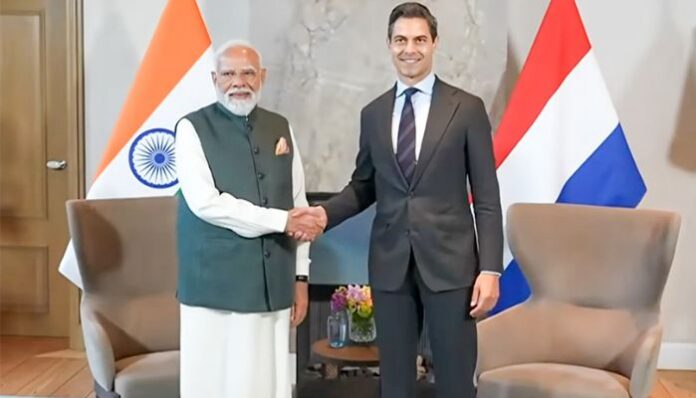
Prime Minister Narendra Modi’s visit to the Netherlands has emerged as one of the most significant of his ongoing five-nation Europe and West Asia tour, coming at a time when the world is facing economic uncertainty, energy insecurity and growing geopolitical tensions. The visit, held between 16th and 17th May at the invitation of Dutch Prime Minister Rob Jetten, came shortly after he visited the UAE.
During the visit, India and the Netherlands decided to elevate their ties to a full-fledged “Strategic Partnership”, while announcing 17 major outcomes across sectors ranging from semiconductors and defence to agriculture, water management, education and cultural heritage.
One of the biggest highlights of the visit was the return of the historic Chola-era copper plates to India after centuries, a move widely seen as a major diplomatic and cultural victory for New Delhi.
PM Modi meets Dutch King, Queen and PM Rob Jetten
Prime Minister Modi began the Netherlands leg of his tour with a meeting hosted by King Willem-Alexander and Queen Máxima at the Royal Palace Huis ten Bosch in The Hague. The Dutch royals also hosted a luncheon in his honour.
Later, PM Modi held restricted and delegation-level talks with Prime Minister Rob Jetten. Both leaders discussed trade, security, emerging technologies, climate issues and geopolitical developments, including the wars in Ukraine and West Asia.
Outcomes of PM Modi’s Netherlands visit
Roadmap of India-Netherlands Strategic Partnership [2026-2030]: Recognising the growing cooperation between both countries, the two leaders formally elevated India-Netherlands relations to a “Strategic Partnership” and adopted the “Roadmap of India-Netherlands Strategic Partnership 2026-2030”, which became the first major outcome of the visit.
The roadmap covers cooperation in defence, semiconductors, cyber security, artificial intelligence, renewable energy, water management, healthcare, maritime development, education and agriculture.
Restitution of Chola Copper Plates: Among all the agreements and announcements, the return of the 11th-century Anaimangalam copper plates, also known as the Leiden Plates, stood out as the most symbolic and emotional moment of the visit.
The plates, also known as the Leiden Plates, are among the most significant surviving records of the Chola dynasty.
Anaimangalam Copper Plates, 11th-century Chola dynasty artefacts.
— Sidhant Sibal (@sidhant) May 16, 2026
India getting them back from Netherlands https://t.co/GKvPFZaIP7 pic.twitter.com/JN9Xa3wJwy
The development follows years of repatriation efforts between the Indian government, the Dutch government and Leiden University, where the artefacts were kept. The plates are 21 in number and weigh about 30 kg. They are held together by a bronze ring locked with the royal seal of Rajendra Chola I. The inscriptions on the copper plates date to the reign of Emperor Rajaraja Chola I (985–1014 CE) and his son Rajendra. The Sanskrit portion in the inscriptions traces the Chola genealogy, invoking divine legitimacy from Vishnu through a line of ancestors.
The copper plates consist of 21 sheets weighing nearly 30 kilograms and are tied together with a bronze ring carrying the royal seal of Rajendra Chola I. The inscriptions contain both Sanskrit and Tamil text.
The Sanskrit portion traces the Chola lineage and royal legitimacy, while the Tamil section records grants made to the Chudamani Vihara, a Buddhist monastery in Nagapattinam built by the Srivijaya kingdom of present-day Indonesia.
Historians believe the plates provide rare evidence of India’s maritime links with Southeast Asia, religious coexistence and cultural exchange during the Chola period.
The copper plates were acquired by Dutch missionary Florentius Camper around 1700 when the Dutch East India Company controlled Nagapattinam after shifting its Coromandel headquarters from Pulicat to there. Eventually, they landed at Leiden University in 1862 through the estate of Prof Hendrik Arent Hamaker and formed part of the university library’s Asian collections. At the varsity, the copper plates were preserved in secure vaults and were accessible only to researchers and scholars.
India had long been making efforts for the return of the copper plates by engaging with the Dutch government and Leiden University. In 2022, India’s repatriation efforts received a boost after the Netherlands finalised a restitution policy for colonial-era artefacts in 2022. This was followed by another breakthrough in 2023, when UNESCO’s Intergovernmental Committee validated India’s claim as the country of origin and urged bilateral talks.
Along with the return of the copper plates, India and the Netherlands also signed a Memorandum of Understanding between Leiden University Libraries and the Archaeological Survey of India for further cooperation in heritage preservation.
MoU on Mobility and Migration between the Government of the Republic of India and the Government of the Netherlands: Recognising the expanding footprint of Indian professionals, researchers, and students in the Netherlands, both governments signed a formal MoU on Mobility and Migration. This agreement establishes a safe, legal, and highly structured pathway for the fair mobility of highly skilled professionals and students.
Concurrently, it sets up robust institutional safeguards to prevent and combat irregular migration and human trafficking, ensuring that migrant workers are treated with dignity, transparent visa processes are maintained, and workers’ rights are fully protected.
MoU between TATA Electronics and ASML to support semiconductor Fab in Dholera: Technology and semiconductor cooperation formed another key pillar of the visit.
One of the most important agreements was the MoU between Tata Electronics and Dutch semiconductor giant ASML to support the semiconductor fabrication plant being developed in Dholera, Gujarat.
Tata Electronics and Dutch semiconductor equipment giant ASML signed a Memorandum of Understanding (MoU) to advance India’s semiconductor manufacturing ecosystem. The partnership focuses on equipping and ramping up Tata’s ambitious 300mm semiconductor fabrication plant in Dholera, Gujarat.
#WATCH | PM @narendramodi witnesses the signing ceremony of the MoU between ASML and @TataCompanies.
— DD News (@DDNewslive) May 16, 2026
The agreement is expected to provide a significant boost to India’s semiconductor ambitions and strengthen its position in the global chip supply chain.@PMOIndia @MEAIndia… pic.twitter.com/XPyIlNUzbk
ASML is the only company in the world that makes extreme ultraviolet lithography machines used to make the most advanced semiconductors by leading companies such as Intel, TSMC, Samsung, Micron and others.
Under the agreement, ASML will provide its advanced lithography tools and holistic solutions to support the establishment and successful operations of Tata Electronics’ Dholera Fab. Lithography is a cornerstone of semiconductor production, and ASML’s industry-leading extreme ultraviolet (EUV) and other systems are essential for high-volume, advanced chip manufacturing.
The collaboration will also emphasise Talent Development, Supply Chain Resilience and R&D Infrastructure. Joint initiatives will train local engineers and build lithography-specific skills. Domestic and trusted global supply chains will be strengthened for the Indian fab. And Research capabilities will be developed to ensure the long-term success of India’s first major commercial 300mm wafer facility.
MoU on Cooperation in the Field of Critical Minerals: India and the Netherlands also signed a Memorandum of Understanding on cooperation in critical minerals. Signed between the Ministry of Mines of the Republic of India and the Ministry of Foreign Affairs of the Kingdom of the Netherlands, this MoU establishes an institutional framework for securing critical mineral value chains. The agreement covers exploration, joint research and innovation, supply chain resilience, circular economy practices, and the enforcement of stringent Environmental, Social, and Governance (ESG) standards.
It ensures that both nations can sustainably secure the rare earth elements and minerals necessary for their tech and clean-energy sectors. The agreement focuses on building resilient supply chains, research cooperation and reducing dependence on limited global suppliers for essential minerals used in clean energy and electronics.
LoI for technical cooperation on the Kalpasar Project: The Ministry of Jal Shakti of India and the Ministry of Infrastructure and Water Management of the Netherlands signed a Letter of Intent to bring world-class Dutch hydraulic engineering expertise to Gujarat’s ambitious Kalpasar Project. This massive coastal engineering initiative involves building a dam across the Gulf of Khambhat to create a vast freshwater reservoir. The Dutch technical assistance will focus on tidal management, salinity control, and delta engineering.
Roadmap on the development of Green Hydrogen Cooperation: To accelerate the global energy transition, the two leaders launched an ambitious, dedicated Green Hydrogen Roadmap. This document blends India’s vast renewable energy production potential and competitive manufacturing costs with the Netherlands’ advanced infrastructure as Europe’s primary hydrogen hub (largely anchored around the Port of Rotterdam). The roadmap outlines joint targets for production technology, infrastructure deployment, safety standards, and commercial export-import frameworks.
Joint working group on renewable energy: Building upon an existing MoU on Renewable Energy, the leaders institutionalised a new Joint Working Group (JWG). This body is tasked with executing a diversified agenda that includes innovative solar energy integration, grid-scale energy storage solutions, and facilitating mutual cross-border investments. The JWG will act as the primary clearinghouse for commercial and state-led clean energy ventures between the two countries.
Joint statement of intent between NITI Aayog and the Netherlands: NITI Aayog (National Institution for Transforming India) and the Government of the Netherlands formally renewed their Joint Statement of Intent. This renewal extends their ongoing partnership in policy formulation, data modelling, and capacity-building strategies for deep decarbonisation. It allows both nations to share socioeconomic blueprints for shifting legacy industrial grids toward net-zero pathways.
Indo-Dutch centre of excellence for flowers in West Tripura: The two sides established the Indo-Dutch Centre of Excellence for Flowers in West Tripura This will help farmers to adopt high value floriculture.
India, Netherlands annouce establishment of joint centre of excellence for flowers in Tripura. This will help farmers to adopt high value floriculture.
— Sidhant Sibal (@sidhant) May 16, 2026
Indo-Dutch Center of Excellence on Training in Dairy at the Center of Excellence for Animal Husbandry (CEAH), Bengaluru: The leaders further welcomed the signing of a Joint Declaration between the Ministry of Fisheries, Animal Husbandry and Dairying and the Ministry of Agriculture, Fisheries, Food Security and Nature of the Netherlands as well as the establishment of an Indo-Dutch Center of Excellence on Training in Dairy at the Center of Excellence for Animal Husbandry (CEAH), Bengaluru. Both sides agreed to continue to explore cooperation in Dairy and other allied agricultural sectors including food processing.
Collaboration in animal husbandry and dairying: Both countries signed a Joint Declaration on cooperation in animal husbandry and dairying, covering areas such as dairy technology, livestock development and food processing. Officials said these initiatives are aimed at bringing advanced Dutch agricultural techniques and technology to India.
LoI between the Indian Council of Medical Research (ICMR) and the Dutch National Institute for Public Health and the Environment (RIVM): Healthcare cooperation was strengthened through a Letter of Intent between the Indian Council of Medical Research (ICMR) and the Dutch National Institute for Public Health and the Environment (RIVM). The agreement focuses on infectious diseases, disease surveillance, climate-health preparedness and research cooperation.
Customs Mutual Administrative Assistance Agreement: India and the Netherlands also signed an Agreement on Mutual Administrative Assistance in Customs Matters to improve customs cooperation, information sharing and trade facilitation.
MoUs on Higher Education: India and the Netherlands also signed an MoU on Higher Education to encourage collaboration between universities, student exchanges and academic research. Expands opportunities for academic exchanges, joint programmes and research collaboration. It expands opportunities for academic exchanges, joint programmes and research collaboration.
India, Netherlands annouce cooperation between Leiden University, ASI to boost research on Chola history; cooperation between Nalanda University & Groningen University; cooperation in higher education with dual programs; Collaboration in health
— Sidhant Sibal (@sidhant) May 16, 2026
Nalanda University–University of Groningen partnership: Nalanda University and the University of Groningen separately signed an academic cooperation agreement to strengthen research and educational ties.
Leiden University Libraries–ASI collaboration: The leaders also welcomed collaboration between Leiden University Library and Archaeological Survey of India for advancing research and knowledge related to the historic artefacts.
Prime Minister Jetten additionally announced that the Netherlands would join the Indo-Pacific Oceans Initiative (IPOI), signalling stronger Dutch engagement in the Indo-Pacific region alongside India.
Following the talks, the two countries signed 14 agreements and Memoranda of Understanding covering technology, green energy, trade, mobility, education, culture and WAH sectors.
Prime Minister Modi also invited Prime Minister Jetten to visit India, an invitation that was accepted by the Dutch leader.


