

When one thinks about electricity generation in India, what would one usually think of? A massive coal plant in Singrauli, a nuclear facility in Tarapur, or a large NHPC hydro project. But solar energy in India? That rarely makes the list. At best, one would think of solar either as a minor domestic backup plan or a fancy (but ultimately unsustainable) experiment that the government periodically attempts. One would hardly think of it as a method of electricity generation that could compete with coal or nuclear, let alone power a country like India.
That assumption, however, no longer holds. By the end of January 2026, solar accounted for nearly 27% of India’s total installed power capacity. Out of India’s total installed power capacity of 520 GW, more than 143 GW comes from solar alone. That is not a side contribution, but it is a structural shift. While it may not always dominate headlines, the scale of this transformation is impossible to ignore.
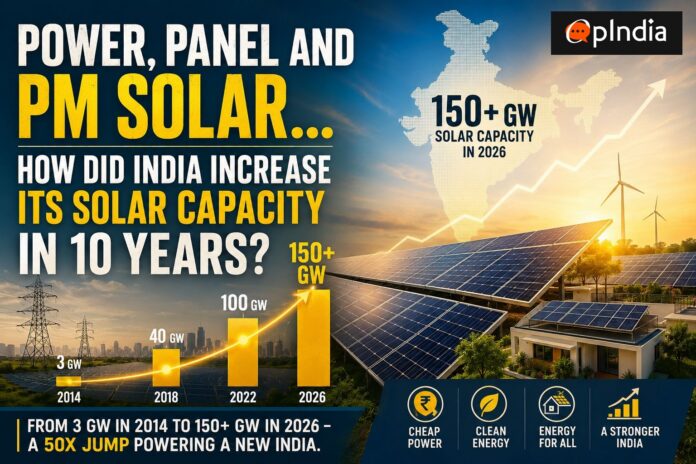
To put it simply, in just 11–12 years, India’s solar capacity has grown nearly 50 times.
India’s Current Solar Capacity (2026)
Saying “solar is growing” seems like an easy punchline, but the real story lies in the scale of growth.
By the end of March 2026, India had crossed 150 GW of solar capacity. To understand how massive this growth is, let us consider an example – if one household uses 1 kw of electricity, India’s current solar capacity is enough to power 15 crore households simultaneously; a massive feat given how quickly India grew her solar capacity in the past few years.
In fact, solar is now the largest contributor to India’s renewable energy mix. Globally, India ranks among the top 3 solar markets, right after the USA and China.
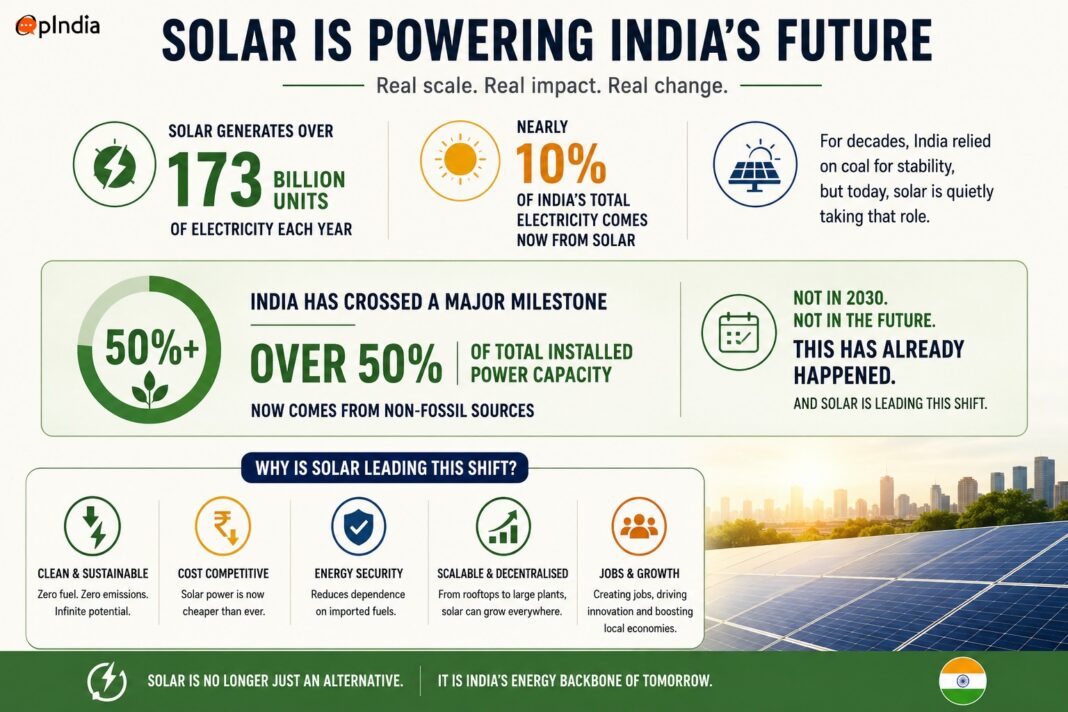
Solar generates over 173 billion units of electricity each year. Nearly 10% of India’s total electricity now comes from solar energy sources. For decades, India relied on coal for stability, but today, solar is quietly taking that role.
And because of this surge, India has crossed a major milestone with over 50% of its total installed power capacity now coming from non-fossil sources. Not in 2030 or in the future, this has already happened, and solar is leading this shift. Why?
Because it’s cheap, scalable, and fast to deploy. We can build a massive solar park or just install panels on your rooftop because both work.
Significance of Solar Energy
To understand just how significant India’s solar stride is, we must also understand why solar energy is so important compared to other sources, and what is its significance in today’s world. First of all, Solar reduces India’s dependence on other sources such as coal, oil, and gas. The more electricity it produces from solar energy, the less vulnerable it becomes to global fuel price shocks, supply disruptions and geopolitical pressure. As we saw in the US-Iran conflict, during the Strait of Hormuz disruption, it became increasingly unconventional to rely entirely on oil. India imports nearly 85% of its crude oil requirements, making solar energy essential for replacing a major economic burden.
Further, Solar is the cheapest source of energy. Because of the Modi Government, Solar tariffs in India have fallen dramatically over the years, making solar one of the cheapest sources of power generation. Unlike coal or gas, sunlight is free, making solar energy economically sustainable in the long run. Moreover, Solar changes the very structure of electricity. With rooftop systems and net metering, homes, farmers, and businesses can generate their own electricity and even send surplus power back into the grid. Consumers become producers. Solar energy helps to reduce the carbon emissions and air pollution caused by fossil fuels. According to the data, Coal-based electricity releases an average of 0.82kg of CO2 per kWh. But if we compare this to solar energy, it produces 0kg of CO2 per kWh during operation. It makes Solar energy a significant source compared to other sources.
How India’s Solar Capacity 50x’ed (2014–2026)
We had talked about the current solar capacity, but the real question is: How did India accomplish this? Because India is going from 3 GW in 2014 to 150+ GW in 2026, this is not typical growth. That’s a 50X jump in just about a decade. And no major economy other than China has done this at this speed.
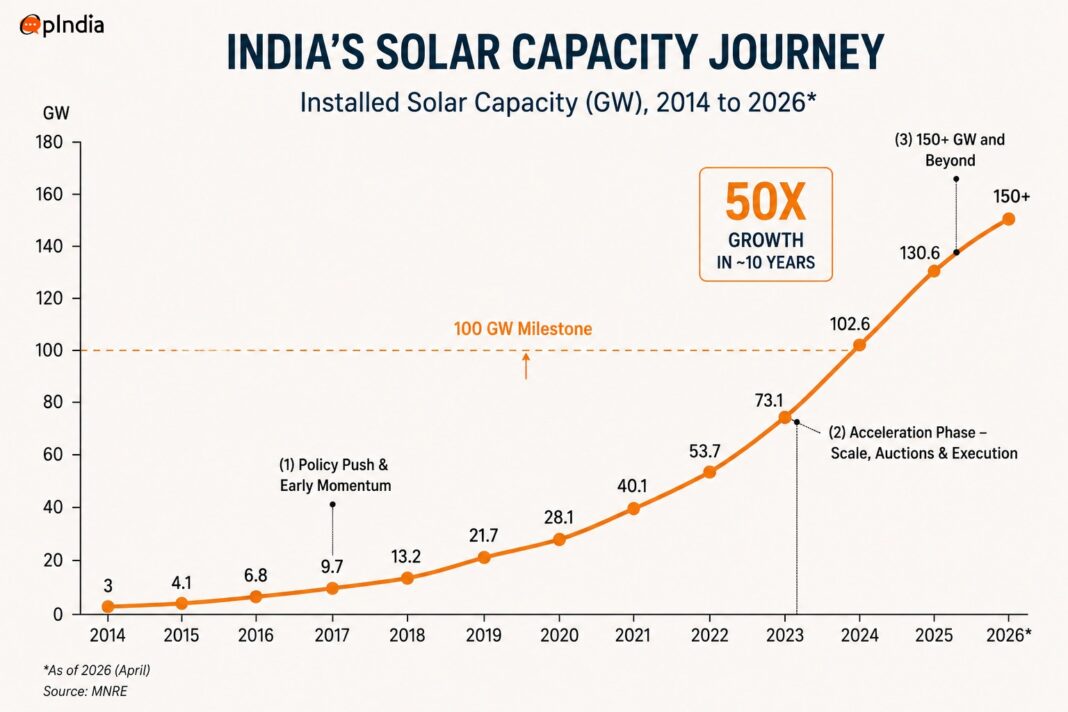
This remarkable feat by the Modi government was accomplished in phases. During the first phase, from 2014 to 2018, when the government set aggressive targets and pushed the National Solar Mission, larger solar parks were introduced. This solved big problems like land and infrastructure, and, more importantly, sent a clear signal that solar is no longer experimental; it’s a serious policy.
The scale phase (2018–2022) marked a turning point: solar became cheap, with tariffs dropping from around 7-8 rupees per unit to under 2 rupees. From that moment, solar was no longer just clean energy – it was the cheapest energy, spurring private sector investment and driving the rise of massive solar parks in Rajasthan, Gujarat, and Karnataka.
The acceleration phase (2022–2026) followed, bringing together manufacturing push, Rooftop solar expansion, and better grid readiness. Most importantly, solar moved beyond big projects—now homes, farmers, and industries are all part of the system.
And the result? India added a record 44+ GW of renewable energy in just one year (FY26), the highest ever.
It’s not just the scale or the speed. India didn’t follow the slow, step-by-step transition model. It basically compressed decades of energy transition into 10–12 years. That’s what makes this transformation different.
The Policy Push: Role of PM Surya Ghar
So the next question is who actually pushed solar into people’s homes? Because making solar parks is one thing, but getting crores of households to adopt solar is another. That’s a different game.
This is where the PM Surya Ghar, Muft Bijli Yojana comes in. It was launched in February 2024 and completely changed India’s solar strategy. Instead of just building large solar parks, the focus shifted to something bigger: making every home a potential power generator. The idea was simple. Give people subsidies, make the process easy, and let them produce their own electricity. Under this scheme, households can install rooftop solar systems and generate up to 300 units of electricity per month. This almost wipes out their electricity bills.
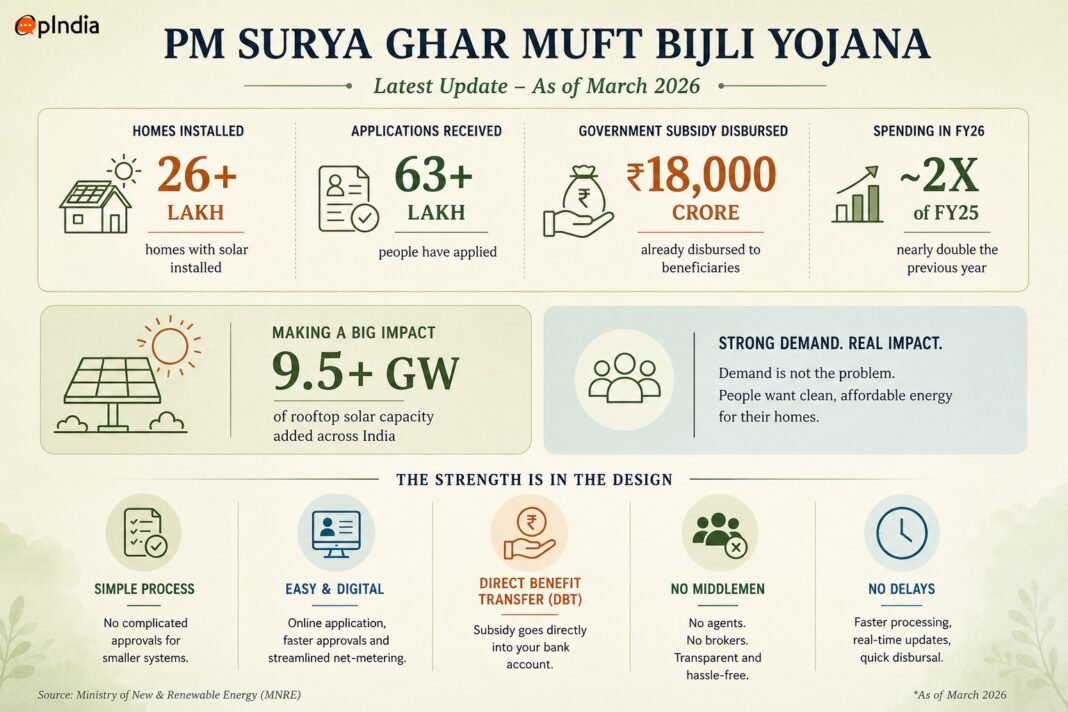
As of early May 2026, over 31+ lakh homes have already been installed with solar panels and more than 60 lakh people have applied. This means demand is not the problem; people actually want this. Financially, this is not a small scheme. The government has already disbursed nearly ₹18,000 crore. Spending in FY26 nearly doubled that of the previous year. In terms of impact, over 9.5 GW of rooftop solar capacity has been added. But the real strength of this scheme lies in its design. The process is simple. No complicated approvals for smaller systems. The subsidy goes directly into your bank account via DBT. No middlemen, no delays.
That’s why adoption is scaling so quickly, as state-level data shows. States like Gujarat, Uttar Pradesh, and Rajasthan are moving ahead rapidly. In fact, Uttar Pradesh, which wasn’t even seen as a solar leader, has now emerged as a top performer. On the other hand, in some states, the story is different. Take Karnataka, for example: in early May 2025, over 54,000 applications but only around 18,000 installations. Same scheme. Same subsidy. Same country. The difference lies in how state governments implement it. In NDA-led states, governance is proactive, approvals are faster, and systems move quickly. Solar adoption is booming there. But in Congress-led states, it’s slow and bureaucratic, and progress stalls. That’s the bigger takeaway.
This is no longer just about solar energy. It’s becoming a test of state-level governance.
Because, in the end, the policy is the same for everyone… but the results clearly aren’t.
But the real strength of this scheme lies in its design. The process is simple. No complicated approvals for smaller systems. The subsidy is deposited directly into your bank account via DBT. No middlemen. No endless delays. And there’s another important point people often miss. Every home with rooftop solar is connected to the electricity grid. This means the house is not just consuming electricity; it can also generate power and send excess electricity back into the system through net metering.
In simple terms, millions of homes are slowly turning into mini power plants connected to India’s grid. That’s a massive structural shift in how electricity works in India.
Citizen Participation: The Missing Link
As discussed in the previous paragraph, the Indian government played a massive role in the solar sector. But this entire solar story isn’t just about government policy. Policy can push, but it cannot scale at this speed on its own. The real drivers have been the people. As of early May 2026, more than 60 lakh rooftop solar applications and more than 31 lakh installed systems show that this is not forced adoption or artificial demand. People are actively choosing solar because it makes economic sense. It lowers electricity bills, reduces reliance on power cuts, and gives households greater control over their energy use. This shift is not limited to urban India; through schemes like PM-KUSUM, over 21 lakh farmers have moved to solar-powered irrigation, cutting diesel costs, ensuring reliable power, and improving income stability. As a result, India is moving toward a “prosumer economy,” where consumers are also producers, rooftops are turning into small power plants that generate electricity, save money, and even feed surplus back into the grid.
This marks a fundamental shift from a centralised, top-down energy system to a distributed, people-driven one. As citizens saw direct value in solar, that’s why solar has scaled so rapidly. The government built the framework, but it was the people who turned it into a nationwide movement.
Industrial Backbone: Production Linked Incentive Scheme
But wait, building solar plants is one thing. The real question is: who is making the solar panels? If everything is imported, then we are not really independent but just dependent in a different way. That was exactly where India had a problem. For years, most solar equipment came from outside, especially China. The government made a strategic move with the Production Linked Incentive (PLI) scheme. This is not just another policy; this is an industrial push. The idea was simple: don’t just install solar, but start manufacturing it in India. Under PLI, the government allocated around ₹24,000 crore to incentivise companies to build the entire solar ecosystem. This includes not just panels, but also cells, wafers, and even polysilicon. The entire supply chain was impacted. The result was massive.
When talking about installed power capacity, India’s installed solar capacity has grown from just 2.82 GW in 2014 to over 150 GW by March 2026, a 53x increase in just over a decade. And when talking about manufacturing capacity, India’s solar module capacity has grown from just 2.3 GW in 2014 to over 172 GW by March 2026, a 75x increase in just over a decade. That’s not just growth; it’s a complete shift.
Indian companies started scaling up fast. Investments poured in. Thousands of jobs were created across the sector. But the most important part was vertical integration. India does not just assemble solar products; it is gradually controlling the entire production pipeline. That changes everything. Now, solar is no longer just an energy story. It becomes an industrial strategy. India is not just consuming solar power; it is building the capability to produce the technology behind it. That’s how you move from adoption to real self-reliance.
Breaking Dependence on China
In this whole story, most people forget to mention India’s dependence on China. For years, India’s solar growth came with a hidden weakness: we were heavily dependent on China. At one point, nearly 80–90% of our solar cells and modules were imported from China.
Now think about that. If the entire energy transition depends on another country, then how secure is it really? One supply disruption or any geopolitical tension can hit the solar push. So this wasn’t just an economic issue. It was a strategic vulnerability. And that’s when the Modi government stepped in.
A series of policy measures were introduced, including Basic Customs Duty (BCD) on imports, ALMM regulations to prioritise domestic manufacturers, and Anti-dumping duties to counter unfair pricing. The idea was simple: if India is to lead the solar revolution, it must give Indian companies a fair chance to compete. Because of earlier cheap imports, it was almost impossible for domestic players to scale. Now, that equation is changing, with domestic manufacturing rising, Indian companies stepping in, and large solar projects gradually shifting towards Made-in-India modules. But let’s be clear, we are not fully independent yet. The critical components, such as calls and wafers, still need to be scaled up. But the direction is clear that India is moving from a system of dependence to building its own self-reliant solar ecosystem. And in a sector as critical as energy, that shift is not optional — it’s essential.
The Global Double Standard on Energy
For over a century, the USA and European countries have built their economies on the massive amounts of coal and fossil fuels during industrialisation. Today, most of these developed nations were powered by high historical carbon emissions long before climate targets became global priorities. And how ironic these so-called climate activists blame India for Carbon emissions.
Data shows that even today, India’s per capita carbon emissions remain significantly lower than those of the USA and many Western countries. India, with a population of over 1.4 billion, is still consuming less energy per person than developed nations. In India, the average person consumes approximately 13.61 GJ/person, whereas in the USA, the figure is more than double, approximately 31.47 GJ/person. It also exposes the hypocrisy of the West and America over climate change, which transitioned to cleaner energy only after becoming rich. In fact, India is trying to industrialise and expand electricity access while simultaneously investing heavily in renewables, such as solar. That makes India’s transition structurally more difficult.
Despite these criticisms of coal usage, India has become one of the world’s fastest-growing solar markets. In just over a decade, India expanded from around 3 GW of solar capacity to more than 150 GW, a scale of transition very few major economies have achieved.
Under Prime Minister Narendra Modi, India co-founded the International Solar Alliance (ISA) and pushed solar diplomacy globally. In 2015, it was co-founded by India and France during the COP21 Climate Summit in Paris. Even the headquarters of ISA is located in Haryana. It was designed as a coalition of solar-rich countries, especially developing nations located between the Tropics of Cancer and Capricorn, to promote affordable solar energy, technology sharing, financing, and cooperation. What makes it significant is that India is no longer just participating in these global climate discussions but leading from the front. In fact, the ISA became the first major international organisation on solar energy.
PM Modi repeatedly framed solar not just as an environmental issue, but as a strategic and developmental tool. At the launch of ISA, he argued that “the world must turn to the sun to power its future” and presented solar energy as a way for developing countries to achieve growth without replicating the West’s fossil-fuel-heavy industrial model, underscoring the importance of the policies of the Modi government.
India also used the ISA to expand its influence across Africa, Asia, and the Global South by supporting solar infrastructure, training, financing, and technology partnerships. According to the Analysts, it is an instrument of “solar diplomacy”, in which India uses renewable energy cooperation to build geopolitical influence and present itself as a responsible climate leader.
The broader vision extended beyond India itself. Through initiatives like “One Sun, One World, One Grid,” Modi proposed interconnected solar energy networks capable of sharing renewable electricity across borders and time zones.
Today, the ISA includes more than 100 member countries and has evolved into one of the largest multilateral renewable-energy platforms led by a developing nation.
Import Reduction
Now the obvious question is, did these policies actually work? Because announcements are one thing, but the real impact is another. As we have seen in previous governments, announcements are made, but the work never starts. However, the Modi government has done a good job in the renewable energy sector.
China’s share in India’s solar cell imports has dropped from over 90% to around 56%. Even solar cell imports are declining, indicating that India is slowly shifting towards domestic sourcing.
Now, while the total import bill has fluctuated over time, this movement is largely driven by global price fluctuations rather than by rising dependence. The more important shift lies in the degree of reliance on imports, and that dependence is clearly declining. As domestic manufacturing capacity continues to expand, India is gradually insulating itself from external vulnerabilities, including global supply disruptions, currency volatility, and geopolitical pressures. In effect, the transition is not just about reducing imports in absolute terms, but about building a more stable, self-reliant energy ecosystem that is less exposed to external shocks.
Beating the 2030 Target Early
India is not just meeting its solar targets; it is consistently beating them. The original goal was to reach 100 GW by 2022, and while that milestone was achieved shortly after, the momentum didn’t slow down; instead, it accelerated. By 2026, India had already crossed 150 GW, effectively advancing targets originally aligned with 2030. This kind of acceleration doesn’t happen by chance. A major driver has been the sharp fall in solar tariffs, which made solar not just viable but the cheapest source of power at scale. At the same time, policy continuity fostered long-term investor confidence, enabling private players to rapidly deploy large projects nationwide. Alongside this, schemes like PM Surya Ghar expanded rooftop adoption, bringing a distributed dimension to growth and widening participation beyond large developers.
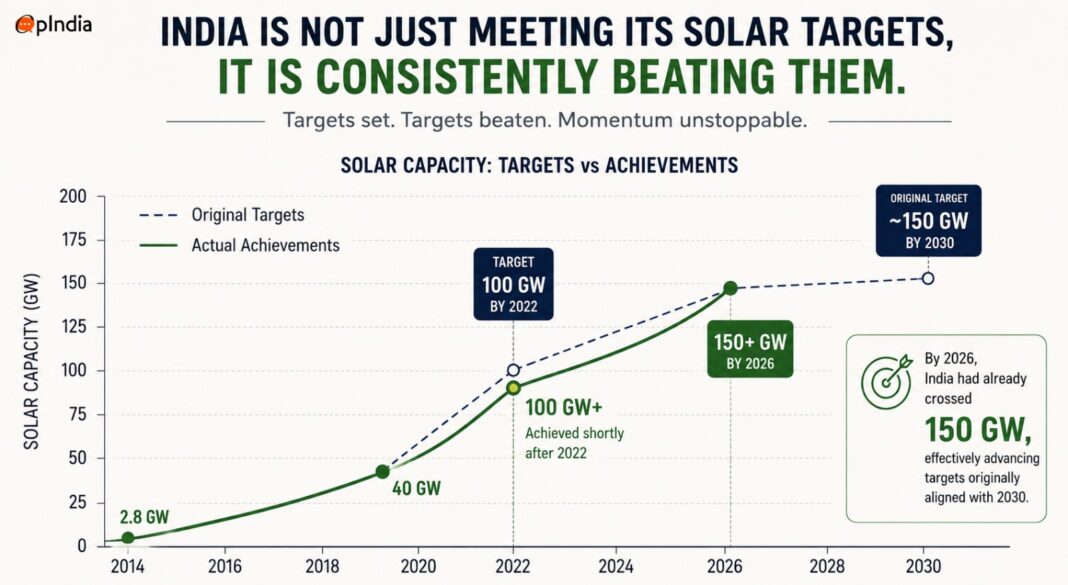
The result is something rarely seen in infrastructure – timeline compression. Instead of slow, linear expansion, India has achieved exponential scaling within a short span. What was expected to take a decade has been accomplished in just a few years, pushing the country ahead of its own projections and redefining the pace of energy transitions.
Why This Matters
The rise of solar power matters because this transformation is not only about generating power, but it is quietly reshaping India’s economic and strategic position. First, it strengthens energy security by reducing dependence on imported fossil fuels, by making the economy less exposed to global price shocks and supply disruptions. Second, it pushes India ahead on its climate commitments. With over 50% of installed capacity now coming from non-fossil sources, a milestone was achieved years ahead of schedule. But the impact doesn’t stop there.
It also drives economic independence. By building domestic manufacturing and reducing import dependence, India is creating a self-sustaining energy sector. This stimulates local industries, creates skilled and unskilled jobs, attracts new investment, and supports long-term industrial growth. And with a clear target of 500 GW of non-fossil capacity by 2030, the direction is obvious.
Solar is now more than just clean energy; it is a strategic asset shaping India’s growth, competitiveness, and future security.
Conclusion
India’s journey in solar energy is no longer about ambition, but it is about execution at scale. In just over a decade, the country has transformed solar from a marginal, policy-driven initiative into a central pillar of its energy system. What stands out is not just the capacity added, but the ecosystem that has been built around it, where policy, manufacturing, and public participation are aligned. Solar is no longer a backup option.
It is now core infrastructure, powering homes, industries, and the broader economy. And as India moves steadily toward its 2030 targets, the direction is clear that this is not just about adopting renewable energy. India is actively reshaping its energy future, and in doing so, setting a benchmark for the world.


