

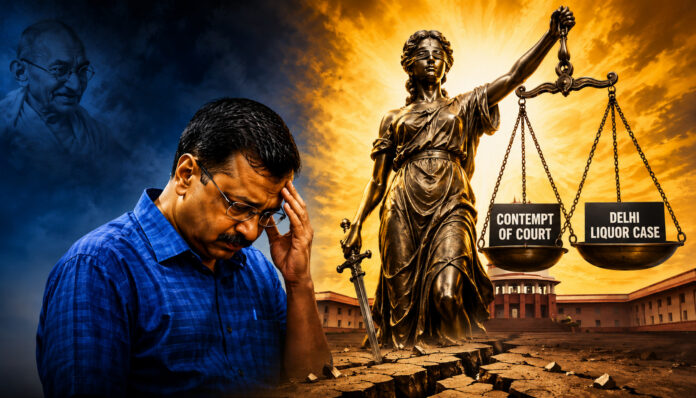
Arvind Kejriwal wrote a few words on X on May 14, 2026, ‘Truth has triumphed. Gandhiji’s Satyagraha has triumphed once again.’ Within minutes, AAP supporters were sharing the tweet, which was then boosted by left-leaning handles and portrayed as a success, a vindication of Kejriwal’s months-long struggle against Delhi High Court Justice Swarna Kanta Sharma. The story being told was straightforward and appealing; the judge had been forced out, the people had won, and truth had triumphed over a biased judiciary.
सत्य की जीत हुई।
— Arvind Kejriwal (@ArvindKejriwal) May 14, 2026
गांधी जी के सत्याग्रह की एक बार फिर जीत हुई।
There is only one problem which is that it is almost entirely false.
What truly occurred on May 14 was not a political success for Kejriwal. It’s the contrary. The excise policy matter transferred to another bench by the Delhi High Court, not because Kejriwal was correct about the judge, but because Justice Sharma initiated criminal contempt proceedings against Kejriwal and five other AAP leaders for what they did. A judge who starts contempt proceedings against a party in a case is not allowed to hear that party’s primary issue under settled Indian law. The transfer wasn’t a retreat. It was a legal formality caused by an escalation, and it occurred at Kejriwal’s cost, not his benefit.
What actually happened?
You must understand the series of events leading up to May 14 in order to see why the ‘truth has triumphed’ story falls apart.
The CBI’s challenge against Arvind Kejriwal, Manish Sisodia, and other AAP leaders’ discharge in the Delhi excise policy case was being heard by the Delhi High Court. Justice Swarna Kanta Sharma was assigned the case. At some time, Kejriwal and other AAP officials submitted a plea for her recusal, basically asking her to withdraw from the case due to suspected bias and conflicts of interest. On April 20, Justice Sharma denied this recusal request, ruling that the recusal request itself amounted to putting the judiciary on trial and that a politician cannot be permitted to sow seeds of doubt against the court.
Kejriwal took a different route rather than contesting this order before the Supreme Court, which is the appropriate legal recourse under the Indian court system. He started using social media. He and other AAP leaders informed Justice Sharma in a public letter that they would no longer be appearing before her. Theatrically invoking the legacy of Mahatma Gandhi, they then staged a visit to Raj Ghat and announced that they would pursue ‘Satyagraha.’ To put it briefly, they devised what the court later called a coordinated digital campaign to malign the judge and publicly boycotted the court proceedings.
Videos that had been manipulated were part of the campaign. AAP leaders circulated a video that reportedly showed Justice Sharma speaking at an RSS function. Later, the court made it clear on the record that the video had been misleadingly edited to provide the false impression that it was a college function. Kejriwal further openly declared that ‘ordinary people cannot believe’ that Justice Sharma would act against the Central government or the BJP, accusing a sitting judge of political prejudice without any evidence, not in court, but on the internet.
In her May 14 judgement, Justice Sharma described this as a ‘calculated campaign of vilification’ intended to weaken the court’s authority under the pretence of free expression. Under Section 2(c) of the Contempt of Courts Act, 1971, she initiated criminal contempt charges against Arvind Kejriwal, Manish Sisodia, Sanjay Singh, Durgesh Pathak, Vinay Mishra, and Saurabh Bhardwaj. She then moved the primary excise policy case to a different bench as required by law.
Why the transfer was inevitale?
The ‘truth has triumphed’ camp is either unaware of or wilfully concealing the fact that Justice Sharma’s transfer of the main case was not a voluntary gesture of retreat. From the moment she initiated contempt proceedings, it was required by law.
Nemo debet esse judex in propria causa, which means that no one should serve as a judge in their own cause, is one of the oldest and most important concepts in law. A party is accused in front of the same judge once the judge starts contempt proceedings against them. The judge would appear to have a personal stake in the outcome if they continued to hear the primary case involving the same accused individuals. Justice must not only be carried out, but also appear to be carried out, even in cases where the judge is completely neutral.
Justice Sharma expressed this clearly from the bench, ‘If I continue to hear this matter after the contempt procedures, these parties can allege I have a personal hatred against them. That is why I believe this case will be heard by another bench.’ Additionally, she made it clear, ‘I am not recusing myself while upholding my recusal order and refuse to alter a single word.’
The case concerning excise policy has been transferred to a new bench. Justice Sharma is still in charge of the contempt proceedings. Kejriwal and five AAP leaders are currently facing criminal contempt of court proceedings, which could result in a fine and up to six months in jail. This is picking up two cases instead than just one when you enter a courtroom.
Debunking the left narrative
1) Justice Sharma was forced to recuse because she was biased: This is factually incorrect because Justice Sharma specifically declared that she was not recusing herself and that she stood by her recusal order, which rejected the AAP’s charges of prejudice. The transfer happened as a result of the contempt proceedings she initiated, not because the recusal application was successful. In April, it failed, and on May 14, it still failed.
2) The Satyagraha worked: This claim is incredibly ironic. The public boycott, letters, social media campaign, and altered videos that Kejriwal is referring to as ‘Satyagraha’ are exactly what have put him and five of his colleagues in criminal contempt proceedings. According to Justice Sharma’s order, this behaviour is not permissible under the pretence of free expression. In contrast to the Satyagraha working, Kejriwal is now charged with criminal contempt in a court of law. The judiciary has categorically denounced Kejriwal’s social media pressure campaign against a sitting judge as an attack on the institution.
3) Truth prevailed: In this scenario, the term ‘truth’ is performing a great deal of heavy lifting on behalf of a political party that is still facing significant charges in the excise policy issue. The discharge of AAP leaders has been challenged by the CBI, and this case has not been resolved. The proceedings will now take place on a different bench. The fundamental legal matter, which is whether Kejriwal and others were properly discharged, is still completely unanswered. An acquittal is not the same as a bench change.
What this actually means going forward
Justice Sharma is now pursuing criminal contempt proceedings against Kejriwal and five key AAP leaders. These are separate proceedings that are not shifted only because the primary case did. Their actions outside of court, the social media campaign, the edited videos, the public letters, and the boycott, are at issue in the contempt case. They must reply to the notices the court has sent. The Chief Justice has ordered a new bench of the Delhi High Court to hear the primary excise policy case. This implies that the CBI’s objection to the dismissal of AAP leaders, such as Kejriwal and Sisodia, will be given another chance. The case is still very much alive even though a new chapter has begun.
In the meantime, Justice Sharma, whom the AAP machinery had spent months attempting to paint as compromised, came out of this incident having turned down their request for her to recuse herself, refusing to be intimidated, filing contempt charges against six politicians, and transferring a case, not because she was overruled, but because the law required it. ‘I refuse to be intimidated,’ she said from the bench. I have defended both myself and this institution.
Conclusion
This episode focuses on a pattern, the weaponisation of public pressure against state institutions, particularly the judiciary. When people with large social media followings launch coordinated campaigns to delegitimise sitting judges, manufacture or manipulate evidence, and publicly refuse to participate in the judicial process, they are not practising Satyagraha. They are systematically undermining public trust in institutions that safeguard ordinary people far more than politicians.
The judge needs to be protected from the kind of public pressure that Kejriwal tried to impose, which is why the Contempt of Courts Act, 1971 and its guiding principles exist. Criticism of court decisions is acceptable and encouraged. A calculated campaign to demonise and discredit a judge through fabricated videos and public remarks intended to weaken the court’s authority is not allowed and is expressly forbidden by law. The next time you come across a post on X claiming that ‘truth has triumphed’ over a legal transfer order, remember this if truth really won, why is the person making the claim now being charged with criminal contempt of court?


