

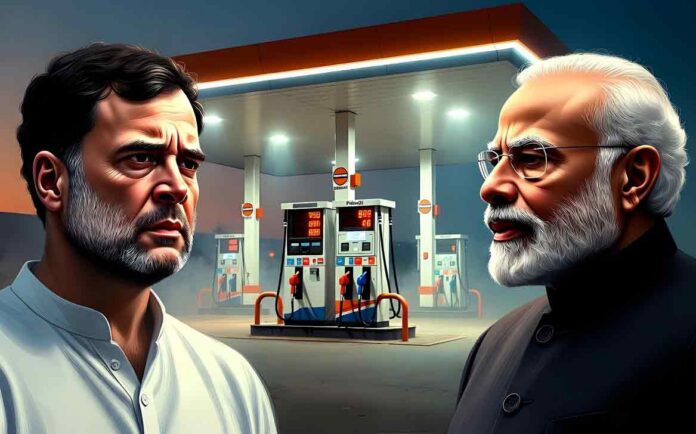
As the fuel prices are under pressure due to the West Asia crisis and the resultant blockade of the Strait of Hormuz, the Congress party has launched a fresh attack against the Modi government over the recent three rupee per litre hike in petrol and diesel prices. The party has claimed that PM Modi has “unleashed the whip” on the public after the fuel price hike. The party has also alleged that the decision was deliberately deferred until the assembly elections were over.
Rahul Gandhi declared, “The public will pay the price for the Modi government’s mistake. The ₹3 shock has already arrived; the rest of the recovery will be done in instalments.” Earlier on 28th April, he had said, “Election relief over, inflation’s heat is on its way! After April 29th, watch out — petrol, diesel, everything will get expensive,” accusing the government of profiteering when oil was cheap and now dumping the burden on citizens.
गलती मोदी सरकार की,
— Rahul Gandhi (@RahulGandhi) May 15, 2026
कीमत जनता चुकाएगी।
₹3 का झटका आ चुका,
बाकी वसूली क़िस्तों में की जाएगी।
Congress President Mallikarjun Kharge echoed this by blaming a “Modi-govt-made crisis” driven by “leadership crisis, lack of vision and incompetence.” Other Congress leaders are also parroting the same line.
Such attacks by the opposition party conveniently ignore history. In this context, it becomes important to revisit the fiscal sleight of hand from the United Progressive Alliance era, a decision that saddled the nation with a deferred liability that ballooned into a multi-lakh crore burden.
Oil Bonds that hid fiscal deficit
These were the special long-term sovereign securities, known as oil bonds, issued by the UPA govt to the Oil Marketing Companies to fund subsidies on petrol, diesel, kerosene, and LPG. Instead of subsidising fuel prices from the budget, the Dr Manmohan Singh govt issued these bonds to the OMCs, which became a costly liability for the country.
Far from shielding consumers, the UPA’s oil bonds proved economically damaging, failed to contain fuel price rises, and left the bulk of the repayment burden to the subsequent govt. In contrast, the Modi government’s refusal to reintroduce blanket subsidies on petrol and diesel stands as a model of financial prudence, especially when the entire world is grappling with the same global shock.
Between 2005 and 2010, the UPA government issued these special oil bonds worth approximately ₹1.48 lakh crore to the oil marketing companies. These were not ordinary borrowings. Instead of paying cash subsidies from the Union Budget to compensate public sector refiners for selling fuel below cost during the global oil price spike, the government handed over long-term sovereign securities.
The oil bonds carried maturities of 15 to 20 years and bore interest rates of around 7 to 8.4 per cent. On paper, this kept the fiscal deficit looking manageable, as subsidies were not funded from the budget. In reality, it was classic off-budget financing. The under-recoveries of the oil companies were masked, the immediate subsidy bill vanished from the books, and the true cost was postponed for future taxpayers.
This approach inflicted several layers of harm on the economy. First, it created a fiscal illusion. By treating the bonds as below the line items, the UPA avoided breaching the targets of the Fiscal Responsibility and Budget Management Act in those high price years when crude touched 147 dollars per barrel. But the liability for these bonds remained. Interest payments alone added roughly ₹1.70 lakh crore over two decades, pushing the total payout, principal plus interest, to over ₹3 lakh crore.
Second, the mechanism cut into govt funds, which could have been used for productive spending. Every year, the government had to set aside nearly ₹10,000 crore just for interest, funds that could have gone into infrastructure, health, or education.
Third, it weakened the balance sheets of the oil marketing companies, which were left holding illiquid bond paper instead of cash. This reduced their ability to invest in refining capacity and exploration, slowing the sector’s expansion and modernisation.
Most importantly, it eroded the fiscal discipline of the administration. Once governments learn that they can hide spending through creative accounting, the temptation to repeat it grows. But such deferral always carries a premium, paid in higher interest later and causes lost economic momentum.
Fuel prices still rose
The worst outcome is that the bonds delivered little relief to end consumers. Despite this massive off-budget support, fuel prices rose sharply throughout the UPA decade. In 2004, petrol in Delhi cost around ₹34 per litre. By 2014, it had climbed to over ₹72 per litre, an increase of more than 118 per cent. Diesel moved from about ₹22 per litre to nearly ₹55 per litre, a rise exceeding 155 per cent.
There were abrupt steep hikes in those years, including an ₹8 per litre jump in petrol prices in a single stroke in 2012. Global crude volatility at that time played its part, but the point remains: even with the bonds absorbing part of the subsidy burden, the government could not shield domestic prices from international reality. The policy brought temporary political calm but delivered no structural protection. Consumers paid more at the pump, the economy absorbed hidden costs through higher deficits and interest, and the oil companies remained squeezed.
Modi govt repays UPA’s debt
The bulk of the oil bonds issued by the UPA govt matured after 2014. Only a small tranche of bonds became due during the UPA. The heavy lifting, running into tens of thousands of crores of rupees each year between 2021 and 2026, was done by the National Democratic Alliance govt. By March this year, the Modi administration fully redeemed the final instalments, closing the bond accounts on a total obligation of around ₹3.20 lakh crore.
While the UPA had issued oil bonds amounting to ₹1.48 lakh crore, it repaid only ₹13,764 crore in principle, while the Dr. Manmohan Singh govt paid a whopping ₹68,750 crore in interest by 2014, the bulk of which was paid during UPA 2.
It is notable that for ₹1.48 lakh crore oil bonds, interest totalling ₹1.71 lakh crore has been paid from the exchequer.
Out of the total oil bonds issued, 14 oil bonds amounting to ₹ 1.34 lakh crore matured during the period from 2014 to 2026, and during this period, a total of ₹1.02 lakh crore was paid as interest by the Mod govt. Therefore, a total of ₹2.36 lakh crore was paid for matured oil bonds between 2014 and 2026.
This was no small achievement; it required careful budgeting, prudent revenue management, and a deliberate choice to prioritise long-term solvency over short-term populism. The government absorbed the interest burden year after year without resorting to fresh off-budget tricks. Despite pressure, the government didn’t reduce excise duty on petrol and diesel when the global oil prices were low, and used that extra revenue to repay the oil bonds with interest.
In doing so, it freed future budgets from this liability and strengthened the country’s fiscal framework. The very administration now being criticised for a ₹3 per litre hike had quietly paid the UPA’s credit card bill of ₹3.20 lakh crore for fuel consumed during its govt.
Today’s price hike, raising petrol to ₹97.77 per litre and diesel to ₹90.67 rupees per litre in Delhi, must be seen against this backdrop and the global context. The Strait of Hormuz crisis, triggered by escalating West Asia tensions, has disrupted nearly a quarter of the world’s seaborne oil trade. Brent crude has crossed 100 dollars per barrel and touched 126 dollars. Shipping insurance costs have jumped, freight rates have climbed, and supply chains from the Gulf to Asia face uncertainty.
Every major importer, from Europe to China to Japan, is feeling the pinch. Fuel prices are rising across continents. India, which imports over 85 per cent of its crude, cannot insulate itself from this reality.
Not repeating the Congress strategy benefits the country
Had the current global crisis taken place during a Congress government in India, it would have adopted the policy of the same deferred liability. It would have tried to subsidise fuel using borrowed money for political benefit.
The Modi government’s decision not to reintroduce subsidies on petrol and diesel is therefore sound economics. Market-linked pricing, introduced for petrol in 2014 and diesel in 2016, allows automatic adjustment according to global prices. This prevents the kind of unsustainable under recoveries that plagued OMCs during the UPA years.
Subsidising fuel indiscriminately, as was attempted earlier, distorts consumption, encourages inefficiency, and benefits the rich more. By contrast, the current system protects the public finance, and targeted interventions such as LPG subsidies reach those who need them most.
It is true that fuel price hike hurts the common man. But the alternative, returning to blanket subsidies funded either by fresh debt or by cutting development spending, would repeat the same mistakes that Congress made. The UPA’s experience shows that deferral of financial liabilities is not relief. It is just delayed pain, compounded by interest.
In an era when global energy markets remain volatile, this policy preserves macroeconomic stability and builds financial resilience. The Congress may find political mileage in selective memory, but the record is clear. The UPA deferred the bill. The Modi government paid it. And the country has to face the current global crisis now, not defer it to the future again.


