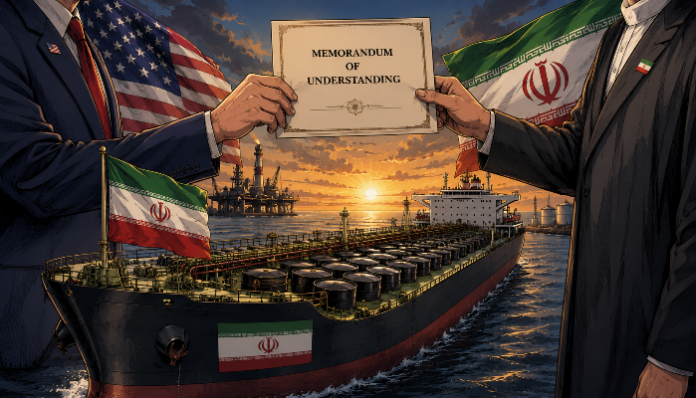
Over 30 oil tankers hauling Iranian crude are currently progressing towards Asia, with active AIS (Automatic Identification System) transponders. Kpler shipping data has also reported the development. These vessels are carrying more than 50 million barrels of crude oil. The major shift has transpired after the agreement between the United States and Iran.
🚨🚨🚨Shocking:
— Anas Alhajji (@anasalhajji) June 23, 2026
More than 30 oil tankers carrying Iranian crude oil — with their AIS transponders turned on — are heading to Asia right now, loaded with over 50 million barrels.
Map from @Kpler pic.twitter.com/mcqFf3MhWO
“Strait of Hormuz crossings rebounded sharply over 19th-21st June, with 71 confirmed transits and a weekend peak of 35 on 20th June, supported by the blockade lift and renewed free-passage signals,” Kpler informed. The volumes have stayed below the levels seen before the crisis, and a sense of caution persists. Nevertheless, the absence of new physical attacks since 10th June outlines that the reopening is fostering a steady recovery amidst critical diplomatic ties, signifying vital improvement.
Hormuz uptick remains fragile
— Kpler (@Kpler) June 22, 2026
Strait of Hormuz crossings rebounded sharply over 19–21 June, with 71 confirmed transits and a weekend peak of 35 on 20 June, supported by the blockade lift and renewed free-passage signals. Commercial crossings recovered with AIS transponder ons,… pic.twitter.com/2YnT6kTnU3
Iranian crude is flooding the global market again, just as the US lifted sanctions on the shipments. The maritime intelligence company TankerTrackers highlighted that the country shipped about 36 million barrels of crude oil since 15th June. It is projected that roughly 150 million barrels of crude will soon reach other nations despite the fragile cease-fire deal between the United States and Iran.
Iran has exported 36 million barrels of crude oil since 2026-06-15. There is roughly an equal amount still afloat in Iran.#OOTT #IranWar #Tankers
— TankerTrackers.com, Inc. (@TankerTrackers) June 21, 2026
More than 30 million barrels, taken from Kharg Island,d which is the Islamic Republic’s main export terminal in the northern Persian Gulf and crude that had been blockaded by the US, departed for Asia in the last week reported Bloomberg. Iran has been able to transport roughly 20 million barrels of its crude on tanker vessels that were anchored off the port of Chabahar, close to the country’s border with Pakistan.
The US gives an oil waiver to Iran
The United States partially removed restrictions on Iranian oil shipments for 60 days on 22nd June (Monday). The US Treasury Department approved “all transactions” previously forbidden by sanctions involving the production, sale, transportation, and delivery of Iranian-origin crude oil and related petroleum commodities until 12:01 am Eastern Daylight Time on 21st August.
“In line with the ongoing productive talks in Switzerland, Iran has committed to free and open transit in the Strait of Hormuz and to permit International Atomic Energy Agency (IAEA) inspectors into their country. As part of the framework, Treasury has issued a temporary 60-day general license authorising the production, delivery and sale of Iranian oil,” Treasury Secretary Scott Bessent stated.
Under President @realDonaldTrump and @VP, we continue to make the world safer and more prosperous.
— Treasury Secretary Scott Bessent (@SecScottBessent) June 22, 2026
In line with the ongoing productive talks in Switzerland, Iran has committed to free and open transit in the Strait of Hormuz and to permit International Atomic Energy Agency…
The two hostile countries continue talks aimed at completely reopening the strait and establishing a more comprehensive peace framework.
Crude oil, petrochemical goods and petroleum products of Iranian provenance are all covered by the permit. It facilitates the importation of Iranian oil into the United States but does not enable transactions involving North Korea, Cuba or Ukrainian territories taken over by Russia.
The oil markets have responded swiftly. West Texas Intermediate crude went below $74 per barrel, while Brent crude slipped past $78. The prices are about 30% more than they were prior to the dispute disrupting maritime routes in the Persian Gulf. However, the present reshuffle in energy costs is progressing in a positive direction.
The US earlier agreed to grant waivers for the trade of Iranian crude oil, petroleum items and derivatives alongside related services under the MoU inked last week. Additionally, the license allowed the importation of the supply into the United States when needed to fulfil its sale, delivery or offloading.
The Strait witnessed ship movements shortly following the peace deal
Shipping data revealed that after the United States and Iran reached an arrangement to reopen the strait, at least 3 tankers holding Iranian oil were able to pass through the American naval blockade a few days ago, with an empty 4th vessel travelling towards the Gulf of Oman, reported Marine Link. The shipments showed a gradual restart of these exports, which are anticipated to boost the supplies to the world market.
According to ship-tracking data from Kpler and Vortexa, the very large crude carriers Hero II and Diona, each containing two million barrels of oil, navigated through the Gulf of Oman and were moving east. Kpler, Vortexa, and LSEG data unveiled that the Suezmax Sonia I, with one million barrels of oil, also managed to get past the blockage and was bound for Singapore.
Kpler statistics illustrated that Hero II loaded its cargo in late March, whilst Diona and Sonia I loaded their cargo between 8th and 19th April. Kpler and LSEG data demonstrated that the empty Iranian-linked VLCC Stream was making its way to the US blockade. According to a senior US official, Washington will permit Tehran to start selling fuel and oil in accordance with the memorandum of understanding (MoU) the two sides reached to end the war.
“3 Iranian oil tankers are currently sailing in the northern Indian Ocean, and two others carrying essential goods and livestock feed are en route and sailing towards southern ports,” Iranian state TV likewise mentioned. “Last night, 12.5 million barrels of oil went through the Strait of Hormuz. That is a high since the beginning of the conflict,” US Vice President JD Vance conveyed on 18th June.
The US reintroduced severe sanctions on Iran in 2018
President Donald Trump withdrew from the Joint Comprehensive Plan of Action (Iran Nuclear Agreement) on 8th May 201,8 during his first term in office. As a result, the White House reinstated all of the sanctions it had waived as part of the accord, which called for the easing of all nuclear-related economic and financial restrictions in exchange for the Islamic regime enforcing strict limitations placed on its nuclear program.
On 5th November, heavy sanctions were put on Iran’s energy industry and petroleum-based transactions after a 180-day wind-down period. Iran has some of the largest oil reserves in the world and was exporting over 2 million barrels of oil per day before the decision. The figure fell to about 350,000 barrels per day by the end of 2020, as the nation lost its crucial economic lifeline.
Notably, Iran encountered international sanctions for the first time in 1979, which were later extended to its energy sector during the 1990s.