

The Bharatiya Janata Party (BJP)-led government in West Bengal presented its full Budget for the financial year 2026-27 in the state Assembly on 22nd June. While the Budget introduced a series of measures aimed at boosting investment, infrastructure and economic growth, a comprehensive thematic analysis by SBI Research [pdf], published on Thursday, 25th June, suggests that the Budget marks a significant shift towards investment-led development and long-term economic transformation.
The SBI report not only examined the contents of the latest Budget but also placed West Bengal’s economic journey in a broader historical context. The analysis highlighted how the state, once among India’s strongest economic performers, gradually lost its position over several decades and now faces the challenge of catching up with the national average.
SBI report provides important historical perspective
One of the most striking aspects of the SBI Research report is its examination of West Bengal’s long-term economic trajectory.
According to the report, West Bengal experienced strong growth in the early years of the last decade. Nominal Gross State Domestic Product (GSDP) growth touched 13.6% in 2012-13 and climbed further to 14.4% in 2013-14. Like the rest of the country, however, the state suffered a severe setback during the COVID-19 pandemic. In 2020-21, both nominal and real growth rates fell into negative territory as economic activity came to a standstill.
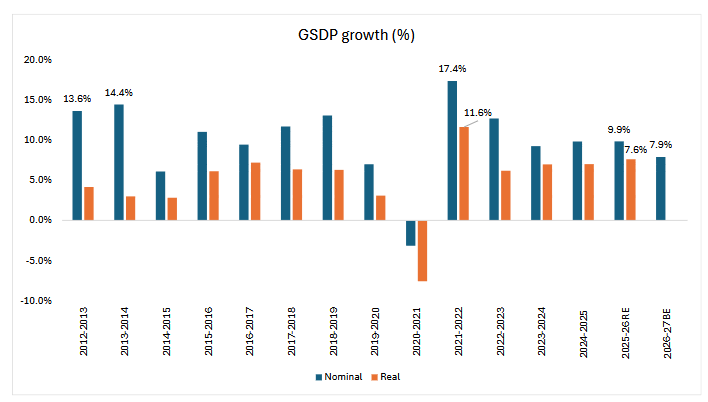
The state witnessed a strong rebound after the lockdown period. In 2021-22, nominal growth surged to 17.4% while real growth reached 11.6 %. Since then, growth has stabilised. For 2025-26, revised estimates place nominal growth at 9.9% and real growth at 7.6%. The Budget Estimates for 2026-27 project a nominal growth rate of 7.9%.
The report notes that West Bengal’s economy today is primarily driven by the services sector, which contributes 58.3% of Gross Value Added (GVA). Industry contributes 21.6%, while agriculture still accounts for a significant 20.1% share.
However, the most revealing part of the analysis concerns per capita income.
SBI Research notes that in FY78, West Bengal’s per capita income stood at ₹1,266, which was higher than the national average of ₹1,194. At that time, the state ranked fifth among all Indian states.
Over the following decades, however, the state’s relative position steadily weakened. By FY2012, West Bengal had slipped to the 21st position among Indian states with a per capita income of ₹56,693.
The state has recovered slightly since then. In FY2025, West Bengal’s per capita income reached approximately ₹1.81 lakh, improving its rank to 19th. Yet it remains substantially behind the national average of ₹2.35 lakh. The report notes that West Bengal’s per capita income is now around 23% lower than the all-India average.
Between FY2012 and FY2025, West Bengal’s per capita income expanded by 3.20 times, compared to a national expansion of 3.28 times, indicating that the state has continued to lag behind the country’s overall economic momentum.
How West Bengal lost its economic lead
This decline is a combination of political, industrial and structural factors spanning several decades.
At the time of Independence and through the 1960s, West Bengal was one of India’s leading industrial and commercial centres. Kolkata served as a major hub for finance, manufacturing, engineering, tea and jute industries.
The situation began changing during the 1970s and 1980s. Political instability, labour unrest, frequent strikes, gheraos and power shortages created an increasingly difficult environment for businesses. Many major industrial houses shifted operations to states such as Maharashtra, Gujarat and Tamil Nadu.
The report also points out that the Left Front government, which came to power in 1977, focused heavily on land reforms and rural development through programmes such as Operation Barga. While these policies improved agricultural productivity and strengthened rural livelihoods, large-scale industrialisation remained limited.
As a result, West Bengal missed much of the manufacturing boom that transformed several western and southern states.
The state eventually became increasingly dependent on services. While sectors such as banking, retail and information technology grew, they were not sufficient to generate the scale of high-paying employment needed to lift incomes at the same pace as other states.
Dependence on central funds remains high
The SBI report also highlights another important aspect of West Bengal’s finances: the state’s long-standing dependence on funds from the Centre.
According to the analysis, West Bengal has consistently received more than 50% of its revenue receipts from the Union government through tax devolution and grants.
For the 2026-27 Budget Estimates, central taxes are projected to account for 34% of total revenue receipts, while grants from the Centre contribute another 22%. Together, these amount to 56% of the state’s revenue receipts.
The report notes that West Bengal’s own tax revenue has remained largely stagnant over the years. In 2010-11, the state’s own tax collections accounted for 45% of revenue receipts. More than a decade later, the figure stands at 41% in the 2026-27 Budget Estimates.
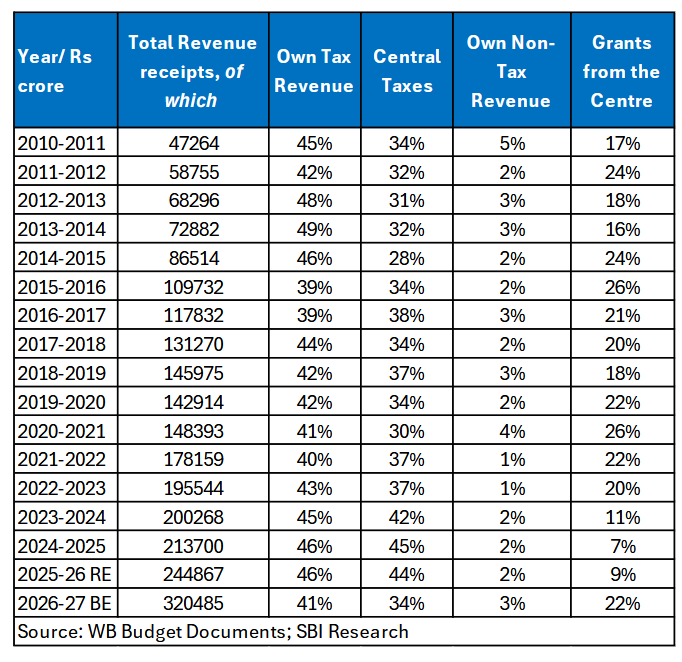
The situation is even more striking when it comes to non-tax revenue. The state’s own non-tax revenue has remained around 3% of total receipts for most of the period under review.
Total revenue receipts have certainly increased over time. They rose from ₹47,264 crore in 2010-11 to a projected ₹3.2 lakh crore in 2026-27. Yet SBI’s data suggests that the state continues to rely heavily on central transfers while struggling to significantly expand its own revenue base.
Despite receiving substantial support from the Centre for years, West Bengal has continued to face significant debt burdens.
Budget language shows a shift from redistribution to capacity building
One of the most interesting sections of the SBI study involves a thematic analysis of Budget speeches delivered over the past sixteen years.
According to the report, earlier Budget narratives under the Mamata Banerjee-led Trinamool Congress (TMC) government largely focused on welfare-oriented and redistributive policies. Social welfare remained a dominant theme across multiple Budget cycles.
The 2026-27 Budget presented by the current BJP government, however, reflects a notable change in emphasis. SBI describes the shift as a transition from redistribution towards capacity building and long-term economic development.
The strongest evidence of this change comes from the increasing focus on investment. The theme of “investment” reached an all-time high of 4.5% in the 2026-27 Budget speech, significantly above the levels recorded during the previous few years.
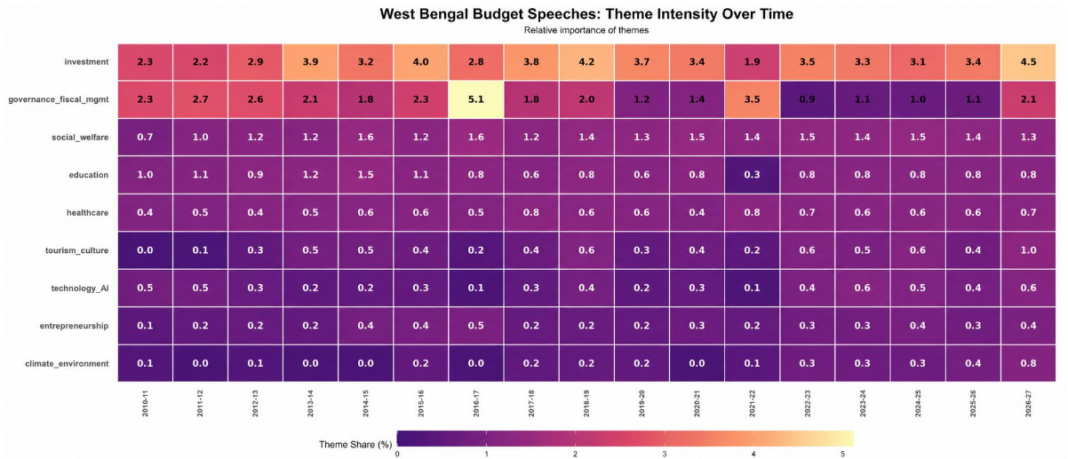
Governance and fiscal management have also returned as major priorities. Their share in the budget discourse rises to 2.1 %, indicating renewed attention towards improving public finances and administrative efficiency.
The report further highlights the emergence of several new themes that received limited attention in earlier years.
Tourism and culture reached a record focus level of 1%. Climate and environment rose to 0.8%, the highest in the available series. Education also stood at 0.8%, while healthcare accounted for 0.7%.
Technology and artificial intelligence reached 0.6%, continuing a steady rise over recent years. Entrepreneurship maintained an elevated presence at 0.4%.
According to SBI, these trends suggest a broader developmental narrative centred around economic capability, investment creation and future-oriented sectors.
Most optimistic Budget narrative in the series
The report also conducted a linguistic analysis of Budget speeches using the Bing sentiment lexicon, measuring the balance between positive and negative words.
The results show that the 2026-27 Budget displays the most optimistic language seen in the entire dataset.
According to SBI Research, the latest Budget records the highest net sentiment score since tracking began in 2010-11. Positive words reached their highest historical share, reflecting an expansionary and highly aspirational tone. The analysis shows a clear upward trend beginning in 2021-22 after the disruptions caused by the pandemic.
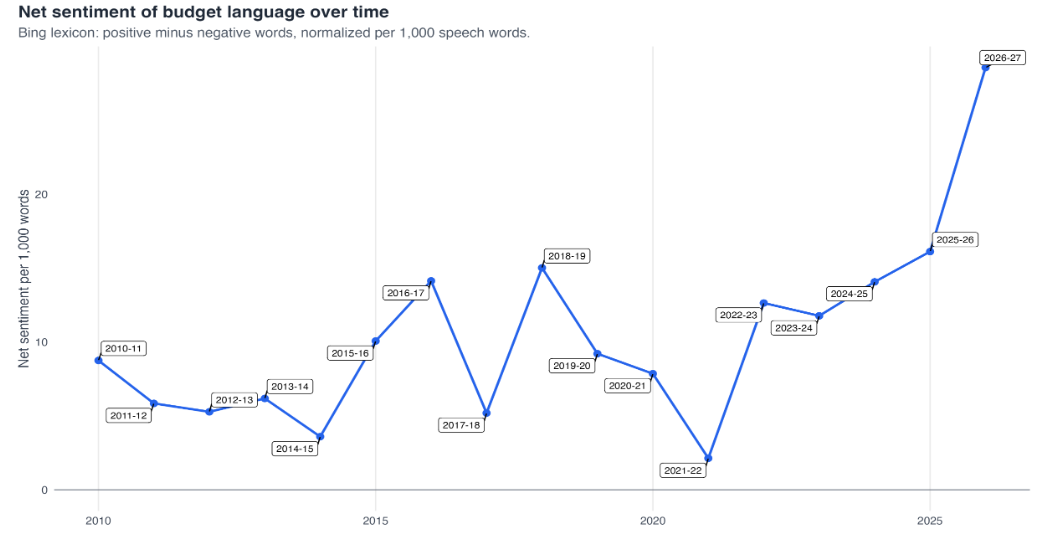
The lowest sentiment score in the series occurred during the immediate post-pandemic period in 2021-22. Since then, sentiment has steadily improved year after year, culminating in the record-high optimism reflected in the 2026-27 Budget.
SBI says this suggests that policymakers are increasingly framing the state’s future around growth, investment and long-term transformation rather than crisis management.
Previous reports pointed to economic decline under TMC rule
The SBI findings also come against the backdrop of earlier analyses that raised concerns about West Bengal’s long-term economic performance.
OpIndia had earlier reported that West Bengal’s economy witnessed significant structural deterioration during the years of Mamata Banerjee-led Trinamool Congress (TMC) rule, citing a financial report published by Finskeptics.
That report argued that despite occasional periods of growth, the state’s overall economic position weakened relative to many competing states. It highlighted the decline in industrial competitiveness, slower income growth compared to the national average and the state’s growing dependence on central transfers.
The new SBI Research report does not make the same political conclusions, but its historical analysis similarly documents West Bengal’s slide from being India’s fifth-richest state in per capita income terms in FY1978 to the 19th position today.
At the same time, SBI’s assessment suggests that the 2026-27 Budget represents an attempt to change that trajectory through greater emphasis on investment, governance reforms, technology adoption and economic capacity building.
Whether this shift ultimately succeeds in reversing decades of relative decline will become clearer in the years ahead. For now, the report presents a detailed picture of a state trying to move from a welfare-dominated economic framework towards a growth-driven model while still confronting the challenges created by its long economic journey.


