

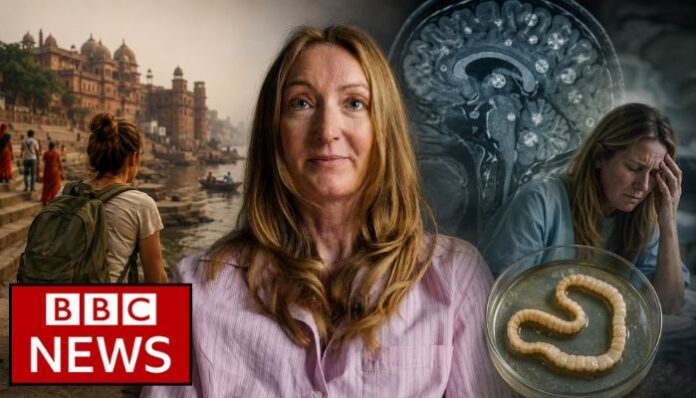
A 42-year-old woman from Wales has claimed that a trip to India nearly two decades ago changed her life after she allegedly developed a rare parasitic brain infection. The story has recently gained international attention after the BBC reported her account, despite the events dating back to 2007.
Lowri Denman, who now lives in the UK, shared her experience with the BBC, saying that a three-month visit to India in 2007 allegedly led to an infection that eventually left her with a metre-long tapeworm and 38 parasites in her brain.
According to her account, the illness took years to diagnose and resulted in severe headaches, seizures and other neurological complications. The renewed coverage of a nearly two-decade-old case has, however, also triggered debate online, with many questioning the timing of the reports and their impact on India’s image.
What is Neurocysticercosis and how it spreads
The condition at the centre of Denman’s story is neurocysticercosis (NCC), a disease caused by the larval stage of the pork tapeworm (Taenia solium). Medical experts have repeatedly clarified that the disease is often misunderstood. Contrary to popular belief, neurocysticercosis is not acquired simply by eating pork. Instead, it occurs when a person accidentally ingests microscopic tapeworm eggs through food or water contaminated with human faeces or through poor hygiene practices.
According to the World Health Organisation (WHO), humans develop an intestinal tapeworm infection, known as taeniasis, after consuming raw or undercooked infected pork. However, the more serious condition, cysticercosis, develops when tapeworm eggs enter the body through the faecal-oral route. The larvae can then travel through the bloodstream and lodge in different organs, including muscles, eyes and the central nervous system. When these cysts form inside the brain, the condition is known as neurocysticercosis.
Doctors describe neurocysticercosis as the most common parasitic infection of the central nervous system worldwide. Symptoms vary depending on where the parasites settle but commonly include severe headaches, seizures, epilepsy, cognitive problems, visual impairment and, in some cases, psychiatric symptoms. The disease is considered the leading preventable cause of epilepsy globally and is estimated to account for nearly 30% of epilepsy cases in countries where the parasite is endemic. Diagnosis usually requires brain imaging such as CT or MRI scans along with laboratory tests, while treatment generally involves anti-parasitic medicines, steroids and seizure-control medication.
Importantly, Denman herself stated that she deliberately avoided eating meat during her India trip. Medical experts quoted in reports suggested that if her diagnosis is correct, the infection would have resulted from accidentally ingesting microscopic tapeworm eggs through contaminated food or water rather than from knowingly eating pork.
What Lowri Denman claimed happened
Speaking to the BBC, Denman recalled that the first sign of something being seriously wrong came in 2010, three years after her India trip, when she discovered what she described as a metre-long tapeworm after using a restaurant toilet.
“It looked absolutely disgusting, like Sellotape with little ridges in it,” she said.
Although stool tests came back normal, her health deteriorated over the following year. She began suffering severe headaches and later experienced her first seizure in 2011.
“I was really starting to struggle getting some words out,” she recalled. “The next thing I came around and I was in an ambulance.”
Brain scans later revealed what doctors initially believed could be another infection. Denman said the doctor eventually told her, “We’ve found 38 parasites on your brain.”
“My mum and I were just jaws on the floor like, ‘what on earth, what is that?'” she said.
According to the report, her mother questioned whether the parasites could be linked to the tapeworm Denman had discovered a year earlier. Further investigations reportedly led doctors to diagnose neurocysticercosis. Denman spent two weeks in hospital and underwent treatment with anti-parasitic drugs and steroids. She later enjoyed several healthy years before suffering another medical setback when scans revealed significant swelling around the remaining parasites in her brain.
Why a 19-year-old story is being reported now
The renewed publication of Denman’s account has sparked criticism on social media that a medical case linked to a trip made in 2007 is being widely promoted in 2026.
Publishing a nearly two-decade-old case appears to reflect the anti-India BBC’s intention to create the impression that such infections are uniquely associated with present-day India, even though neurocysticercosis is a recognised parasitic disease found across several developing regions in Asia, Africa and Latin America. The infection described in the BBC report is linked to hygiene and contamination rather than simply travelling to or eating food in India.
Reviving the story after 19 years contributes to negative perceptions about India, especially when the reports receive wide international circulation.
Social media reactions turn into anti-India remarks
Following the publication of the BBC report, several users on social media posted comments targeting India and Indians as per the motive of the BBC, the British broadcaster with a history of furthering anti-India propaganda.
One user wrote, “Ban immigration from India ASAP,” while sharing the BBC article. Another commented, “Would go anywhere in Africa before I ever went to India.”
Ban immigration from India ASAP! https://t.co/LrzBhaFbVp
— Tom Stoukas (@StoukasTom) July 1, 2026
Some remarks became even more offensive. One post claimed, “India’s biggest export is parasites, either shaped like humans or worms; they’re all bioweapons.”
Indias biggest export is parasites, either shaped like humans or worms, they’re all bioweapons. https://t.co/C1WRvLyn3K
— Neon White Rabbit (@RedPillRabbit) July 1, 2026
Another user mocked Indians by writing, “It’s amazing that 38 Indians actually fit into her brain.”
It's amazing that 38 Indians actually fit into her brain https://t.co/2GWIYygAne
— Insane Cope (@InsaneCope) July 1, 2026
These highly volatile reactions demonstrate how dated medical anomalies can be easily manipulated by media outlets to feed pre-existing biases, turning a personal healthcare crisis into a tool for geopolitical defamation.
Would go anywhere in Africa before I ever went to India https://t.co/Hri8pzkiwa
— Quality Learing Center (@qualitylearnc) July 1, 2026
A report to spread hate against India
The renewed attention has also drawn scrutiny over the reporting itself. The BBC article centres on events that began with a trip in 2007, raising questions about why the case has been prominently highlighted nearly 19 years later.
The author of the article, Journalist Nicola Bryan, has reported versions of the same story across multiple publications over the past week, with differing descriptions of Denman’s location in some reports.
The same narrative has been appearing across multiple outlets all week, with Nicola Bryan changing important details along the way.
— Rupsy Saini (@ZiviiBloom) July 2, 2026
One report says Wales, another says Scotland, another says England. Looks more like a media placement than organic journalism. 🤔@BBCNews… pic.twitter.com/9ualmo3JNK
In one version, the woman is from Wales, in another from Scotland, and in another from England. These variations, combined with the revival of an old medical case, have fuelled speculation online that the story is being amplified in a way that reinforces negative narratives about India.
The writer "Nicola Bryan" is spamming this same Article with changed details across multiple news agency for the past 1 week
— Muji Singh Rangi (@mujifren) July 1, 2026
The lady the story says allegedly went to India 20 years back
In some story the lady who got parasite in India is from Cardiff, Wales, in other she is… https://t.co/HiEHza0Lhu pic.twitter.com/H3Tleve8cl
The reports themselves also acknowledge that Denman had avoided meat during her India trip. According to the BBC article, doctors believed she may have inadvertently ingested microscopic tapeworm eggs through contaminated food or water, rather than because she knowingly consumed pork. Her first seizure occurred about three years after her 2007 trip to India. Given this timeline, it is difficult to conclude solely that the infection was definitively acquired during her visit to India.
The manner in which the BBC has revived and amplified a nearly two-decade-old medical case also fits into a broader pattern in which sections of the Western media disproportionately highlight stories that reinforce stereotypes about India. While diseases such as neurocysticercosis are recognised by the World Health Organisation as a public health issue across multiple countries in Asia, Africa and Latin America, the report’s framing risks creating the impression that such infections are uniquely associated with India. Such selective editorial choices often end up fuelling prejudice rather than informing readers about the actual epidemiology of the disease.
The resulting online reaction illustrates how quickly such reporting can morph into casual racism against Indians. The social media responses following the BBC article included calls to ban Indian immigration and dehumanising remarks comparing Indians to parasites.
This echoes previous instances in which Western media coverage of India has relied on caricatures and stereotypes. One of the most widely criticised examples was a 2014 cartoon published by The New York Times after the Mars Orbiter Mission successfully entered Mars orbit. The cartoon depicted a turbaned Indian with a cow knocking on the door of an elite space club, a portrayal that was patronising and rooted in colonial stereotypes. It is such reportages and portrayals that contribute to normalising casual racism against India under the guise of commentary.


