

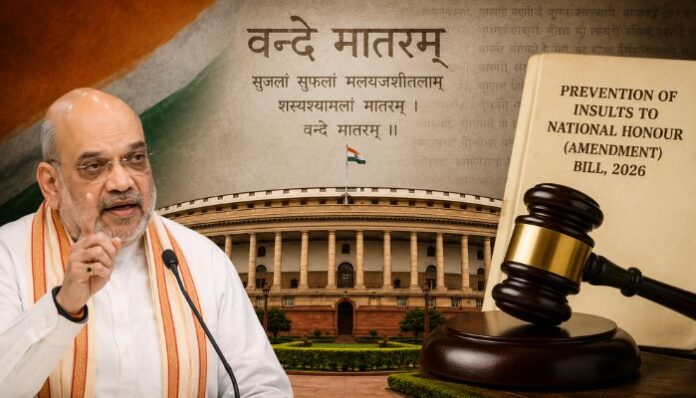
The central government is all set to introduce an important piece of legislation in the Rajya Sabha on Monday, 20th July, marking the very first day of the Parliament’s Monsoon Session. Union Home Minister Amit Shah will introduce the Prevention of Insults to National Honour (Amendment) Bill, 2026, which aims to make any insult or obstruction to the national song, Vande Mataram, a criminal offence.
The bill has already been formally listed on the Rajya Sabha’s agenda for the day, following a prior clearance by the Union Cabinet. This legislative move comes as part of the country’s year-long celebrations marking the historic 150th anniversary of the creation of Vande Mataram.
If Parliament passes the Bill, deliberately insulting Vande Mataram, stopping its rendition or creating a disturbance while it is being sung could attract punishment of up to three years in jail, a fine, or both.
🚨 The government is set to introduce a bill in the Rajya Sabha today to make insulting 'Vande Mataram' a criminal offense. pic.twitter.com/47nTo9XyAh
— Indian Tech & Infra (@IndianTechGuide) July 20, 2026
At present, the Prevention of Insults to National Honour Act, 1971 provides legal protection to the National Flag, the Constitution, and the National Anthem. However, there is no specific provision in the law that deals with insults to the National Song. The proposed amendment aims to fill this gap by bringing Vande Mataram within the scope of the Act.
According to the Bill’s statement of objects and reasons, there is currently “no specific legal provision” to prevent anyone from intentionally disrupting or insulting the singing of Vande Mataram. “The proposed amendment seeks to prohibit any person from deliberately preventing the singing of the National Song or causing disturbance during its rendition by making such acts punishable under law,” the government has said.
The Union Cabinet had earlier approved the proposal to amend the 1971 Act before it was listed for introduction in Parliament.
What the Bill will change
The biggest change proposed by the Bill is that Vande Mataram will receive the same statutory protection as Jana Gana Mana. Once the amendment becomes law, any deliberate act of insulting the National Song or intentionally disrupting its performance will be treated as a criminal offence in the same manner as offences involving the National Anthem or National Flag.
The Centre intends to bring a bill in the Rajya Sabha to make any obstruction or insult to the national song Vande Mataram a criminal offence on Monday, the first day of the Monsoon Session of Parliament.
— The Indian Express (@IndianExpress) July 19, 2026
The Prevention of Insults to National Honour (Amendment) Bill, 2026, has… pic.twitter.com/n3i7sSR23o
The government says the move is aimed at ensuring equal respect for both national symbols. “The objective is to extend the same legal protection to the National Song that already exists for the National Anthem under the Prevention of Insults to National Honour Act,” the proposed legislation states.
The amendment is also being brought as part of the year-long celebrations marking the 150th anniversary of Vande Mataram, which has played an important role in India’s freedom movement.
Key changes and legal penalties under the proposed law
Once this proposed legislation is passed by the parliament, any deliberate insult directed at Vande Mataram or any intentional disruption created during its rendition will become a criminal offence.
The legal consequences for breaking this law are stringent. Anyone found guilty of intentionally insulting the song or deliberately obstructing people from singing it will face a prison term of up to three years, a fine, or both. The government hopes that by introducing these tough penalties, the song will receive the highest level of legal dignity and protection across the country.
Alongside the criminal penalties, the new bill outlines a very specific set of protocol guidelines regarding how the national song should be performed and respected. The legislation mandates that Vande Mataram must be sung at all official government functions and should be performed right before the commencement of these official programmes.
Furthermore, the guidelines state that all six stanzas of the song must be rendered during these occasions, which takes a total time of approximately 3 minutes and 10 seconds. The law also requires that people remain standing in the attention position while the song is being sung.
Additionally, schools will be required to play or sing Vande Mataram every day before their morning prayers begin.
Earlier, the Union Home Ministry had directed states to ensure that wherever the National Anthem is played during official events, the National Song should also be performed according to the prescribed protocol, with Jana Gana Mana following Vande Mataram.
Historical significance of India’s National Song
Vande Mataram was written by renowned author Bankim Chandra Chattopadhyay. The song, written in a blend of Sanskrit and Bengali, consists of six stanzas and first appeared in his famous novel Anandamath.
It was publicly sung for the first time in Calcutta in 1896 and later became one of the most powerful symbols of India’s freedom struggle. Over the decades, the song has remained closely associated with the country’s nationalist movement and continues to hold a special place in India’s cultural and political history.
Political debate begins before the introduction
Even before the Bill is formally introduced in Parliament, it has triggered a political debate.
The Bharatiya Janata Party (BJP) has described the proposed legislation as an important step towards strengthening respect for national symbols and preserving the dignity of Vande Mataram.
🔴#BREAKING | Home Minister Amit Shah to introduce Vande Mataram bill tomorrow in Parliament : Bill aims to protect the National Song, to include 3 years jail for disrupting it
— NDTV (@ndtv) July 19, 2026
NDTV's @AkhileshSharma1 joins @divyawadhwa with more details pic.twitter.com/nSlssQH5ig
The Congress, however, has criticised the move, arguing that it reflects what it called the Modi government’s “jail first” approach to governance. Opposition leaders have questioned whether criminal penalties are the right way to promote respect for national symbols.
The CPI(M) is also opposing the Bill. Speaking to media, CPI(M) MP John Brittas stated, “I have also written a letter to Amit Shah, saying that he should forthwith withdraw this Bill. When this issue came up in the Supreme Court in March, the Supreme Court had said that there is no legal burden and there is no penal provisions attached to this and that they are not entertaining the plea. Now, since the Govt failed on its executive mission, they want to come around with a legislative move to thrust this upon us. They shouldn’t enter into a situation whereby patriotism can be manufactured by such acts of criminalising anything concerning Vande Mataram”
#WATCH | Monsoon session of Parliament | Delhi: On Prevention of Insults to National Honour (Amendment) Bill, 2026, CPI(M) MP John Brittas says, "I have also written a letter to Amit Shah, saying that he should forthwith withdraw this Bill. When this issue came up in Supreme… pic.twitter.com/of6RIZX0DT
— ANI (@ANI) July 20, 2026
He accused the government of playing the politics of polarisation.


