

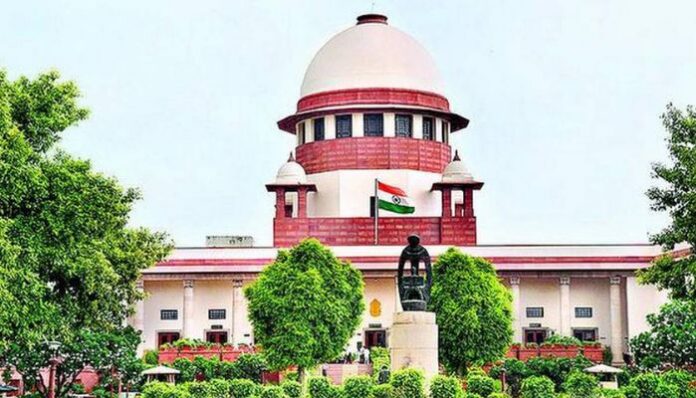
On 30th July (Thursday), the centre raised questions regarding the insistence on including the Chief Justice of India (CJI) on the panel to appoint the Chief Election Commissioner (CEC). The union government contended that an “outsider” or a former judge should also be consulted when selecting cabinet ministers if the prime minister’s decision cannot be trusted.
The argument transpired during the hearing of pleas challenging the Chief Election Commissioner and other Election Commissioners (Appointment, Conditions of Service, and Term of Office) Act, in the Supreme Court. In previous hearings, a bench led by Justice Dipankar Datta had questioned absence of even “one absolutely neutral person” on the panel. It countered that a cabinet minister would rarely oppose the prime minister. The court had claimed that the public would receive wrong signals from the executive’s “dominant” presence on the committee.
“The office of the prime minister has a certain sanctity attached. If his decisions are not to be trusted and are to be seen as necessarily a bad faith exercise, then why not have a provision that even while selecting his cabinet, he must consult some other former judge or outsider,” submitted solicitor-general Tushar Mehta before a bench of Justice Dipankar Datta and Justice Satish Chandra Sharma.
However, the court mentioned that since the Election Commission was an independent body, the issue was one of justice and transparency in the nomination of the CEC and the ECs rather than mistrusting the prime minister. It emphasised the necessity of an impartial and independent procedure and noted that the poll monitor must both operate independently and be perceived as doing so. The court also questioned Parliament’s decision to leave out CJI from the panel when drafting the bill.
Justice Datta conveyed, “The appointment procedure should be shown to be fair. The issue is that the composition of this committee tilts in favour of one side. There is a two versus one here, two of the executive and one of the opposition. Should there not be a show of fairness in the appointment to one of the most important offices of this country.”
Mehta inquired if the Anoop Baranwal ruling could really limit the Parliament’s ability to replace the CJI on the panel with a cabinet minister. According to him, the Constitution envisions independence for the Legislative and Executive branches, just as it does for the judiciary.
He highlighted, “When the executive wants to participate in the selection of another organ, it becomes a question of independence of another organ. Can it be said to the judiciary then that we will not trust your appointments because there is no outsider? This is not adversarial. I am just saying this as a student of law.” The government’s repeatedly unaddressed grievances against the “Collegium” system of “judges selecting judges” was mentioned by Justice Datta in response.
SG Mehta and Attorney General (AG) R Venkataramani urged the bench to refrain from challenging Parliament’s wisdom, otherwise it would be equivalent to interfering with the legislature’s independence. The AG stated that “Parliament cannot be gagged” and that the legislative decision made by it could not be questioned only because a different model could be used. Mehta pointed out that the independence of the country’s three branches: executive, legislative, and judicial, must be preserved.
He further remarked, “The issue is whether one democratic organ of the state could assume that decisions of another constitutional organ would necessarily be taken in bad faith merely because the executive enjoyed a numerical majority in the selection committee.”
The bench asserted that there was no doubt about the prime minister’s credibility. Recalling that the court had earlier relied on the elected government to make sure that individuals with criminal records were not chosen as ministers, it asked the SG how many government ministers had charges pending against them.
According to the petitions, the aforementioned act “defeated” a constitution bench judgement in the Anoop Baranwal case, which established a CEC selection panel headed by the prime minister and comprised the CJI along with the Leader of the Opposition in the Lok Sabha. It was passed after a few months of the verdict and substituted the CJI with a prime minister-nominated cabinet minister. Mehta contended that the goal of the order was only to close a legislative vacuum that existed at the time and was later filled by the act.
Although the prior petitions contesting the current statute have not yet been resolved, the court is also handling later pleas contesting the centre’s nomination of Gyanesh Kumar as CEC last year. Following a day of deliberations, the bench reserved its decision on whether the CJI’s absence from the selection panel constituted a “substantial question of law” that needed to be addressed by a five-judge constitution bench.
The Supreme Court’s 2023 verdict
On 2nd March 2023, a constitution bench of the Supreme Court ruled that the chief justice of India, the prime minister, and the opposition leader in the Lok Sabha would serve on the panel that selects the chief election commissioner and other commissioners until the Parliament passed legislation outlining the selection process.
On 377 page of the ruling, the court issued a set of guidelines stating unequivocally that “We declare that the appointment of the chief election commissioner and the election commissioners shall be made on the recommendations made by a three-member committee comprising of the prime minister, leader of the opposition of the Lok Sabha and in case no leader of opposition is available, the leader of the largest opposition party in the Lok Sabha in terms of numerical strength and the chief justice of India.”
This was until the parliament passes legislation in accordance with Article 324(2) of the Constitution. The bench led by Justice KM Joseph passed the order to guarantee the independence of election commissioners. It declared that there was no parliamentary bill that outlined the procedure for choosing election commissioners at the time the order was passed, in compliance with Article 324(2) of the constitution. As a result, it was clarified that the order, which included the CJI in the selection committee, was only in effect until a legislation was passed by the parliament.
Meanwhile, with this judgement, the apex court directed the government to follow a framework that the court had previously rejected for appointing judges through the National Judicial Appointment Commission (NJAC). Additionally, it mandated that the government implement “necessary changes” to guarantee that ECI becomes “truly independent,” implying that ECI was not operating independently up until this point. However, the same can be extended to the appointment of judges to the Supreme Court and the High Courts, which is carried out by a closed body of justices called the “Collegium.”


