

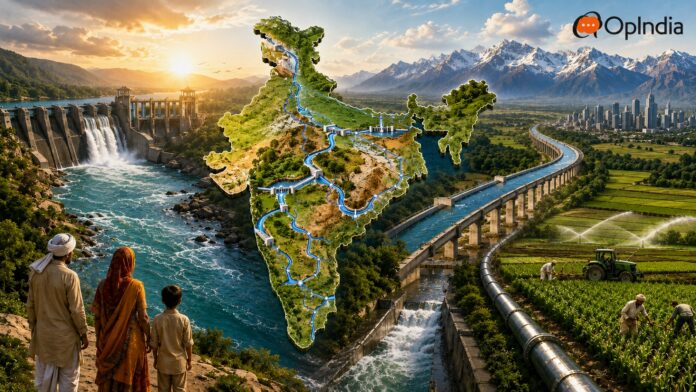
The third and concluding part of the river linking series examines the delicate balance between vision and execution in India’s Interlinking of Rivers (ILR) project. While creating a unified national water grid offers a definitive solution to India’s recurring flood-drought cycles, transforming this ambitious blueprint into ground reality requires navigating complex ecological, financial, and inter-state political challenges.
Part 3 delves deep into the primary hurdles facing the mega-project. Constructing massive canal networks and reservoirs inevitably involves significant environmental concerns, including the submergence of forest land, wildlife habitat fragmentation, and the displacement of local communities requiring fair rehabilitation. Furthermore, the report analyzes the delicate hydro-politics between states, where sharing river waters frequently leads to prolonged legal battles and political friction, testing the spirit of cooperative federalism.
To evaluate whether such large-scale engineering feats can succeed, the report draws critical comparisons with major global water transfer initiatives. It analyzes China’s monumental South-North Water Transfer Project, the largest water diversion project in human history, and the California State Water Project in the United States. These international benchmarks demonstrate that moving surplus water across vast geographical basins is not only technologically feasible but can fundamentally secure a nation’s agricultural, energy, and industrial future when backed by strong national willpower.
However, the analysis emphasizes that India cannot blindly copy foreign models without tailoring them to its unique socio-ecological reality. Overcoming these hurdles demands adopting advanced engineering technologies, satellite-based water monitoring, transparent environmental impact assessments, and building lasting consensus among states.
Ultimately, Part 3 concludes that while the challenges of river interlinking are immense, the cost of doing nothing, reflected in annual flood devastation and looming water scarcity for over a billion people, is far higher. With strategic execution, rigorous environmental safeguards, and political determination, India’s river-linking ambition can be turned into its greatest ecological and economic triumph.
The full article is available on Chapter One Mag.


