One could perhaps comfortably say that the history of Indian politics reads like a necrology of scams – of buried skeletons rotting just beneath the surface of the earth – forgotten, as if they never existed. In India, most corruption cases are so elaborate and intricate that good men who once believed they would get the perpetrators to pay for their sins get tired of swimming against the tide and give up. What’s the point, one may wonder. The cases would go on for decades, and with fading public memory, if the case ever reaches its conclusion, and if the perpetrator ever gets punished, it would certainly mean very little. The media, which is supposed to hold power, real power, accountable, moves on either because the news cycle has long changed or because their affiliations don’t allow them to pursue pesky cases that their political overlords want erased from public memory.
But there are some cases of corruption that have lived on because the ones fighting for accountability refused to give up.
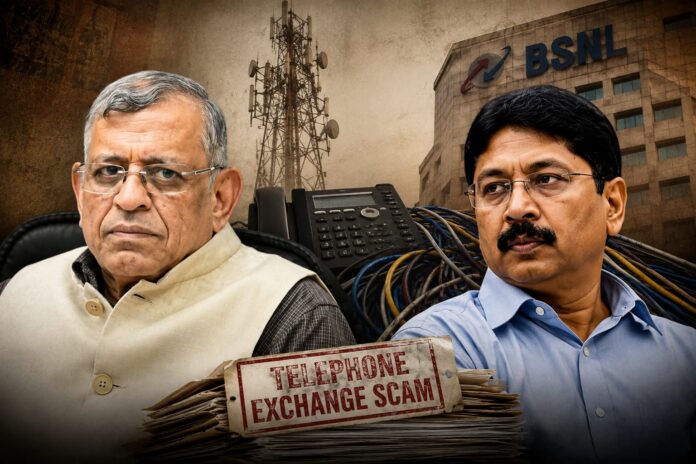
The alleged illegal telephone exchange involving former Union Telecom Minister Dayanidhi Maran became one of S. Gurumurthy’s longest investigative pursuits. What began with his 2011 exposé in The New Indian Express developed into an institutional battle involving the CBI, BSNL, the government and ultimately the judiciary.
The investigation alleged that while Maran was Telecom Minister, hundreds of high-capacity BSNL lines were installed at his Chennai residences and that the network was connected through underground optical fibre to Sun TV, controlled by his brother Kalanithi Maran.
His original exposé, published under the print headline “Minister Steals a Telephone Exchange, Loots BSNL”, focused on 323 high-speed ISDN lines installed at Maran’s Boat Club Road residence. These were not ordinary residential connections but facilities capable of carrying large volumes of voice, data and video.
According to CBI material, the lines were connected through approximately 3.4 kilometres of underground cable to Sun TV. More significantly, the connections stood not in Maran’s name but in the official name of the Chief General Manager, Chennai Telephones.
This was central to the alleged fraud: private use had apparently been given the colour of legitimate official use.
More than 400 additional connections were associated with the Gopalapuram residence, taking the total to approximately 764 lines. Gurumurthy repeatedly asked the obvious question: why would any minister require 764 high-speed lines?
The Case Began Under UPA
Like all other scams, the ones who fleeced public money cried political vendetta when the investigation began.
In 2015, only a year after the Modi government assumed power, Maran claimed that the investigation was politically motivated and the CBI was trying to “please somebody”. And it wasn’t just Maran. Political compulsions forced several others to cry vendetta – the last refuge of the corrupt.
The charge can be easily disproved by delving into the chronology of the case.
Maran was Telecom Minister between 2004 and 2007. According to Gurumurthy, the CBI had already examined the telephone exchange issue and communicated with the Telecom Ministry seeking action in September 2007.
Yet effective prosecution did not follow.
It was alleged that after the Marans reconciled politically with DMK patriarch M. Karunanidhi, the matter went into cold storage. By the time The New Indian Express exposed it in June 2011, the investigative trail was already nearly four years old.
This undermined the later vendetta argument. The case did not originate after the NDA came to power; it had originated under the UPA itself.
Maran denied the allegations. Gurumurthy continued publishing documentary material, approached the CBI and, when the investigation still failed to progress, moved the Supreme Court in 2013. The Court sought responses from the CBI and BSNL, and the CBI subsequently registered its case.
For Gurumurthy, the sequence—CBI inquiry in 2007, public exposure in 2011 and FIR only after judicial intervention—demonstrated institutional delay, not investigative haste.
₹1.2 Crore or Hundreds of Crores?
The most important dispute concerned the alleged loss to BSNL. During subsequent proceedings, approximately ₹1.2 crore came to be treated as the loss. Gurumurthy argued that this fundamentally understated the case because it represented essentially BSNL’s cost of laying the infrastructure, not the commercial value of hundreds of high-capacity lines allegedly used without normal billing.
He argued that rental alone on 764 lines could exceed ₹200 crore, without counting actual user charges.
More strikingly, the September 2007 CBI communication cited by him stated that in just one line and one month more than 48 lakh units of calls had emanated, indicating, in his interpretation, massive multimedia usage.
If that was the traffic on one line for one month, what was the value of hundreds of lines over several years?
The CBI case was subsequently reported as involving an alleged loss of around ₹440 crore.
Gurumurthy’s distinction was fundamental: the cost of creating the facility was not the same as the value of the facility used. Moreover, if the lines had deliberately been kept outside the billing and monitoring system, the absence of ordinary billing records itself could not establish absence of loss.
August 2015: Gurumurthy Takes On the Supreme Court
The defining moment came in August 2015. The Supreme Court stayed Maran’s arrest. Media reports quoted the Court asking: “Why did you not arrest him for all this time?”
The Court was also reported as observing: “Your assessment of the loss is ₹1.2 crore. Maran is ready to pay that money to BSNL. We are not saying that there is no misuse of power. But it is not that kind of corruption which requires arrest.”
The Court stayed Maran’s arrest till September 14 and directed the CBI to file an affidavit detailing its investigation.
Gurumurthy responded with “Maran Fraud: Political Vendetta? Just Misuse?”
This was where he directly challenged the apparent judicial framing of the case.
The ₹1.2 crore Maran was reportedly prepared to pay, Gurumurthy argued, was only the cash cost incurred by BSNL for laying the infrastructure. He asked:
“Will the CBI tell the court that the loss is minimum ₹200 crore, not counting the immeasurable user charges?”
But the larger question concerned intent.
Why were 764 high-speed lines required? Why were they installed in the official name of the Chief General Manager? Why were they connected to Sun TV? Why were they outside the normal monitoring and billing system?
Gurumurthy suggested that the Attorney General should ask the Court:
“Is this just misuse of power, my lord? Or is it a deeper and highly meditated conspiracy and fraud?”
That question was the core of his intervention. A few excessive official telephone connections might constitute misuse. But hundreds of concealed, unbilled high-capacity lines connected to a private commercial network raised questions of design, beneficiary and conspiracy.
Vendetta and National Security
Gurumurthy also challenged the suggestion of political vendetta through chronology. The alleged lines were installed during Maran’s tenure; the CBI examined the issue in 2007; the matter stagnated; the media exposed it in 2011; Gurumurthy approached the Supreme Court in 2013; and only thereafter did effective prosecution begin.
His question was straightforward: if a later government investigates what the previous government failed to pursue, does that make the investigation vendetta?
He also raised a national-security dimension. Gurumurthy cited a 2003 meeting chaired by the Telecom Secretary and a 2010 TDSAT ruling which stated:
“Operation of clandestine/illegal telecommunications facilities has serious implications from national security point of view.”
His point was not that a particular security breach through the alleged Maran network had been established. It was that hundreds of high-capacity lines allegedly operating outside normal monitoring demanded investigation from a national-security perspective.
Challenging Judicial Indulgence
Gurumurthy then directly questioned the manner in which preliminary judicial observations were being made and reported.
He wrote: “Freewheeling observations of a judge without the other side filing its affidavit have no value in law.”
Yet, he complained, the media carried those observations almost as if Maran had been acquitted. He added:
“That is why wise judges resist the temptation to make casual observations.”
The criticism was significant. Gurumurthy was not challenging a final acquittal; none had occurred. He was arguing that oral observations made before the complete investigative record was before the Court risked virtually prejudging the public understanding of the case.
He sharpened the argument by citing a Supreme Court case involving a public servant convicted for accepting a ₹265 bribe. Despite the small amount, the age of the accused and the decades that had elapsed, punishment followed.
His question was one of principle: why should anti-corruption law appear harsh towards a petty official but considerate towards a powerful former minister merely because ₹1.2 crore could be repaid?
Gurumurthy’s principle was: “The higher the official, the stricter should be the rule.”
A minister takes a constitutional oath to act according to the Constitution and law. Therefore, if a Telecom Minister used the machinery of his own ministry to create a fraudulent exchange, Gurumurthy argued, it constituted not merely an offence but a “fraud on his constitutional oath.”
The Battle Continued
In 2018, a Special CBI Court discharged the accused. Gurumurthy attacked the CBI for failing to establish the actual user charges and properly present the security dimension, calling it a “prosecution launched to lose the case.”
The discharge was subsequently overturned by the Madras High Court, which found “error, illegality and perversity” in the lower court order.
By 2022, Gurumurthy was still pursuing the matter, focusing on further investigation, the attempt to bring Sun TV—the alleged beneficiary—within the prosecution, and judicial delay.
Conclusion
The Maran telephone exchange exposé ultimately became much larger than an allegation about telephone lines. It became a test of political influence, investigative independence, judicial scrutiny and constitutional accountability.
Its defining episode was August 2015, when Gurumurthy refused to allow the case to be reduced to ₹1.2 crore, ordinary “misuse of power” or “political vendetta”.
In 2015, Maran questioned the CBI for inadequately presenting the alleged loss; the Attorney General for not sufficiently addressing the purpose of 764 lines, the Sun TV connection and the security implications; the media for treating interim observations almost as exoneration; and, most unusually, the Supreme Court’s apparent preliminary approach to the case. In 2015, it was Mukul Rohatgi who was representing the CBI on the Telecom scam case.
In 2026, Maran, represented by Mukul Rohatgi, who was advising the CBI in the same case 10 years ago, is in the Supreme Court. Maran wants to summon the Union Telecom Secretary as a court witness in the telecom misuse case against him. While the sessions court rejected the petition, the Madras High Court overturned the judgment and allowed the telecom secretary to be summoned. The CBI has now approached the Supreme Court challenging the HC order.
If the allegations are eventually established, this was not simply a case of a consumer owing money to BSNL. It concerned a Telecom Minister allegedly using the machinery under his own control to create a concealed telecommunications network benefiting private interests.
His argument ultimately rests on one principle: The greater the public power, the greater the accountability.