

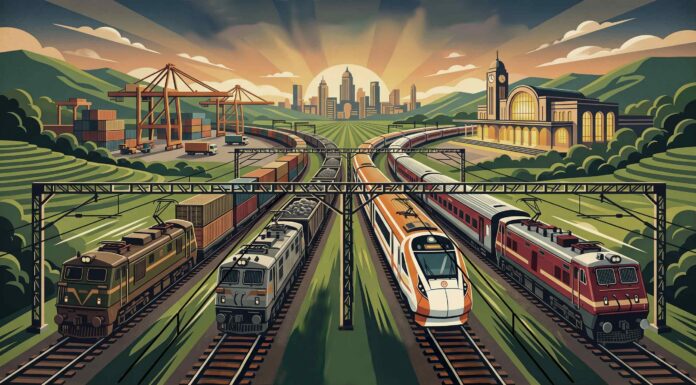
For decades, Indian Railways operated under an intractable economic paradox. Passenger trains were heavily subsidised, while freight tariffs were inflated to offset operational losses. Compounding this fiscal imbalance was the physical nightmare of mixed-traffic operations: goods rakes sharing standard double-track corridors with express trains were routinely shunted onto loop lines, dragging freight velocities down to a dismal 25 km/h and bloating national logistics costs to nearly 14% of GDP.
Today, that systemic bottleneck is being dismantled through an aggressive, freight-first infrastructure overhaul. At the heart of this paradigm shift lies the operationalisation of the 2,843-kilometre Dedicated Freight Corridor (DFC) network. Spanning the Eastern and Western corridors, this fully electrified broad-gauge system is engineered for 25-tonne axle loads and 1.5-kilometre-long rakes operating at 100 km/h. By connecting northern industrial belts directly to the Jawaharlal Nehru Port Trust (JNPT), the DFC has collapsed transit times from days to hours. This seamless movement is anchored inland by dry ports like the 110-hectare ICD Dadri, which handles up to one million TEUs annually and clears customs inland, completely bypassing coastal maritime bottlenecks.
To address saturation across the legacy network, Indian Railways is quadrupling tracks across 11,000 kilometres of its seven primary High-Density Networks (HDN)—arteries like Delhi–Howrah and Mumbai–Chennai that shoulder 41% of national traffic on just 16% of total route length. This multitracking permanently separates high-speed express trains from heavy freight, preventing cascading delays and unlocking massive path availability.
Simultaneously, India has rewritten heavy-haul logistics through vertical expansion. Leveraging its 1,676 mm broad gauge, the Western DFC raised overhead catenary wires to an unprecedented 7.45 metres, enabling high-reach pantographs to power double-stacked containers on green electricity. For standard overhead clearances on legacy routes, indigenous wider “dwarf containers” yield 67% higher volumetric capacity.
This logistical leap is propelled by a modernised motive fleet, featuring Alstom-partnered 12,000 HP WAG-12B twin-section giants and Chittaranjan Locomotive Works’ 9,000 HP single-frame WAG-9HH engines. As freight migrates onto dedicated rails, passenger services are flourishing via Vande Bharat and push-pull Amrit Bharat trains, all shielded by indigenous SIL-4 certified Kavach 4.0 automatic train protection and AI-based Gajraj Suraksha wildlife intrusion detection. By systematically decoupling goods from passengers, India is no longer merely upgrading tracks—it is engineering a high-velocity circulatory system vital for a five-trillion-dollar economy.
Read the full article on Chapter 1 Magazine.


