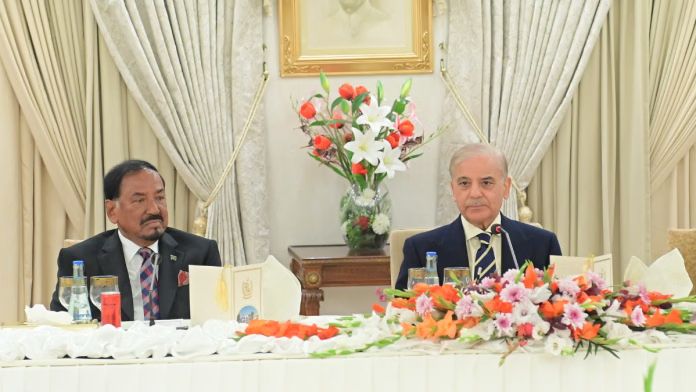
Bangladesh is facing one of the most difficult periods of its 55-year history. Months into pervasive anti-Hindu violence, Bangladesh has taken another hard turn to Islamism as its political representatives are now going all out in their efforts to appease Pakistan. On Wednesday, Bangladesh Parliament Speaker Hafiz Uddin Ahmed whitewashed the Pakistani massacre of Bangladeshis during the Liberation War of 1971, then proceeded to accuse India of not helping Bengalis but merely weakening Pakistan.
Ahmed, who is currently on an official visit to Pakistan, made the remarks while speaking to reporters at the Parliament House in Islamabad, where he recalled the events surrounding the war and the fall of Dhaka.
“India did not help the Bengalis but weakened Pakistan,” Ahmed said, attempting to recast India’s role in the liberation of Bangladesh as an act motivated chiefly by hostility towards Pakistan rather than the plight of millions of Bengalis who were being subjected to brutal military repression.
It is an atrocious statement to make, particularly coming from someone occupying the highest legislative position in Bangladesh. Ahmed is not an ordinary politician making an opportunistic remark to score points with a foreign audience. He is the Speaker of the Parliament of a country whose very existence is the result of the brutal repression unleashed by Pakistan against its Bengali population and the subsequent liberation war.
And yet, here he is, sitting in Islamabad, attempting to peddle a narrative that conveniently whitewashes the crimes committed by the Pakistani military and reduces India’s intervention in 1971 to a geopolitical manoeuvre aimed at weakening its western neighbour.
Ahmed’s remarks are not merely an insult to India. They are an insult to the millions of Bengalis who suffered under the Pakistani military, to the families of those who were murdered, to women who were subjected to horrific sexual violence, and to those who sacrificed their lives to ensure that Bangladesh could emerge as an independent nation.
The fact that Bangladesh’s Parliament Speaker is now attempting to whitewash those atrocities while standing on Pakistani soil tells us a great deal about how Bangladesh has gone to the dogs following the ouster of Sheikh Hasina.
A Bangladesh Parliament Speaker who appears more interested in pleasing Islamabad than remembering his own country’s history
Hafiz Uddin Ahmed’s comments did not emerge out of the blue. His entire visit to Pakistan appears to have been an exercise in signalling the warmth of the emerging relationship between Dhaka and Islamabad, particularly after the ouster of Sheikh Hasina and the Islamist takeover of Bangladesh in 2024.
Ahmed is on an official visit to Pakistan from November 23 to 29 at the invitation of Pakistan’s National Assembly Speaker Sardar Ayaz Sadiq. It is the first official visit to Pakistan by a sitting Speaker of Bangladesh’s Parliament. During the visit, Ahmed has met Pakistani President Asif Ali Zardari and Prime Minister Shehbaz Sharif, while expressing confidence that bilateral relations between the two countries would strengthen.
It is ironic that someone who is at the highest legislative position in Bangladesh is openly wooing the leaders of a country that sought to subjugate his nation not so long ago.
It would be one thing if Bangladesh and Pakistan were simply seeking to improve diplomatic relations. Countries routinely engage with former adversaries, and diplomatic engagement does not necessarily mean forgetting the past.
But Ahmed has gone much further. Instead of acknowledging the historical reality of Pakistan’s brutal military crackdown against the Bengali population in 1971, he has chosen to question India’s role in the liberation struggle and repeat a narrative that Pakistan has long attempted to propagate.
Ahmed claimed that Bengalis were demanding democracy in 1971 but were denied their rights. Yet, while speaking about the events of that period, he conveniently omitted the most important part of the story: it was West Pakistan and the Punjabi Muslim leadership that denied the rights of people of East Pakistan.
The 1970 general elections had produced a decisive victory for Sheikh Mujibur Rahman’s Awami League, which secured a majority in Pakistan’s National Assembly. The party had won an overwhelming mandate in East Pakistan and, by virtue of its electoral victory, was entitled to form the government.
But Pakistan’s political and military establishment refused to allow the transfer of power. Instead, the crisis was met with repression, military action and violence. The Pakistani Army launched Operation Searchlight in March 1971, unleashing a brutal campaign against Bengalis.
Ahmed’s selective recollection of history is therefore particularly revealing. He remembers the demand for democracy. He remembers the political crisis. He remembers the role India played. But the Pakistani Army’s atrocities appear to have conveniently disappeared from his account.
That is not historical analysis. That is historical whitewashing.
The Pakistani Army did not merely suppress a political movement: it unleashed a campaign of terror
The Pakistani Army’s atrocities in East Pakistan were not some incidental collateral consequence of a military operation. Violence against civilians became an instrument of the Pakistani state’s attempt to crush Bengali aspirations for independence.
The military targeted students, intellectuals, political activists, civilians and members of the Hindu minority. Universities and residential neighbourhoods became sites of violence. People were killed, homes were destroyed, and communities were terrorised. Mass graves and killing sites subsequently became grim reminders of what had happened.
The Jathibhanga massacre is one such example of the brutality inflicted upon Bengalis, particularly Hindus, during the Liberation War.
On April 23, 1971, thousands of Hindu civilians from villages in the Thakurgaon region were attempting to flee towards India to escape the violence. They gathered at Jathibhanga, hoping to cross the border and seek refuge. Instead, Pakistani military personnel and local collaborators reportedly surrounded them and carried out a massacre.
The victims were predominantly Hindu men from the Rajbanshi and Bengali communities. Reports and local accounts describe thousands being killed during the massacre, with bodies subsequently buried or disposed of near the river.
The tragedy left behind hundreds of widows and families whose lives were permanently destroyed. The massacre remains one of the most horrific episodes of violence recorded in the Thakurgaon region during the Bangladesh Liberation War.
A memorial was subsequently established at the site. Commemorative events have been held over the years, with survivors and families of victims demanding justice and remembrance.
These are the people Ahmed has effectively insulted through his attempt to rewrite the history of 1971.
When he claims India did not help Bengalis but merely weakened Pakistan, he is not making a harmless diplomatic observation. He is attempting to erase the context in which India intervened. He is ignoring the violence that forced millions to flee East Pakistan and seek refuge in India. He is ignoring the atrocities that made the liberation struggle inevitable. And he is ignoring the sacrifices made by Bengalis who fought for an independent Bangladesh.
India did not manufacture Bangladesh’s liberation struggle
The Pakistani establishment has always had a convenient explanation for the loss of East Pakistan: India supposedly engineered the separation, weakened Pakistan and exploited its internal crisis.
This narrative allows Pakistan to avoid confronting the uncomfortable reality that its own political and military leadership destroyed the possibility of a united Pakistan by refusing to respect the democratic mandate of East Pakistan and subsequently unleashing violence against its population.
In fact, India maintained a remarkable restraint throughout the turbulent period when Pakistan was unleashing horror upon its Bengali-speaking population in the hopes of quelling a rebellion. It was only after Pakistan launched preemptive air strikes on Indian air bases that Indira Gandhi, India’s then Prime Minister, declared a war on Pakistan.
India, meanwhile, was faced with an enormous refugee crisis as millions of people fled East Pakistan and crossed into Indian territory. The humanitarian and economic consequences were immense.
To reduce India’s role to an attempt to “weaken Pakistan” is therefore an exercise in dishonesty. It is an attempt to strip the 1971 war of its historical and humanitarian context and portray India’s intervention as an act of aggression against Pakistan rather than a response to the crisis created by Pakistan itself.
Ahmed may be attempting to curry favour with his hosts in Islamabad, but his remarks cannot erase the history of 1971.
Islamists who hid behind Bangladeshi nationalism are now showing their true colours
It has been Bangladesh’s misfortune that Islamists who hibernated after the 1971 Bangladesh Liberation War have started showing their true colours after the ouster of Sheikh Hasina, which has catapulted them and their political allies to positions of influence and power in the country.
For years, political actors who had sympathies for Pakistan, or whose ideological positions were deeply hostile to the secular and nationalist foundations of Bangladesh’s liberation, had to operate within a political environment shaped by the memory of 1971.
They could not openly glorify Pakistan without facing the historical baggage associated with the country. They could not casually whitewash the Pakistani Army’s atrocities without confronting the fact that Bangladesh’s independence was achieved after a bloody liberation war against Pakistan.
But the political upheaval following Sheikh Hasina’s ouster has altered the landscape.
Now, those who once had to cloak themselves in the language of Bangladeshi nationalism appear increasingly comfortable expressing positions that align with Pakistan’s interests. The attempt to portray India as the real villain of 1971, while downplaying Pakistan’s atrocities, is one such manifestation.
Being in power has seemingly emboldened them to believe that they can rewrite history.
And this is precisely the kind of historical revisionism that Pakistan has perfected over decades.
Pakistan has always attempted to rewrite the history of its wars with India
Pakistan has repeatedly demonstrated that when facts do not support its narrative, it attempts to manufacture a different version of reality.
The country has lost multiple wars and military confrontations with India. Yet its political and military establishment has consistently attempted to portray those defeats as victories, or at the very least, as episodes in which Pakistan emerged triumphant against overwhelming odds.
The Pakistani public is often fed narratives that bear little resemblance to the actual events on the battlefield. Military defeats are presented as strategic successes. Losses are minimised. Indian victories are denied or disputed. And whenever uncomfortable facts emerge, the Pakistani establishment attempts to bury them under propaganda. The same was witnessed after the Kargil war in 1999.
The same pattern was visible during Operation Sindoor in May 2025.
Following India’s strikes against terror camps and PAF bases in Pakistan and Pakistan-occupied territories, the Pakistani establishment and its media machinery attempted to construct a narrative around so-called Indian aircraft losses. The claims were repeatedly amplified even as India provided its own account of the operation and released material documenting strikes against terror camps and military infrastructure.
The Pakistani narrative was built around mythical claims of Indian losses, with the country attempting to present itself as having inflicted a decisive defeat on India. The reality, however, was far more uncomfortable for Islamabad.
Pakistan was forced to seek de-escalation. The Pakistani Director General of Military Operations contacted his Indian counterpart, and the two sides agreed to halt military action. The Pakistani DGMO is reported to have told his Indian counterpart that they have had enough of BrahMos hitting targets in Pakistan, and now the tensions could cool down.
And Hafiz Uddin Ahmed appears to be attempting the same thing when he claims India did not help Bengalis but merely weakened Pakistan.
Ahmed’s remarks about Kashmir reveal where his sympathies lie
Ahmed’s comments during his Pakistan visit have not been limited to 1971. He has also echoed Pakistan’s long-standing position on Kashmir, saying that the dispute should be resolved in accordance with United Nations resolutions.
He has also accused Sheikh Hasina of seeking refuge in a country he described as hostile to Muslims, referring to India, and claimed that she would be sent to prison if she returned to Bangladesh. Ahmed further suggested that Bangladesh could approach the International Court of Justice if India refused to extradite Hasina, although he did not explain the legal basis for such a move.
The Speaker has also described the Awami League as a “terrorist party” and praised the February 2026 elections in Bangladesh as free and fair.
Taken together, these statements paint a picture of a political leader who appears increasingly comfortable adopting positions that align with Islamabad’s interests.
His remarks about Kashmir, his criticism of India, his attempt to portray India’s role in 1971 as an effort to weaken Pakistan, and his praise for the growing relationship between Dhaka and Islamabad are not isolated statements. They form a broader political narrative.
A Bangladesh that once emerged from Pakistan after a bloody liberation war is now witnessing its Speaker travel to Islamabad and question the role of the very country that helped its people escape Pakistani military repression.
The irony of Bangladesh’s Speaker praising Pakistan while rewriting 1971
Ahmed also claimed that nearly the entire stadium in Dhaka supported Pakistan during the football final of the 2026 SAFF Championship, in which India defeated Pakistan 2–1.
He claimed that 99.9 per cent of the spectators were supporting Pakistan and that the Pakistani team had won the hearts of the people despite losing the match.
The claim was intended to demonstrate the growing warmth between Bangladesh and Pakistan. In fact, it underlines the desperation in Dhaka to woo Pakistan while simultaneously downplaying the atrocities committed by the Pakistani Army against the people of Bangladesh.
In essence, what Bangladesh is trying is to erase its history, wipe out the very cause of its existence.
Bangladesh can engage with Pakistan without pretending that the Pakistani Army did not commit atrocities in 1971. Bangladesh can pursue diplomatic relations with Islamabad without portraying India’s intervention as an act of hostility towards Bengalis. Bangladesh can even seek a pragmatic relationship with Pakistan without erasing the sacrifices made by its own people during the Liberation War.
Ahmed’s remarks, however, appear to cross that line.
Pakistan’s propaganda is now finding an audience in Bangladesh
For decades, Pakistan has attempted to deny, minimise or distort the events of 1971. It has never adequately confronted the crimes committed by its military in East Pakistan. It has never shown the kind of remorse that would be expected from a country whose armed forces inflicted such horrific suffering upon an entire population.
Instead, Pakistan has repeatedly attempted to blame India for the disintegration of the country.
Now, Bangladesh’s own Parliament Speaker appears to be lending credibility to that narrative.
The question is will Bangladeshi population allow their leadership to carry on with such brazen historical distortion or will they attempt to bring them to reckoning?
Because if Bangladesh’s Speaker can stand in Islamabad and claim that India did not help Bengalis but merely weakened Pakistan, then the problem is no longer just Pakistani propaganda. It is the complicity of the Bangladeshi masses who expect Ahmed to work in the interests of the country.
The question Bangladesh’s youth must now ask themselves is this: Did they rise against Sheikh Hasina only to replace her government with one that is now busy whitewashing the Pakistani Army’s atrocities against their ancestors and rewriting the history of the Liberation War?