

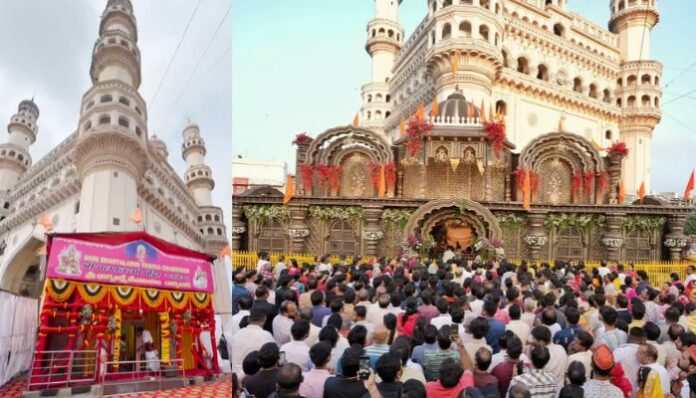
The Bhagyalakshmi Temple in Hyderabad, located alongside the Charminar, has once again become the centre of a controversy after thousands of devotees gathered at the Temple during the Diwali celebrations to offer aarti and seek the blessings of Goddess Lakshmi. On Monday, 9th November, massive crowds thronged the shrine for the annual Diwali celebration, creating long queues that stretched for hundreds of metres all the way up to Gulzar Houz, a historic square roughly 500 metres from the monument.
Thousands of devotees visited the historic Bhagya Laxmi Temple near Charminar in Hyderabad to offer prayers on Deepavali. Long queues stretched up to Gulzar Houz as police made special security and traffic arrangements to manage the heavy rush. https://t.co/dL87ZySG3h
— South Matters (@SouthMatters) November 9, 2026
Devotees from different parts of Hyderabad, Secunderabad, and nearby districts waited in line for hours to receive ‘Khazana’, special silver coins distributed as prasadam after the festive prayers.
These coins are crafted from silver donated by worshippers over the course of the year and carry the image of Goddess Lakshmi on one side and the Charminar on the other. Temple authorities arranged separate queues to manage the large gathering and facilitate the distribution.
#Hyderabad: Heavy crowds of #devotees are thronging the #BhagyalakshmiTemple near #Charminar for the annual distribution of the goddess’s #silvercoins, popularly known as ‘#Khazana’. The distribution began at 7 pm on Sunday, with queues stretching up to #GulzarHouse. The #templecommittee has arranged 10 queue lines to manage the rush. The three-day programme will continue until November 11. Heavy #traffic restrictions are in place around Charminar, with commuters advised to plan their journeys accordingly.
— NewsMeter (@NewsMeter_In) November 9, 2026
Muslims question growing crowds, raise concerns over Charminar’s safety
The massive gathering of devotees at the temple and the growing attention it has received have triggered criticism from Muslims. They have questioned the increasing prominence of the shrine located next to the Charminar and raised concerns about the safety of the historic monument.
Some social media users have gone as far as comparing the situation to the Babri Masjid dispute, alleging that the Charminar could face a similar fate. Others have accused the authorities of indirectly legitimising the temple by allowing its activities and the growing crowds around the heritage structure.
Sanjaya Baru, media adviser to former Prime Minister Manmohan Singh, also reacted to the visuals of the celebrations. Sharing his concern on X, he wrote, “The destruction of Charminar is happening.”
A Muslim journalist Mubashir Khurram also shared the visual on his X account and wrote, “Thousands of devotees visited the Bhagya Laxmi temple for Deepavali. Police ensured security and traffic management. But who is ensuring the protection of the 435-year-old #Charminar?”
Thousands of devotees visited the Bhagya Laxmi temple for Deepavali. Police ensured security and traffic management. But who is ensuring the protection of the 435-year-old #Charminar? Can @ASIGoI publicly clarify the legal status of every structure adjoining this protected monument? #Hyderabad
— Mubashir.Khurram (@infomubashir) November 9, 2026
As videos of the massive queues winding through Hyderabad’s walled city circulated widely on social media, sharp reactions poured in online. Questioning the arrangements made at the site, critics asked, “Why did the police make arrangements that provide legitimacy to an illegal temple?”
Meanwhile, netizens and heritage activists also questioned the silence of the ASI, asking who would ensure the long-term protection of the historic monument amid such heavy footfall.
Amit Shah, BJP and BRS leaders visit Bhagyalakshmi Temple before Diwali celebrations
The rush at the Bhagyalakshmi Temple began even before Dhanteras on 6th November, and increased further during the Diwali celebrations.
On 2nd November, Union Home Minister Amit Shah visited the temple and offered prayers to Goddess Bhagyalakshmi. He was accompanied by Union Minister G Kishan Reddy, MP Raghunandan Rao and Telangana BJP president N Ramchander Rao. Shah’s visit came before he participated in the BJP’s ‘Save Democracy, Remove Anarchy’ padayatra against the Opposition’s campaign over electoral rolls.
BIG BREAKING NEWS – HM Amit Shah offers prayers at Bhagyalakshmi Temple near Charminar in Hyderabad. https://t.co/NL9cSZay2q
— News Algebra (@NewsAlgebraIND) November 2, 2026
On 6th November, BRS MLA D Sudheer Reddy also visited the temple and offered prayers on the occasion of Dhanteras. BJP leader and former national general secretary P Muralidhar Rao visited the shrine with his family.
#WATCH | Hyderabad, Telangana: On the occasion of Dhanteras, puja was organised at Sri Bhagyalaxmi Mata Temple at Charminar in Hyderabad After offering prayers, BRS MLA Sudheer Reddy said, "Today, I had the opportunity to seek the blessings of Goddess Bhagyalakshmi. Diwali is just two days away. Thousands and lakhs of devotees visit the temple over these three days to seek the blessings of the Goddess. May everyone remain happy. May Hyderabad, Telangana, and the entire country remain happy and prosperous."
— ANI (@ANI) November 6, 2026
Former Haryana Governor Bandaru Dattatreya visited the temple on 7th November. Describing it as a sacred place with a rich history, he also offered prayers to the goddess.
The visits continued on 8th November, when Telangana Governor Shiv Pratap Shukla and his wife Janaki Shukla offered aarti at the temple on Diwali. Telangana BJP president N Ramchander Rao and BJP Rajya Sabha MP K Laxman also visited the temple.
Speaking to ANI, K Laxman welcomed the growing number of devotees and said, “It is a matter of great pride that the temple’s popularity continues to grow, with devotees visiting from across the country.”
Telangana BJP president N Ramchander Rao also welcomed the celebrations, saying that Diwali was being celebrated with great enthusiasm across the state, particularly at the Bhagyalakshmi Temple, which attracts large numbers of devotees every year.
BRS MLA Talasani Srinivas Yadav and Telangana State Planning Board vice-chairperson Vijayalaxmi Gadwal also visited the temple with their families during the festival.
The growing political attention around the shrine has once again brought its decades-old dispute with the adjoining heritage monument into focus.
A history of Past controversies
The friction surrounding the Bhagyalakshmi Temple is far from new and has flared up repeatedly over the decades. In reply to a Right to Information (RTI) query in 2013, the ASI also classified the temple as an “unauthorised construction” built after 1959.
Congress leader calls Bhagyalakshmi Temple an ‘illegal construction’ and demands the mosque inside the Charminar structure be reopened for Islamic prayers.
The controversy surrounding the Bhagyalakshmi Temple and the Charminar exposes the sheer hypocrisy behind the outrage over heritage preservation. On one hand, massive gatherings of devotees and high-profile political visits to the temple are routinely painted as a grave threat to the existence, safety, and sanctity of the Charminar. Yet, the same voices abandon all concerns for structural preservation when demanding the reopening of the mosque located inside the very same monument for the Namaz prayers.
This double standard was on full display in May 2022, when Telangana Congress leader Rashed Khan labelled the Bhagyalakshmi Temple “illegal” and launched a signature campaign at the nearby Mecca Masjid, demanding that the mosque inside the Charminar structure be reopened for Islamic prayers.
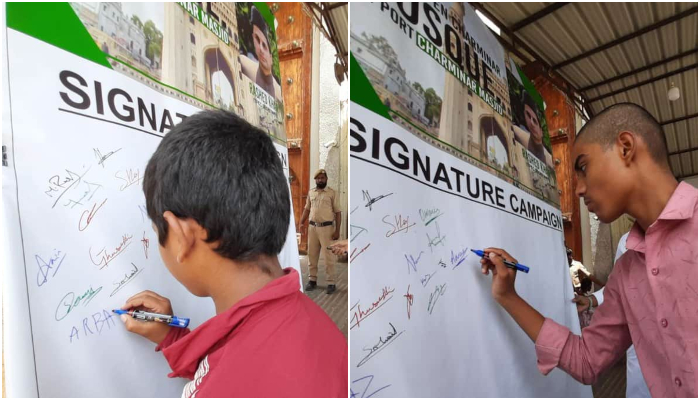
Notably, the Archaeological Survey of India (ASI) had barred Namaz inside the monument two decades earlier. Asserting that offering prayers was a constitutional right, Khan said, “When we spoke to the Ministry of Culture, Kishan Reddy said there will be a law and order problem. I will take all the signatures and go to the secular CM of Telangana. If our requests are not addressed, we will do a sit-in protest at the Pragati Bhavan. Wrong promises are being made across the country on mosques.”
Backed by Maulana Ali Quadri, who acknowledged that Namaz inside the Charminar had been stopped years ago following a suicide at the heritage site, Khan targeted the adjoining temple as an unauthorised encroachment and demanded its closure if Muslims were not permitted to pray inside the Charminar.
Explaining his stance, Khan remarked, “We believe in Ganga Jamuna tehzeeb. If prayers are happening in the temple, let it happen, but in the same way, our mosque is closed, and it should be opened, and we should be given permission for the Namaaz.” Around the same time, Congress Sevadal further politicised the issue by dragging the Bhagyalakshmi Temple into debates surrounding the Gyanvapi mosque dispute, drawing sharp backlash from opponents.
Last day of Signature campaign demanding @ASIGoI n @kishanreddybjp to reopen Masjid e Charminar was conducted at Mecca Masjid,Charminar road.Will be soon giving representation to @TelanganaCMO for law and order clearance on this issue.@INCTelangana @manickamtagore @ShayarImran https://t.co/sRaDIBtrbb
— Rashed Khan (Mohd Perwaiz khan) (@rashedkhan_inc) May 31, 2022
Ultimately, this selective outrage makes it clear that the outcry is less about protecting a 16th-century monument and more about political posturing. If crowds gathering outside the monument at the temple are supposedly endangering the structural safety and heritage value of the Charminar, opening up the interior of an ASI-protected historical structure for regular mass Namaz congregations would pose an even more direct risk to its safety and preservation.
2012 dispute: High Court orders status quo on temple construction
The issue boiled over into a major political and law-and-order crisis in late October 2012, when construction work, which temple authorities called routine repairs, sparked communal tensions.
On 5th November, 2012, the Andhra Pradesh High Court stepped in and ordered a strict status quo, ruling that the temple must remain exactly as it stood on 30th October, 2012, and banning any construction touching the Charminar.
The dispute soon turned into a political confrontation. Days later, on 11th November, 2012, Hyderabad Police detained All India Majlis-e-Ittehadul Muslimeen (AIMIM) MLAs, including Akbaruddin Owaisi, who were protesting against the alleged expansion. The following day, AIMIM chief Asaduddin Owaisi withdrew his party’s support from both the Congress-led state government and the UPA government at the Centre, accusing then Chief Minister N Kiran Kumar Reddy of favouring Hindu groups.
Allegations of temple expansion resurface in 2018 and 2022
Even though the Hindu community and temple authorities have consistently abided by the court-ordered status quo, and formally assured the court that the shrine would not be expanded, they have repeatedly faced unfounded allegations of encroaching upon the Charminar.
Despite strict adherence to judicial directives, claims of temple expansion resurfaced in 2018 and again in October 2022, when Muslims and so-called activists alleged that the shrine was gradually occupying more space around the monument.
In October 2022, members of the Muslim community once again accused the temple of increasing its footprint following the COVID-19 lockdown, pointing to barricades, security arrangements, and routine festive setups as evidence of restricted access to parts of the heritage site.
However, Archaeological Survey of India (ASI) officials debunked these claims, confirming that no permanent expansion had taken place and clarifying that the changes were merely temporary arrangements. The officials also affirmed that the monument and its protected perimeter remain strictly governed by heritage conservation laws, proving that the repeated accusations against the temple and the Hindu community were baseless.
Selective outrage and double standards over heritage and land Claims
The latest controversy surrounding the Bhagyalakshmi Temple celebrations exposes a stark double standard in how Muslims have previously claimed ownership of several Hindu Temples. They have repeatedly challenged the status of Hindu religious sites such as Krishna Janmabhoomi in Mathura and the Gyanvapi complex in Varanasi, demanding legal recognition of their claims and, in some cases, the restoration of what they describe as historically wrongfully occupied mosque properties.
The Gyanvapi dispute, for instance, centres on the claim that Mughal ruler Aurangzeb demolished the original Kashi Vishwanath temple and built a mosque at the site. The remains of an earlier Hindu temple can still be seen on parts of the mosque structure, while the present Kashi Vishwanath temple was built nearby in 1777 by Rani Ahilyabai Holkar.
While there is fierce opposition and alarmism from Muslims over Hindu devotees gathering in larger numbers at an existing shrine next to the Charminar, a completely different standard is applied when contesting historic Hindu temples.
Portraying peaceful Diwali crowds as a precursor to a “Babri Masjid-like fate” relies on fear-mongering rather than a consistent standard for protecting historical structures.
This hypocrisy of Muslims becomes even more pronounced when contrasted with the expansive property claims by them routinely defended under state Waqf Boards across India. In Gujarat, the Waqf Board staked a claim to the Surat Municipal Corporation building, arguing that it had once been used as a sarai for Haj pilgrims. It also approached the Gujarat High Court over two islands near Bet Dwarka, raising questions about the basis of its ownership claim. Other disputes have involved residential plots and properties being declared Waqf, triggering concerns among residents and property owners.
Yet, while such claims are defended as legitimate exercises of religious and legal rights, the sight of Hindu devotees gathering in large numbers at the Bhagyalakshmi Temple appears to invite an entirely different response.
Ultimately, this contrast highlights a glaring inconsistency. When claims are made over Hindu temples, historical sites, residential properties or even land in the vicinity of Krishna Janmabhoomi, they are projected as matters of faith and justice. A simple increase in Hindu worshippers visiting a temple during Diwali near the Charminar is treated as an existential threat. A rise in the number of devotees, festive prayers and visits by political leaders is portrayed as a warning sign for the future of the 16th-century monument.


