

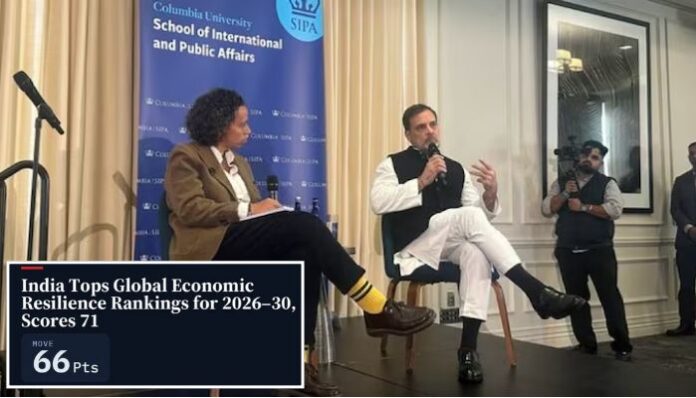
Congress leader and Leader of the Opposition Rahul Gandhi once again used an international platform to paint a distorted picture of India by criticising its economy and democratic institutions. On Tuesday, 17th November, during his ongoing visit to the United States, Gandhi claimed that India was sitting on the verge of an economic disaster, had a massive unemployment problem and was struggling with serious shortcomings in its education system.
Rahul Gandhi also repeated his unfounded “vote chori” accusation against the Election Commission.
Gandhi made these remarks during an interaction at Columbia University in New York. Responding to a question by moderator Lydia Polgreen about India’s youth, he claimed, “The blunt thing is that India is sitting on an economic disaster. That’s the reality. One can brush it aside, the media can brush it aside, but India’s got a massive unemployment problem. India’s got a massive problem with its education system.”
At Columbia University @RahulGandhi said “The blunt thing is India is sitting on an economic disaster. ok One can brush it aside but India has got a massive unemployment problem and India has got a massive problem with its education system.” https://t.co/2lLvbmraRy
— Arun Kumar Singh (@arunsingh4775) November 17, 2026
Continuing his bleak assessment, Gandhi argued that educated young Indians from middle-class families are deeply disillusioned because they see no future ahead of them.
Gandhi claimed to have studied the issue closely and concluded that a generational divide has opened up within Indian households over career prospects.
Explaining this supposed rift, he asserted, “We’ve been studying this, we’ve been looking into this, and the reason is very interesting, which is that the crux of it is they do not see a future for themselves.” He went on to allege that young people are openly dismissing their parents’ life advice, saying, “So what they’re actually saying to their parents, and we’re hearing this from the parents, is, listen, You’re not successful, you don’t have a job, you can’t tell us to do what you did because it doesn’t work.”
Beyond the economy, Gandhi directed sharp attacks at the Election Commission of India, reviving his unsubstantiated “vote chori” (vote theft) narrative before a foreign audience.
Without offering verifiable proof, he alleged massive deletions from the voter list, stating, “140 million people who would have voted in 2024 have been removed from the electoral roll. We ask the Election Commission: how can an election be considered valid under these circumstances? Yet, they remain silent on this. Nothing will happen without reforming the electoral system. We are working on it. We have ample evidence of electoral fraud.”
He also engaged in dramatic fearmongering about civil unrest and state repression, claiming, “People within the system are speaking to us out of fear. I fear that if pressure builds beyond a certain point, the government may resort to violence in response. There was an atmosphere of fear earlier, but now people have stopped being afraid. The student movement has played a major role in this.”
A pattern of running down India abroad
Rahul Gandhi’s latest remarks in New York are hardly an isolated slip of the tongue; rather, they fit into a well-established pattern of using foreign soil to demean India, question its democratic institutions, and spread alarmist narratives.
Time and again, whenever he travels overseas for mostly paid or arranged university lectures or diaspora gatherings, domestic political grievances are packaged as existential crises facing the Indian state.
In doing so, he routinely overlooks hard economic data, institutional realities, and ground-level facts, choosing political point-scoring abroad over constructive debate at home.
In July 2025, when the US President Donald Trump called India’s, alongside Russia’s, economy “dead”, Rahul Gandhi did not condemn Trump. Instead, Gandhi said he was “glad” the US President had “stated a fact” by calling the Indian economy “dead.”
“Yes, he is right. Everybody knows this except the Prime Minister and the Finance Minister. The Indian economy is dead. I’m glad President Trump has stated a fact… BJP has finished the economy to help Adani,” Gandhi told reporters.
https://t.co/vOt6wZzZWc
— Rahul Shivshankar (@RShivshankar) July 31, 2025
Global data contradicts the “Economic Disaster” claim; India projected to be the most resilient economy among the world’s top 10
While Rahul Gandhi was describing ‘India as an economy heading towards a disaster’, a report released just five days before his Columbia University interaction presented a different picture of India’s projected economic performance.
Contrary to some beliefs, global economic disasters have only underscored India’s growing resilience! With a score of 71/100, India tops the macroeconomic resilience rankings for 2026–30, outpacing major economies and demonstrating its strength amid global uncertainty.
— infoindata (@infoindata) November 18, 2026
Far from collapsing, India is projected to be the most resilient economy among the world’s 10 largest economies between 2026 and 2030, outperforming major powers like China, Japan, Germany, and the United States.
According to the report titled India’s Economic Edge in the Top Ten Economies, released by the Associated Chambers of Commerce and Industry of India (ASSOCHAM) on 12th November, India topped the Comparative Macroeconomic Resilience Score with 71 points out of 100. China finished second with 66 points, followed by Japan and Russia tied at 60 each, while the United States ranked last among the ten with a score of 36.
The ASSOCHAM study relied on data from the International Monetary Fund’s World Economic Outlook database, evaluating the ten largest economies across ten key macroeconomic indicators.
The analysis looked back at the 2021–25 period and projected forward for 2026–30, while also examining 2025 and 2026 individually. Based on projected performance across these metrics for 2026–30, India’s leading score of 71 stood well clear of China (66), Japan (60), Russia (60), Germany (59), Italy (53), Brazil (53), the United Kingdom (52), France (40), and the United States (36).
India’s top ranking is anchored by strong fundamentals: it placed first in both real GDP growth and real GDP per capita growth, second in gross savings and gross capital formation, third in export growth and debt-to-GDP ratio, fifth in primary balance, seventh in current account and structural balance, and eighth in overall fiscal balance.
India is heading on a credible path towards $1 trillion worth of exports in FY 2026-27 with sustained momentum.
Japan Credit Rating Agency upgrades India’s sovereign ratings to ‘A-‘
Adding to the growing international confidence in India’s economic trajectory, the Japan Credit Rating Agency (JCR) recently upgraded India’s Long-Term Foreign Currency and Local Currency Issuer Ratings by one notch from ‘BBB+’ to ‘A-’, while maintaining a Stable Outlook.
Alongside this sovereign upgrade, JCR also raised India’s country ceiling by one notch to ‘A’. The Government of India welcomed the decision, noting that it reflects the country’s solid economic expansion, effective policy framework, strengthened financial sector, and healthy external position.
In its assessment, JCR highlighted that India has sustained a high rate of growth driven by strong private consumption and steady public investment. Figures from the Ministry of Statistics and Programme Implementation (MoSPI) confirm that India’s real GDP grew at a robust 7.8% in FY26 and maintained that exact 7.8% pace in the first quarter of FY27 despite global economic headwinds.
While Gandhi scion chose an international university platform to describe India as an economy on the verge of disaster, the ASSOCHAM projections and JCR’s rating milestones stand in stark contrast to his distorted portrayal.
Rahul Gandhi’s selective ‘vote chori’ allegations against the Election Commission
Just as his economic claims fall apart against hard data, Rahul Gandhi’s repeated accusations of “vote chori” crumble under basic logical scrutiny. Over recent months, he has frequently attacked the Special Intensive Revision (SIR) of electoral rolls and even demanded the resignation of Chief Election Commissioner Gyanesh Kumar. His speeches routinely leap from isolated administrative queries to sweeping conspiracy theories about democracy being hijacked.
Yet, repeating an accusation with dramatic flair at Columbia University does not turn a political talking point into fact. If a government and constitutional body have truly orchestrated mass electoral fraud, the public deserves concrete proof, specific constituencies, verifiable records, and legal evidence, rather than vague slogans.
The Election Commission had earlier asked Gandhi to substantiate his allegations through a formal declaration under oath. In August 2025, after Gandhi alleged that more than one lakh votes had been manipulated in the Mahadevapura Assembly segment of the Bangalore Central Lok Sabha constituency during the 2024 elections, the Karnataka Chief Electoral Officer asked him to provide the names of the allegedly fraudulent electors and submit a declaration under Rule 20(3)(b) of the Registration of Electors Rules, 1960.
The Commission also stated that if Gandhi believed his allegations were correct, he should submit the declaration so that necessary proceedings could be initiated. Similar communications were sent by the electoral authorities in Maharashtra and Haryana following his allegations about electoral rolls in those states.
On 17th August last year, Chief Election Commissioner Gyanesh Kumar also asked Gandhi to either submit an affidavit supporting his allegations within seven days or apologise to the country.
The question, therefore, remains: if Gandhi was so certain about the alleged electoral fraud, why did he not substantiate his claims through the affidavit and the supporting evidence sought by the Election Commission? The demand for an affidavit was not a demand to abandon political criticism but an opportunity to put the allegations through an official process of scrutiny.
Most tellingly, these cries of electoral manipulation mysteriously disappear whenever the Congress party wins state assembly elections or crucial bypolls.
Congress’s ballot paper demand and embarrassing defeat in MLC elections
The ‘vote chori’ narrative is not limited to Rahul Gandhi. The wider Congress ecosystem has repeatedly amplified allegations that Electronic Voting Machines (EVMs) are manipulated and that the BJP would struggle to win elections if voting were conducted using ballot papers. Congress leaders have persistently demanded a return to the ballot paper system, claiming that EVMs are responsible for the party’s electoral defeats.
Whenever the Congress suffers an electoral setback, EVMs and the Election Commission become convenient scapegoats. However, recent elections conducted entirely on paper ballots delivered a harsh reality check to this narrative.
In Legislative Council (MLC) polls held across 28 seats in four major states, Uttar Pradesh, Bihar, Maharashtra, and Karnataka, the Congress suffered a humiliating whitewash, drawing a complete blank. Even more embarrassing for the party was losing all four contested seats in Karnataka, including a seat held by a sitting Congress MLC in a state where the Congress itself is in power. Despite this unambiguous verdict under the very ballot-paper system it champions, the party has continued its campaign to malign the Election Commission as a tool of the ruling government.
This selective outrage exposes the hollowness of the “vote chori” campaign. A party that celebrates democratic mandates when it wins but cries fraud when it loses, even in ballot-paper elections, lacks credibility.
Furthermore, if Rahul Gandhi genuinely possesses “ample evidence” of 140 million voters being illegally deleted, nothing stops him from submitting a formal, sworn affidavit with documented proof to the Election Commission or challenging the rolls in court. Refusing to follow constitutional procedures at home while broadcasting unverified claims to foreign audiences only underscores that the false rhetoric is meant for political theatre rather than invoked discrepancies.
Outsourcing domestic propaganda at the Bharat Summit: Congress’s ‘vote chori’ narrative reaches the event through European socialist leader
The campaign to discredit India’s democratic institutions has not remained confined to Rahul Gandhi alone; it is actively being echoed by foreign political figures invited onto Congress platforms. At the Congress-organised Bharat Summit in Hyderabad on 14th November, Giacomo Filibeck, Secretary-General of Italy’s Party of European Socialists, openly repeated the party’s domestic political slogan, raising the cry of “Vote Chor, Gaddi Chhod” against the ruling dispensation in India.
"VOTE Chor.. GADDI Chhod. VOTE Thief.. LEAVE your seat " – Party of European Socialists Secretary General, Giacomo Filibeck at Bharat Summit. https://t.co/UUjSnrLmtN
— Gulte (@GulteOfficial) November 14, 2026
Rather than objecting to a foreign politician interfering in India’s internal democratic affairs and attacking its constitutional bodies on Indian soil, Rahul Gandhi was seen applauding as his domestic political lies were amplified by a European socialist leader. The Congress propaganda summit itself drew sharp criticism for providing a stage to individuals and networks with well-documented records of anti-India commentary, anti-Hindu rhetoric, and links to organisations backed by regime-change financier George Soros. Inviting controversial foreign figures to validate partisan attacks against India’s electoral system marks a troubling normalisation of internationalising domestic political battles.
A track record of anti-India rhetoric overseas
Rahul Gandhi’s latest remarks in the United States are not an isolated incident. The Congress leader has repeatedly used his foreign visits to criticise India’s democratic institutions, question the functioning of its government and make allegations about the country’s political environment.
In October last year, while speaking at EIAuniversity in Colombia, he delivered a similar tirade alleging that Indian democracy faces a “wholesale attack” and claimed that the country suffers from deep “structural flaws.” Attempting to drag domestic ideological battles onto the international stage, he attacked the BJP and the Rashtriya Swayamsevak Sangh (RSS), alleging that cowardice lies at the heart of their ideology and misrepresenting remarks made by India’s External Affairs Minister regarding China. During the same speech, he also launched an attack on freedom fighter Veer Savarkar, distorting historical accounts to paint nationalist icons in a negative light.
An earlier example was his visit to the United Kingdom in March 2023, when he delivered a lecture at Cambridge Judge Business School titled Learning to Listen in the 21st Century at an event arranged by Sam Pitroda.
Ignoring the obvious irony that an Indian opposition leader was freely travelling abroad to criticise his own country without any restriction, Gandhi claimed that India’s parliament, judiciary, and free press were all under severe constraint. Shortly after completing his months-long Bharat Jodo Yatra from Kanyakumari to Kashmir without hindrance, he told students in Cambridge that “the idea of just moving around is under constraint” in India.
During that same Cambridge interaction, Gandhi resorted to outright falsehoods, claiming that he and fellow opposition MPs were violently thrown into jail merely for standing outside Parliament and raising issues. In reality, Rahul Gandhi has never been jailed in such an incident; the photograph he displayed to substantiate his claim was actually from 2020 on the way to Hathras, where police temporarily prevented political leaders from entering an area placed under curfew to prevent caste tensions from escalating. He also repeated unverified claims that Pegasus spyware had been planted on his phone and alleged that intelligence officers had personally warned him that his calls were being tapped.
Frustration turning into anti-India narratives
These episodes reveal a clear and troubling pattern. Whether speaking in Cambridge, Colombia, or New York, Rahul Gandhi consistently relies on exaggeration, selective facts, and unverified claims to portray India as a failing economy and a broken democracy. Repeated electoral defeats and prolonged exclusion from power appear to have shaped the Congress leadership’s approach. For them, attacking the ruling party has blurred into running down the country itself.
From applauding foreign politicians who parrot partisan slogans at the Bharat Summit to lecturing Western universities about an imaginary economic collapse. While global agencies upgrade India’s growth and credit ratings.
The Congress party’s frustration over its electoral setbacks cannot become a substitute for evidence, nor can repeatedly making allegations against India on foreign soil establish them as facts. If Rahul Gandhi wants his claims about electoral fraud and economic mismanagement to be taken seriously, he must be prepared to substantiate them with facts rather than relying on speeches, slogans and international platforms.


