

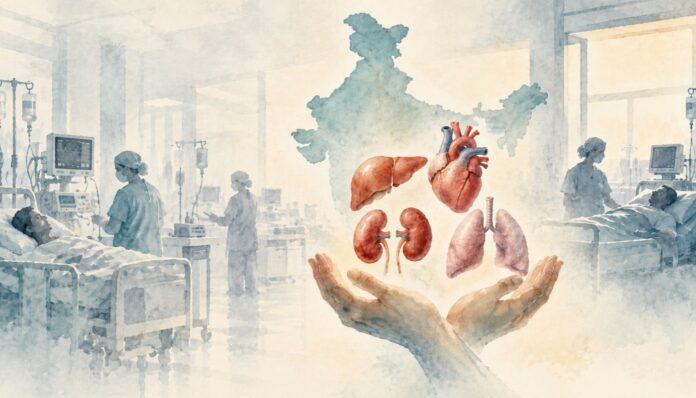
India performed 20,138 organ transplants in 2025, its highest annual total, yet 89,839 patients were registered on waiting lists for major organs as of 3rd March 2026. Behind every successful transplant lies a network of hospitals, doctors, donor families, government authorities and transport agencies. From identifying suitable recipients and retrieving donated organs to transporting them across cities and preventing illegal trade, India’s transplantation system involves far more than surgery.
How patients receive an organ transplant
A patient suffering from severe organ failure cannot automatically undergo transplantation. Doctors must first assess whether the patient is medically fit, whether other treatments remain possible and whether a compatible donor is available. Those without suitable living donors may have to register for a deceased-donor organ and wait until one becomes available.
Understanding how India’s organ transplant system works also requires examining the role of the National Organ and Tissue Transplant Organisation (NOTTO), regional and state authorities, and authorised hospitals. Medical urgency, compatibility, allocation rules and geographical location can influence a patient’s chances of receiving an organ.
In September 2025, 72-year-old Ganga Verma donated a kidney to her 46-year-old son in Indore. Her case also highlighted a wider imbalance. Women account for most living kidney donors in India, while men receive most such transplants. Financial difficulties, limited access to specialised hospitals and lifelong treatment requirements create additional challenges for patients and their families.
When a deceased donor can save several lives
Living donation cannot meet every patient’s requirements. Hearts, for example, cannot be donated by living individuals. Deceased donation therefore remains essential, particularly for patients requiring organs that cannot be donated while alive.
The process of deceased organ donation in India involves medical examinations, legal certification and family consent. Brain-stem death occurs when all functions of the brain stem permanently and irreversibly cease. Unlike coma, recovery is not possible. However, a ventilator may continue supporting breathing and circulation, making the condition difficult for relatives to understand.
Doctors must certify brain-stem death according to prescribed procedures. Families then decide whether to permit organ donation. Transplant coordinators assess possible donations, identify suitable recipients and organise retrieval.
In May 2026, the family of a 41-year-old woman declared brain-stem dead at Command Hospital, Chandimandir, agreed to donate her organs. Four patients subsequently received organs, including a 14-year-old boy. The case demonstrated how one donor can help several people, provided medical suitability, consent and coordination come together.
How donated organs travel across India
Once an organ is retrieved, time becomes critical. Different organs can survive outside the body for different periods, even under specialised preservation conditions. Delays in retrieval, packaging or transportation can make an organ unsuitable for transplantation.
The transportation of donated organs across India involves ambulances, commercial aircraft, Indian Air Force planes, trains and specially arranged green corridors. In February 2023, an Indian Air Force aircraft transported a donated heart from Delhi to Pune for a 29-year-old woman. Two green corridors and coordination between military hospitals, police and aviation authorities helped complete the operation.
Other documented cases involved Vande Bharat Express and challenging road journeys. The Union Government introduced National Organ Transport Standard Operating Procedures in August 2024 to improve coordination.
However, differences in hospital infrastructure, transport availability and geographical accessibility continue to influence how quickly donated organs can reach recipients.
The illegal trade operating alongside legitimate transplantation
The shortage of suitable organs has also created opportunities for criminal networks to exploit financially vulnerable people. Although Indian law permits living donation under specified conditions, commercial dealings in human organs are prohibited.
Investigations into illegal organ trade and kidney transplant rackets in India have exposed allegations involving forged documents, false family relationships, intermediaries and financial transactions.
A 2026 investigation in Kerala uncovered suspected manipulation of transplant approval documents. In Kanpur, a dispute involving Rs 50,000 led police towards an alleged illegal transplantation network, while a Delhi investigation involved Bangladeshi nationals.
These cases raise questions about donor protection, hospital accountability and the effectiveness of authorisation committees. Preventing exploitation requires stronger verification, effective enforcement and protection for vulnerable donors.
Ultimately, India’s transplant system depends on both medical capability and public trust. Increasing legitimate organ donation, improving access and ensuring transparent procedures remain essential to saving more lives.
Read the complete series
Read the first article, Waiting for an organ: How India’s transplant system works, on Chapter One Magazine.
Read the second article, When death gives life: How deceased organ donation works in India, on Chapter One Magazine.
Read the third article, The race against the clock: How donated organs travel across India, on Chapter One Magazine.
Read the fourth article, The dark world of illegal organ trade in India, on Chapter One Magazine.


