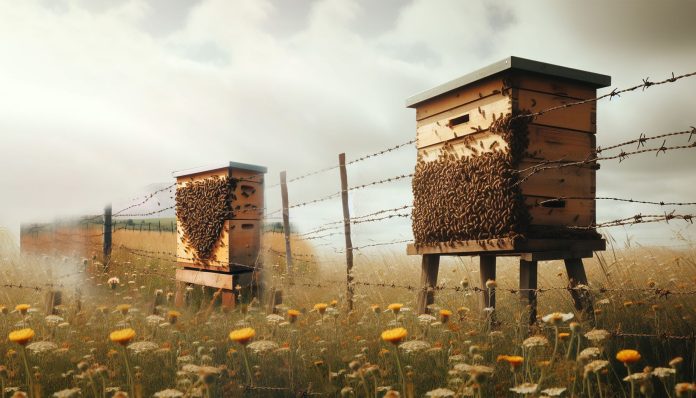
In a unique experiment, the Border Security Force (BSF) has installed beehives on the India-Bangladesh border fence in West Bengal, news agency PTI reported on 5th November (Sunday). This serves multiple purposes, first, it stops instances of cutting the fence for cattle smuggling and illegal immigration, and curbs other crimes. Moreover, it will also generate livelihood for the locals.
Informing about the unique initiative, a senior BSF officer said that the first-of-its-kind initiative was launched recently by the BSF’s 32nd battalion in the border areas of Nadia district. The aim of the initiative is to ensure border security and help the local populace through apiculture, the officer added.
The India-Bangladesh border is 4,096 kilometres long, and West Bengal makes up approximately 2,217 kilometres of this border. Other states that share borders with Bangladesh are Assam, Meghalaya, Mizoram and Tripura.
As per the PTI report, BSF has roped in the Ayush ministry for the project. On its part, the ministry has provided the BSF with the beehives and required expertise to fix those on the alloy-made “smart fence”.
It is important to note that the BSF is the designated central force that has been tasked with guarding the India-Bangladesh front. Additionally, the “Vibrant Village Programme” which was launched recently by the Union government aims to ensure all-round development of the far-flung and remotely-located regions on the front.
The Commandant of the 32nd BSF battalion, Sujeet Kumar has conceptualised the idea. Speaking with PTI, the BSF Commandant said that the force has undertaken the initiative under the Centre’s “Vibrant Village Programme” (VVP). It has gone a step further by requesting the Ayush ministry to provide it with medicinal plants that bear flowers and can be planted around these bee boxes so that the bees can pollinate in abundance, he added.
Kumar said, “The idea of tying beehives to the India-Bangladesh border fence was launched on November 2. The BSF will ensure that these bee boxes are accessible to the locals engaged in apiculture and there has been a very warm response from the villagers to this initiative.”
According to the officials, the border areas under the South Bengal frontier of the BSF in Nadia district are prone to cross-border crimes like cattle, gold, silver, and narcotics smuggling. There have been instances in the past when miscreants and smugglers have either cut or attempted to cut the fence for their illegal activities, the officials added.
A BSF official asserted that the beehives on the fence will be a deterrent for the smugglers trying to cut the fence as any such attempt will disturb the bees and a swarm attack of the bees can seriously injure them.
An official, on the condition of anonymity, said that while the exact numbers cannot be disclosed, the bee boxes are being put on the fence using a wooden support frame at regular intervals and in smuggling-prone vulnerable areas.
The official added that the Ayush ministry has also provided the BSF with saplings of medicinal plants. These include plants like tulsi, ekangi, satmuli, ashwagandha, and aloe vera. The security personnel, along with the locals, are planting these saplings in the border areas.
Additionally, Mustard saplings have also been planted. A public camp was recently held in the Kadipur village of Nadia. At the camp, the locals were informed that the honey that they extracted from these beehives would be sold through the established setup and shops of the BSF Wives’ Welfare Association. The officials added that the profits made from the sale of the honey will go to the locals.
According to Ayush ministry officials, they learned from the locals that Mango trees in the area do not bear good-quality fruits. But with this new initiative, the Ministry officials told BSF that due to beekeeping in the border area, these (mango) plants could start producing good-quality fruits, which will help increase the income of the villagers.
Honeybees hover above flowers to gather nourishment. In their role as pollinators, they have a vital role in the cultivation of numerous crops essential to nourishing the world’s population. Bees are accountable for pollinating nearly all global crops, including fruits, vegetables, and nuts. Quoting Ayush Ministry experts, the officials pointed out that it has been estimated that without bees, global crop yields could decrease by up to 35 percent.