

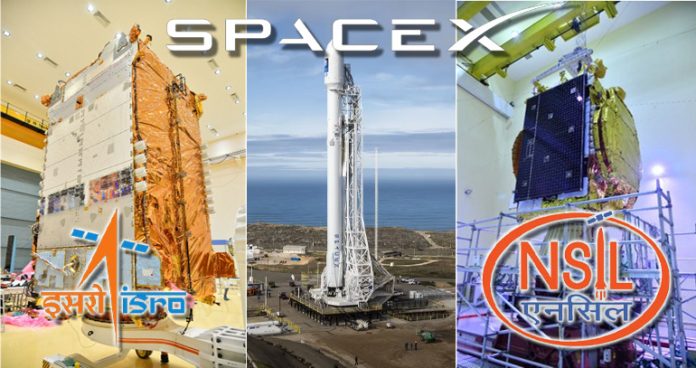
Indian Space Research Organisation (ISRO) is set to launch its latest communication satellite from the USA using the Falcon 9 rocket of Elon Musk’s SpaceX. The satellite named GSAT-N2, also called GSAT-20, will provide in-flight internet access, finally bringing the service to India.
GSAT-N2 weighs 4700 kg, too heavy to be launched by ISRO’s own rockets, which is why the agency has opted to use the heavy launch vehicle of SpaceX. While the satellite has been made by ISRO, it is a commercial operation under ISRO’s commercial arm New Space India Limited (NSIL). Apart from Internet services in aeroplanes, the satellite will also provide Internet services to remote areas of the country.
This will be ISRO’s first commercial launch using a SpaceX vehicle.
GSAT-N2 (GSAT-20) is a Ka-band high-throughput communication satellite, and it is set to enhance broadband services and in-flight connectivity (IFC) across the Indian region, as per ISRO. It has multiple spot beams and wideband Ka x Ka transponders, and it aims to support a large subscriber base with small user terminals, significantly boosting system throughput through its multi-beam architecture which allows frequency reuse.
GSAT-N2, with a lift-off mass of 4700 kg, has a mission life of 14 years. The satellite is equipped with 32 user beams, comprising 8 narrow spot beams over the Northeast region and 24 wide spot beams over the rest of India. These 32 beams will be supported by hub stations located within mainland India. The Ka-Band HTS communication payload provides a throughput of approximately 48 Gbps. The payload consists of three parabolic 2.5-meter deployable reflectors with multiple feeds generating 32 spot beams over the Indian region using a single feed per beam configuration.
“This homegrown satellite when operational will fill that big hole of in-flight Internet connectivity that exists over India on the world Internet map,” said Dr M Sankaran, Director of UR Rao Satellite Centre in Bengaluru, where the satellite has been built. “This is India’s highest throughput satellite and the only one operating exclusively in the much sought after Ka band,” he added.
At present, in-flight internet is not allowed in India, and as a result, airlines that offer this service have to switch off the service while flying over India. However, the govt recently amended the rule to allow in-flight internet access over India. As per new rules, internet services through Wi-Fi can be offered inside aircraft at an altitude of over 3,000 metres.
The govt has however clarified that flight passengers will be able to use internet services through Wi-Fi only when electronic devices are permitted to be used in the aircraft, even after it attains altitude of 3,000 metres in Indian airspace.
In order to prevent interference with terrestrial mobile networks, the government has required In-flight and Maritime Connectivity service providers to operate mobile communication services in aircraft at a minimum height of 3,000 metres in Indian airspace, as per the Flight and Maritime Connectivity Rules, 2018.
In-flight internet won’t be available immediately after the launch of GSAT-N2, because before that the service providers will have to get licences and the airlines offering the service will have to install necessary equipment in the planes.
American satellite communication company Viasat said that it will also use GSAT-N2 for in-flight and maritime connectivity services in India. Notably, Viasat has partnered with BSNL to launch Direct-to-Device Satellite Connectivity in India.
Earlier this year, Tata’s military-grade satellite was successfully placed into orbit by a Falcon 9 rocket.
(This news report is published from a syndicated feed. Except for the headline, the content has not been written or edited by OpIndia staff)


