

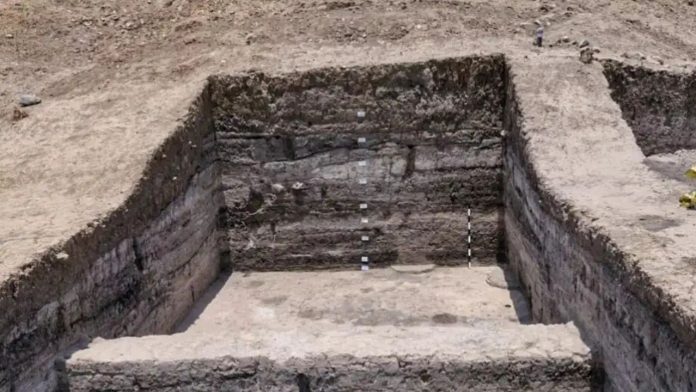
In a discovery that could reshape the history of early human habitation in central India, researchers from Nagpur University have unearthed what appears to be a 3,000-year-old Iron Age settlement in Maharashtra’s Yavatmal district. The excavation, led by Dr. Prabash Sahu from the university’s Department of Ancient Indian History, Culture and Archaeology, was conducted at Pachkhed village under Babulgaon taluka during the 2023–24 academic year.
An ancient mound with millennia of secrets
The dig site—an 8.7-metre-high mound just outside Pachkhed—revealed cultural layers spanning several historical periods. Archaeologists identified four distinct phases of human occupation: the Iron Age, the Satavahana period (2nd century BCE to 3rd century CE), the Medieval era, and finally the Nizam period (18th–20th century).
The earliest layer, dating back to the Iron Age, yielded iron tools, pottery, and round house foundations with limestone floors—hallmarks of early agrarian communities. Notably, researchers uncovered a full house layout with a chulha (mud oven), offering rare insight into ancient domestic life.
A Glimpse into ancient daily life
The site teemed with artefacts: pottery of varying styles, iron implements, bone tools, terracotta and semi-precious stone beads—evidence of a society engaged in craft, trade, and possibly rituals. The presence of decorative beads hints at a network of cultural or commercial exchange extending beyond the region.
Confirming a 3,000-year timeline
To scientifically verify the site’s age, organic samples have been sent to New Delhi’s Inter University Accelerator Centre for AMS carbon dating, with results expected by June 2025. If confirmed, the site would represent one of the oldest Iron Age settlements in the Vidarbha region, vastly enriching our understanding of early life in central India.


