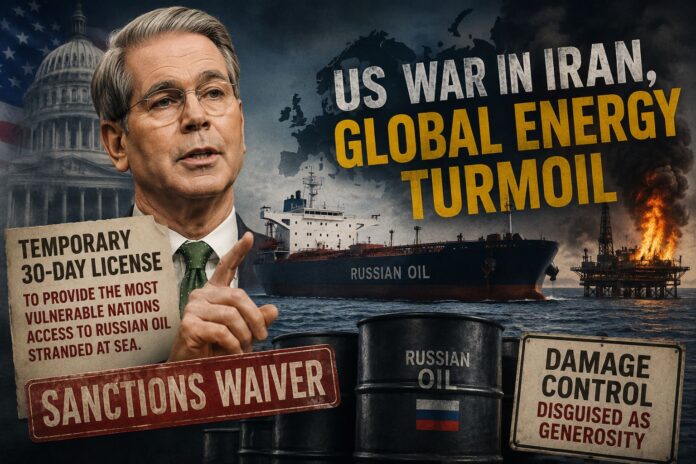
The United States has a peculiar habit of waging unwarranted wars and manufacturing crises and then behaving as though the rest of the world must applaud Washington for selectively easing the pain caused by its own actions. The latest example came from US Treasury Secretary Scott Bessent, who took to X to announce that the United States was issuing a “temporary” 30-day general licence allowing “vulnerable nations” to access Russian oil stranded at sea.
.@USTreasury is issuing a temporary 30-day general license to provide the most vulnerable nations with the ability to temporarily access Russian oil currently stranded at sea.
— Treasury Secretary Scott Bessent (@SecScottBessent) May 18, 2026
This extension will provide additional flexibility, and we will work with these nations to provide…
The wording of the announcement itself exposed the deeply patronising worldview through which Washington sees the world. The US Treasury Secretary effectively presented sanction waivers not as a correction of flawed American policy, but as a benevolent favour bestowed upon desperate nations by a global overlord. The implication was unmistakable: the world must remain dependent on American permissions for its energy security, even when the instability threatening that security was itself triggered by Washington’s reckless geopolitical adventurism.
Bessent claimed that the waiver would “stabilise the physical crude market” and ensure oil reached “energy-vulnerable countries.” But the obvious question is this: if allowing nations to access Russian oil helps stabilise global energy markets, why is the access merely temporary?
After all, the Treasury Secretary also attempted to justify the move by claiming it would reduce China’s ability to stockpile discounted Russian oil. If that is indeed America’s strategic concern, then permanently allowing broader access to Russian crude would logically weaken Beijing’s leverage even further by increasing competition for Russian exports. China would likely be forced to pay more as more countries enter the market for discounted Russian oil.
Instead, Washington chose a 30-day “temporary” waiver. That alone demolishes the moralistic framing of the announcement.
The reality is far more straightforward. This is not a principled recalibration of sanctions policy. It is damage control.
The Trump administration’s war against Iran has triggered serious disruptions in global energy markets, particularly for countries dependent on the Strait of Hormuz for oil shipments. Iran’s growing control over maritime movement through the Strait, including reports of additional charges and disruptions affecting oil transit, has created uncertainty across global supply chains. Countries far removed from the battlefield are now paying the economic price for a war they neither approved nor wanted.
Washington appears to have grossly underestimated the wider consequences of military escalation with Tehran. Oil-importing economies across Asia and beyond have been forced to confront rising freight costs, supply anxieties, and market volatility because of a conflict initiated by the United States. The resulting anger against Washington is no longer confined to diplomatic whispers behind closed doors.
Bessent’s carefully worded “humanitarian” waiver announcement appears less like generosity and more like an attempt to calm increasingly frustrated capitals around the world.
Notably, India has already made it clear that it does not require American approval to secure its energy interests.
On 18th May, the Modi government unequivocally stated that India would continue procuring Russian crude irrespective of whether the United States grants sanctions waivers or not. Joint Secretary in the Ministry of Petroleum and Natural Gas, Sujata Sharma, bluntly underlined that India’s crude purchases are driven by commercial logic and economic sustainability, not geopolitical pressure from Washington.
“Regarding American waiver on Russia, I would like to emphasise that we have been purchasing from Russia before waiver also, during waiver, and now also,” Sharma stated.
She further clarified that there is no shortage of crude supplies and India’s procurement decisions are based entirely on national interest and economic viability.
That position is neither new nor ambiguous.
India imports more than 80 per cent of its crude oil requirements. Any responsible government in New Delhi would naturally prioritise affordable and reliable supplies over Western geopolitical theatrics. Russian crude became attractive after 2022 primarily because it was available at discounted rates. India purchased it because it made economic sense, not because Washington approved or disapproved of it.
In fact, the United States itself previously acknowledged that India’s purchase of Russian oil helped stabilise global crude prices. India’s Ministry of External Affairs had revealed last year that American officials privately conveyed to New Delhi that continued Indian imports of Russian oil were beneficial for keeping global energy markets sustainable.
Washington’s position only changed when it decided to weaponise tariffs and sanctions pressure once again.
This contradiction exposes the sheer opportunism underlying American foreign policy. One day, India buying Russian oil is considered essential for stabilising markets. The next day, the same activity becomes grounds for punitive tariffs and sanctions rhetoric. The principles shift depending on Washington’s immediate geopolitical compulsions.
Now, after the Iran war has created turbulence across global energy markets, the United States is once again quietly relaxing restrictions while pretending it is performing a noble service for “vulnerable nations.”
The condescension embedded in that posture is impossible to ignore.
The world is expected to believe that the same superpower which destabilised West Asia through military escalation is now magnanimously rescuing poorer nations from an energy crisis. Washington wants credit for temporarily easing constraints that became dangerous only because of its own actions in the first place.
More importantly, the very issuance of this waiver is an unstated admission that the American strategy has backfired.
If sanctions architecture needs emergency exemptions to prevent economic distress across the world, then the sanctions regime itself is failing. If countries require temporary licences merely to access affordable crude during wartime disruptions caused by the United States, then the war planning clearly ignored the broader consequences for global energy security.
India, meanwhile, has demonstrated strategic clarity throughout this episode. New Delhi has repeatedly asserted that energy security is a sovereign matter. It has refused to subordinate national interest to Western political messaging. And despite repeated attempts by Washington to project itself as the arbiter of acceptable global trade behaviour, India has continued to make decisions based on economic pragmatism.
The Treasury Secretary’s announcement therefore reveals something far larger than a temporary sanctions waiver. It reflects an increasingly desperate American attempt to retain geopolitical control over a world that is steadily resisting Washington’s unilateral dictates.
The waiver is not a sign of American generosity. It is evidence that the consequences of Washington’s Iran war have become too severe to ignore.