

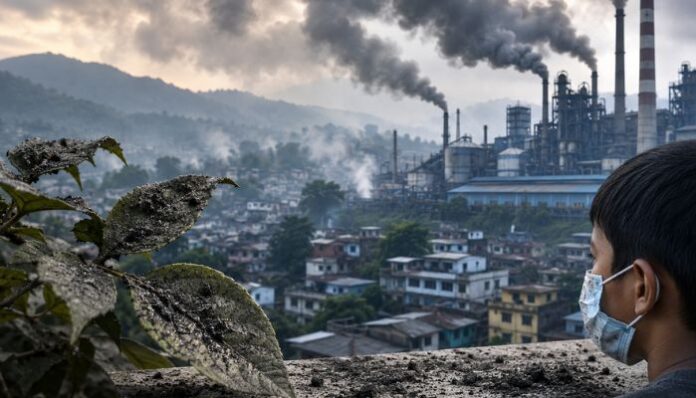
Byrnihat has been all over the news lately. This small industrial town sitting right on the Assam-Meghalaya border was named the world’s most polluted metro area, and that alone would be a big story. But it’s gotten a lot bigger recently because of a viral YouTube documentary by journalist Sarthak Goswami, called “Inside The World’s Most Polluted City.” In the video, Goswami travels through Byrnihat with a local translator, talks to residents, and shows thick black soot coating leaves, rooftops, and vegetables. He frames much of the blame around one specific factory – an ethanol distillery.
The video has already surpassed a million views and has sparked genuine outrage, protests, and pointed questions directed at the state government. All of the outrage is understandable. The pollution in Byrnihat is not exaggerated. People really are getting sick, the air really is bad, and residents really have been living with this for years. But when you actually lay out the timeline of events, the specific claim that one ethanol factory is responsible for Byrnihat becoming the world’s most polluted city just doesn’t hold together.
The dates that don’t add up
First, let’s get straight to the timeline: the factory at the centre of all this is Umiam Distillation Pvt. Ltd., a grain-based ethanol distillery located in the Export Promotion Industrial Park (EPIP) in Byrnihat, Ri-Bhoi district. According to the report, the plant officially began commercial ethanol production in September 2024. Now compare that against when Byrnihat’s pollution problem was first flagged. The Central Pollution Control Board identified Byrnihat as critically polluted back in 2022-23. Basically, two years before the ethanol plant even opened its doors.
And the report that really put Byrnihat on the global map. According to the 2024 IQAir World Air Quality Report, it recorded an annual average of PM2.5 concentration of 128.2 micrograms per cubic metre (over 25 times higher than the WHO’s safety guideline of 5 micrograms per cubic metre). It was published in March 2024. That’s a full six months before the ethanol plant started running. So think about what that actually means.
A factory that hadn’t even opened yet cannot be responsible for a pollution crisis that regulators had already documented, and a global report had already publicised, before it existed. This isn’t a matter of opinion or interpretation; it’s simply a matter of dates lining up or not lining up, and in this case, they don’t.
The coal ash precedent nobody’s talking about
This isn’t the first time Byrnihat has dealt with a thick layer of industrial residue settling over the town every morning. Long before the ethanol plant became the story, Byrnihat’s industrial belt was dominated by coal-based coke ovens and ferro-alloy furnaces, the kind of units that produce exactly the sooty, ash-like layer the documentary shows coating leaves and rooftops today. The Central Pollution Control Board actually listed the Byrnihat Industrial Area as a “Critically Polluted Area” as far back as 2018, at a time when the zone housed 34 small, medium, and large factories, most of them producing coke (a coal-based fuel) and cement.
According to the residents in the area, they have long described mornings where ash and black dust had visibly settled on everything overnight on the vehicles, plants, rooftops, and laundry left out to dry. That’s the same visual signature the recent documentary presents as if it were new, when in fact it echoes a pollution pattern that predated the ethanol plant by years and was driven by coal combustion, not distillation.
The state eventually acted on this. In September 2024, the Meghalaya State Pollution Control Board issued closure notices to six industrial units in Byrnihat for failing to comply with emission norms – Shillong ISPAT and Rolling Mill, Shyam Century Ferrous Limited, Nalari Ferro Alloys, Jaintia Ferro Alloys, Maithan Alloys, and Khasi Alloys. All come under coal-dependent coke or ferro-alloy operations.
Separately, Chief Minister Conrad Sangma told the state assembly in March 2025 that the government had shut down seven industries in the area for flouting pollution norms. These were the kind of units that would have been producing the coal-ash layer residents describe, and several of them were no longer operational by the time the ethanol plant even started up in September 2024.
If a documentary is showing black residue on surfaces in Byrnihat now, the more consistent explanation, given the town’s own regulatory history, is the decades of coal-based coke and ferro-alloy operations, not a distillery that came later and, per the MSPCB’s own June 2026 inspection, is currently within its emission limits.
Byrnihat has never been a one-factory town
The documentary tries to portray that one single factory of ethanol is the real cause of pollution. Part of what makes the single-factory narrative so appealing is that it’s simple. One villain, one smoking gun, one clean story. But Byrnihat’s industrial landscape is nowhere near that simple. According to Sarthak Goswami ‘s own documentary, his translator suggests that there are somewhere around 80 factories operating in and around the town – cement plants, limestone processing units, ferro-alloy factories, steel plants, and at least three separate liquor and distillery operations, not just the one that’s gone viral.
On top of that, Byrnihat sits in a bowl-shaped valley, a geographic feature that traps emissions instead of letting them disperse into the atmosphere. That means smoke and particulate matter from any of these dozens of sources tend to just sit over the town rather than blow away, building up day after day. Add heavy truck and vehicle traffic constantly passing through the area, since Byrnihat functions as a manufacturing and transport hub for the wider Northeast region, and you get a pollution problem with many contributing causes layered on top of each other, not one single source.
Even Meghalaya’s own Health Minister, Wailadmiki Shylla, has acknowledged this complexity publicly. He’s pointed out that a majority of the factories believed to be contributing to Byrnihat’s pollution are actually located on the Assam side of the border, not the Meghalaya side, and that pinning down exactly which state or which factory is responsible for how much pollution is genuinely difficult, given the town’s location straddling two states.
What happened when officials actually went and checked
After the documentary went viral and public pressure mounted, the Meghalaya State Pollution Control Board didn’t wait around. On June 29, 2026, they sent a task force to inspect the Umiam Distillation plant directly, acting on their own initiative rather than waiting for a formal complaint to be filed. Their findings were made public on July 1, 2026. The inspection covered several things: particulate matter levels, stack velocity, differential pressure, and temperature at the emission source.
According to the Board, particulate matter levels recorded during the inspection were well within the limits permitted under the unit’s Consent to Operate. They also found that the plant’s pollution-control infrastructure was functioning as intended, including an Electrostatic Precipitator installed for the plant’s captive power unit, and a Multi-Effect Evaporator paired with a Zero Liquid Discharge system for the distillery itself. According to the officials, samples of raw and treated effluent were sent for lab testing and confirmed that treated wastewater was being recycled back into the plant’s cooling tower rather than being discharged into the environment.
None of this means Byrnihat’s air is safe, and the Pollution Control Board isn’t claiming that either. Byrnihat remains officially classified as a “non-attainment” town under the National Clean Air Programme. It means it continues to fail national air quality standards, and it stays under continuous monitoring as a result. Multiple other industrial units have actually been shut down over the past two years for violating pollution norms. But specifically regarding this one ethanol plant, when regulators went and tested it against its own legal standards, they didn’t find a violation.
The human cost is real, even if the single-villain story isn’t accurate.
None of the timeline math or inspection results erases what Goswami’s documentary actually captured. The visuals are genuinely disturbing – thick black dust settling on crops and rooftops, residents saying they have to wash vegetables multiple times before they’re safe to cook, families describing rising cases of asthma, skin disease, and breathing problems.
According to the Government data cited alongside the documentary’s release, respiratory disease cases in the region are climbing from 2,082 in 2022 to 3,681 in 2024, an increase of nearly 77 per cent in just two years. That is a real and serious public health emergency, and it absolutely deserves the national attention it’s getting. The issue isn’t whether Byrnihat has a pollution crisis. It clearly does. The issue is how that crisis gets explained to the public. Framing it as the fault of one ethanol factory makes for a tighter, more shareable story, and it gives people a clear target to be angry at. But it also lets the other roughly 79 factories, the unregulated vehicle traffic, the weak enforcement across two state jurisdictions, and years of accumulated industrial growth completely off the hook.
If the public conversation stays focused on one plant that opened after the crisis was already documented, it becomes much easier for everyone else contributing to the problem to stay out of the spotlight. There’s also a broader irony worth mentioning here. Ethanol-blended fuel is being pushed heavily by the central government as a cleaner, greener alternative to fossil fuels, with officials like Union Minister Nitin Gadkari promoting it as safe, low-emission, and good for farmers.
Critics of the documentary’s framing have pointed out that the real story in Byrnihat isn’t really about ethanol production being inherently dirty — it’s about a broader failure to regulate industrial growth properly in a town that was already ecologically vulnerable long before any ethanol plant showed up.
Conclusion
Byrnihat was already flagged as critically polluted by the CPCB in 2022-2023. It was ranked the world’s most polluted metropolitan area in a report published in March 2024. The ethanol factory that’s currently being blamed only began commercial operations in September 2024, after both of those milestones had already happened.
A government inspection carried out in June 2026 found the plant operating within its permitted emission limits, with working pollution-control equipment. And there are roughly 80 factories operating in and around Byrnihat altogether, spanning cement, steel, ferro-alloys, and multiple distilleries, not just one. Byrnihat’s air is genuinely dangerous, and the people living there deserve real answers and real accountability. But based on the actual timeline and the evidence available, the claim that a single ethanol factory is responsible for turning Byrnihat into the world’s most polluted city simply doesn’t add up.


