

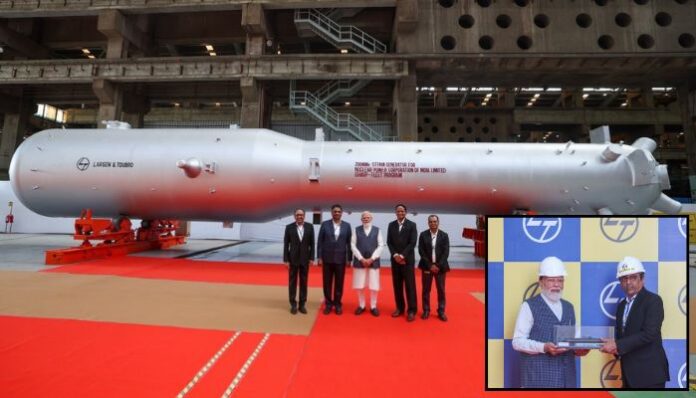
On Friday, 5th June, Prime Minister Narendra Modi visited Larsen & Toubro’s (L&T) massive manufacturing complex at Hazira in Gujarat, highlighting the growing role of Indian industry in strengthening the country’s defence and strategic manufacturing capabilities. The visit was part of his broader Gujarat tour and marked his first trip to the facility in nearly seven years.
During the visit, the Prime Minister reviewed several indigenous technologies and defence platforms being developed at the Hazira complex. The facility has emerged as one of India’s most important centres for heavy engineering, defence manufacturing and strategic industrial production. Modi spent several hours at the plant and interacted with officials while examining some of the advanced systems being produced there.
PM Modi shares glimpses from Hazira visit
Soon after the visit, the Prime Minister shared photographs and details on X, praising the role played by L&T in advancing India’s self-reliance goals.
“This afternoon, went to the L&T complex at Hazira. Witnessed some of their pioneering innovations across differegunt sectors. The role played by L&T in furthering self-reliance in the defence sector is commendable,” Modi wrote.
This afternoon, went to the L&T complex at Hazira. Witnessed some of their pioneering innovations across different sectors. The role played by L&T in furthering self-reliance in the defence sector is commendable.@larsentoubro pic.twitter.com/FZ6eOhTDXF
— Narendra Modi (@narendramodi) June 5, 2026
Among the photographs shared by the Prime Minister, one image attracted particular attention on social media. It showed him standing beside a giant nuclear steam generator manufactured at the Hazira facility in Gujarat. The photograph sparked widespread discussion because these steam generators are among the most sophisticated pieces of equipment manufactured by Indian industry and are critical for the country’s nuclear energy programme.
Here are some more glimpses from the visit to the L&T complex in Hazira, Gujarat. pic.twitter.com/NZjUq70NlD
— Narendra Modi (@narendramodi) June 5, 2026
What is a 700 MW nuclear steam generator?
The steam generator seen in one of the photographs shared by the Prime Minister has an important place in India’s nuclear manufacturing journey. L&T had manufactured its first indigenous 700 MW nuclear steam generator at the Hazira facility in 2022.
A nuclear steam generator is essentially a giant heat exchanger used inside nuclear power plants. It plays a critical role in converting the heat produced inside a nuclear reactor into steam, which is then used to generate electricity.
The reactor core produces enormous amounts of heat. That heat is carried by a coolant system to the steam generator. Inside the steam generator, the heat is transferred to water in a separate circuit, converting it into high-pressure steam. This steam then drives large turbines connected to generators that produce electricity.
Without steam generators, the heat generated inside a nuclear reactor cannot be converted efficiently into usable electrical power.
The steam generators being manufactured at Hazira are designed for India’s indigenously developed 700 MW Pressurised Heavy Water Reactors (PHWRs), which form the backbone of the country’s future nuclear expansion plans.
What you see behind PM Modi is a 700 MW nuclear steam generator, indigenously manufactured in India.
— DigitalSanghi🚩 (@digitalsangghi) June 5, 2026
Only a handful of countries can manufacture these at scale.
For a nuclear engineer, this photograph is actually more impressive than most missile or aircraft photos. It represents… pic.twitter.com/yCuRsJMXue
Why is this manufacturing capability important in India?
The ability to manufacture such massive nuclear components inside India is strategically important for several reasons.
- It strengthens the government’s vision of Aatmanirbhar Bharat by reducing dependence on foreign suppliers for critical nuclear equipment.
- It allows India to accelerate the construction of new nuclear power plants without being constrained by imports or international supply chain disruptions.
- Manufacturing these components domestically helps develop advanced engineering expertise and creates thousands of highly skilled jobs.
India has set ambitious goals for expanding its nuclear energy capacity in the coming decades. The government aims to significantly increase nuclear power generation as part of its strategy to meet rising electricity demand while reducing carbon emissions.
The Nuclear Power Corporation of India Limited (NPCIL) is currently building a fleet of indigenously designed 700 MW reactors at multiple locations across the country. Steam generators manufactured by companies such as L&T and BHEL are critical components for these projects.
L&T’s Heavy Engineering division has already dispatched multiple 700 MW steam generators ahead of schedule for NPCIL projects. The company manufactures these components at its advanced facilities in Hazira and Vadodara.
Supporting India’s Nuclear expansion
The steam generator that attracted attention during Modi’s visit is part of a broader effort to support India’s long-term nuclear energy ambitions.
According to NPCIL, the successful manufacturing and dispatch of these components strengthens India’s plan to achieve major growth in nuclear power generation by 2047. Industry experts note that the ability to produce these highly specialised systems domestically places India among a relatively small group of countries with advanced nuclear manufacturing capabilities.
Defence platforms also featured during the visit
While the steam generator attracted significant attention, it was only one of many strategic technologies reviewed by the Prime Minister.
The Hazira facility is widely known as the largest private-sector manufacturer of tracked armoured vehicles in India. It has played a major role in producing the Indian Army’s K-9 Vajra self-propelled artillery systems.
This afternoon, went to the L&T complex at Hazira. Witnessed some of their pioneering innovations across different sectors. The role played by L&T in furthering self-reliance in the defence sector is commendable.@larsentoubro pic.twitter.com/FZ6eOhTDXF
— Narendra Modi (@narendramodi) June 5, 2026
L&T has already delivered 100 K-9 Vajra artillery guns to the Indian Army. Several of these systems have been deployed in the high-altitude regions of Eastern Ladakh along the Line of Actual Control. The government has also approved the procurement of another 100 units.
The facility also became nationally significant after the rollout of the indigenous Zorawar light tank. Developed in just 19 months, the Zorawar has been specifically designed for high-altitude warfare in the Himalayan region and is currently undergoing trials.
In addition, Hazira is a key centre for L&T’s participation in the Indian Army’s Futuristic Infantry Combat Vehicle (FICV) programme, which aims to replace the ageing BMP-2 fleet.
The Prime Minister’s visit to Hazira highlighted how India’s industrial ecosystem is increasingly supporting both strategic defence requirements and critical energy infrastructure.
From advanced artillery systems and indigenous tanks to sophisticated nuclear steam generators, the facility represents the broader push towards self-reliance in sectors that were once heavily dependent on foreign technology.


