

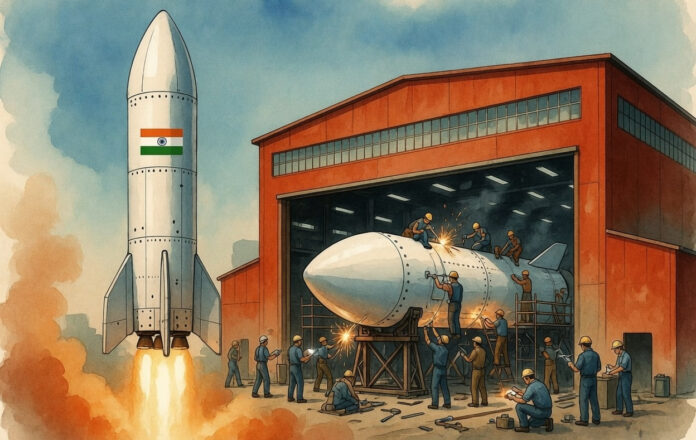
On 18 July 2026, Skyroot Aerospace’s Vikram-1 lifted off from the First Launch Pad at the Satish Dhawan Space Centre, Sriharikota. Mission Aagaman made Skyroot the first private Indian company to place satellites into orbit. India thereby joined the United States and China as only the third country whose private industry had independently achieved orbital launch capability. Co-founder Pawan Kumar Chandana said the rocket was designed, manufactured and built entirely in India.
While it was a success of a private sector company, the government played a crucial role through policies and supports. It followed a deliberate opening of the space sector by the government. In May 2020, as part of the Aatmanirbhar Bharat package, Finance Minister Nirmala Sitharaman announced that the entire space value chain would be opened to non-governmental entities. On 24 June 2020 the Union Cabinet created IN-SPACe as a single-window agency under the Department of Space to authorise private missions, ensure a level playing field and give companies access to national facilities.
NewSpace India Limited, incorporated in 2019, was given a demand-driven commercial mandate. The Indian Space Policy 2023 authorised non-government entities to design and operate launch vehicles subject to IN-SPACe clearance. FDI rules were liberalised and a ₹1,000-crore Venture Capital Fund and a ₹500-crore Technology Adoption Fund were created. The ecosystem grew from a handful of firms to more than four hundred active start-ups.
Skyroot signed a framework MoU with the Department of Space in September 2021. That agreement opened ISRO’s solid-motor casting and static-test facilities at Sriharikota, engine-test stands at the Liquid Propulsion Systems Centre, trajectory and range-safety support, and tracking through ISTRAC. Mission-readiness reviews involved specialists from ISRO and IN-SPACe. The launch-authorisation board was headed by ISRO veteran Dr B.N. Suresh.
The same framework has assisted Agnikul Cosmos, Pixxel, Digantara, Dhruva Space and GalaxEye through authorisations, technology transfers and access to testing facilities. NSIL has signed more than seventy technology-transfer agreements. Skyroot now plans its own launch pad to schedule flights more freely and raise cadence. India’s space economy, valued at about $8.4 billion, is projected to reach $40–45 billion by 2030.
You can read the full article on Chapter 1 Magazine.


