

HMS Trincomalee, a 46-gun Leda-class frigate, is among the oldest warships in the world that is still afloat. It is docked proudly at the National Museum of the Royal Navy at Hartlepool, England. Every year, thousands of visitors walk her deck, expressing awe at the glorious legacy of the British Royal Navy.
The ship was built in India, by Indian craftsmen, with Indian wood and Indian expertise.
She was laid down in 1816 at the Wadia shipyards of Bombay, and launched in 1817 under the supervision of a master shipbuilder named Jamsetjee Bomanjee Wadia. She is made of Malabar teak, and as per Parsi traditions, she has a silver nail hammered into her keel for good luck.

HMS Trincomalee is one of the 14 ships built by Jamsetjee Bomanjee Wadia in his lifetime. She was deployed in the Crimean War, survived both World Wars as a training ship and is still afloat. Between 1736 and 1884, nine generations of the Wadia family built more than four hundred ships at the Bombay Dockyard, all for the British Empire. They demonstrated that Indian shipbuilding could match, and in durability often exceed, European standards.
There lies a paradox: while India built the British Empire’s ships, with Indian craftsmen and Indian timber, India’s own shipbuilding industry gradually withered into oblivion.
How and why the British throttled Indian shipbuilding
The British knew the importance of the industry and for that reason, they pushed back hard, doing all they could to make sure the industry only existed to serve their interests or did not exist at all.
The Registry Act of 1815 prohibited the registration of India-built ships as British vessels, imposed severe restrictions on their use in profitable trades, and limited the employment of Indian seamen, all to protect Britain’s own shipbuilding industry. When the act was being debated in the British parliament, one of the arguments went to list how the superior durability of Malabar teak than European oak, less frequent need for repair, cheaper freight for materials in India and the potential scale of Indian yards gave such a decisive edge that Britain’s own shipbuilding industry needs to be protected by a law against Indian merchants trying to register India-built ships for commercial trade.

The Wadias built vessels for the East India Company and warships for the Crown under the Admiralty contract, so they were allowed to build, as salaried employees of the Empire, not as independent contractors.
With British laws designed to suppress Indian shipbuilding, Indian yards that had supplied the empire suddenly found themselves locked out of the very markets they had served. What colonial policy carefully throttled in the early 19th century, independent India later struggled to reclaim against a transformed global industry.
Post Independence, India focused on defence capabilities, not global competition
Post-independence, shipbuilding in India did not resume as private commercial revival, but as state policy focused on defence shipbuilding. Public sector shipyards like Mazagon Dock Shipbuilders, Garden Reach Shipbuilders & Engineers, Hindustan Shipyard and later Cochin Shipyard became the drivers of this effort, concentrating overwhelmingly on warships, submarines and auxiliary vessels for the Indian Navy and Coast Guard. They were building for defence capacity, not for global competition.
In sharp contrast, South Korea, which also began shipbuilding in the 1970s, built ships with an export-oriented national strategy, backed by aggressive state financing especially crafted designed to win international orders and outcompete other nations.
While Indian shipyards did construct some merchant tonnage under license regimes and subsidy schemes, the emphasis stayed on building capacity fot Navy and Coast Guard, not for the commercial global market. The long term result was that Indian commercial shipbuilding never developed the scale, supply-chain depth or export orientation that enabled East Asian yards to capture the world’s merchant fleet.
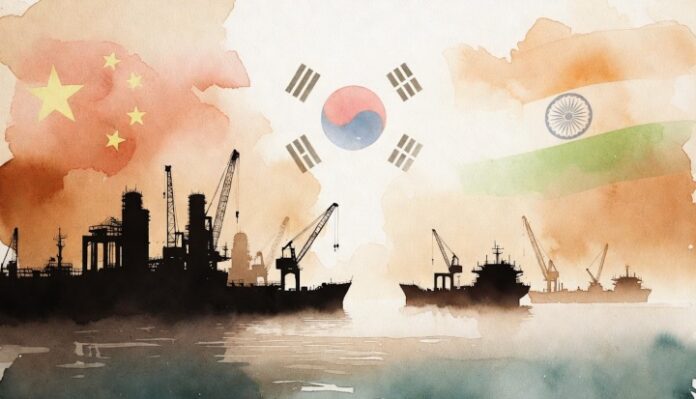
The result is the stark reality of 2026: India remains a minor commercial player in global shipbuilding, while China, South Korea, and specialised European yards dominate overwhelmingly.
The global shipbuilding landscape
Global shipbuilding is heavily concentrated among a few players. Measured by compensated gross tonnage (CGT) or deadweight tonnage (DWT), three countries, China, South Korea, and Japan, currently account for more than 90% of output and orders.
China alone exercises an overwhelming domination over the global market. As per reports, China’s share of new orders dipped slightly in 2025 amid geopolitical uncertainty but rebounded strongly into 2026; it still holds the overwhelming majority of the global order book, around 65-70% by mid-2026.
The scale and diversity of China is unmatched. Their yards deliver the majority of the world’s bulk carriers, tankers and container ships. In 2025, they completed over 53 million DWT. The reason? No, not cheap labour. China outshines every other nation in shipbuilding because it has successfully built an integrated maritime industrial ecosystem comprising steel production, engine manufacturing, heavy cranes and dock infrastructure, navigation equipment, component suppliers, export credit and state financing, all driven by high domestic demand in addition to global competition appetite.

China builds almost every class of commercial vessels at scale and has even launched massive LNG-powered bulk carriers and record-breaking methanol dual-fuel container vessels.
South Korea has specialised in higher value and more complex vessels. Its ‘Big Three’ shipbuilders, HD Hyundai, Samsung Heavy Industries, Hanwha Ocean specialise in LNG carriers, large container ships and sophisticated designs.
Japan’s overall share has declined significantly in recent years. Europe, on the other hand, has mostly exited the commercial market, focusing on high-tech specialised crafts, research vessels and cruise ships.
Compared to these giants, India’s output remains small. A rise is already being seen. From 40,923 GT in 2024 to 57,637 GT in 2025, that’s a 41% increase. But India still has a long way to go to even enter the top 10 shipbuilding nations.
Specific gaps in Indian shipbuilding
India currently builds only smaller commercial vessels, coastal craft, and defence ships for the Navy. The gaps are in large bulk carriers, crude/product tankers, large container ships, LNG/LPG carriers, and the latest specialised green vessels that run on methanol, ammonia, or hydrogen-ready, wind-assisted, fully electric or hybrid designs of ships.
India’s shipping yards also face challenges because of various reasons, low labour productivity, expensive financing, and limited access to domestically produced high-grade steel are only a few of them. The domestic workforce has limited exposure to automated ship design and advanced marine engineering practices.
Leading global yards invest heavily in proprietary designs, hydrodynamic optimisation and green-technology integration. Indian yards still rely more heavily on licensed or foreign designs for complex commercial ships. Building indigenous design houses and R&D centres will be one of the most critical gaps to cover.

Leading shipbuilding hubs like South Korea’s Ulsan (the world’s largest shipyard) and China’s Jiangsu (builds one-third of all commercial ocean-going ships globally) benefit from dense supply chains and specialised R&D sitting right next to the yards. The entire support industry of designers, component makers, testing labs, and classification societies is within a short distance, reducing overall costs and duration for rapid and effective production at scale. This is something India will need to work to develop as a priority.
Domestic supply chain maturity is also the main reason behind the success of China and Korea. India India still imports a lot of engines, propulsion systems, electronics and specialised equipment. Building a dense, competitive domestic supplier base will not only reduce costs, but also ensure strategic autonomy.
How is the new policy push working to close the gap?
As discussed in the previous article, the new policy push and ₹69,725 crore comprehensive package approved by the Union Cabinet, is perhaps the most systematic effort in decades to reverse India’s long-standing commercial shipbuilding deficit. Focused on the interlocking pillars of capacity expansion through greenfield and brownfield projects, supporting ecosystem reforms, and maritime financing, the package is carefully designed to move the industry from protected domestic capacity-building toward genuine global competitiveness.
The cleanest example is the ₹1,570 crore ship repair facility at Vadinar, jointly developed by Cochin Shipyard Ltd. and Deendayal Port Authority, approved by the Cabinet Committee on Economic Affairs in May 2026. It has also received in-principle SbDS approval for 25% financial assistance.
Early outcomes are already visible. According to UNCTAD data, India’s shipbuilding output rose 41 per cent from 40,923 GT in 2024 to 57,637 GT in 2025. The government has granted in-principle approvals for the three greenfield shipbuilding clusters in Andhra Pradesh, Gujarat and Tamil Nadu, with the Thoothukudi project in Tamil Nadu as the flagship initiative.
The change is visible
One of the most remarkable steps where the Modi government displayed its commitment to realise their vision for Indian shipbuilding was when the policy package moved from headline announcement to real scheme rollout. In the past few months, operational guidelines have already been issued for the SBFAS and MDF. SBI Ventured Limited has appointed a Fund Manager for the Maritime Development Fund. The administrative machinery, the slowest-moving cog in India’s growth story, is on the move already.
South Korea’s HD Hyundai has signed a tripartite MoU with the National Shipbuilding & Heavy Industries Park, Tamil Nadu, and Sagarmala Finance Corporation for a mega greenfield shipyard. The project is expected to generate substantial annual capacity and thousands of jobs.
In a different project, Cochin Shipyard Ltd is progressing on a JV with HD Hyundai for a ship-block fabrication facility near its Kochi yard, with an initial investment range of Rs 4000-5000 crores. Transfer of design expertise is expected for productivity enhancement for larger commercial vessels.

Slowly, the commercial orderbook is showing improvement too. In February this year, Cochin Shipyard secured an order from French liner CMA CGM for six feeder container vessels of approximately 1,700 TEU capacity, one of the largest commercial export contracts won by an Indian shipyard in recent years, valued at around $360 million. Mazagon Dock has received a landmark domestic order for a methanol dual-fuel platform supply vessel. Private yard Swan Defence and Heavy Industries has booked orders for chemical tankers from Norwegian owners and Kamsarmax bulk carriers.
The government’s demand aggregation has created visibility for as many as four hundred vessels of diverse categories, with tenders or expressions of interest already floated for dozens of ships. The policy logic was that yards won’t invest in capacity without confidence in future demand. The government has Applications under the new financial scheme covering contracts worth thousands of crores. In-principle clearances worth over ₹2,500 crore have already been received for brownfield expansion proposals by existing yards.
Already, a shift is happening from a defence-centric, subsidy-dependent model. While the absolute numbers will remain modest relative to China or South Korea for the next several years, if the momentum is sustained, the current push may actually lay a credible pathway to sail India from being a marginal commercial player towards a meaningful presence in the global shipbuilding market. Time will tell.
The Wadias demonstrated what Indian shipbuilding can do if there is supporting machinery working in favour of the sector. Finally, that machinery is there, and this time, we don’t need permission from London to surge ahead.
This is the second article in the series on shipbuilding in India. The first can be read here.



