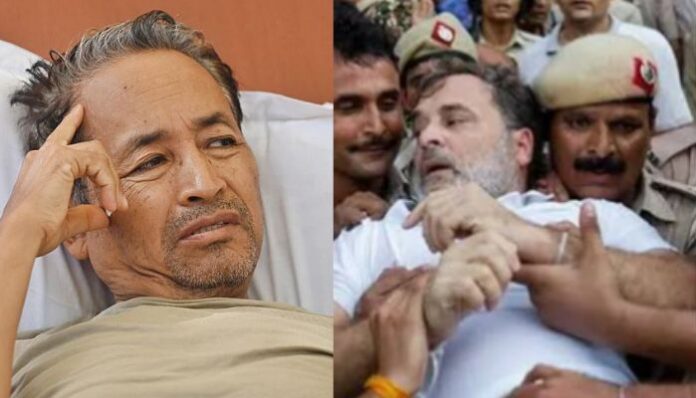
Sonam Wangchuk, the climate activist and education reformer who gained national attention for his 26-day hunger strike at Jantar Mantar during the Cockroach Janta Party (CJP) protest in July, has said he wanted Leader of the Opposition (LoP) Rahul Gandhi to end his fast unto death. Sonam Wangchuk said that his wife Geetanjali Angmo pursued Rahul Gandhi to break his fast. However, the Congress leader gave no positive response.
Speaking to India Today, Sonam Wangchuk said, “Actually, we were pondering on breaking my fast through the Leader of the Opposition, Rahul Gandhi, and Geetanjali was working on that. She was not against Rahul. She was working hard to see if Rahul Gandhi could break my fast. She didn’t get a positive response.”
BIG REVEAL BY SONAM WANGCHUK
— Megh Updates 🚨™ (@MeghUpdates) August 5, 2026
Sonam Wangchuk says he wanted Rahul Gandhi to personally end his hunger strike. His wife, Gitanjali, also tried to make it happen, but they received no positive response.
According to Wangchuk, that is why Gitanjali later criticized Rahul Gandhi.… pic.twitter.com/OWFbmHLYQh
The Ladakh-based activist said that giving this context of Rahul Gandhi’s nonchalance towards efforts to get him on board to end his hunger strike was important, since Geetanjali Angmo was brutally trolled by Congress supporters over her later criticism of the Congress leadership.
It must be recalled that Sonam Wangchuk ended his hunger strike on 24th July 2026, at Medanta Hospital in the presence of Union Ministers JP Nadda and Jitendra Singh.
Sonam Wangchuk wanted to hand over the political momentum to Rahul Gandhi?
Sonam Wangchuk has maintained that he has no political ambitions and that his hunger strike was only an act of civic responsibility to seek accountability from the government. However, Wangchuk was concerned and invested in the political optics surrounding the end of his hunger strike.
The climate activist said that he wanted the end of his hunger strike framed as a joint effort involving figures from the ruling dispensation, the Opposition, and student leaders.
It is apparent that there is no way Rahul Gandhi could have delivered the demands Sonam Wangchuk had raised, be it resignation of Dharmendra Pradhan as Education Minister, or compensation for students who allegedly committed suicide over NEET paper leak, etc, since Gandhi is not a part of the ruling dispensation.
Logic says Wangchuk’s fast could have only ended if he voluntarily gave up, was force-fed, or if the government agreed to consider his demands. Neither any student leader nor the LoP could have made this possible.
Beyond the missed ‘joint effort’ framing that Sonam Wangchuk is now talking about, a question arises here: Did Sonam Wangchuk want to hand over the political momentum of the CJP-Wangchuk protest to Rahul Gandhi and secure a heroic off-ramp?
As Sonam Wangchuk talked about a Ladakhi custom, which says that the person who offers water, juice or soup, or formally breaks the fast, signals acceptance, moral endorsement or a shared ownership of the outcome.
Rahul Gandhi preferred manoeuvring to hijack the CJP protest momentum rather than sharing credit with Sonam Wangchuk
While Sonam Wangchuk may have pursued an off-ramp that linked the resolution with cross-party validation, such anti-status quo optics are unattractive to a leader like Rahul Gandhi, whose brand depends primarily on being the main face of the Opposition.
It is perhaps for this reason that Rahul Gandhi did not respond positively to Geetanjali Angmo’s efforts to get him to end Sonam Wangchuk’s fast. Instead, Rahul Gandhi treaded the path of a parallel protest at the right moment.
Sonam Wangchuk began his hunger strike over the NEET paper leak issue on 28th June 2026; weeks passed, but he received no major political support beyond the online rhetoric. It was only when the Monsoon Session of the Parliament neared that key Opposition leaders, including Samajwadi Party’s Dimple Yadav, Azad Samaj Party’s Chandrashekhar Azad, and Aam Aadmi Party’s Arvind Kejriwal, began flocking to Jantar Mantar.
Rahul Gandhi has proven to be a disappointment in elections while he and his party continue to seek out fresh or controversial platforms in the hope of a miracle that will transform him into a real “JanNayak” and not merely in their social media campaigns.
However, Rahul Gandhi remained distant from the CJP protest throughout and extended only performative support. Instead of joining or visibly amplifying the ongoing CJP protest as a supporting force, Rahul Gandhi deliberately pursued a parallel track. The Congress party launched a “Chhatron Ki Goonj” student outreach program, and pressed the overlapping demand for Dharmendra Pradhan’s resignation from its own platform.
The Congress party had even faced criticism from the anti-BJP ecosystem for choosing a measured separation rather than fully integrating into the CJP momentum. On 20th July, when the CJP proceeded with its announced “Chalo Sansad” march to Parliament, Rahul Gandhi and Congress leaders staged a parallel protest over the same demands the CJP raised.
The timing of Rahul Gandhi’s ground protest was interesting. While Congress supporters argue that Gandhi waited for the Parliament session to begin to escalate his demands for Pradhan’s resignation, Congress’s protest was staged a protest outside Prime Minister Narendra Modi’s residence.
If Congress had to protest near PM Modi’s house only, they could have done it way earlier. However, Congress and Rahul Gandhi apparently waited for the CJP protest to build momentum, earn wider public support against the Modi government and hijack the political momentum when it reached its peak on 20th July.
The choice of location was deliberate as Congress did not want to play a supporting role in the CJP protest, which clearly had the participation of workers of Samajwadi Party and other anti-BJP parties.
Following Sonam Wangchuk’s revelation that he wanted Rahul Gandhi to break his fast and that the Congress leader purportedly refused, many opined that Gandhi missed a golden opportunity to naturally become the political hero of the CJP-Wangchuk-led protests that enjoyed wider youth attention if not support.
However, Rahul Gandhi does not operate this way. Throughout his career, Rahul Gandhi has undergone numerous failed relaunches, and none of these relaunch manoeuvres has ever involved Gandhi relying on support from outside elements or by playing a supporting role in an anti-Modi government show pulled off by someone else.
Rahul Gandhi’s whole idea behind attempting to hijack the CJP protest was to avoid credit-sharing, knowing that the protests have peaked to a point that the Central government will have to give concessions, if not fully capitulate before the CJP’s violent street veto.
The Congress party has long itched for a Nepal-like violent regime change in India. And perhaps, Congress did not want to be completely absent from the theatre when there was a possibility of its dream coming true.
Call it petty ego or political selfishness, Congress and Rahul Gandhi would always prefer to sit back and wait for an anti-government agitation to grow big and eventually hijack, rather than play a supporting role and share credit. For Congress, playing a supporting role in a protest orchestrated by CJP, the B-team of the Aam Aadmi Party, would have meant an admission that the party failed to raise the issue concerning youth, and is only backing it for political mileage.
Being a national party that still positions itself as the main opposition to the BJP despite three consecutive setbacks in general elections, Congress cannot afford to lose this ‘principal opposition’ status, for the party will then be at risk of losing its relevance fully.