

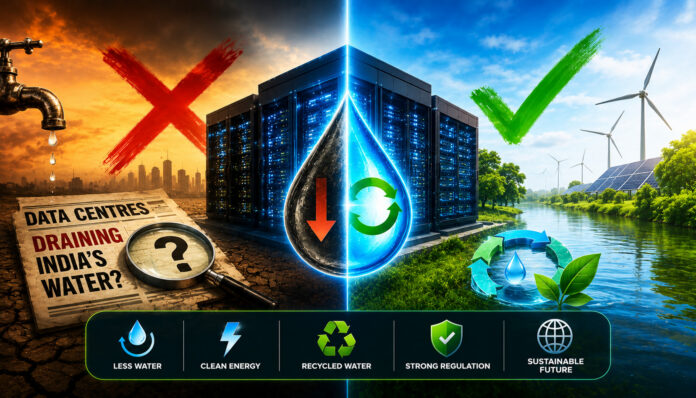
Are data centres really draining India’s water supply? The numbers tell a very different story than the headlines.
When word got out in 2025 that a major data centre was coming to Visakhapatnam, locals panicked, and understandably so, given the city’s chronic water shortages. Similar fears have flared up in Bengaluru, Chennai, and Hyderabad. The narrative that’s taken hold, tech companies are quietly siphoning off water that should go to homes and farms. The scary numbers driving this story are real. India’s data centres could use around 150 billion litres of water a year, and a BBC report citing S&P Global found that 60-80% of the country’s future data centre capacity may be built in high water stress zones. Compared to household usage, that sounds enormous.
But here’s the catch, almost all of this coverage confuses ‘withdrawal’ with ‘consumption,’ and that distinction changes everything.
A 2026 report from the Council on Energy, Environment and Water found that data centres account for just 0.02 to 0.03% of India’s total water demand. For context, agriculture alone eats up 78-80%. The 150 billion litre figure isn’t wrong, but it’s measuring water passing through cooling systems, not water permanently lost. Most of that water evaporates in cooling towers and returns to the atmosphere as rain, the same water cycle a lake or irrigated field participates in. A smaller portion goes out as treated, regulated wastewater. Only a sliver escapes as stray droplets. Actual permanent loss is far smaller than the headline number suggests.
Regulation is already tighter than people assume, too. Groundwater use requires official clearance, discharge is governed by pollution control standards, and states like Rajasthan now mandate wastewater recycling and zero liquid discharge for new facilities. India’s IT ministry has said it hasn’t seen widespread complaints of unsustainable water use from the sector. Other water-stressed places offer a preview of where India could head: Singapore leans on recycled wastewater for cooling, Microsoft is targeting water positive status by 2030, and Equinix has pushed some facilities’ water-efficiency scores below the industry benchmark using recycled water and hybrid cooling.
There’s also an angle almost nobody raises: data centres increasingly run on solar and wind power, which use virtually no water, unlike coal and gas plants, which are heavy freshwater users for cooling. That’s a water saving nobody’s currently counting.
The full article can be read on Chapter One Mag.


