

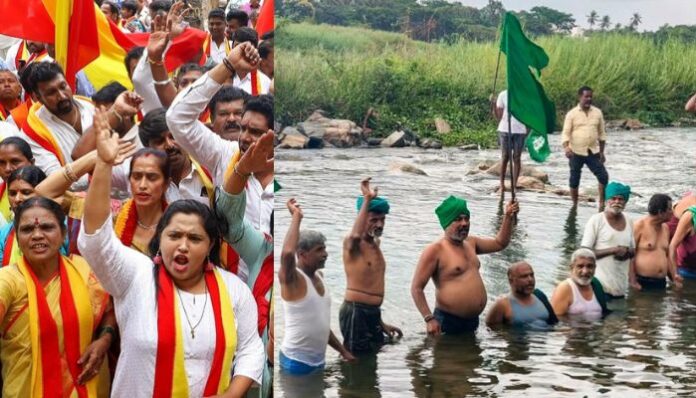
On Thursday, 13th August, Karnataka is observing a statewide bandh over the long-running Cauvery water-sharing dispute with Tamil Nadu. Pro-Kannada organisations have called the shutdown from 6 am to 6 pm, mainly to oppose the release of Cauvery water to Tamil Nadu.
VIDEO | Mandya, Karnataka: Pro-Kannada groups protest against the release of Cauvery water to Tamil Nadu, urging the state government not to release water. Police security tightened in the district amid a call for a bandh.
— Press Trust of India (@PTI_News) August 13, 2026
(Full video available on PTI Videos -… pic.twitter.com/UBvbkbzx9t
The protesting groups are also demanding progress on the Mekedatu, Mahadayi and Kalasa-Banduri projects. However, the bandh has not brought normal life across the state to a complete stop, particularly in Bengaluru, where several essential and public services continue to operate.
Essential services continue during the bandh
Despite the statewide shutdown call, several important services are functioning normally. Hospitals, pharmacies and other healthcare services are expected to remain open, with emergency medical services continuing without interruption. Bank branches and government offices are also expected to function, while online banking and other digital financial services remain available.
Schools across Karnataka are also expected to remain open. The Karnataka Associated Managements of Schools had initially called for schools to stay closed during the bandh but later withdrew the appeal, citing concerns about disruption to the academic calendar. The organisation has instead extended moral support to the protest and suggested that schools may show solidarity by wearing black ribbons or bands.
In Bengaluru, Namma Metro services are running normally, while BMTC buses are also operating. However, commuters may still face delays or changes in movement around areas where protests are being held. Autos and taxis could see some disruption, while private buses, including services connecting Karnataka and Tamil Nadu, may also be affected.
Shops, markets, malls, hotels and restaurants are more likely to be affected because pro-Kannada organisations have appealed to commercial establishments to support the bandh. Hotel owners in Bengaluru and Mysuru have also been urged to shut their establishments. However, there is no blanket government order requiring all commercial establishments to close, so the impact may differ from one area to another.
Why have pro-Kannada groups called the bandh?
The immediate reason behind Thursday’s protest is the Cauvery Water Management Authority’s (CWMA) direction asking Karnataka to release 12,000 cusecs of Cauvery water every day to Tamil Nadu for 15 days from 12th August.
Pro-Kannada organisations and farmers’ groups are opposing this direction. They argue that Karnataka itself needs sufficient water for drinking and farming, particularly when rainfall and reservoir storage are under pressure. Along with opposing the water release, the groups are demanding progress on the Mekedatu, Mahadayi and Kalasa-Banduri projects.
The Cauvery issue has repeatedly become a major source of tension between Karnataka and Tamil Nadu, especially during years when rainfall is poor. Whenever water levels fall, the question of how much water Karnataka should release to Tamil Nadu becomes a major political and public issue in the state.
Congress government detains protestors at the Attibele border
The bandh also saw protests at the Attibele border between Karnataka and Tamil Nadu. More than 20 members of the Kannada Jagruthi Vedike were detained after they attempted to block the highway at the border.
The protesters staged a road blockade at around 8 am and marched from the Attibele toll area towards the state border. The protest was led by the organisation’s state president, Manjunath Deva. The protesters raised slogans against the Tamil Nadu government and warned it against obstructing the implementation of the Mekedatu project. They were taken into police custody after attempting to block the highway.
The arrests and detentions took place under the Congress government in Karnataka as police moved to prevent the protest from disrupting traffic and movement at the busy state border. Security had already been increased in the area as a precaution. An Additional SP, three inspectors and around 50 police personnel were deployed at the border.
What is the Cauvery water dispute?
The Cauvery dispute is a more than century-old disagreement over the sharing of river water between Karnataka and Tamil Nadu. The Cauvery originates in Karnataka’s Kodagu district, flows through Tamil Nadu and eventually reaches the Bay of Bengal. Kerala is also part of the Cauvery river basin.
The river is important for drinking water, irrigation, hydropower and the livelihoods of millions of people across southern India. Because both Karnataka and Tamil Nadu depend heavily on the Cauvery, any shortage of water can quickly lead to disagreement between the two states.
The dispute has been dealt with through agreements, tribunals, court proceedings and central government mechanisms over the years. The Cauvery Water Disputes Tribunal delivered its final award in 2007 after years of hearings. It allocated 419 TMC ft to Tamil Nadu, 270 TMC ft to Karnataka, 30 TMC ft to Kerala and 7 TMC ft to Puducherry from the basin’s assessed utilisable water.
Supreme Court formula and water management bodies
The Supreme Court modified the tribunal’s water-sharing formula in February 2018. Under the revised arrangement, Karnataka’s share was increased to 284.75 TMC ft, while Tamil Nadu received 404.25 TMC ft. Kerala was allocated 30 TMC ft and Puducherry 7 TMC ft.
The Supreme Court also reduced the quantity Karnataka was required to ensure at the Biligundlu gauging point on the Karnataka-Tamil Nadu border from 192 TMC ft to 177.25 TMC ft during a normal water year. Following the judgment, the Union government notified the Cauvery Water Management Scheme in 2018. The Cauvery Water Management Authority and Cauvery Water Regulation Committee were established to oversee and monitor implementation of the water-sharing arrangement.
However, having a legal framework has not completely ended the dispute. The main disagreements now often arise over how the water-sharing formula should be implemented during years of poor rainfall.
Fresh Dispute over water release in 2026
The Cauvery issue has once again intensified in August 2026. Tamil Nadu has approached the Supreme Court amid a fresh disagreement over Karnataka’s compliance with directions to release Cauvery water. The latest dispute involves a release direction of 3,500 cusecs per day for 15 days.
The Cauvery Water Management Authority has upheld the Cauvery Water Regulation Committee’s release direction. Karnataka, however, has pointed to deficient rainfall and declining reservoir storage while opposing the order or seeking a deferment.
At the centre of the latest disagreement is the question of how water releases should be decided when the river basin does not receive enough rainfall. Karnataka says factors such as rainfall, inflows, reservoir levels and drinking-water requirements must be considered before releasing water. Tamil Nadu maintains that Karnataka should follow the prescribed water-sharing and release schedule.
Why the dispute keeps returning
The Cauvery dispute continues because water availability changes from year to year. During a normal water year, the existing arrangement provides a framework for sharing the river. But when rainfall is below normal, and reservoirs in Karnataka have less water, pressure builds over how much water should be released downstream.
Tamil Nadu continues to seek the water it says is due under the established arrangement, while Karnataka stresses its own drinking-water and irrigation needs. These differences often lead to protests, political pressure, meetings before water-management bodies and court proceedings.
The 13th August bandh has therefore brought an old dispute back into the centre of public attention. With pro-Kannada organisations protesting the latest release direction, commercial establishments facing possible disruption and more than 20 protesters detained at the Attibele border, the Cauvery issue remains highly sensitive in Karnataka.
Despite the Supreme Court’s decisions and the creation of dedicated bodies to manage the river-sharing arrangement, disagreements continue whenever rainfall falls short. The latest developments show that the Cauvery dispute is still closely linked to Karnataka’s water needs, Tamil Nadu’s demand for its share and the wider political tension between the two states.


